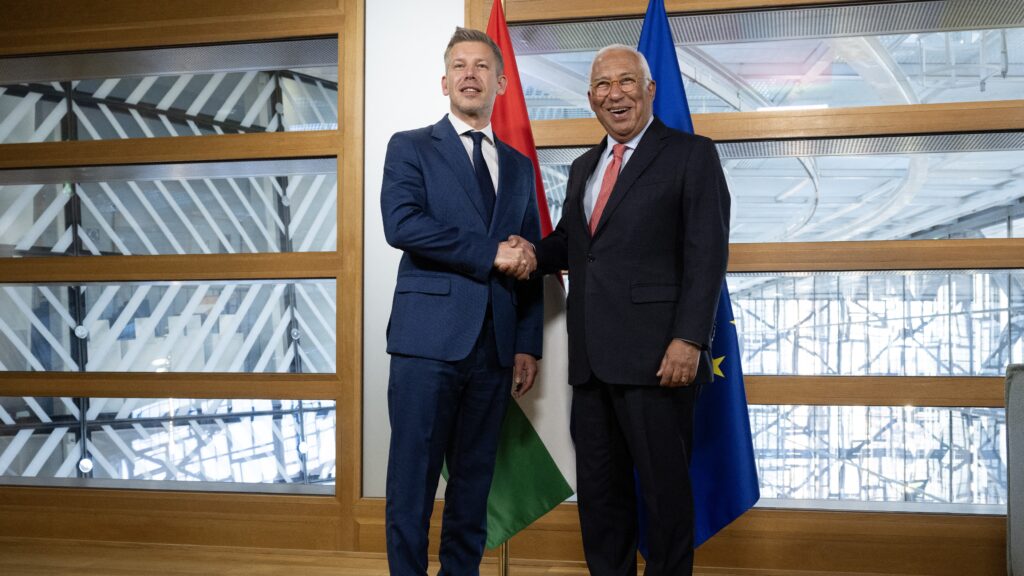
Hungary’s new instructions for its delegation to the 81st UN General Assembly have redrawn several lines of the country’s unique foreign policy, built deliberately around the idea of challenging the established liberal global order during Viktor Orbán’s 16-year rule. The most visible shift concerns Russia: the 25 August resolution signed by Prime Minister Péter Magyar describes Moscow’s conduct as a threat to Hungary, Europe and the global order. A quieter change on migration, however, may prove consequential in the long run, yet has received considerably less attention.
The difference only becomes clear when the new instructions are compared with those issued a year earlier. The 2025 document ordered Hungarian diplomats to defend national control over borders and residence rules, highlight the direct security risks posed by migration and press those positions during negotiations over common EU statements. It then added a separate instruction requiring Hungary to oppose references to both the Global Compact for Safe, Orderly and Regular Migration (GCM) and the Global Compact on Refugees (GCR) in new UN resolutions and official statements, explicitly because Budapest refused to participate in their implementation.
Magyar’s 2026 instructions preserve the language on border sovereignty, national control over residence rules and migration as a security risk. The passages concerning common EU positions and opposition to the two UN Compacts have disappeared. The distinction is important because sovereignty alone provides no barrier to participation in the GCM: the Compact is non-legally binding, expressly recognizes state sovereignty and leaves governments free to choose measures from its objectives according to national circumstances.
Notably, the underlying government resolution from July 2018, which declared the GCM ‘completely contrary to Hungary’s interests’ and ruled out participation in either its adoption or implementation, remains unchanged, leaving the new government’s formal position unclear and creating a potential conflict between its diplomatic instructions and the existing legal basis.
Migration Management versus National Control
Hungary’s rejection policy started eight years ago, when the country voted against the GCM alongside Czechia, Israel, Poland and the United States, then spent years dissociating itself from UN texts referencing it. Former foreign minister Péter Szijjártó summarized the core philosophy during the negotiations, stating that migration should not be managed but stopped. Orbán’s successive governments opposed migration becoming a normalized answer to labour shortages, demographic decline or instability, arguing that those problems should be solved domestically or in countries of origin.
The GCM provides a broader set of tools for countries that chose the other approach, setting 23 objectives covering regular pathways, labour recruitment, border management, alternatives to detention, basic services, integration, return and reintegration. The GCR complements that system for refugees by encouraging responsibility-sharing and expanding third-country solutions, including resettlement and legal routes based on family reunification, employment, education, humanitarian admission and private sponsorship. A government can adopt selected elements gradually through domestic policy and administrative practice, which means formal accession is only one measure of alignment.
‘President Donald Trump’s United States has returned to a position close to Orbán’s original doctrine’
The current international divide illustrates the difference. President Donald Trump’s United States has returned to a position close to Orbán’s original doctrine. During the International Migration Review Forum on 20 May, Washington declared that it did not recognize the GCM, described admission decisions as an exclusive sovereign prerogative and attacked international mechanisms capable of facilitating mass migration.
Italy, Poland, Czechia and Slovakia adopted a less sweeping version of the same rejection. Their joint statement said they remain outside the GCM and ‘do not intend to become one’, while criticizing its treatment of regular and irregular migration and demanding greater emphasis on border security, smuggling, returns and national control over legal pathways.
Two EU members, Bulgaria and Romania, demonstrate how much room exists between formal rejection and practical implementation. Bulgaria told the UN that it had implemented most GCM elements and objectives despite remaining outside the Compact, while Romania acknowledged domestic measures consistent with several objectives even though its formal position had remained similar to Sofia’s.
From MAGA to EU Mainstream
Hungary’s own trajectory since the April election makes the August deletion more ambiguous. Tisza campaigned in a country where attitudes towards immigration remain overwhelmingly restrictive: a July Republikon analysis found that 47 per cent of Hungarians would admit no immigrants from poorer countries and another 40 per cent would admit only a few. Magyar responded to that electorate by promising zero new non-EU guest workers from June, while Tisza’s programme pledged to end their mass employment and prioritize Hungarian labour.
On 13 April, during his first international press conference as prime minister-elect, Magyar promised to retain the southern border fence, pursue an ‘extremely strict’ approach towards illegal immigration and reject allocation mechanisms, while seeking a legal solution to the €1 million daily EU penalty inherited from the Orbán government. The fine stems from Hungary’s failure to comply with a 2020 Court of Justice judgment concerning asylum procedures, applicants’ right to remain during appeals and the removal of illegally staying third-country nationals.
The government subsequently closed applications for new dedicated guest-worker residence permits from 6 June and began a wider review of third-country employment. The measure targeted that specific fast-track permit category; other employment channels remained available. Interior Minister Gábor Pósfai also told parliament on 15 June that Hungary continued to reject the EU Migration Pact in its existing form and regarded technical assistance to countries under migratory pressure as the acceptable solidarity mechanism.
‘That emerging position also widens the distance between Budapest and Washington’
At the UN, the Magyar government initially carried Orbán’s rejectionist policy forward almost word for word. On 20 May, Hungary told the General Assembly that it had never joined the GCM, had withdrawn from negotiations on the 2026 Progress Declaration and had never participated in implementation. On 6 July, Budapest again dissociated itself from a resolution’s GCM reference, called for policy to address migration’s root causes so people could remain in their homelands and reaffirmed national control over migration policy.
The 25 August instructions therefore mark a change within the Magyar government itself, barely seven weeks after Hungary last formally restated the Orbán position at the UN. The immediate consequences remain limited by Hungary’s restrictive domestic rules and the unrepealed 2018 resolution. The ideological boundary has nevertheless moved: Hungarian diplomats no longer receive an annual instruction to resist the international framework built around managing migration through coordinated legal pathways, protection mechanisms and returns.
That emerging position also widens the distance between Budapest and Washington, as ideological similarity on migration was one of the key pillars of relations between Donald Trump and Orbán. It provides one of the first clear practical manifestations of the new foreign policy direction recently described by Hungarian Institute of International Affairs director Botond Feledy as a ‘complete break’ with the ‘American-led, MAGA-camp’ model. It is also another step in Magyar’s efforts to realign Hungary with the European mainstream, creating room for a fundamentally different approach from within, rather than outside, the international migration-management system.
Related articles:
At a time when public debate is increasingly polarized and superficial, Hungarian Conservative remains committed to depth, intellectual honesty, and independent conservative thought.
Producing high-quality journalism requires resources. Your contribution helps us expand our coverage, reach new audiences, and keep our content accessible.

Please consider supporting our mission.