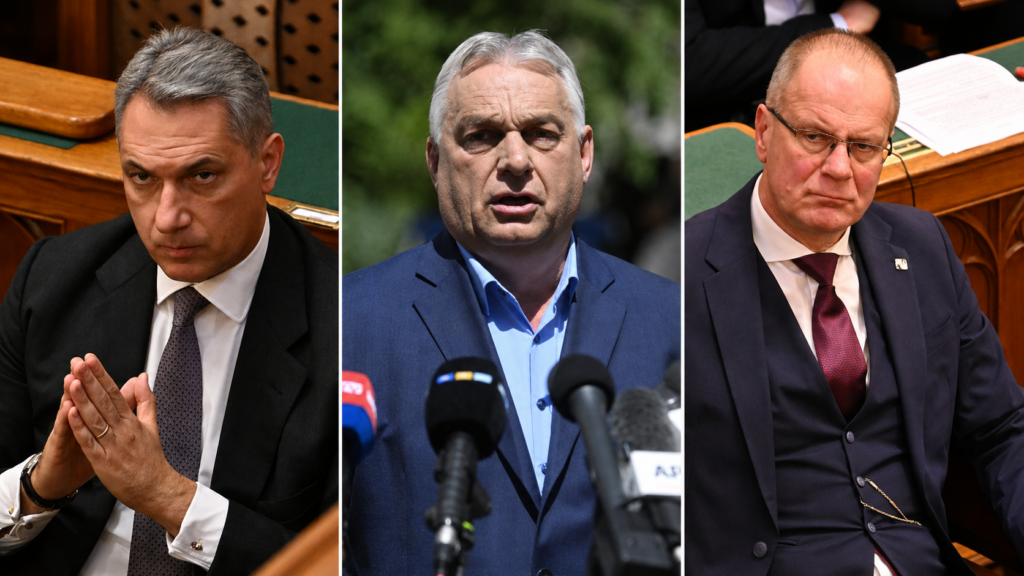
Hungary remains one of Europe’s most consistently anti-immigration countries, according to a new Republikon Institute analysis based on international polling data, a finding that points to strong public support for continued restrictive migration policy under Prime Minister Péter Magyar despite his government’s break with former prime minister Viktor Orbán in several other areas.
The report, titled Anti-Immigrant Sentiment and Integration in Hungary, is not a new standalone Republikon poll, but an analysis of European Social Survey, TÁRKI, MIPEX, and comparative European data. Its main empirical finding is significant: nearly half of Hungarians would not allow any immigrants from poorer countries into Hungary, while a further 40 per cent would admit only a small number.
According to the ESS figures cited by Republikon, 47 per cent of Hungarians in 2025 said no immigrants from less-developed countries should be admitted, while 40 per cent said only a few should be allowed in. Just 11 per cent would admit some, and only 2 per cent would admit many. The combined restrictive camp therefore stands at 87 per cent.
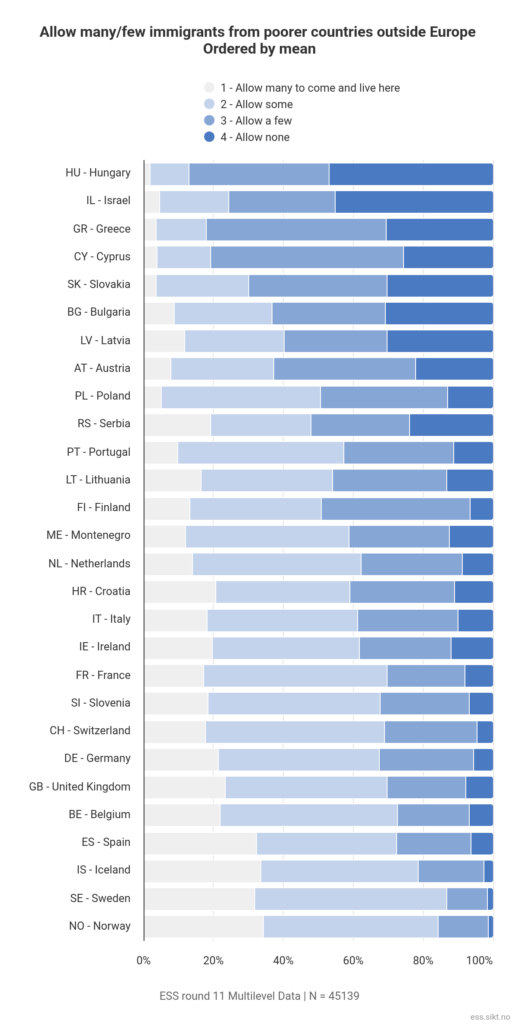
The figures have remained remarkably stable. In 2011, 44 per cent chose the ‘none’ option and 41 per cent chose ‘few’; in 2015, during the migration crisis, the corresponding figures were 48 and 39 per cent; and in 2022, 43 and 44 per cent. Republikon concludes that the anti-immigration campaigns conducted by the previous Orbán administrations caused only temporary negative fluctuations rather than a fundamental change in public attitudes.
That finding is politically significant. It suggests that Orbán’s hardline migration policy did not create Hungarian anti-immigration sentiment from nothing, but gave organized political expression to a long-standing social attitude.
The analysis also ranks Hungary at the top of an 11-country European immigration-attitude index, with a score of 3.63. Slovenia follows at 3.23, Austria at 3.16, Poland at 3.13, and Czechia at 3.10, while Portugal and Iceland are at the lower end of the list.
Data Make Migration Policy Shift Look Unlikely
Viewed from the perspective of Hungary’s current transition of power, the Republikon study shows little evidence of mass public demand for a softer migration policy under the Magyar government. Although Magyar’s Tisza Party has sought to present itself as a rupture with the Orbán era, particularly in political culture and on some rights issues, migration appears to be an area of strong continuity.
That continuity is already visible and has drawn criticism from human rights organizations. Amnesty International Hungary and the Hungarian Helsinki Committee have accused Magyar and Tisza politicians of using language on migration that they said resembled ‘Orbán-style exclusionary’ rhetoric. The criticism followed Magyar’s publication of internal documents showing that the former Orbán government had prepared plans for a migrant reception facility near Vitnyéd while publicly campaigning against immigration.
At the policy level, Budapest has also maintained a restrictive line. Interior Minister Gábor Pósfai has said the government rejects the EU Migration Pact in its current form and will not submit a national implementation plan unless the framework changes. The government also continues to oppose mandatory relocation quotas and financial contributions in exchange for refusing migrants, while arguing that migration pressure should primarily be handled outside the EU.
The new government has already moved to restrict legal routes of labour migration by closing the specific ‘guest-worker residence permit’ scheme to new applicants from 6 June. Currently, no third country is designated whose nationals may apply for the permit.
Related articles:
At a time when public debate is increasingly polarized and superficial, Hungarian Conservative remains committed to depth, intellectual honesty, and independent conservative thought.
Producing high-quality journalism requires resources. Your contribution helps us expand our coverage, reach new audiences, and keep our content accessible.

Please consider supporting our mission.