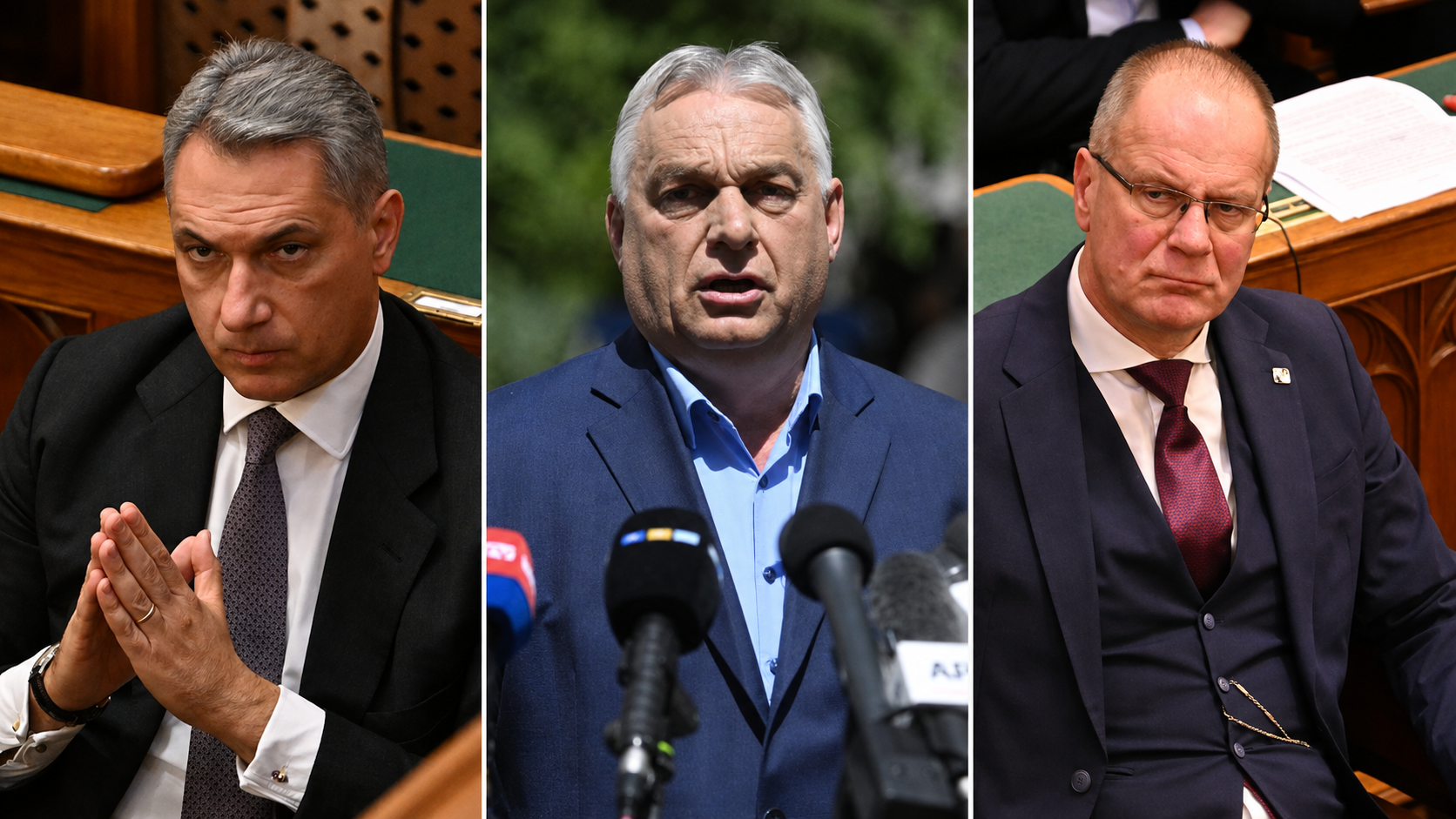
After the long-weekend national holiday of St Stephen’s Day, former prime minister Viktor Orbán and the loyalist core linked to him inside Fidesz are facing increasing pressure coming from within and outside the party.
A group of moderate conservatives is organizing around former minister Tibor Navracsics; his long-time challenger within Fidesz, János Lázár, has resigned his parliamentary mandate and called for ‘new direction and leadership’ after spending months visiting the party’s regional organizations; and, to top all that, the new anti-corruption and asset-recovery super-agency established by the Tisza government is about to take institutional shape and prepare to investigate cases linked to the previous Fidesz–KDNP governments over the past 16 years.
The Moderate Revolt Takes Shape
Navracsics and former space commissioner Orsolya Ferencz launched Civic Democrats (Polgári Demokraták; PD) on 20 August, inviting discussion about the previous 100 days, 16 years and 36 years of Hungarian politics. On the same day, former construction and transport minister János Lázár resigned his parliamentary mandate and said Fidesz needed structural and cultural change. Ferencz followed by saying the Orbán years had included ‘very serious mistakes, even sins’.
Within two days, PD had an official logo and branding, while reporting revealed that the matching internet domain had been registered on 17 June, only days after Fidesz’s congress, which saw Orbán re-elected as president of the party without a challenger. Gyula Porga, the Fidesz mayor of Veszprém since 2010, then announced that he was joining. Navracsics continues to say that he is not establishing a party, although he has described the initiative as ‘open-ended’.
Fidesz MP János Pócs has already responded to talk of a split, warning that the party’s trajectory after the April election defeat increasingly resembles what the so-called ‘old opposition’ witnessed after Orbán’s landslide comeback in 2010.
A July Medián survey found that roughly one third of current Fidesz supporters expressed a stronger willingness to vote for a new civic-conservative party established by Fidesz politicians critical of Orbán, while a further 27 per cent said they could imagine doing so. That put the number of those who would support a conservative party without Orbán at 60 per cent, although the conclusion comes from a small Fidesz subsample within a national survey of about 1,000 respondents.
According to political scientist Gábor Tóka, Fidesz voters may not suddenly be demanding a more ‘civic’ or moderate party; many are rather angry because Fidesz lost. Orbán spent years holding together politicians and voters with repeated electoral victories. After April, Tóka argued, belief in his ability to deliver those victories has weakened. About a third of Fidesz supporters in the same research, however, still regarded the party as inseparable from Orbán, leaving a large middle group looking for something different without having decided what that should be.
Their language is markedly different from the opposition ‘resistance’ strategy advocated by the Orbánist core. Navracsics said the ‘extreme, fatal confrontation’ of Hungary’s two camps was damaging the country. Ferencz has called for constructive dialogue and a reckoning with failures under Fidesz rule. Fidesz communications director Bertalan Havasi answered that confrontation with Tisza was ‘necessary and should be strengthened’ and that dialogue with Prime Minister Péter Magyar was impossible.
Tisza absorbed far more of the former opposition than of Orbán’s old electorate on its way to government. A 21 Research Center survey conducted immediately before the April election found that 87 per cent of people who had voted for the united opposition in 2022 moved to Tisza, compared with 12 per cent of former Fidesz voters. Tisza also mobilized 30 per cent of those who had not voted four years earlier.
That voter mix gives PD no easy route into Tisza’s current support. Former Fidesz voters who backed Magyar mainly because of disillusionment with Orbán could become available later if the government disappoints them, but large parts of Tisza’s electorate came from the previous liberal–left opposition or from non-voters. Losing confidence in Tisza would not automatically make those voters civic conservatives.
For Navracsics, the more immediate opportunity is to persuade conservatives that rejecting Orbán no longer requires joining Tisza. That requires more than waiting for government mistakes. Nevertheless, the platform still has no developed policy programme or national organization, and it is still a question what political promise its founders can offer beyond doing an older version of Fidesz ‘better’.
Regarding credibility, Navracsics, Ferencz and Porga are not among the politicians most closely identified with corruption allegations that damaged Fidesz during its final years in government, but neither are they outsiders to those 16 years. Navracsics served as deputy prime minister and justice minister, Ferencz as a government commissioner, while Porga has governed Veszprém under the Fidesz banner for 16 years.
‘Roughly one third of current Fidesz supporters expressed a stronger willingness to vote for a new civic-conservative party established by Fidesz politicians critical of Orbán’
That history makes a complete break with the Orbán period difficult. Their more credible pitch would be to accept responsibility for having served in the system while arguing that its political style and structure became unsustainable.
Despite not being an official party, there is already speculation over who might join Navracsics from within Fidesz. The most frequently cited potential defectors are more independent, successful rural Fidesz mayors, such as Székesfehérvár’s long-time leader András Cser-Palkovics. He already called for much wider self-reflection than Orbán offered after the defeat, arguing that Fidesz should discuss corruption, its confrontational rhetoric, Hungary’s drift away from the EU and towards Russia, and the political effect of the enrichment of businessmen linked to Orbán and his circles.
Debrecen mayor László Papp has been similarly harsh, describing Fidesz as being in a ‘vegetative phase’ and calling the 2022–26 government ‘straight-up tragic’. Parliamentary group leader János Bóka has separately entertained the possibility that the Hungarian right could eventually operate through several parties or associations rather than one all-encompassing Fidesz.
A Rare Opening for Orbán’s Long-Time Rival
Days before 20 August, media reports surfaced about an internal questionnaire sent to Fidesz members, asking them to rate leading figures of the party, including Orbán, Lázár, and Navracsics; choose between resistance politics and constructive criticism from opposition; assess the party’s loss of moral credibility; and even consider dissolving Fidesz and creating a new conservative party. The presidency is due to assess the results in September and make organizational, personnel and structural decisions.
Lázár, who took up his parliamentary seat in April for ‘no longer than one year’, had spent the past months travelling around the country, visiting regional and local Fidesz organizations, assessing morale, infrastructure and atmosphere. He is expected to report on his findings in September.
Five days after the process became public, Lázár resigned from Parliament and said political continuity was no longer as important as renewal, demanding ‘new direction and leadership’ for the party, which was interpreted by many as a clear message towards Viktor Orbán.
That kind of rhetoric is not unfamiliar to Lázár; he has long been considered the No 1 challenger to Orbán within the party.
Direkt36 reported days before the April election that Orbán removed Lázár from government in 2018 amid concern over his ambitions, after which the two barely spoke for almost two years. Lázár had previously discussed when his own time might come and whether provincial MPs could provide a base. Orbán later resisted giving him an agriculture and rural-development portfolio precisely because he did not want Lázár building an independent rural hinterland.
Orbán nevertheless brought him back when Fidesz was under pressure. During the final months of the election, the former prime minister announced the ‘Three Musketeers’ format, involving him, Lázár and former foreign minister Péter Szijjártó, stating that the three were carrying the weight of the campaign. Reporting from November 2025 already described concern inside Fidesz that Lázár was preparing for the post-2026 period and noted that making him a central campaign figure would also leave him carrying responsibility for defeat. After Lázár’s resignation, Orbán said he still counted on his ‘comradeship’, making sure that his possible challenger could not alienate himself from the core of the party and the previous governments.
Lázár is among the most controversial figures in Fidesz, and several of his remarks sparked scandals over the past 16 years. One of the most recent examples is his remarks from January 2026, during which he represented the country’s Roma population as an ‘internal reserve’ for work Hungarians are unwilling to do, such as cleaning toilets on trains. Later polling data found that 55 per cent thought he should resign over the remark; even one fifth of Fidesz voters agreed. Another poll, conducted by Europion in May, found that only 24 per cent wanted to see him in an important public role, way below other Fidesz figures, including Orbán.
That record would matter in any succession fight. Lázár could plausibly appeal to more radical Fidesz voters looking for a more forceful leader after Orbán, and his years in government and ties to the party organization give him advantages that Navracsics does not necessarily have. But replacing Orbán inside Fidesz and rebuilding the much broader coalition that gave the party repeated national majorities are different tasks. The latter would be considerably harder, if not impossible, with Lázár.
Wake Me Up When September Ends
On Monday, Parliament’s Justice and Constitutional Affairs Committee narrowed the 96 applicants for president of the National Asset Recovery and Protection Office (NVVH) to three: Transparency International Hungary legal director Miklós Ligeti, ELTE political scientist Anna Róza Unger, and corruption researcher Dávid Jancsics. Fidesz has said it will not participate in choosing the leadership.
There are already examples of Fidesz-linked businessmen adjusting to the new government, while Péter Magyar’s announcement of reviewing all state contracts with 4iG, a company of strategic importance under Orbán, sent its shares down more than 11 per cent in one day. Businessmen who spent years treating proximity to Fidesz as an advantage now have reason to hedge, distance themselves or cooperate with investigators where their legal interests demand it, significantly weakening the economic hinterland of the Orbánist core. Lázár himself has already been mentioned by Magyar as a potential target of the agency.
As Hungarian Conservative already noted in a July analysis, Jarosław Kaczyński’s Law and Justice (PiS) could serve as a useful indicator of what might eventually await Fidesz if it sticks to the resistance politics declared by Orbán earlier. After years of internal disputes over party trajectory, intensified after the 2023 election defeat, PiS officially broke in July, with former prime minister Mateusz Morawiecki and 40 MPs leaving, turning his Development Plus platform into a parliamentary faction. An August Opinia24 poll put the new group at 5.3 per cent as PiS fell to 17.2 per cent.
‘Navracsics’s PD is essentially what Morawiecki’s Development Plus was back in April’
Navracsics’s PD is essentially what Morawiecki’s Development Plus was back in April, when it was officially registered. The main difference between the PiS and Fidesz trajectories is that, due to the gravity of the electoral defeat, the disintegration is much faster in Orbán’s party.
Navracsics and Ferencz are building the moderate alternative that could draw voters and local politicians away from Fidesz, while Lázár could become the contender for the party itself. The NVVH is beginning work while both arguments are unfolding, potentially accelerating the process even more.
September 2026, therefore, is looking to be one of the most consequential months of Hungary’s post-communist political history, as the last regime change party, Fidesz, could break. The party’s membership survey, Lázár’s report from regional organizations, the next phase of Navracsics’s initiative and the start of NVVH are all scheduled for September.
The Orbánist core, meanwhile, still insists that nothing fundamental has changed, and from the outside, that is true: Orbán is still the president; the party is still together. What has irreversibly changed, however, is the perception of Orbán himself. The former prime minister, for 16 years, could keep rivalries, resentments, and succession ambitions under control because Fidesz kept winning and staying close to him meant staying close to power. April removed the first guarantee; the new government and the NVVH are steadily removing the second. September may show whether Fidesz can survive both losses as one party or whether Orbán will face the same fate as his long-time ally, Jarosław Kaczyński.
Related articles:
At a time when public debate is increasingly polarized and superficial, Hungarian Conservative remains committed to depth, intellectual honesty, and independent conservative thought.
Producing high-quality journalism requires resources. Your contribution helps us expand our coverage, reach new audiences, and keep our content accessible.

Please consider supporting our mission.