This article was originally published in Vol. 6 No. 2 of our print edition.
Introduction
The violent nature of colour revolutions ought to be exposed, as their primary weapon entails hiding behind their so-called ‘non-violent’ character, which reveals their instrumental role. This in turn ultimately presents a danger to the institutional and normative framework of political conduct as such. That is, the artificial legitimacy derived in part from the narrowed definition of what constitutes violent action. Furthermore, the methods and instruments of struggle are presented as ‘non-violent’ only when compared with the equipment of the police that the colour revolutionaries clash against, which gives the impression that ‘non-violent’ protestors are fighting against a repressive dictatorship, thus enhancing their legitimacy. The problem here is that colour revolutions operate in such a way that makes every government look like a violent oppressor. This shows that artificial legitimacy is their main weapon, since no violent oppressor is ever a legitimate ruler. The fabricated loss of government legitimacy consequently justifies the withdrawal of consent, which is the modus operandi of colour revolutions. This serves as a call to arms for the people to join with protestors who have previously been orchestrated by political structures, mainly the opposition. These are the reasons that point toward the high possibility of using colour revolutions as tools for achieving pragmatic political objectives against any legitimate government, which is almost always the case, instead of pursuing the genuinely noble cause of overthrowing a dictatorship, which is the pretext and justification for the political violence that colour revolutions unleash.
This reveals their instrumental character and exposes that in the majority of cases colour revolutions are not local, spontaneous uprisings for democratization. Instead, they are nothing less than purposefully initiated protests used like weapons by political structures to wage political warfare with the purpose of coercing and overthrowing the incumbent government and seizing power. This illuminates their true violent nature, since the efficiency of the coercion depends on the capacity to cause damage and harm that has political effects, which is how the government is forced to resign. These are the reasons that underline the importance of exposing the artificiality of their ‘non-violent’ legitimacy, which is merely a charade, since this carefully crafted illusion is what attracts ordinary people to join the protests by making them believe that they are participating in a noble cause, when in fact they are being manipulated and used as cannon fodder to give strength to these instruments of political warfare.
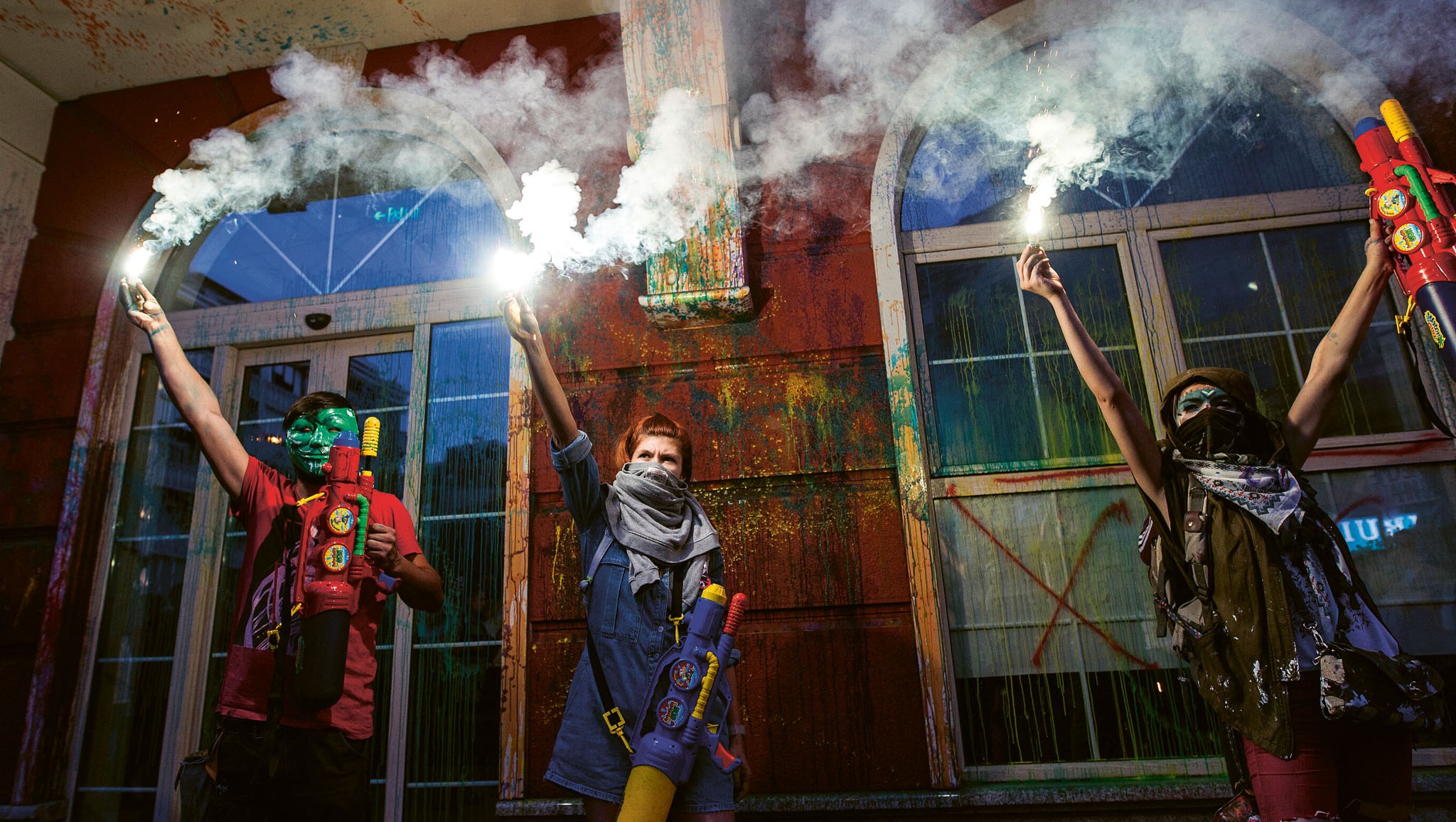
The theoretical background that characterizes them as ‘non-violent’ is based on the idea that everything that excludes fists and guns is ‘non-violent’ action. In other words, anything that does not kill or cause severe injuries is not violence. This can include the vandalization of public space and property, physical and psychological pressure, physical blockades, physical occupations, naming and shaming, the stalking of public officials, etc. all are considered non-violent methods of action, simply because they do not produce corpses.
A simple observation of these actions, all of which include the intentional causing of damage and harm with the purpose of imposing the will of a group and coercing the opponent into subjugation, brings to the fore the violent nature of colour revolutions. Consequently, this shows that fist-fights and shooting are not the only forms that violence can take, thus proving that their categorization as ‘non-violent’ methods of action is based on, at the very least, a narrow understanding of what constitutes violence. Moreover, consider that they avoid direct physical clashes with the repressive apparatuses of the state, i.e. the police, only for tactical and strategic reasons, to circumvent the strongest points of the adversary and attack its weakest, and not out of a moral creed based on non-violence.
‘Colour revolutions can be defined as political action that stands on the edge between the categories of non-violent action and civil resistance’
The way colour revolutions unfold on the streets show even more clearly that they are hard-power tools of a violent nature, tailored precisely to the exigencies of political warfare. In other words, it is not ‘non-violence’ that is their modus operandi, but rather the use of raw power. What makes this force violent is the intent behind the action. That is, colour revolutions do not use force in the way a father would, to stop his child from running in the middle of the street, but to crush the will of their opponents by causing enough damage to coerce them into withdrawing in order to achieve political objectives. Imagine it as if the father, instead of using his strength to firmly hold the hand of his child to prevent trouble, rather breaks it to subjugate and overpower him for the sake of it.
And this is the purpose of this study: to contribute to the preservation of the ethical, institutional, and normative framework in which the political struggle is taking place, without it first being reduced to rubble by the colour revolutions themselves. The study finds that ultimately, this is the threat that colour revolutions pose, since any political subject for whatever reasons can ultimately turn to this weapon and overthrow the incumbent government through the power of artificial legitimacy generated by these specially crafted tools for waging the political struggle for power. This is an issue that is not addressed adequately in the existing literature, thus leaving a gap that this study seeks to fill.
The primary hypothesis of the study will be proven by adopting the ontological viewpoint, alongside an objectivistic approach and deductive reasoning, by which the secondary data will be analysed. Ontology was chosen because it has been described as the philosophical approach that fundamentally ‘takes into consideration the existing elements and concepts and examines their relationships in order to gain deeper insight in the nature of reality…’1 One’s ontological viewpoint is the answer to the nature of the reality to be inquired.’2 Objectivism is the second level of analysis, since it is defined as ‘an ontological position that states that events and their meaning have independent existence. [T]hus objectivism claims the existence of one objective reality.’3
In the context of colour revolutions, this means that there is no single point beyond which, if not passed, an action remains non-violent. An action is violent if it falls under the category of intentionally causing damage, and this is, in short, the manifestation of violence that has independent existence. Finally, deductive reasoning was selected because by John Losee’s definition it ‘includes the creation of a conceptual and theoretical structure via empirical observation’,4 which is the way in which this study is structured: a hypothesis was developed that is about to be tested for its ontological truth.
Defining Colour Revolutions
Colour revolutions are weapons for waging political battle, and rely on the so-called ‘methods of non-violent action’ that unfold as protests against the government, under the pretext of fighting against dictatorship and corruption, led by the opposition. They function on the principle of delegitimizing the government by striking it in ways that damage its status and operate by creating an asymmetrical clash through the forces at its disposal.
In this way, they appear to be the antithesis of the typical robust and repressive tools used by the state apparatus. They are based on the insight that one can destroy the power of the state by undermining its legitimacy, thus serving as justification to mobilize the people to act against it by empowering them with the awareness that its power lies in their consent.5 This is the background philosophy of colour revolutions.
According to the father of colour revolutions, Gene Sharp, this is due to the fact that political power is fragile, because it depends on the sources from which it is drawn. This is where it can most easily be controlled. This is a social view of power, which, as Sharp states, ‘views governments as dependent on the people’s support and its power as continually rising from different parts of the society and as fragile since it depends for its strength and existence upon many institutions and peoples obedience that’s not fixed. This means that political power can be best controlled at its sources.’6
In other words, colour revolutions and the ‘methods of non-violent action’ are the form which the principle of withdrawing consent takes when pragmatically utilized and exploited in the struggle for power, like a specific set of instruments that carries the name of ‘methods of non-violent action’. They are considered non-violent forms of political action because part of the methodology that they are using falls into that category. Namely, by definition, a non-violent action ‘is a term that includes several specific methods of protest, non-cooperation, and intervention, in which the conflict is waged by doing or refusing to do certain things without using physical violence. It is considered not as passive or inaction, but as a non-violent action.’7
‘Colour revolutions operate in such a way that makes every government look like a violent oppressor’
However, what differentiates colour revolutions from genuine non-violent action are the intention, the purpose, the instruments added to the methods of action, the way these methods are being used, and the effects they produce. That is, in their hands, some methods of genuinely non-violent action become coercive tools, because colour revolutions enhance the capacity of those methods to cause damage and harm that determines their efficiency—which is violence per se—while being aimed at the overthrowing of a regime. That is why they can be defined as a ‘non-violent’ violence. Another category of political actions that colour revolutions might to a degree fall into is ‘civil resistance’, which is a ‘similar term to some other like “nonviolent action”, “non-violent resistance”, and “people power”. In it are included a set of activities that challenge a particular power, force, policy, or regime which is why they are named as “resistance”. Some of its actions are pressure and coercion based. Their aim is to increase the costs to the adversary of pursuing particular policy, to weaken the adversary’s capacity to pursue a particular or to completely undermine the opponent sources of legitimacy and power, whether domestic or international.’8
Coercion is the foundational operating principle of colour revolutions, as can be seen in the ‘methods of non-violent action’. The way they operate should be distinguished from genuine forms of pressure like regular protests. Specifically, colour revolutions aim to cause enough damage to the government to weaken it, in order to impose their will upon it and force it to resign. That is coercion, and its efficiency is dependent on the capacity to cause damage and harm, i.e. violence.
On the other hand, genuine protestors aim is to express dissatisfaction with particular government policies that cause them harm, with the intention of pressuring the government to change it, instead of causing it damage in order to crush its will, force it to resign, and seize power. Their instrumental nature, efficiency, and ultimately their raison d’être all make colour revolutions appealing to political actors as useful tools for waging the political fight. That is one of the reasons why they have occurred with great frequency in many countries. Being harbingers of political clashes for power, they stand on the edge between civil resistance and political actions that have the sole purpose of coercing and overthrowing a government. David Lane frames colour revolutions ‘as a combination of coup d’état and a revolution—a revolutionary coup d’état. […] Colour revolutions are not true revolutions, because the protestors are just a tool for the opposition to oust the government and replace it with their own personnel. Instead of a bottom–up political process, he observes a top–down chain.’9
In short, colour revolutions can be defined as political action that stands on the edge between the categories of non-violent action and civil resistance, and are neither revolutions nor coups d’état, but precisely crafted weapons for waging the political battle that are based on Gandhian insights and military strategy which function on the principle of coercion but employ subtler forms of violence for strategic reasons.
The ‘Non-Violent’ Violence of Colour Revolutions
By including everything except fist fighting and a pile of corpses, this limited view actually provides justification for the use of many other forms of violence and protects those who use them. It blinds observers to the nature of violence and therefore to the character of the actions undertaken.
The ‘methods of non-violent action’ that are the basis for the functioning of colour revolutions have been developed to cause damage and harm in order to coerce and impose a particular political order. That is why they are a violent, since a truly non-violent action in this sense is an action that is aimed at raising the awareness of one’s role in the political system. The purpose behind true non-violent protest is to enable individuals to stand firm as the equals of their representatives in the case of injustice and mistreatment, and to effectuate their power by refusing to comply and protest in order to make themselves heard. The aim is to make the government see the wrongness of its action and stop the policy in question by accepting individuals’ positions. This represents a genuine non-violent action because it does not cause damage or coerce anybody. Instead, it leads to the development of a better mutual understanding of the relationship between the people and the government by clarifying the position of each in the political system. This can only lead to the improvement of the immediate situation, which will in the long term influence the political consciousness of the nation and thus lead to an incremental change of values which will affect the political ethics of the society.
In order to draw a clearer picture of why colour revolutions and the ‘methods of non-violent action’ are ‘non-violent’ violence, we may consider the example of Mohandas Gandhi’s satyagraha, which did not include actions that caused damage, whether psychological or physical. As Gandhi puts it, ‘passive resistance is a way of protecting rights by personal suffering; it is the opposite of violent resistance. When I refuse to do something that troubles my conscience, I use soul-force. If the Government passes a law that I do not like and if by using violence I force the Government to repeal the law, I am using body-force. If I do not obey it and accept the consequences, I use soul-force. Essentially, it is a sacrifice.’10
In short, the difference is in the intention, character, and outcome of the means used. Colour revolutions and the ‘methods of non-violent action’ use methods that cause damage and harm in order to coerce, while passive resistance is not a coercive action intended to crush the will and subjugate the opponent, forcing them to behave in line with the will of the revolutionaries. Simply put, it is a refusal to comply with the purpose to change without damaging anybody or anything. Gandhi considers these two as completely different types of force: the force of arms and what he calls a ‘soul-force’: ‘If one hurts another for whatever reason, that action represents essentially a force of arms while the second kind of force, which can be defined as refusal to obey if our demands are not met, that is, we can be governed only as long as we decide to obey, can be called a love force, soul-force or, more popularly but less accurately, passive resistance.’11
The aggressive, violent, and damaging character of colour revolutions and the ‘methods of non-violent action’ is what reveal their violent nature, which Gandhi calls force of arms. That is why Harvard Professor Thomas C. Schelling explains that ‘violent action and nonviolent action should be compared in regard to the achievement of political purpose and the necessary costs for that endeavor…which means that the difference between the two types of action is not like a difference between prayer and dynamite. Both have their aim to make somebody do something or not do something or stop doing something. The goal is to influence behavior…’12
In other words, they represent different methods of political action, but the same underlying violent nature. That is because they only generate different physical outcomes in terms of degree; one can produce a pile of corpses, the other bruises and broken windows, while also psychologically disturbing the public, vandalizing public spaces, and blocking the system, but both function on the identical principle of causing damage and harm with the same aim of crushing the will of opponents and forcing them to withdraw so that the revolutionaries’ political objectives can be achieved. They are identical even in the targets of their action, which include both people and objects. Namely, the coercive techniques of the colour revolutions and the ‘methods of non-violent action’ cause damage to people, since they are always used against the government and the forces of the government, both of which are comprised of people, to objects, since they vandalize public buildings and spaces as part of their activities, and to society in general, because a minority of the population is blocking the functioning of the system. This affects the livelihood of the vast majority of the people, who are part of and affected by that system, and who do not take sides in the political struggle for power. What is essentially happening is a reverse of the process by which the government is authorized by the citizens to use violence. In this case, the withdrawal of consent, as employed in colour revolutions, serves to empower and legitimize the ‘revolutionaries’ to use violence against the government, albeit with other, subtler methods.
Colour Revolutions: The Struggle for Power and Geopolitics
In the domestic arena, the struggle for power in politics is conceived of as a fight for the government as the ultimate expression of political power, while in the international realm, it takes the form of geopolitical conquest of territories, achieved through political, economic, cultural, and military means. Just as in war, the purpose of this fight is to obtain greater power, which implies subduing the opponent.
In the domestic political realm, the clashing sides are the government and the opposition, which use various means to wage their political battle. As weapons of political warfare, Julia Gerlach writes, ‘colour revolutions represent a fight between “government” and “opposition”. Therefore, one can say that the results of the protests can rely on one or a combination of the regime’s and/or the opposition’s strategies and actions.’13 One thing is clear, however: whatever the method or actions being used, in order for them to be successful in the political struggle for power, they have to carry the potential of causing damage. That makes the crucial difference that determines whether one will successfully coerce the opponent, which is necessary in politics since essentially it is a clash of forces in the name of power. In other words, the nature of the political game determines the character of the means that are to be used. And this is similar in both violent—i.e. ordinary—revolutions, and in so-called ‘non-violent’ campaigns like the colour revolutions.
That is why it has been said that ‘both violent and nonviolent campaigns aim at seizing power by force, only the method of applying force differs among the different resistance types’.14 In both cases however, the exercise of force is dependent upon the capacity to cause damage and harm, which determines the efficiency of the coercion. Logically it follows that violence is the common ground upon which both classical violent and the so-called ‘non-violent’ campaigns like colour revolutions stand. One cannot reasonably expect it to be otherwise, since both are means developed for waging the political struggle for power, and differ only in the particular methods that they use. That is why the authors of Why Civil Resistance Works conceptualize them ‘as an unconventional warfare that uses different weapons and applies force differently.’15
Therefore, colour revolutions are violent means for waging the political fight developed precisely to subjugate the opponent by causing damage and distress following the military strategy and tactics derived from The Art of War. It is noticeable that the ‘methods of non-violent action’ are an adaptation of Sun Tzu’s advice that ‘to fight and conquer in all your battles is not supreme excellence; supreme excellence consists in breaking the enemy’s resistance without fighting…Thus, in war, one should avoid what is strong and strike at what is weak.’16
From this perspective, it becomes clearer that the colour revolutions and the ‘methods of non-violent action’ are militaristic means tailored specifically for waging political warfare, having been disguised as ‘non-violent’ to create an aura of legitimacy which is their main power. They are supported by tactical actions that only exclude ‘fist fighting’ in order to avoid the strongest points of the opponent and strike at its weakest, which is strategic and not a moral creed of non-violence.
This is observable also in the words of Sharp, who says that ‘whatever the efficiency level of violent means can be, in that way, one wages the type of struggle in which the adversary is always superior’.17 In other words, colour revolutions are only reluctant to use the same violence that the government is using because that would entail fighting the opponent by the means in which it is superior, which is a strategic and tactical mistake and will not achieve the desired results. As Sharp puts it, ‘with nonviolent action one evades confronting the government with the same weapons that it is using. On the contrary, nonviolent protestors reflect back the repressive violence in different ways, mainly by employing a different technique of waging conflict that aims at giving the resisters advantage. In such a way, the protestors create an asymmetrical conflict, with the two sides fighting by different means. Nonviolent action serves to weaken the opponent’s power position, by alienating the institutions and groups which support the sources of power of the government, to impede the effective usage of its forces, and weaken its will to use all of its capacities. The result is elimination of the adversary’s capacity to continue the struggle.’18
‘[Colour revolutions] have been nothing less than purposefully initiated protests used like weapons by political structures to wage political warfare with the purpose of coercing and overthrowing the incumbent government and seizing power’
The ultimate purpose of a colour revolution is always to oust the government against which it is fighting. The change of government is naturally followed by changes of policy. This is what reveals the ulterior motives of colour revolutions. That is, colour revolutions are launched under the pretext of fighting against dictatorship, election fraud, and corruption in countries that are digressing from the political, security, and economic field of gravity of a major geopolitical player, and by sponsoring a colour revolution this major power is protecting its own sphere of interest. The purpose is to oust the disobedient government and realign that country’s policy with its own by installing a new, obedient regime.
On the same line of thinking, Lane argues that ‘revolutions that come as the results of elections, can be considered as one of the means used to install them in power. Western interests are present in these processes—as support for groups, in Margaret Thatcher’s words, “with whom we can do business”, or from a geo-strategic point of view, to change allegiances in favor of the West.’19 This was the case with all of the colour revolutions that have happened to date, but the most blatant example was the colour revolution that occurred in the Republic of Macedonia in 2016. It started under the pretext of fighting corruption, election fraud, and dictatorship, which fits the pattern of all other colour revolutions that have ever been initiated: Ukraine in 2005 and 2014, Georgia, Serbia, Azerbaijan, Moldova, Armenia, and Kyrgyzstan, to name but a few. In this regard, twelve colour revolutions are examined statistically by Pavel K. Baev in his article ‘A Matrix for Post-Soviet “Colour Revolutions”: Exorcising the Devil from the Details’. Baev confirms that colour revolutions are being used as instruments to advance the foreign policy of a particular country in the pursuit of its geopolitical interests. That is so because the results of the research show that ‘the colour revolutions in Ukraine, Georgia, Belarus and Azerbaijan were heavily supported by the West while those in Kyrgyzstan, Armenia and Moldova received far less support.’20
The geopolitical interest of the West is what distinguishes the former group from the latter. That is, Ukraine, Georgia, and especially Belarus represent the soft spot or ‘near abroad’—as those countries are called in the Russian Federation—which means that by installing pro-Western regimes, the West is spreading its geopolitical influence into the immediate vicinity of the Russian Federation. This is the first step toward the ultimate geopolitical goal of NATO expansion towards Russia’s borders. In Baev’s view, another reason to consider colour revolutions as instruments for advancing a particular foreign policy is that the West ‘supported the colour revolutions that occurred in countries that had by far milder governments”,21 with the exception of Belarus, but were of greater geopolitical significance, compared to those that were truly dictatorial, like Turkmenistan, but of lesser significance for the West. In other words, the underlying cause is geopolitical interest and not genuine democratization, which is the reason why the gap between the officially proclaimed intentions and the consequences remains. In other words, the cause of colour revolutions was geopolitical interest and not democratization, which shows that colour revolutions are violent weapons for waging the political warfare that can serve as tools for advancing the foreign policy of a particular country in the pursuit of its geopolitical goals, and not local, spontaneous uprisings for democracy. Lane puts it as follows:
‘The results from the colour revolutions are far from “revolutionary”: only the personnel may change in the existing institutions which remain with the same structures. The “democratic revolution” usually fails to democratize the electoral structure, and may even lead to new types of electoral discrimination. The new elites act like their predecessors, just sometimes (as in Serbia, Ukraine, and Georgia) with a stronger Western orientation. Successful “colour” revolutions involving elite replacement and policy change happen when there is alternative policy option available, like joining the Western economic and security organizations and not only when the population is willing for change.’22
Naturally, the gap between the official cause and the effect of colour revolutions remains, since the real cause is geopolitical interest under the pretext of democratization and not genuine democratization itself, which shows the instrumental character of colour revolutions, and that their purpose is to create obedient regimes, not democracies. The democratization gap therefore is the real danger, potentially causing the ethical, normative, and institutional framework of political conduct to disappear as such, since every political subject can turn to this weapon of political warfare in an attempt to seize power, as colour revolutions can delegitimize even the legitimate government, hence why the artificial legitimacy of ‘non-violence’ should be exposed in its true, violent light.
NOTES
1 Egon Guba, and Yvonna Lincoln, ‘Competing Paradigms in Qualitative Research’, in Norman Denzin, and Yvonna Lincoln, eds., Handbook of Qualitative Research (Sage, 1994), 105–117.
2 Monty Sutrisna, ‘Research Methodology in Doctoral Research: Understanding the Meaning of Conducting Qualitative Research’, Proceedings of the Association of Researchers in Construction Management (ARCOM), doctoral workshop held in John Moores University Liverpool (2009).
3 Sutrisna, ‘Research Methodology in Doctoral Research’.
4 John Losee, A Historical Introduction to the Philosophy of Science (Oxford University Press, 1993).
5 Gene Sharp, How Nonviolent Struggle Works (The Albert Einstein Institution, 2013), 3–112.
6 Sharp, How Nonviolent Struggle Works, 3–112.
7 Sharp, How Nonviolent Struggle Works, 3–112.
8 Adam Roberts, and Timothy Garton Ash, Civil Resistance and Power Politics (Oxford University Press), 2–3.
9 Julia Gerlach, Color Revolutions in Eurasia (Springer, 2014), 28–33.
10 Mahatma Gandhi, Hind Swaraj or Indian Home Rule (Navajivan Publishing House, 1938), 70–75.
11 Gandhi, Hind Swaraj or Indian Home Rule, 70–75.
12 Thomas Schelling, ‘The Diplomacy of Violence’, in John Garnett, ed., Theories of Peace and Security (Palgrave Macmillan, 1970), 19–20.
13 Gerlach, Color Revolutions in Eurasia, 28–33.
14 Erica Chenoweth, and Maria Stephan, Why Civil Resistance Works: The Strategic Logic of Non-Violent Conflict (Columbia University Press, 2011), 27.
15 Chenoweth and Stephan, Why Civil Resistance Works: The Strategic Logic of Non-Violent Conflict, 27.
16 Sun Tzu, The Art of War (Aziloth Books, 2010), 6–16.
17 Gene Sharp, From Dictatorship to Democracy (The Albert Einstein Institution, 2010), 4–30.
18 Sharp, How Nonviolent Struggle Works, 3–112.
19 David Lane, ‘“Colored Revolution” as a Political Phenomenon’, in Journal of Communist Studies and Transition Politics (Routledge Taylor and Francis Group, 2009), 131–132.
20 Pavel Baev, ‘A Matrix for Post-Soviet “Color Revolutions”: Exorcising the Devil from the Details’, in International Area Studies Review (Sage Publications, 2011), 10–14.
21 Baev, ‘A Matrix for Post-Soviet “Color Revolutions”: Exorcising the Devil from the Details’, 10–14.
22 Lane, ‘“Colored Revolution” as a Political Phenomenon’, 131–132.
Read more:
At a time when public debate is increasingly polarized and superficial, Hungarian Conservative remains committed to depth, intellectual honesty, and independent conservative thought.
Producing high-quality journalism requires resources. Your contribution helps us expand our coverage, reach new audiences, and keep our content accessible.

Please consider supporting our mission.