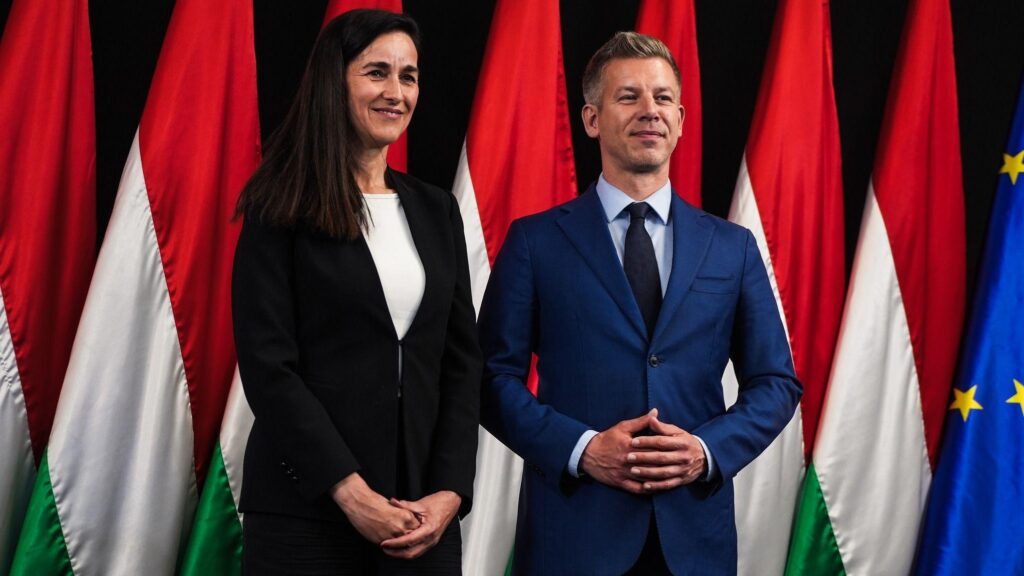
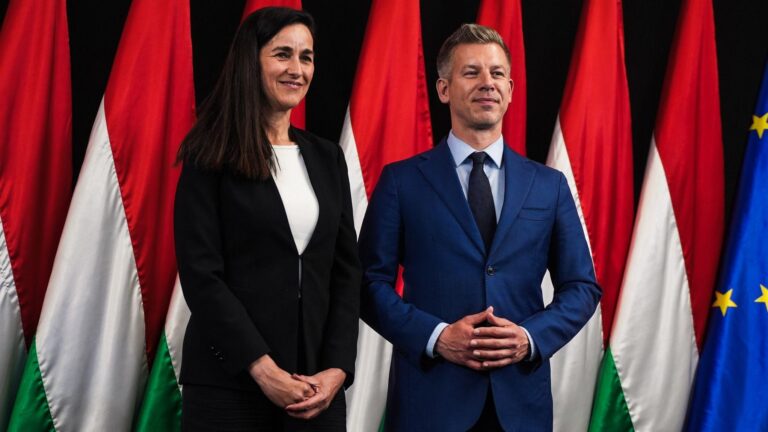
The Kremlin welcomed Hungarian Prime Minister Péter Magyar’s decision not to send weapons or military equipment to Ukraine, arguing that peace would come sooner if other countries adopted a ‘similar approach’, Kremlin spokesman Dmitry Peskov said last week.
The remarks came after Magyar’s meeting with NATO Secretary General Mark Rutte, during which the Hungarian prime minister reiterated the new government’s position that it would not participate in arms deliveries to Ukraine. ‘Russia praised Péter Magyar,’ Peskov said regarding the decision, speaking to journalists according to Russian state news agency Interfax.
Magyar later reiterated on Facebook that Hungary would provide humanitarian assistance to Ukraine but would not send weapons or combat equipment into the war. He also highlighted areas of agreement with Rutte regarding Hungary’s NATO contributions.
The remarks are particularly notable given that the 2026 election was largely framed by Magyar and the Tisza Party as a choice between ‘Europe and Russia’. Throughout the campaign, the Tisza leader accused former prime minister Viktor Orbán of isolating Hungary within the European Union through his increasingly close relationship with Moscow and his confrontational approach towards Brussels.
Under Orbán, Hungary faced years of criticism from EU partners over its Russia policy, especially after Moscow’s full-scale invasion of Ukraine in February 2022. Orbán remained the only EU leader to maintain regular high-level contacts with Russian President Vladimir Putin, repeatedly travelling to Moscow while calling for ceasefire negotiations and opposing further military escalation. Many European governments increasingly viewed Budapest as Russia’s closest political partner within both the EU and NATO.
After securing a constitutional supermajority in the 12 April elections on a promise of pro-European realignment, the new government has nevertheless already signalled substantial continuity regarding pragmatic cooperation with Russia, particularly in the field of energy.
On 15 April, only days after the election, Peskov stated that Moscow had ‘noted with satisfaction’ Magyar’s willingness to pursue ‘pragmatic dialogue’ with Russia and expressed readiness to maintain mutually beneficial relations with Hungary. At the same time, Magyar confirmed that Hungary intended to continue importing ‘cheap Russian oil’ while gradually diversifying supply routes. That position was later reinforced during the parliamentary hearing of Minister of Economy and Energy István Kapitány.
At the same time, the new government has adopted a considerably harsher tone towards Moscow regarding the war itself. On 15 May, Hungarian Foreign Minister Anita Orbán summoned Russia’s ambassador to Budapest after Russian drones struck Ukraine’s Transcarpathia region, including settlements inhabited by ethnic Hungarians, in what local authorities described as the largest attack on the western oblast since the start of the full-scale war in 2022.
‘At the same time, the new government has adopted a considerably harsher tone towards Moscow regarding the war itself’
The diplomatic protest was widely viewed as the most serious action taken by Budapest against Moscow since the beginning of the war. Anita Orbán also stated that Russia ‘must do everything possible’ to achieve an immediate ceasefire and a lasting peace settlement, while confirming that Hungarian authorities remained in constant contact with diplomats in the region amid concerns for the local Hungarian minority.
The minority issue also remains central to Hungarian–Ukrainian relations even after the change of government. Magyar has repeatedly stated that Budapest would support Kyiv’s EU accession bid only if Ukraine restores every right previously enjoyed by the Hungarian community in Transcarpathia before Kyiv’s restrictive policies introduced after 2014. Magyar and Ukrainian President Volodymyr Zelenskyy are expected to meet in Berehove (Beregszász), a Hungarian-majority town in Transcarpathia, in June.
Related articles:
At a time when public debate is increasingly polarized and superficial, Hungarian Conservative remains committed to depth, intellectual honesty, and independent conservative thought.
Producing high-quality journalism requires resources. Your contribution helps us expand our coverage, reach new audiences, and keep our content accessible.

Please consider supporting our mission.