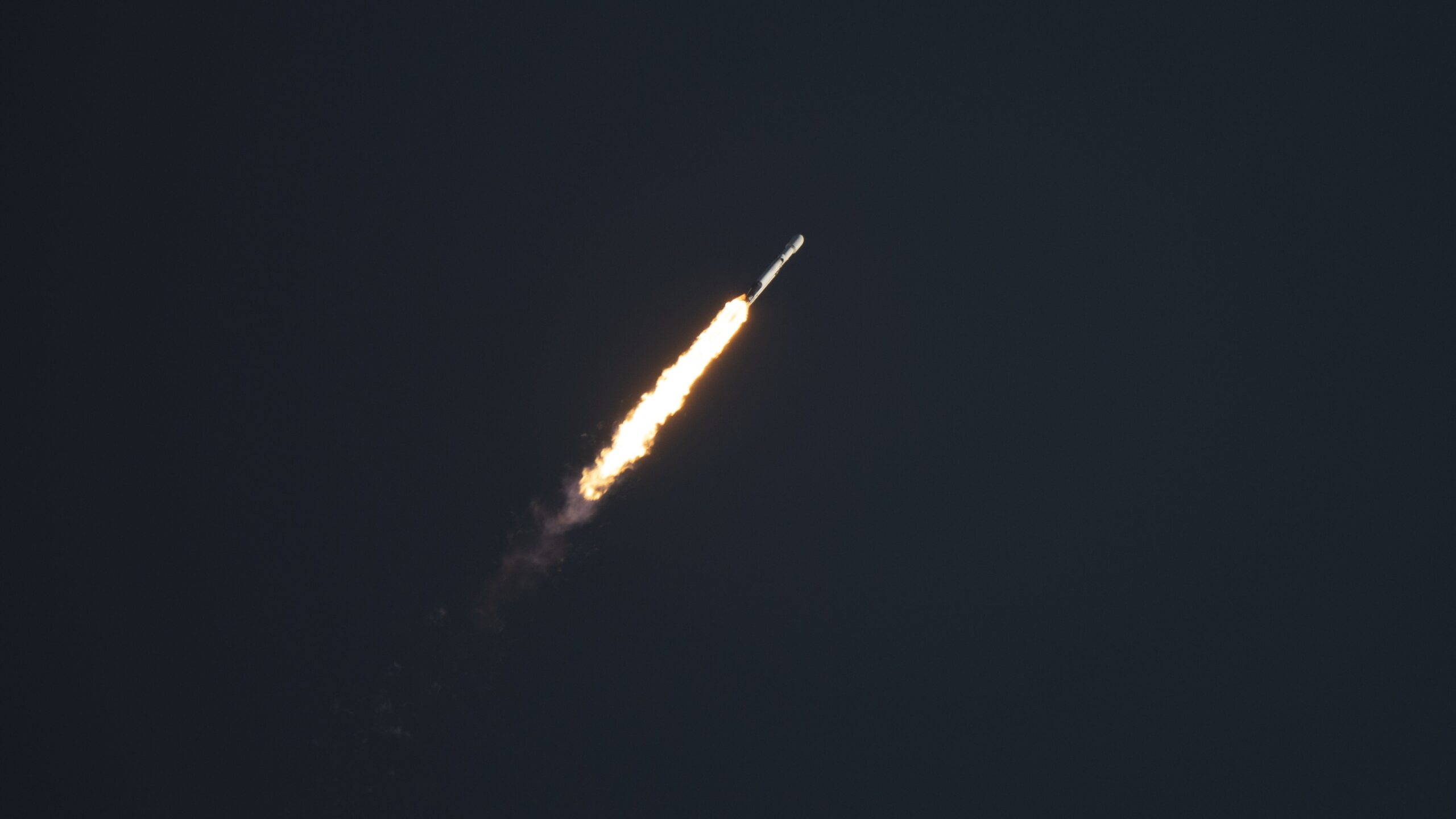
NASA’s next-generation Roman Space Telescope was launched from the Cape Canaveral Space Force Station in Florida on Sunday.
The telescope was carried into space aboard a SpaceX Falcon Heavy rocket and will operate around 1.6 million kilometres from Earth, in the same general region of space where the James Webb Space Telescope is currently stationed.
The bus-sized observatory is expected to reach its designated position in about three months. NASA hopes it will help scientists discover and study planets in previously unexplored planetary systems.
Roman will work alongside the Webb Space Telescope and the European Space Agency’s Euclid space telescope, providing complementary observations of the universe.
‘It will find thousands of supernovas, tens of thousands of planets, millions of solar systems and tens of billions of stars,’ Nicky Fox, NASA associate administrator for the Science Mission Directorate, said at the launch. She highlighted the telescope’s exceptionally wide field of view, saying it would allow scientists to observe phenomena that had previously been beyond their capabilities.
Roman’s primary mirror has the same 2.4-metre diameter as the Hubble Space Telescope, which was launched in 1990 and operates in low Earth orbit. However, Roman’s field of view is around 100 times larger.
NASA researchers have said that Roman could collect enough data to map the Milky Way in a month that would take Hubble roughly a century to gather.
The telescope will also investigate dark matter and dark energy, two of the major unresolved questions in modern cosmology.
Roman was designed to be refuelled, meaning its operational lifetime could potentially be extended significantly if a robotic spacecraft replenishes its fuel within the next decade.
The telescope is named after Nancy Grace Roman, a former NASA chief astronomer who played a key role in the development of the Hubble Space Telescope.
Related articles:
At a time when public debate is increasingly polarized and superficial, Hungarian Conservative remains committed to depth, intellectual honesty, and independent conservative thought.
Producing high-quality journalism requires resources. Your contribution helps us expand our coverage, reach new audiences, and keep our content accessible.

Please consider supporting our mission.