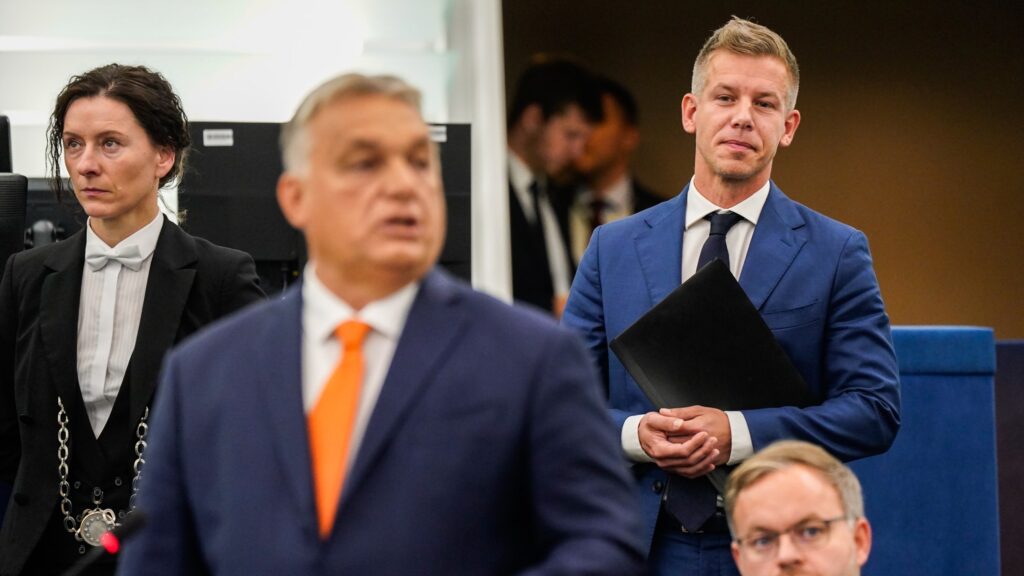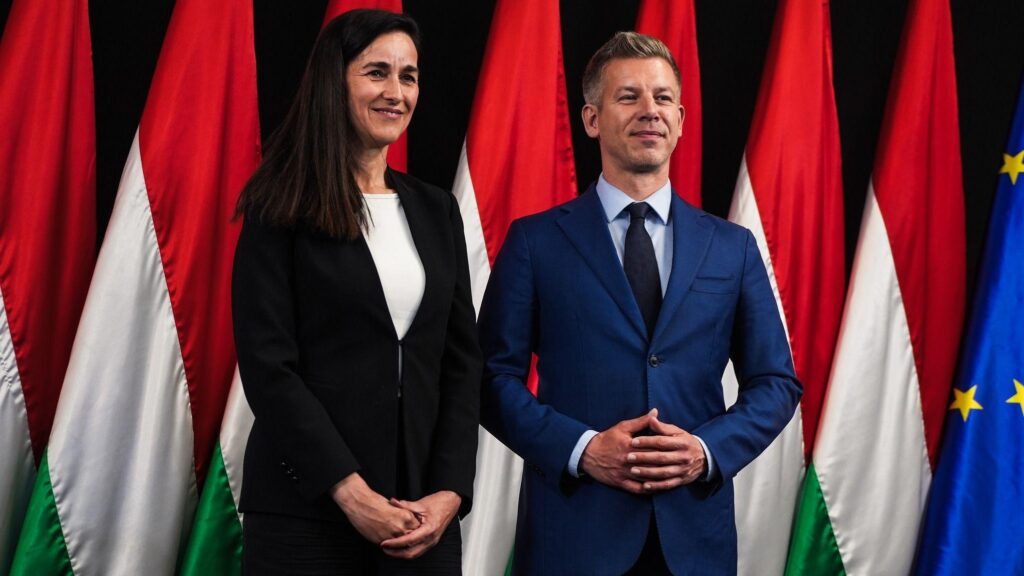
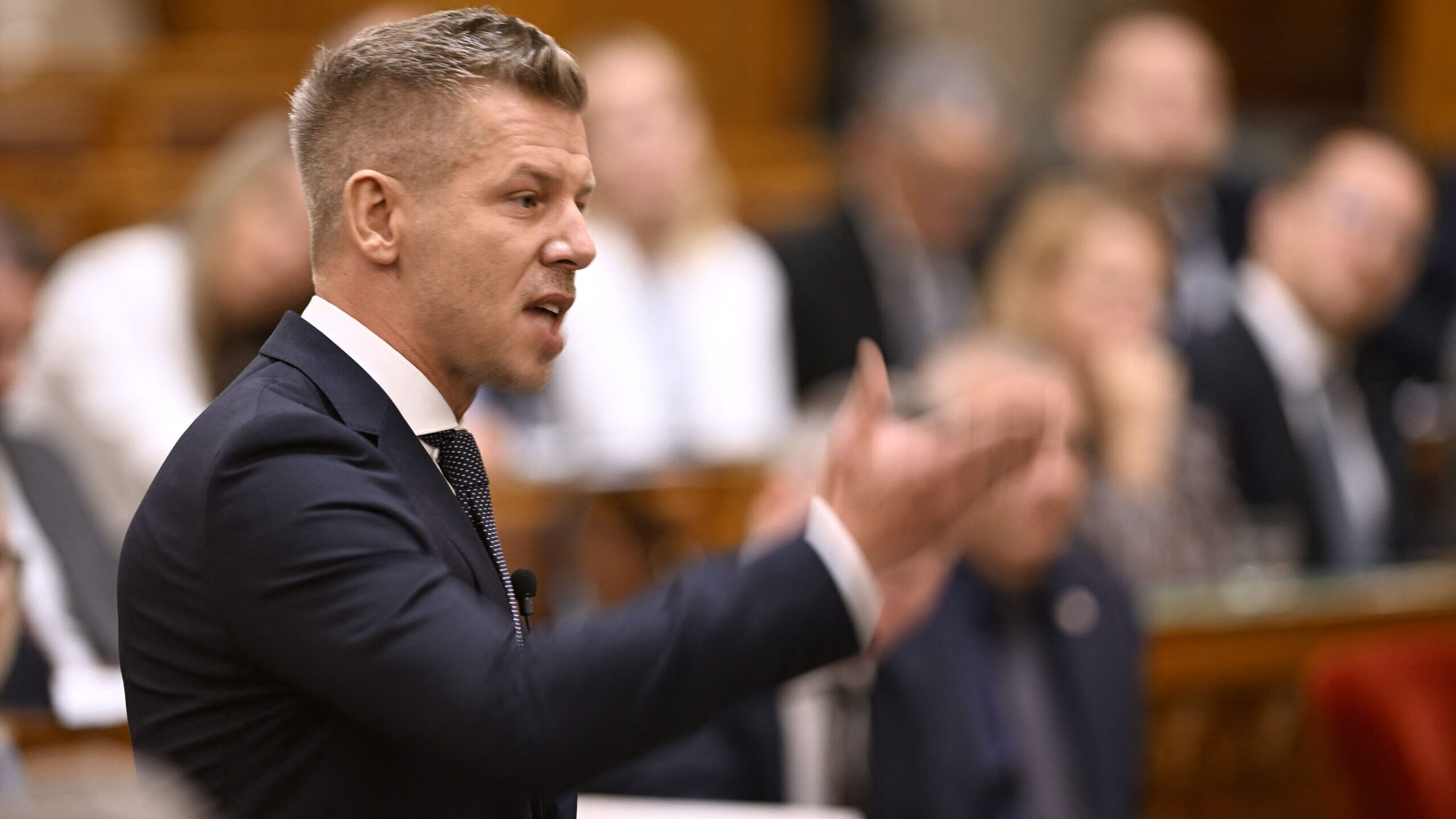
Péter Magyar’s political rise began on 10 February 2024, with a perceived failure of accountability surrounding the so-called pardon scandal, which resulted in the resignation of President Katalin Novák and the withdrawal from public life of former justice minister and Magyar’s ex-wife, Judit Varga. ‘I do not want to be part of a system for a minute where the real responsible people hide behind women’s skirts,’ he wrote that evening on social media, accusing the Fidesz leadership of sacrificing others while escaping responsibility themselves.
That framing soon became Magyar’s wider indictment of the NER, the acronym commonly used to describe Viktor Orbán’s System of National Cooperation. Holding the real decision-makers behind corruption, scandals, and the extraordinary enrichment of politically connected businessmen accountable developed into arguably the single most important campaign theme of Tisza’s rise to power.
By 2026, Magyar was no longer speaking merely about transparency or institutional reform. He was promising the ‘Path to Prison’ programme and telling voters that those who had committed crimes under the previous system would face consequences. Accountability became one of Tisza’s most emphatic promises, as well as one of the greatest expectations attached to its victory.
Now in government, Magyar and Tisza are confronting the bitter reality behind the promise that helped carry them there. Genuine accountability must be fast enough to satisfy voters expecting recovered fortunes, prosecutions, and prison sentences, yet painstaking enough to survive independent courts and the standards of the rule of law Tisza promised to restore.
It requires investigators, prosecutors, judges, experts, and years of work that political rhetoric can compress into memorable campaign slogans but legislation cannot simply wish away. How Magyar manages that contradiction may determine more than the success of his accountability programme. The promise born from the downfall of the old system could ultimately become one of the greatest threats to his own.
Handcuffs, Handcuffs, Bars, Bars
Magyar’s aggressive rhetoric on accountability helped create the very expectations now confronting him and Tisza. His ‘bilincs, bilincs, rács, rács’—‘handcuffs, handcuffs, bars, bars’—emoji combination became a catchphrase among Tisza supporters during and after the campaign. After the April election, the prime minister did not step back; in fact, he turned that rhetoric up significantly. Much of Hungary’s electorate has now been conditioned by that communication and expects accountability to match it.
After the election, 84 per cent of Hungarians told 21 Kutatóközpont that accountability was necessary; among Tisza voters, the figure reached 97 per cent. Publicus separately found that 59 per cent expected at least some figures linked to the former Fidesz political or economic elite to end up in prison.
‘Much of Hungary’s electorate has now been conditioned by that communication and expects accountability to match it’
Since taking office, Magyar has attempted to turn those expectations into institutions through ‘Operation Purgatory’, a wider political and legal crackdown on what he described as the ‘political and economic patronage network’ built around Orbán over the past 16 years. Announced on 22 June, it included the creation of the National Asset Recovery and Protection Office (NVVH) and a constitutional overhaul that ultimately removed President Tamás Sulyok on 20 July, along with those of other public officeholders and constitutional judges.
The NVVH was granted unusually broad powers to investigate suspected abuses of public assets, pursue their recovery, and exercise investigative and prosecutorial functions in relevant criminal cases. The powers of the office are unparalleled in Europe. A month later, Tisza MPs elected ELTE political scientist Anna Róza Unger as its first president for a six-year term beginning on 1 September, following a chaotic selection process discussed in detail later in this article. The office is therefore no longer a campaign promise: the machinery through which Magyar intends to deliver the promised reckoning now exists.
Justice System Cannot Run on Political Time
Politics, however, can promise prison much faster than the justice system can lawfully deliver it. One of the main problems is a shortage of manpower. Hungary ended 2024 with 1,837 prosecutors and 186 vacant allocated posts; 62 prosecutors left during the year, against only 32 appointments, while 216 were already aged 60 or above. The relevant pool is even smaller: complex corruption cases require specialists who cannot be created simply by moving money from one budget line to another.
The same problem exists among investigators: the National Tax and Customs Administration’s entire criminal investigation organization had 1,215 filled posts at the end of 2025, 50 below plan. NVVH President Anna Róza Unger said around 70 people—close to half the office—would work under the investigative deputy, while about a dozen prosecutors and investigators had accepted offers by 1 September.
That creates an obvious capacity problem. The National Asset Recovery and Protection Office was established partly because existing institutions failed to pursue major abuses effectively, but it must recruit specialists from those same bodies. Strengthening one part of the machinery can therefore weaken another.
‘Legal changes alone would not accelerate proceedings without first identifying where cases actually stall’
And the bottleneck does not stop at the indictment phase. At the Budapest-Capital Regional Court, 681 of 756 authorized judicial posts and 1,810 of 2,158 judicial-support posts were filled at the end of 2024; support staffing had fallen by 105 in a year. The head of the National Office for the Judiciary called its clerk shortage ‘extreme’. One of the largest corruption investigations of the Socialist era, the Quaestor case, shows what those numbers mean: a 1,548-page indictment, more than 132,000 pages of investigative material, and 359 trial days before the first-instance judgment.
During the parliamentary hearings of applicants for NVVH president, Unger had already warned about this, stating that it was unrealistic to expect every newly uncovered major case to reach a final judgment during her mandate. The statement sparked a revolt among Tisza supporters and intellectuals, pressuring Magyar to address the problem. On 28 August, the prime minister promised legislation to shorten procedural deadlines, changes to criminal-procedure rules, and stronger investigative and judicial capacity.
Miklós Ligeti, Transparency International Hungary’s legal director and Unger’s defeated rival—the preferred candidate of the Tisza camp—had already challenged that approach, arguing that legal changes alone would not accelerate proceedings without first identifying where cases actually stall.
There is another recruitment problem that no salary scale can remove: prosecutors may hesitate to join a politically charged institution out of concern over how their participation would be viewed after another change of government.
The NVVH is entrenched in the Fundamental Law, but a future two-thirds majority could amend the constitution and abolish or redesign it. A future government could not lawfully punish prosecutors merely for having worked there, yet politically explosive cases could be re-examined under a hostile successor.
Slovakia provides a nearby example: after Robert Fico returned to power, his government abolished the Special Prosecutor’s Office in March 2024 and reorganized anti-corruption structures, and, according to the European Parliament, changed personnel affecting high-level corruption investigators. Accepting such jobs would therefore immediately create the possibility of future political stigma.
That might explain why two of the three NVVH deputy presidencies reserved for serving prosecutors remain unfilled because too few valid applicants were available during the selection process.
The Opposition Magyar Built for Himself
That month-long procedure, which ended on 28 August, exposed the second half of the accountability trap.
Of the 96 people who applied, the parliamentary committee initially narrowed the field to Ligeti, Unger, and corruption researcher Dávid Jancsics. He later withdrew, saying the immediate task required a prosecutor–investigator-type expert—a ‘pitbull’, as he put it. Tisza then pushed for the hearing of asset-recovery specialist Nicholas Sárvári, originally the fourth-ranked applicant, calling him the party’s candidate, only to clarify hours later that he was not an official Tisza candidate. That awkward communication failure itself undermined the supposedly transparent and credible process.
Outrage grew further after the committee nominated Unger over Ligeti. During the hearings, Ligeti offered the more legalistic conception and told MPs that ‘the rule of law cannot be built at the expense of the rule of law’. Unger presented a more radical systemic agenda, describing the previous order as ‘more than corruption’ and ‘feudalism’, and arguing that the office should map recurring patterns and networks of responsibility. Political analyst Gábor Török interpreted the distinction as Ligeti’s case-focused, justice-oriented approach versus Unger’s more political, system-level conception.
‘Unger presented a more radical systemic agenda, describing the previous order as “more than corruption” and “feudalism”’
Even the Tisza-controlled committee divided over Unger. With Fidesz boycotting and Our Homeland absent, she received six votes in favour, one against, and one abstention; Ligeti received four votes and four abstentions. The sole vote against Unger came from Tisza MP Márton Melléthei-Barna, the party’s main legal expert and Magyar’s failed nominee for justice minister, who said he acted on professional conviction and regarded Ligeti as the strongest candidate.
The pick sparked widespread backlash from people strongly in favour of the original concept of the NVVH. Anti-corruption activist and former MP Ákos Hadházy called the process a ‘theatre’ and a ‘charade’ and sought the scoring system and rankings of applications, threatening litigation after the committee declined to release the data.
Hódmezővásárhely Mayor Péter Márki-Zay, who supported Tisza in the election, also criticized the decision, stating that voters he encountered regarded Unger’s appointment as a ‘betrayal of accountability’. Pro-Tisza actor and activist Áron Molnár ended his self-imposed first-100-day grace period for the government over the affair and asked why Magyar or Tisza was ‘afraid’ of Ligeti. Furious Tisza voters flooded the comment sections of the prime minister’s social media posts, raging over Unger. Europion then found that only 21 per cent of Tisza voters considered Unger a good choice, against 27 per cent who considered her a bad one.
Magyar responded that appointments cannot be decided by influencers, former politicians, or opinion polls, and that ‘the most popular decision is not always the best decision’. Constitutionally, he is right, of course, but politically, the reaction points to a wider contradiction. Magyar rose by mobilizing anger that powerful people escaped responsibility, and now has to tell the constituency he helped create that it cannot dictate who administers the reckoning or how quickly it happens.
That constituency can already pull him in opposite directions. Accountability maximalists will ask where the recovered money, convictions, and prison sentences are; rule-of-law watchdogs will ask what powers, procedures, and legal changes were used to obtain them. Ligeti may become particularly important precisely because he remains outside the NVVH: as president, he might have constrained Tisza from within; outside it, he can constrain its legitimacy from without.
Ligeti could also indirectly shape Brussels’ assessment of the new government: Transparency International Hungary is embedded in the civil-society coalition that has fed evidence into the European Commission’s annual Rule of Law Report for seven consecutive years, meaning sustained criticism from him could enter the Commission’s own evaluation of Magyar’s government. The April election already demonstrated how damaging the withholding of EU funding can be.
This is the paradox Magyar cannot legislate away. Move too slowly, and Tisza risks betraying the promise from which it rose. Move too aggressively, and it risks reproducing the accusation that made him powerful in the first place: that political power determines who bears responsibility while the system is bent around the desired outcome.
Related articles:
At a time when public debate is increasingly polarized and superficial, Hungarian Conservative remains committed to depth, intellectual honesty, and independent conservative thought.
Producing high-quality journalism requires resources. Your contribution helps us expand our coverage, reach new audiences, and keep our content accessible.

Please consider supporting our mission.