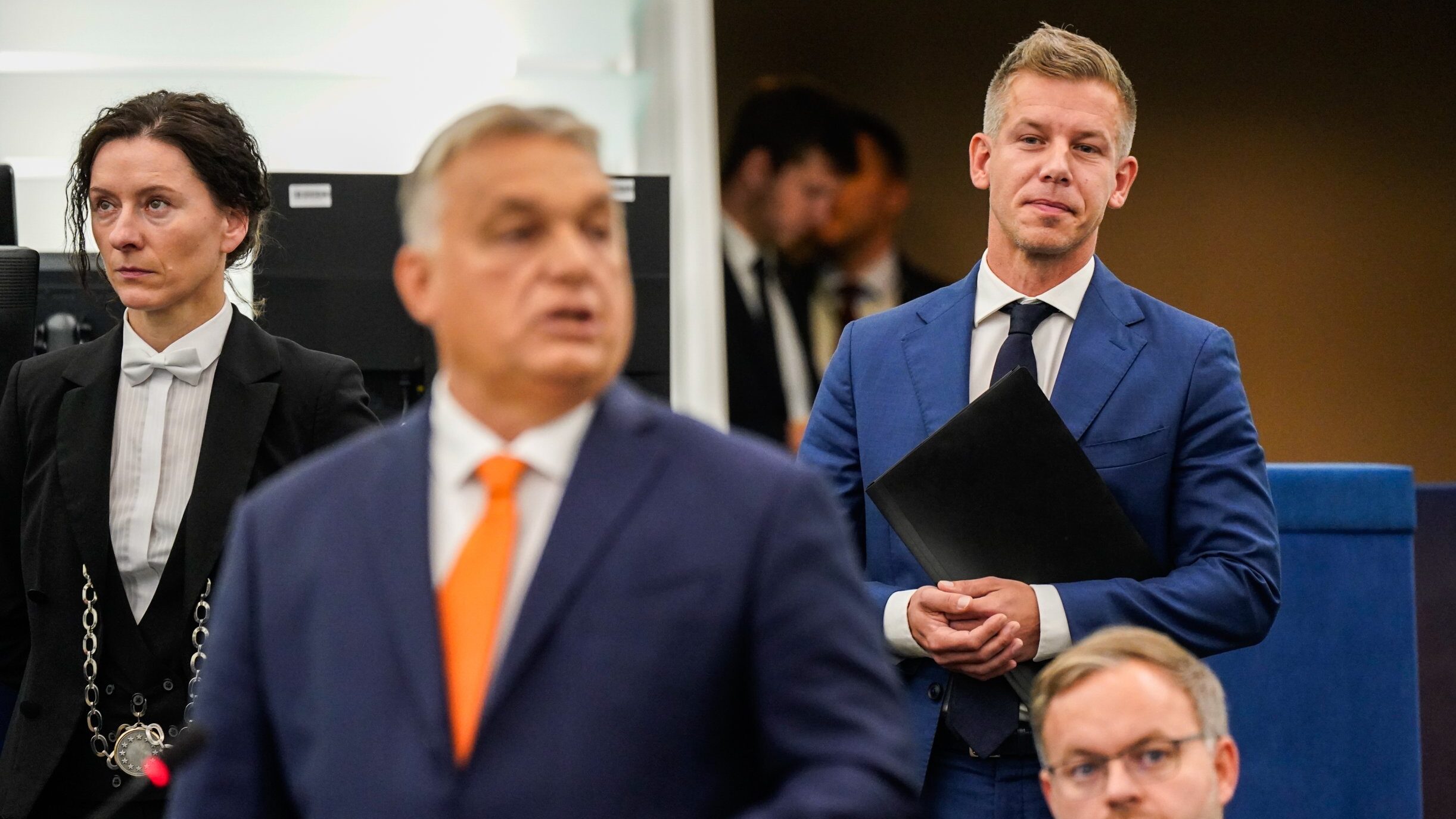
Hungarian Prime Minister Péter Magyar took the stage at the Bled Strategic Forum on Monday, delivering a surprisingly coherent and realistic diagnosis of the state of the European Union and the future of Europe. Had one heard parts of it without seeing who the speaker was, a substantial part of his remarks could easily have been mistaken for an assessment by his predecessor, Viktor Orbán, of what the bloc needed to do to regain its previous global position.
Speaking at a panel discussion featuring Slovenian Prime Minister Janez Janša, Czech Prime Minister Andrej Babiš, and Croatian Prime Minister Andrej Plenković, Magyar said the EU suffers from a ‘lack of political leadership’, is weighed down by a bureaucracy whose institutions compete for ever greater powers, and should return to the founding logic of economic cooperation and competitiveness.
The Familiar Language of European Decline
Europe, he argued, must decide whether it merely wants ‘to survive or to win’. While Brussels occupies itself with institutional rules and bureaucracy, China is building nuclear plants and electric-car factories. The answer, he said, is stronger political leadership at the level of nation-states, defence-industry cooperation, more investment in artificial intelligence, education and research, and energy security.
In a 2025 interview, Orbán argued that when things go badly, ‘political leadership is needed’ because ‘a bureaucracy is incapable of political leadership’, concluding: ‘This is why there’s no political leadership in the Union today.’ Six years earlier, launching Fidesz’s 2019 European Parliament campaign, he described a ‘Brussels bubble’ detached from the realities of the member states and said migration exposed Europe’s ‘crisis of political leadership’.
The overlap becomes even clearer when we look at the economic diagnoses delivered by the two leaders just a few years apart. At Bled, Magyar urged a return to the EU’s founding ideas, putting economic cooperation and competitiveness ahead of ideological disputes. Orbán’s 2021 theses on Europe declared that ‘without shared economic success the European Union will fall apart’, while accusing Brussels of lecturing, coercing, and punishing member states on ideological grounds instead of concentrating on that shared success.
‘The overlap becomes even clearer when we look at the economic diagnoses delivered by the two leaders just a few years apart’
During Hungary’s 2024 EU Council Presidency, Orbán’s programme put a European competitiveness deal first, alongside a stronger common defence policy, Western Balkan enlargement, tackling illegal migration, and preserving cohesion policy as the core strategic funding instrument of the European Union. In Strasbourg that October, he said ‘the EU needs to change’, demanded faster Western Balkan accession, and called cohesion funds ‘not charity nor a donation’ but one of the Union’s major investment policies.
Magyar returned to almost the same wording at Bled. He called for Western Balkan accession after decades of delay, proposed using cohesion funding for a high-speed rail link connecting Warsaw, Budapest, Bratislava, and Prague, and argued that Central Europe should act together to become a stronger pole inside Europe. He also urged less ‘double-speak’ and fewer ideological arguments in Brussels, with greater attention to energy links, infrastructure, and practical cooperation.
Speaking at the same forum in Bled on 31 August 2020, Orbán answered a question about Europe’s condition with two words: ‘In trouble.’ Europe, he said, had failed to identify its new place in the global economy, while China and the United States had become the ‘game changers’. Magyar’s 2026 formulation was that Europe must decide whether it wants to survive or win while China builds industrial capacity. The phrasing is not identical, but the diagnostic frame is almost the same.
When Magyar Sounds Most Like Orbán
Then came migration, which has already become the clearest area of continuity between the Orbán governments and Magyar’s new administration. Magyar said Hungary was right to defend the EU’s external border, pledged continued action against illegal migration, and called the €1 million daily penalty imposed on Hungary unfair. ‘It is very difficult to explain to Hungarians why Hungary is treated unfairly in Brussels,’ he said, arguing that the country was being punished ‘just because we protect the common European borders’.
In February 2025, Orbán said Hungary was paying €1 million a day ‘because we do not let them in’; later, he put the argument even more explicitly: Hungary had to pay because ‘we do not let migrants into Hungary; we protect the borders’. In an October 2024 interview, he called the fine a ‘disgrace’—Magyar calls it ‘unfair’—arguing that Hungary was ‘protecting the Europeans’ and was being punished for defending the Schengen border. Magyar’s Bled formulation therefore did more than preserve Orbán’s hard line on illegal migration: it reproduced almost the exact political rationale Orbán had used to contest the penalty.
Magyar also recounted his negotiations with European Commission President Ursula von der Leyen over frozen EU funding in language that would have been entirely familiar during the Orbán years. ‘I looked Ursula von der Leyen in the eye’ and told her that he had come ‘for our money’, Magyar recalled, before saying that securing the funds had been ‘quite smooth’. That framing is very important: rather than presenting the Hungarian prime minister as petitioning a superior EU institution, Magyar casts himself as von der Leyen’s sovereign equal—and, in the telling, the dominant actor in the encounter, arriving in Brussels to demand what already belongs to Hungary.
Both the wording and the strong-leader staging closely resemble Orbán’s characteristic presentation of negotiations with Brussels. After the Commission unlocked roughly €10 billion in December 2023, Orbán insisted: ‘This money is due to us… this is our money’, arguing that Brussels could delay it or impose new conditions but ultimately had to hand it over. Six months later, he personalized the process even further, boasting that ‘I have already obtained €12 billion’ through ‘bloody hand-to-hand fights’, battles, and bargaining.
The two, however, use the same sovereignty-inflected language to make almost opposite arguments. Orbán treated the withholding of funds as proof that Brussels abused its power and made member states ‘dance to the tune it whistles’; his conclusion was that the Brussels leadership had to be replaced. Magyar uses a similar strong-leader scene to argue almost the opposite: a Hungarian prime minister can assert national interests, bargain hard, and still reach a smooth agreement.
Conquer or Cooperate?
And that brings us to the end of the sometimes eerie similarities between Orbán’s and Magyar’s diagnoses of the state of the EU. They agree on the fundamental challenges and structural problems, yet offer two entirely different solutions to them.
By the end of his premiership, Orbán’s thesis was not merely that Brussels was bureaucratic or misguided. It was that normal cooperation had become structurally unreliable because the Commission and the wider Brussels establishment had become political and ideological actors. His 2021 EU theses accused the Commission of being transformed from an impartial ‘Guardian of the Treaties’ into a ‘political body’. By December 2024, he openly described his Patriots for Europe (PfE) political family as ‘Brussels’ opposition’ seeking to become ‘Brussels’ majority’, predicting that by 2030 the whole of the EU would turn conservative—in practice, that would mean a decision-making majority in both the European Parliament and the European Council. In June 2025, he explicitly said: ‘we’ll take Brussels, and we’ll transform the whole European Union’, so that ‘Brussels bureaucrats’ could no longer dictate to nation-states.
Magyar’s conclusion, drawn from the same diagnosis, is the opposite. Hungary, he said in Bled, is now a more constructive partner in Europe, though it ‘does not mean that we would not defend Hungarian interests every minute’. In contrast to Orbán’s continuous strategy of strategic confrontation, Magyar’s proposition is that sovereign nation-states can cooperate successfully with EU institutions while maintaining national interests, direct bargaining, and regional coalition-building.
‘Orbán ultimately saw Brussels as the enemy of nation-states, while Magyar sees it as flawed and full of structural problems, yet still capable of cooperation’
In other words, Orbán thinks Hungary’s interests can be achieved through confrontation, while Magyar thinks they can be achieved through cooperation; Orbán ultimately saw Brussels as the enemy of nation-states, while Magyar sees it as flawed and full of structural problems, yet still capable of cooperation.
The asymmetry is therefore one of goals. Orbán increasingly sought leverage to change who controlled Brussels; Magyar seeks leverage to make the existing institutional system deliver agreements—the first treats recurring confrontation as structural, the second as governable.
Of course, there are substantial differences, such as relations with Russia and the war in Ukraine; but the package in which the EU diagnosis is delivered—bureaucracy versus political leadership; competitiveness versus ideological distraction; sovereign national interest; hard external borders; Central European coordination; Western Balkan enlargement; cohesion as strategic investment; Brussels’ loss of public trust; and EU funds as ‘our money’—contains so much overlap at the level of policy, phrasing, and wording that it is hard to ignore.
Bled therefore suggests that Hungary’s post-Orbán turn may be less a move from sovereignty to integration than from sovereignty through confrontation to sovereignty through bargaining, at least on a rhetorical level. Magyar may therefore now—with or without fully realizing it—be testing Orbán’s most consequential European claim in practice: whether a government can maintain many of the same hard national positions and still cooperate successfully with Brussels, or whether, as Orbán insisted, the institutional conflict eventually returns regardless, making national interests advanceable only through confrontation and political change at the head of the EU.
Related articles:
At a time when public debate is increasingly polarized and superficial, Hungarian Conservative remains committed to depth, intellectual honesty, and independent conservative thought.
Producing high-quality journalism requires resources. Your contribution helps us expand our coverage, reach new audiences, and keep our content accessible.
Please consider supporting our mission.