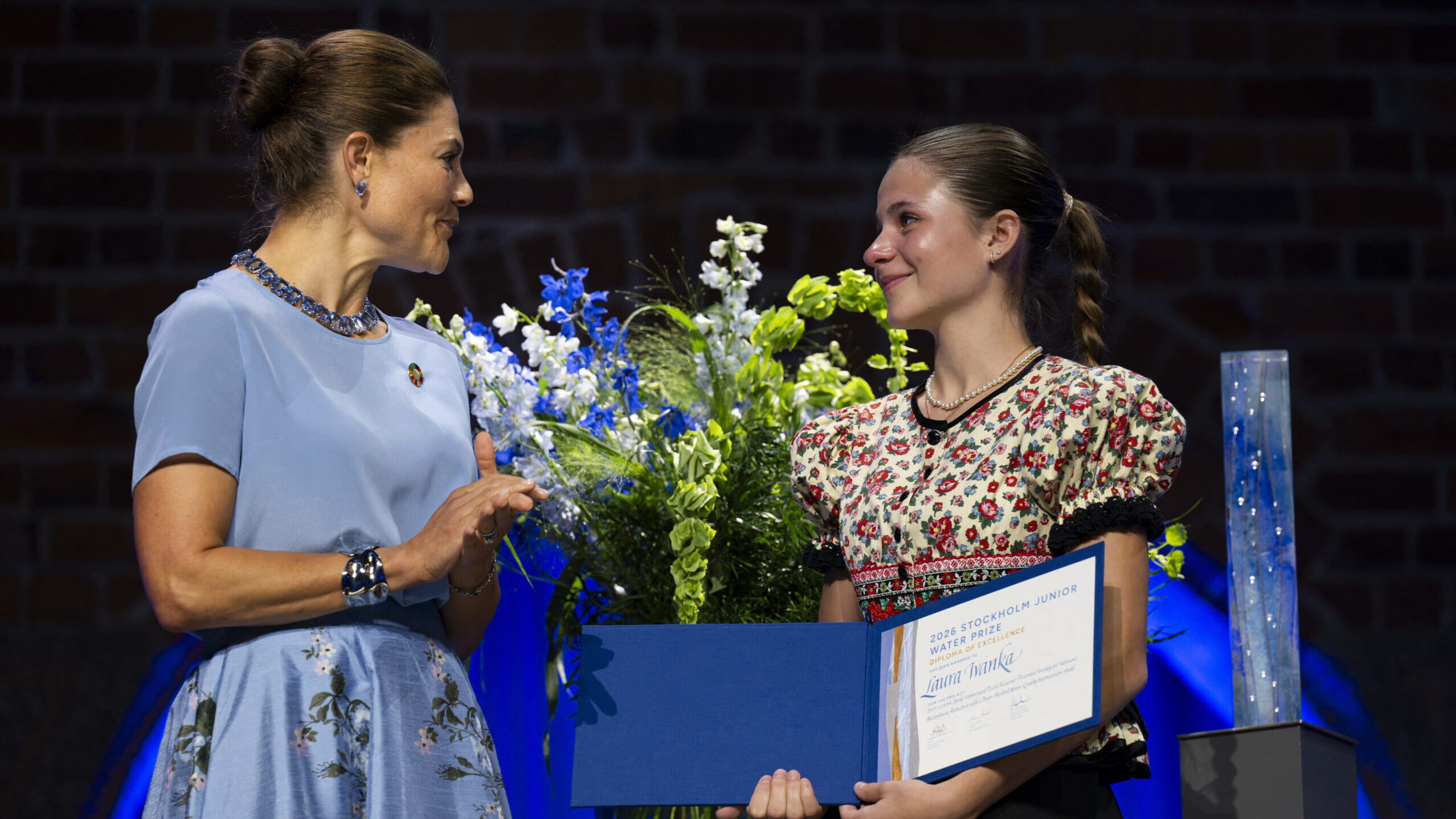
Fifteen-year-old Hungarian student Laura Ivánka has become the first Hungarian to receive an award at the international final of the Stockholm Junior Water Prize in the competition’s nearly three-decade-long history, earning the 2026 Diploma of Excellence for DIVE&CLEAN, an innovative system for removing plastic waste from the seabed before it breaks down into microplastics.
Ivánka received the award at Stockholm City Hall on 25 August during World Water Week, where Crown Princess Victoria of Sweden, the prize’s official patron, presented the awards. More than 40 national winners competed in this year’s final. The main Stockholm Junior Water Prize went to Canadian student Moroti Adegboyega, while Ivánka received the jury’s Diploma of Excellence.
The 15-year-old’s journey to Stockholm began years earlier, at the age of eight, when she first went scuba diving and became increasingly interested in marine biology and environmental science while spending time around the coast. During repeated family diving trips to Malta, she encountered rubbish accumulating on the seabed and began thinking about a simple problem: divers willing to pick up waste often have nowhere underwater to leave it.
‘Intervention during the first five years could prevent more than 96 per cent of long-term microplastic accumulation’
That idea developed into DIVE&CLEAN, a low-cost system of fixed collection bins placed along recreational diving routes. Divers can deposit submerged plastic during ordinary dives, allowing larger pieces to be removed before they fragment into persistent microplastics. Each installation could also function as a fixed sampling point for monitoring microplastic pollution.
The project has since developed into a combination of environmental science, engineering and behavioural research. Ivánka conducted international surveys, built and refined prototypes, carried out field tests in Malta and analyzed whether the seabed structures could withstand currents, waves, buoyancy and overturning forces.
Her model found that intervention during the first five years could prevent more than 96 per cent of long-term microplastic accumulation under the fragmentation scenarios she tested, compared with 76 per cent if action were delayed until year 20.
The Stockholm jury singled out her hands-on approach, including her work and engagement with potential users, repeated prototype development and testing, and efforts to pursue patent protection.
The historic prize caps an unusually broad scientific record for a 15-year-old. In 2025, Ivánka won Hungary’s National Scientific and Innovation Olympiad with DIVE&CLEAN and represented the country at the European Union Contest for Young Scientists. She also won a Fourth Award at the Taiwan International Science Fair.
In May 2026, she competed at the Regeneron International Science and Engineering Fair in Phoenix, one of the world’s largest pre-university science competitions. Her more engineering-focused project, A Coastal Underwater Seabed Waste Bin: Design, Development, and Stability Analysis, won a Fourth Award in Environmental Engineering.
‘Together with her younger sisters Lizanna and Leticia, Ivánka won the RoboCupJunior European title’
Ivánka is a tenth-grade student at the British International School Budapest, but science takes up only part of her crowded schedule. She has been scuba diving since childhood, competes as a junior windsurfer and is also involved in robotics, where she volunteers and mentors younger students. At school, she helps with visual design and the construction of sets for theatre productions.
Exceptional talent is not confined to Laura alone in her family. Together with her younger sisters Lizanna and Leticia, Ivánka won the RoboCupJunior European title in Bari in 2025 before later taking third place in the advanced category at RoboCup Asia-Pacific in Abu Dhabi and winning its SuperTeam competition.
The 15-year-old is considering studying environmental engineering or marine science at university and says she wants to continue tackling water-quality problems through an interdisciplinary combination of physics, technology and human behaviour.
Related articles:
At a time when public debate is increasingly polarized and superficial, Hungarian Conservative remains committed to depth, intellectual honesty, and independent conservative thought.
Producing high-quality journalism requires resources. Your contribution helps us expand our coverage, reach new audiences, and keep our content accessible.
Please consider supporting our mission.