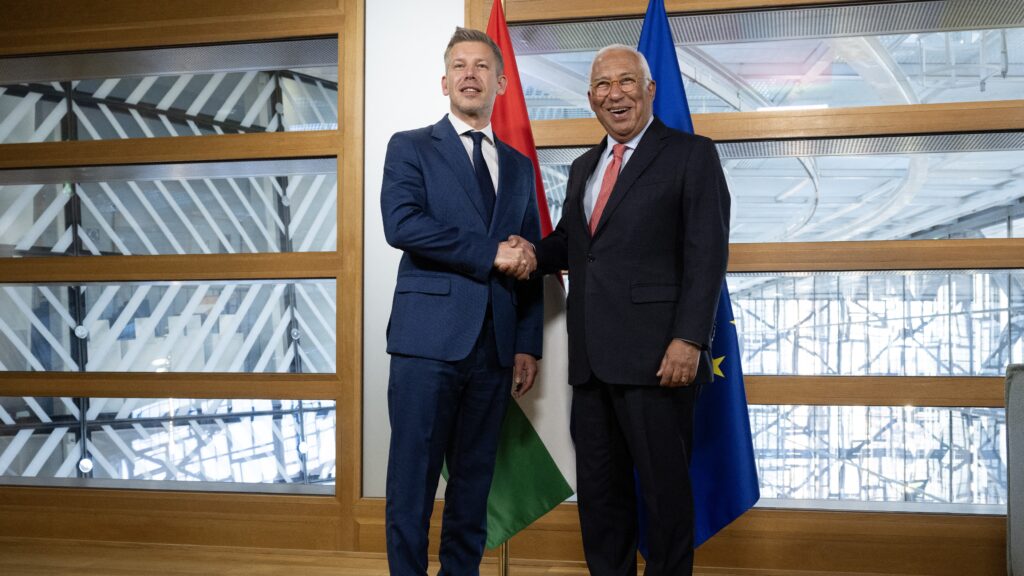
Hungarian President Tamás Sulyok has refused to step down by the 31 May deadline set by Prime Minister Péter Magyar and the Tisza Party government. According to earlier statements by Magyar, the governing supermajority in parliament is now expected to introduce legislation aimed at removing the president—an unprecedented move in Hungary’s post-communist history.
Magyar, in a social media post published on Sunday evening, stated that he and Justice Minister Márta Görög would meet Sulyok on Monday morning to discuss the next steps. ‘Tamás Sulyok has never stood up for the vulnerable, for those under attack, or for the rule of law,’ Magyar concluded, reaffirming Tisza’s central argument for why the president should have resigned.
The conflict between the two has steadily escalated since Tisza’s landslide victory on 12 April, which ended the 16-year rule of Viktor Orbán and Fidesz–KDNP. The new government argues that the Hungarian people gave it a historic mandate to dismantle the patronage network of the Orbán era, including replacing public officials appointed by previous governments, as part of a broader ‘regime change’ in Hungary.
President Sulyok, however, maintains that constitutional offices derive their legitimacy from the Fundamental Law rather than shifting political majorities and, therefore, cannot be removed on political grounds. The 31 May deadline was given not only to the president, but also to the heads of other key institutions, including the Constitutional Court. However, Sulyok became the central figure of this pressure campaign.
Since the election, Magyar has repeatedly called on Sulyok to resign. During the inaugural session of the new Hungarian parliament on 9 May, the prime minister publicly demanded that the president step down while sitting only metres away in the chamber, facing him directly.
Sulyok has consistently rejected those demands, arguing that there is ‘no legal or constitutional reason’ for his resignation and that his oath obliges him to defend Hungary’s constitutional order regardless of changes in government.
The confrontation escalated further on Friday, 29 May, when the president formally requested the opinion of the Venice Commission, the Council of Europe’s constitutional advisory body. In a statement issued by the Sándor Palace, Sulyok described the situation as a ‘deeply contradictory constitutional conflict’ and argued that demands for the removal of a sitting head of state on political grounds are difficult to reconcile with the Fundamental Law.
The dispute also revolves around how exactly the government intends to remove the president.
Under Hungary’s current constitutional framework, a sitting president can only be removed through a special procedure initiated by parliament but ultimately decided by the Constitutional Court. The court must determine whether the president intentionally violated the Fundamental Law, another law, or committed a deliberate criminal offence. Only then can the head of state be stripped of office.
However, Magyar has repeatedly suggested a different path. Since the election, the prime minister has argued that Tisza’s constitutional supermajority gives parliament the authority to amend the Fundamental Law itself in order to introduce legislative changes necessary to remove Sulyok.
While the government has not yet presented detailed proposals, legal experts have speculated that such a strategy could involve constitutional amendments affecting the presidency itself, prompting criticism of potential person-specific legislation.
In a statement issued on the day of the deadline, Fidesz declared its support for the president, accusing Magyar of conducting an unconstitutional campaign against the head of state.
‘Fidesz stands by the president of the republic, who is being attacked unconstitutionally by Péter Magyar,’ the party stated. It further accused the prime minister of ‘continuing down the path of dictatorship and unlawful ultimatums’.
‘Fidesz stands by the president of the republic’
Rejecting Magyar's deadline altogether, Fidesz argued that ‘in Hungary’s constitutional order, the term of office of public officials is not determined by Péter Magyar’s arbitrary will’, adding that ‘there is therefore no deadline, and consequently nothing can expire’.
The party also described Magyar’s planned visit to the Sándor Palace on Monday morning as ‘another act of open blackmail’.
With the deadline now expired and Sulyok showing no sign of resigning voluntarily, attention is increasingly turning to how exactly the government intends to remove him. Whether Tisza pursues the existing constitutional removal mechanism or attempts to use its parliamentary supermajority to redesign the framework governing the presidency, Hungary appears to be heading towards one of the most consequential constitutional confrontations of its post-communist era.
The parliamentary group of Tisza already initiated its first constitutional amendment proposals last week, including the introduction of an eight-year term limit for the office of prime minister, applied retroactively to 1990, which would make it impossible for Viktor Orbán to return to power in the future.
Related articles:
At a time when public debate is increasingly polarized and superficial, Hungarian Conservative remains committed to depth, intellectual honesty, and independent conservative thought.
Producing high-quality journalism requires resources. Your contribution helps us expand our coverage, reach new audiences, and keep our content accessible.

Please consider supporting our mission.