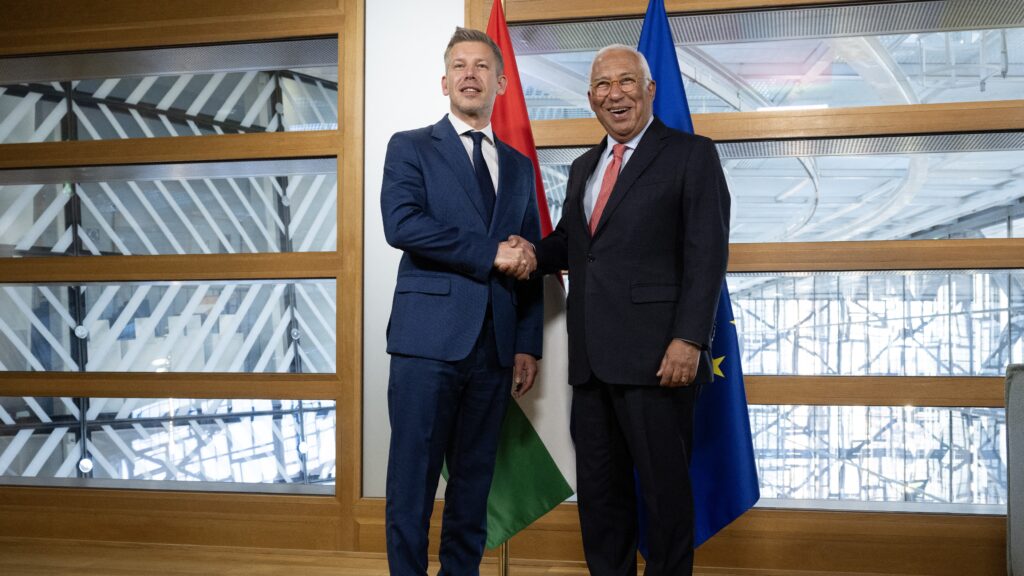
Hungarian President Tamás Sulyok received the leaders of the parties elected to the new parliament in Sunday’s vote on Wednesday, 15 April, including prime minister-elect Péter Magyar, outgoing prime minister Viktor Orbán, and leader of the hard right Mi Hazánk (Our Homeland) László Toroczkai. The president tasked Magyar with forming the country’s next government, as the Tisza Party won the largest share of the vote, securing a supermajority.
Speaking to journalists after meeting Sulyok, Péter Magyar said that, referring to his talks with the president, the inaugural sitting of the new parliament could take place as early as 4 May, though a more realistic timeframe would be between 6 and 7 May. He added that both sides agreed on the need to convene the session at the earliest possible date, arguing that the scale of the electoral mandate requires a swift government transition.
Consultations between parliamentary parties—Tisza Party, Fidesz–KDNP, and Our Homeland—on committee structures and the inaugural session are set to begin as early as Friday.
I have arrived at the Sándor Palace to meet the President of Hungary.@DrTamasSulyok is unworthy of representing the unity of the Hungarian nation. He is unfit to serve as the guardian of legality. He is not fit to serve as a moral authority or a role model.
— Magyar Péter (Ne féljetek) (@magyarpeterMP) April 15, 2026
Following the… pic.twitter.com/aBChLJrv7K
Framing his mandate as the voters’ desire for a ‘fundamental political reset’, Magyar called on President Sulyok to resign, describing him as ‘unfit’ and ‘unworthy’ to embody national unity or oversee the rule of law. The prime minister-elect said he had raised these concerns directly during their meeting, citing what he described as the president’s failure to speak out on key issues, including the protection of vulnerable groups and the functioning of democratic institutions.
Sulyok was elected by parliament in March 2024, following the resignation of former President Katalin Novák after the so-called pardon scandal, which ultimately contributed to the emergence of Péter Magyar and the Tisza Party. Sulyok was the candidate of the governing Fidesz–KDNP alliance—and the only candidate running for the office—elected with 134 votes in favour and five against, as most traditional opposition parties abstained from the vote. His mandate lasts until 2029.
Magyar said that, should Sulyok remain in office, the incoming parliamentary supermajority would use its mandate to remove him, along with several senior officeholders appointed under Viktor Orbán’s government, including the chief prosecutor and the head of the Constitutional Court.
Sulyok reportedly responded cautiously to the call for his resignation, saying he would consider the arguments in light of maintaining Hungary’s legal order and international reputation. Speaking to Partizán, former communications director of Sulyok, Georgina Szántó, said that Sulyok will not resign voluntarily, claiming that the president is ‘out of touch with reality’ and ‘doesn’t grasp what’s happening around him and in the country’.
One of the Tisza Party’s key constitutional proposals is the introduction of direct presidential elections, under which the president of the republic would be elected by voters rather than by parliament, thereby granting greater legitimacy and potentially expanded powers to the position. Magyar argued that the Hungarian head of state holds excessively weak powers by European standards, and that the reform would aim to strengthen checks and balances, ensuring that the executive branch cannot fully dominate the institution.
The removal of Hungary’s president is formally constrained by strict constitutional rules, requiring a two-thirds parliamentary vote to initiate proceedings and a final decision by the Constitutional Court, making it impossible to dismiss the head of state purely on political grounds.
‘The removal of Hungary’s president is formally constrained by strict constitutional rules’
However, alternative legal and political pathways exist, including constitutional amendments by a two-thirds majority, which could reshape the president’s mandate or institutional role, or sustained political pressure aimed at forcing a resignation—as in the case of President Novák.
However, these solutions have been the subject of serious criticism: politically ‘tailored’ amendments to the constitution may constitute a violation of the rule of law, the restoration of which is the stated goal of the incoming government, while resignations under political pressure carry the risk of undermining formal legal guarantees.
Related articles:
At a time when public debate is increasingly polarized and superficial, Hungarian Conservative remains committed to depth, intellectual honesty, and independent conservative thought.
Producing high-quality journalism requires resources. Your contribution helps us expand our coverage, reach new audiences, and keep our content accessible.

Please consider supporting our mission.