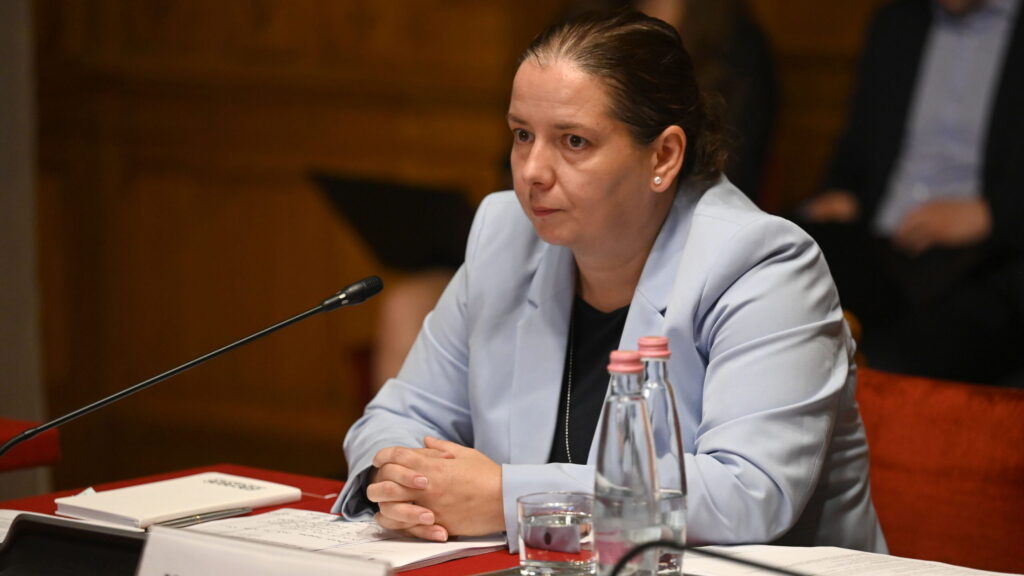
Hungarian President Tamás Sulyok has formally asked the Venice Commission to assess the constitutional conflict surrounding his office after months of mounting political pressure from Prime Minister Péter Magyar and the governing Tisza Party demanding his resignation.
In a statement released by the Sándor Palace on Friday, Sulyok announced that he had requested the involvement of the Council of Europe’s constitutional advisory body, officially known as the European Commission for Democracy through Law, to evaluate what he described as a ‘deeply contradictory constitutional situation’ affecting the presidency.
The move marks another escalation in the increasingly open public confrontation between the head of state and Hungary’s new government.
Since Tisza’s landslide victory in the 12 April parliamentary election, Magyar has repeatedly called on Sulyok to resign, arguing that senior public officials associated with the Orbán era should leave office. The pressure campaign has steadily intensified in recent weeks, with the prime minister raising the issue in speeches, public statements, and interviews alike.
The most memorable intervention came during the inaugural session of Hungary’s new parliament on 9 May. After taking his oath, Magyar used his first major address to publicly demand Sulyok’s resignation while the president was sitting only metres away.
‘Tamás Sulyok should be the first to do so,’ Magyar declared while calling on senior public officials linked to the previous government to step down. He further warned that if the president failed to resign voluntarily by 31 May, parliament could begin impeachment proceedings against him. Such a move would be unprecedented in modern Hungarian history.
During the remarks, Sulyok was seen smiling and nodding rather than responding directly—which he could not do in any case, as no response from the president had been scheduled on the session’s agenda.
The prime minister has repeatedly argued that the presidency became too closely associated with the previous Fidesz–KDNP administration and has called for a broader renewal of Hungary’s constitutional institutions.
Sulyok, however, has consistently rejected those demands. In recent interviews, he stated that there was ‘no legal or constitutional reason’ for his resignation and emphasized that his oath bound him to defend Hungary’s constitutional order regardless of changes in political majorities.
Friday’s statement suggests that the president believes the dispute has moved beyond ordinary political disagreement. According to the Sándor Palace, calls for the removal of the head of state on political grounds are constitutionally unintelligible under the Fundamental Law and have created a situation that harms both the functioning and authority of the presidential institution.
‘The president believes the dispute has moved beyond ordinary political disagreement’
The statement also directly addressed tensions surrounding the release of frozen EU funds. The presidency noted that Magyar had publicly expressed concern that Sulyok could exercise constitutional oversight over legislation required to unlock billions of euros in EU financing, potentially slowing the process.
The president rejected any suggestion that constitutional review should be treated as an obstacle to governance, arguing that constitutional and EU values must remain guiding standards rather than inconveniences to be bypassed.
Magyar responded mockingly under Sulyok’s announcement on Facebook. ‘Interesting. When we spoke privately, he understood quite well. He even asked which minister he should submit his resignation to,’ the prime minister wrote. In a sarcastic remark aimed at the president’s record, Magyar added: ‘He has already done so much to bring home EU funds…and for the protection of neglected and ruined children.’
At the time of writing, Magyar is in Brussels negotiating a deal on frozen EU funding with European Commission President Ursula von der Leyen.
The Venice Commission, based in Strasbourg and composed of constitutional law experts from across Europe, provides legal opinions on constitutional and rule-of-law disputes within member states. While its recommendations are not legally binding, they often carry significant political weight within European institutions.
Related articles:
At a time when public debate is increasingly polarized and superficial, Hungarian Conservative remains committed to depth, intellectual honesty, and independent conservative thought.
Producing high-quality journalism requires resources. Your contribution helps us expand our coverage, reach new audiences, and keep our content accessible.

Please consider supporting our mission.