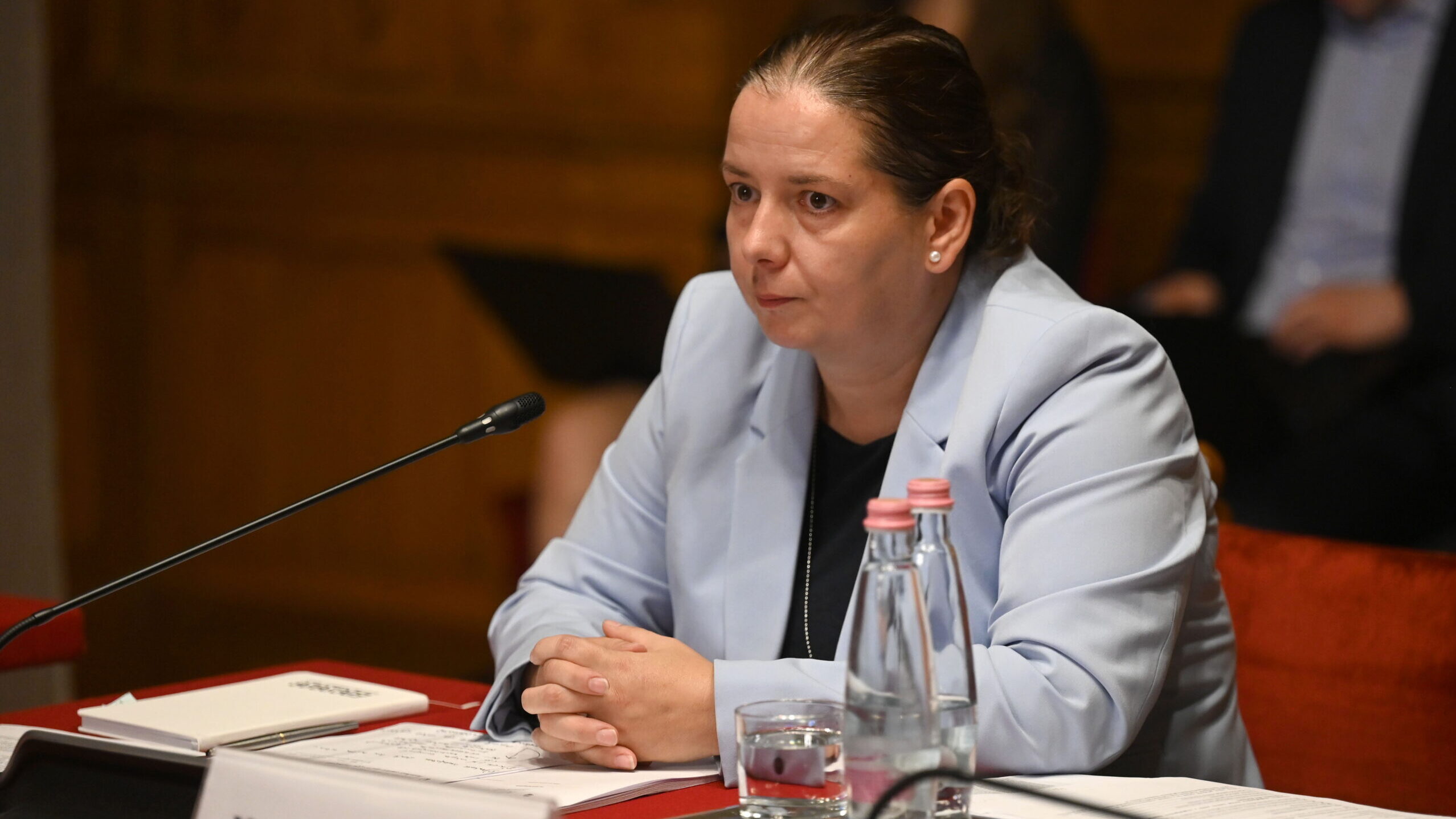
Hungary’s Justice and Constitutional Affairs Committee on Thursday nominated political scientist Anna Róza Unger to become the first president of the National Asset Recovery and Protection Office (NVVH), selecting the candidate who advocated the broadest post-Orbán accountability programme despite having the least direct professional experience in investigation, prosecution or asset recovery among the three finalists.
The 12-member committee backed Unger by six votes to one, with one abstention. Fidesz’s three members boycotted the process and Our Homeland’s István Apáti was absent, meaning all eight votes cast came from Tisza MPs. Transparency International Hungary legal director Miklós Ligeti received four votes and four abstentions, while international risk and asset-recovery specialist Nicholas Sárvári received three votes and five abstentions.
The sole vote against Unger came from committee vice-chair Márton Melléthei-Barna, one of Prime Minister Péter Magyar’s closest legal allies and his brother-in-law. Magyar named him as prospective justice minister on 30 April, but Melléthei-Barna withdrew on 7 May, arguing that their family and personal relationship could weaken public consensus around restoring the rule of law. Tisza MP Orsolya Miskolczi cast the only abstention.
Systemic Vision over Operational Experience
Unger’s Tuesday hearing made clear that she sees the NVVH as more than a conventional anti-corruption authority. She argued that Hungary had not merely suffered individual corruption cases but a system in which political power subordinated economic actors and institutions, while accumulated wealth could preserve or rebuild political influence. Democratic consolidation, she said, was impossible without accountability.
Her proposed mission is systemic: reconstruct how the Orbán-era network operated, identify not only direct perpetrators and beneficiaries but also officials and institutional actors who enabled it, and publicly explain how the system functioned. ‘The actors must be named—those who did it and those who let it happen,’ she said, citing prosecutors and central-bank officials who may have failed to act. Six years, she added, would not realistically produce final judgments in every case but should be enough to map the system and launch proceedings.
‘Six years…would not realistically produce final judgments in every case but should be enough to map the system and launch proceedings’
Professionally, however, Unger is the least directly experienced of the three finalists in the agency’s core enforcement functions. An ELTE associate professor with a doctorate in political science, her career has centred on elections, democracy, autocratization and political transition. In contrast, Ligeti previously worked at the National Institute of Criminology and in the justice and interior ministries before becoming Transparency International Hungary’s legal director, while Sárvári has more than two decades of experience in corporate investigations, fraud, crisis management and international asset tracing.
The disparity is possible because the statutory eligibility rules are broad. Candidates may come from law, economics, state science, political science, public administration or other social-science backgrounds, subject to experience requirements; prior work as a prosecutor, criminal investigator or asset-recovery specialist is not required. Applicants were initially assessed through anonymized CVs and a concept paper limited to two pages.
Committee member and Deputy Speaker Hallerné Nagy Anikó defended the choice. She said Unger was exceptionally determined, had a strong sense of mission and clearly understood the organization she would have to build. Asked whether her lack of a law degree was a weakness for an authority with investigative and prosecutorial powers, Hallerné said specialist deputies would provide the professional expertise while Unger maintained the overall direction.
That defence came as the deputy-selection process produced an incomplete leadership team. Of the NVVH’s four vice-presidential posts, only the investigative portfolio produced a nominee, Katalin Tasnádi. The prosecutorial and appeals competitions had already been declared unsuccessful on Monday because too few candidates remained, while the public-finance deputy procedure met a similar end on Thursday. Hallerné rejected describing the outcome as a failure, calling it ‘responsible to leave posts open’ rather than force appointments. Committee chairman István Hantosi said the three contests would be relaunched soon. According to the NVVH Act, parliament must elect deputy presidents within 30 days of the law entering into force, a deadline that expires on Friday.
Tisza Intellectuals Divided over Unger
Unger’s record also complicates a purely partisan reading of her nomination. In December 2024, she was one of the official opponents of Balázs Orbán’s doctoral dissertation at ELTE during a politically charged defence that became a national media story. Although Unger distanced herself from Orbán’s political views, she concluded that his academic work met the required scholarly standards and defended the examination committee when critics suggested political pressure had influenced the process. She insisted academic assessment had to remain independent of ideology and party politics, providing a positive indication regarding her impartiality.
She has nevertheless had a long professional relationship with Bálint Ruff, now minister heading the Prime Minister’s Office and deputy prime minister. Ruff and Unger worked in the same political-analysis media milieu for years, including Szabad Európa’s Elemző team.
The nomination has divided analysts and parts of Tisza’s sympathetic intellectual milieu. Political analyst Gábor Török described Unger as a theoretical specialist far removed from the practical world of the field, contrasting her with Ligeti, whom he called Hungary’s best-known specialist in the area, and Sárvári’s corporate investigative background. Török said the appointment would signal what role the governing majority intends the NVVH to play.
‘The nomination has divided analysts and parts of Tisza’s sympathetic intellectual milieu’
A 444 commentary likewise noted that Tisza-supporting intellectuals clearly preferred Ligeti and viewed the choice as another integrity test, while also praising Unger’s forceful political diagnosis. Péter Uj argued that if the task were simply recovering money, he would turn to Sárvári. The committee instead chose the candidate offering the strongest theory of systemic accountability rather than the strongest conventional enforcement résumé.
Tisza supporters were equally divided. Many had openly backed Ligeti before the vote and questioned why the committee chose a political scientist with little direct investigative or asset-recovery experience over Hungary’s best-known anti-corruption lawyer. Others said Unger’s hearing changed their minds, praising her as the most forceful and determined candidate and arguing that the NVVH needed a ‘steamroller’ capable of maintaining political and institutional pressure.
Parliament is expected to vote by secret ballot on Unger and Tasnádi on Friday. If they secure the required two-thirds majority, which Tisza comfortably provides with 141 MPs, both can begin six-year mandates on 1 September, while three deputy posts remain unfilled.
Related articles:
At a time when public debate is increasingly polarized and superficial, Hungarian Conservative remains committed to depth, intellectual honesty, and independent conservative thought.
Producing high-quality journalism requires resources. Your contribution helps us expand our coverage, reach new audiences, and keep our content accessible.

Please consider supporting our mission.