Former Hungarian Minister of Foreign Affairs and Trade Péter Szijjártó is facing increased scrutiny following developments in recent days regarding his close ties to Russia and China while in office.
Prime Minister Péter Magyar, responding to a journalist’s question on Thursday, 16 July, confirmed that an investigation had begun into Szijjártó’s relations with Russia, escalating a scandal over allegations that Hungary’s former chief diplomat fed sensitive information to Moscow.
‘There are classified documents, there are Foreign Ministry documents and other kinds of documents. When there is something to tell the public, we will do so,’ Magyar said during a government briefing. Stating that he wanted to avoid ‘prejudging the case’, Magyar did not disclose further details regarding the probe.
The so-called ‘Russiagate’ scandal erupted in March, during the final phase of Hungary’s high-stakes election campaign. The first report came from The Washington Post, which, citing unnamed European intelligence sources, alleged that Szijjártó repeatedly telephoned Russian Foreign Minister Sergey Lavrov around closed EU foreign ministers’ meetings, relaying near-live accounts of discussions among member states.
Days before the 12 April vote, an investigative consortium published calls recorded between 2023 and 2025. In one, Szijjártó promised Hungary and Slovakia would ‘do our best’ to remove sanctioned oligarch Alisher Usmanov’s sister from the EU sanctions list; others indicated sanctions coordination with Russian Deputy Energy Minister Pavel Sorokin. Szijjártó also allegedly briefed Lavrov on Ukraine’s accession talks and Orbán’s meeting with Volodymyr Zelenskyy, helped arrange Orbán’s Moscow visit, and offered to send Lavrov a non-confidential EU document through Hungary’s embassy.
The leaks sparked significant outrage across Europe. The European Commission demanded an explanation, Polish Prime Minister Donald Tusk called the relationship ‘repulsive’, while Ireland’s Micheál Martin described its tone as ‘sinister’. Orbán’s government instead focused on who had intercepted Szijjártó’s calls, launching an espionage investigation into journalist Szabolcs Panyi, which was later dropped after the change of government.
Szijjártó initially dismissed parts of the reporting as ‘fake news’, then acknowledged consulting Lavrov before and after EU meetings. Speaking with Russia, the US, Türkiye, and Israel was normal diplomatic practice, he argued.
The scandal strengthened the campaign message of Péter Magyar and the Tisza Party, which already framed the election as a choice between Hungary’s future orientation towards Russia or the European Union. The allegations, which remained largely without substantial explanation, increasingly portrayed Szijjártó as uncomfortably close to Russia.
Abuse of Office, Espionage or Treason?
What charges could be brought against the former foreign minister, if any, however, remains a separate question. A potential criminal case would most likely focus not on the contact itself, but rather on what Szijjártó disclosed, why he disclosed it, and whether he was effectively collecting information for Moscow.
Hungary’s Criminal Code presents several possible offences. The most immediate is Section 265, which criminalizes making classified information available to an unauthorized recipient. In that case, investigators would have to identify the specific material and establish its formal classification, since politically sensitive or closed-door discussions are not classified by definition.
More serious questions arise under Section 261/A, which applies Hungary’s espionage provisions to intelligence activity conducted for a non-EU country against the European Parliament, Commission, or Council. Former intelligence official András Telkes argued that a systematic pattern of gathering and transmitting EU information could bring that provision into play.
Section 261 would instead require intelligence activity directed against Hungary, while abuse of office under Section 305 would depend on proving that Szijjártó deliberately misused his authority to secure an unlawful advantage or cause unlawful harm.
After the scandal broke in March, Magyar straightforwardly accused Szijjártó of ‘treason’, which invokes an even higher threshold. Sections 258–259 require conduct intended to violate—or endanger—Hungary’s independence, territorial integrity, or constitutional order. Basic treason carries five to 15 years’ imprisonment, rising to ten to 20 years or life in aggravated cases, including where public office is used.
The Revolving Doors of BYD
An unexpected decision has further intensified scrutiny of Szijjártó. On Wednesday, 15 July, he submitted his parliamentary resignation and joined Chinese EV manufacturer BYD as global head of external relations and new business development. He described the appointment as a ‘highly prestigious offer’ from a defining company of the global economy.
As foreign minister, Szijjártó became the chief political salesman for Orbán’s ‘Eastern Opening’, helping turn Hungary into a leading European destination for Chinese battery and electric-vehicle investment while opposing EU tariffs on Chinese-made cars. His signature achievement was securing BYD’s first European passenger-car factory in Szeged after what he said were 224 rounds of negotiations; production is scheduled to begin in late 2026. He also promoted the company’s European headquarters and research centre in Budapest and the expansion of its electric-bus and truck operations in Komárom.
The officially disclosed grants include HUF 20 billion for the Budapest project and HUF 3.1 billion for Komárom, while the direct subsidy for Szeged remains undisclosed. Hungarian reporting places the wider public contribution—including infrastructure and related development—at roughly HUF 300 billion, although that estimate should not be confused with a direct payment to BYD.
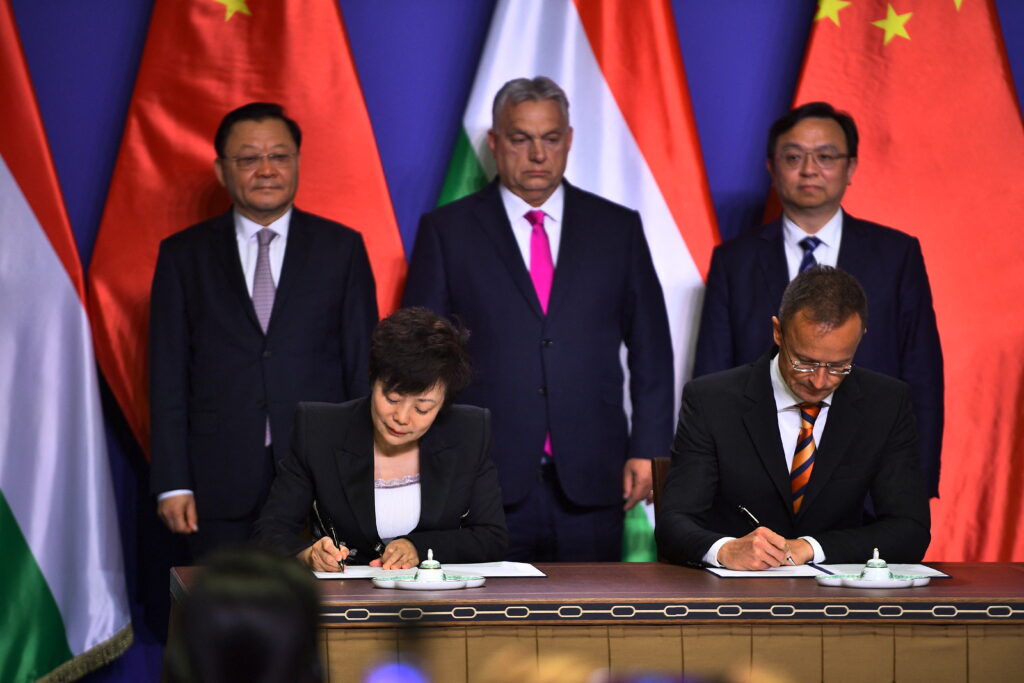
The announcement immediately sparked backlash among government officials and supporters alike, with Prime Minister Magyar accusing Szijjártó of representing foreign interests and saying that the BYD move raised ‘corruption suspicions’. Foreign Minister Anita Orbán called the speed of the appointment extraordinary: ‘This does not normally happen so quickly.’ Magyar said his government was considering tighter revolving-door rules, although no cooling-off legislation has yet been announced.
Both Magyar and Anita Orbán described the move as ‘unprecedented’ in Europe. However, there are several similar revolving-door cases across the continent. Gerhard Schröder did not even wait a month after leaving the German chancellorship before becoming chairman of the shareholders’ committee of the North European Gas Pipeline Company, later Nord Stream AG. Similarly, former Austrian foreign minister Karin Kneissl joined the board of Russia’s state-controlled oil company Rosneft two years after leaving office, while former French prime minister François Fillon joined the boards of state-owned Russian oil company Zarubezhneft and petrochemical producer Sibur in 2021, nine years after leaving office.
The European Commission’s Rule of Law Report, published on 17 July, ironically calls for reforms on lobbying and revolving doors in Hungary. Prepared before Szijjártó joined BYD, it nevertheless provides a near-perfect illustration of the regulatory gap.
Reacting to the backlash, BYD Hungary said Szijjártó’s role was international and outside the management of its Hungarian subsidiary. Neither side has disclosed when negotiations began, his reporting line, or any conflict-of-interest safeguards. In an official statement, communications director Bertalan Havasi said Viktor Orbán had discussed the decision with Szijjártó twice and supported it. Fidesz likewise welcomed Szijjártó’s decision.
Related articles:
At a time when public debate is increasingly polarized and superficial, Hungarian Conservative remains committed to depth, intellectual honesty, and independent conservative thought.
Producing high-quality journalism requires resources. Your contribution helps us expand our coverage, reach new audiences, and keep our content accessible.

Please consider supporting our mission.