The following is an adapted version of an article written by Lázár Pap, originally published in Hungarian in Magyar Krónika.
The monarch, who also gained the Polish throne, was considered one of the leading powers in Europe.
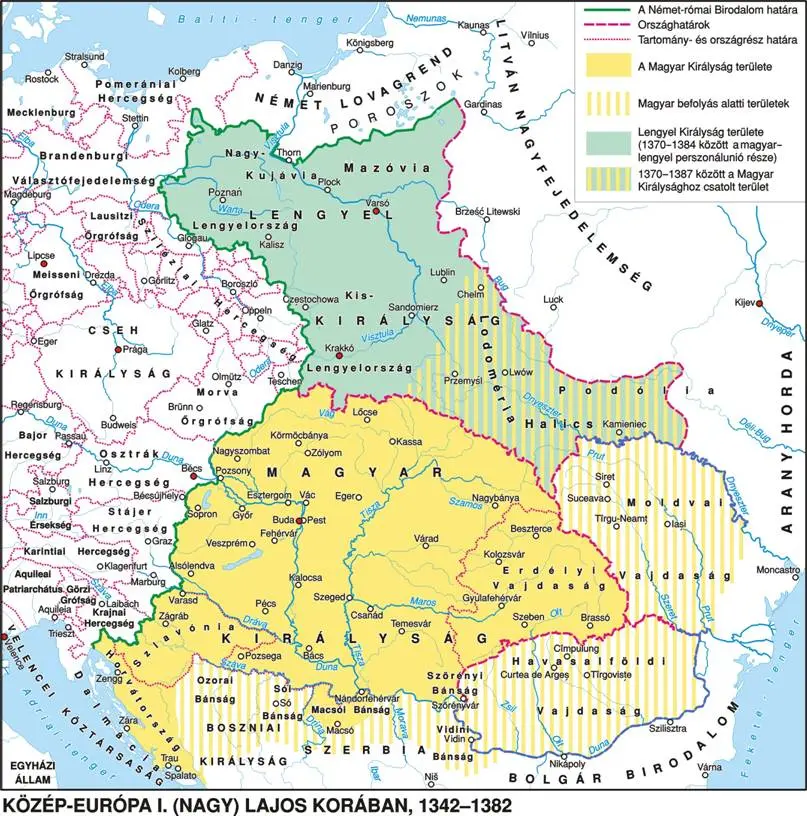
700 years ago, in 1326, King Louis the Great was born, and, according to legend, during his reign, three seas washed Hungary’s shores. This is not true in several respects—although Louis did gain the Polish throne, he did not annex the country to the Kingdom of Hungary, and the Poles did not have access to the Baltic Sea at the time.
Nevertheless, Louis created a unique and lasting imperial model, which accompanied the history of Central Europe until the end of the First World War. However, staying with the Middle Ages, it is not an exaggeration to say that the confederation of states created by Louis was considered a great power.
Little Ice Age and Plague
Historian Gergely Buzás explained to Magyar Krónika that from roughly the 12th century onwards, Paris was considered the centre of Europe. The largest population was concentrated there, and the French king had the largest income of any European monarch.
Only the English kings could compete with them—and they did: they were constantly at war, and sometimes the English and sometimes the French were able to tear off larger areas from the territory of present-day France. Both thrones were basically occupied by kings of French origin; the Plantagenet House, for example, grew out of the Anjou Dynasty.
In the 13th century, however, the French gained more dominance and gradually pushed the English out of the continent. Overall, these two kingdoms—especially Paris and its surroundings—were considered the political, economic, and cultural centre of Europe.
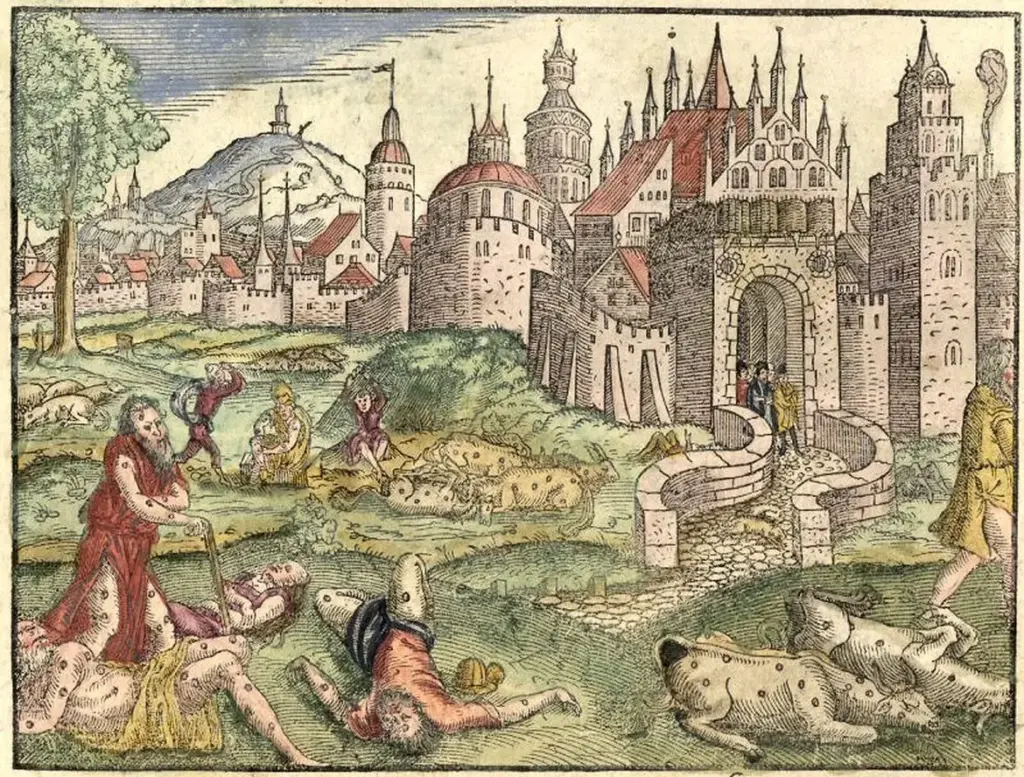
However, in the 14th century, a climatic change began, which we call the medieval Little Ice Age. This cooling period primarily affected the overpopulated regions of Western Europe compared to the conditions of the time, and the poorer quality arable land, which was still cultivated due to the high population density, was ruined. Famines broke out, and thanks to this, the plague appeared on the continent. The epidemic that broke out in 1347 caused enormous destruction; historians estimate that up to half of the population may have died. In the meantime, the Hundred Years’ War also broke out between the English and the French, which exhausted the resources of the two great powers for a long time.
‘The epidemic that broke out in 1347 caused enormous destruction’
Central Europe remained largely free from these problems: the population density was lower, so the plague was less destructive, and a relatively peaceful political system was established. The Visegrád Congress played an important role in this, contributing to the settlement of relations between Poland, the Czech Republic, Hungary, and the Teutonic Knights. As a result, wars in the following century took the form of smaller, local conflicts. For example, there was a Hungarian–Czech war that lasted only a week or two and resulted in fewer casualties than a pub fight, as the expert put it.
As a result of these factors, the cultural and economic centres of Europe were located in Central Europe by the mid-14th century. The following rulers are worth highlighting from this period: Bohemian King and Holy Roman Emperor Charles IV, thanks to whom the centre of the empire moved from the Rhineland to Prague. Władysław the Łokietek—a contemporary and brother-in-law of the Hungarian King Charles I, who united Poland, which was still fragmented and consisted of smaller local duchies in the early 14th century. The kingdom became a prosperous and wealthy state under the reign of his successor, Casimir III. In the history of the Kingdom of Hungary, Charles I stabilized the disintegrating royal power and boosted gold mining, thanks to which the country became extremely strong by the time of Louis the Great.
Imperial Ambitions
Of the listed rulers, Louis the Great proved to be the most successful, who was able to pursue an active foreign policy thanks to his huge income from the gold mines, the historian highlighted. The Árpád kings—starting with Coloman of Hungary—tried to acquire neighbouring territories and create vassal states from them. Of these, Coloman’s conquest of Croatia was considered the largest, but even contemporary Croatia only comprised a few Hungarian counties. Overall, they sought to correct the borders.
Louis was the first to think about creating a state union. This policy was initiated by his father, Charles I, when he devised a plan for one of his sons to be king of Naples, the other of Poland, and the third of Hungary. He wanted to create a dynastic state union, but only Louis managed to achieve this in the end.
In Naples, he initially seemed to be successful, but it later became clear that his rule, despite his military successes, was unsustainable. He could not maintain power so far from Hungary. Louis behaved as a Hungarian king throughout: although he had acquired other thrones, he considered them secondary acquisitions. In the case of Naples, he finally resorted to a different method: he sent Charles of Durazzo in his own name with a Hungarian army, who eventually conquered Naples, and a dynastic alliance was established, albeit not for long.
‘Louis behaved as a Hungarian king throughout: although he had acquired other thrones, he considered them secondary acquisitions’
Louis’s greatest success was perhaps his acquisition of the Polish throne. He owed this to his father, who had agreed with Casimir III that if the Polish ruler died without a male heir, his son would inherit the royal title.
Louis created a state union between the two countries; he did not unite them, and he left the structure of Poland intact. He sent his mother as regent, and an effective dynastic union was established between the two countries. Thanks to the common ruler, the two states did not compete but supported each other militarily and economically. A new kind of power structure was born.
Louis also expanded towards the Balkans, but he did not conquer there in the literal sense; he created vassal states. He married the daughter of the Bosnian king, made the Romanian principality a vassal, and organized border banovinas from Bulgarian and Serbian territories.
Overall, he created a monumental Central European confederation of states—comparable in size to the Holy Roman Empire of Charles IV. While the emperor at the head of the latter was less and less able to interfere in the affairs of the empire, Louis, as the sole ruler, kept his own system in control more effectively. In terms of its political weight, his ‘empire’ competed with France and England, Gergely Buzás emphasized.
An Enduring Model
This model worked so well that after Louis’ reign, Hungarian kings tried to follow his example. Although Sigismund of Luxembourg maintained bad relations with the Poles throughout his reign, he succeeded in gaining the Czech throne. After 1410, he also acquired the German royal title, thus creating a Czech–Hungarian–German state union. Sigismund also tied the Habsburgs to himself through marriage ties, so after his death, Albert of Habsburg inherited the Hungarian, German, and Czech thrones.
After that, Władysław I, King of Poland and Grand Duke of Lithuania, gained the Hungarian throne. King Matthias also set similar goals, but as a ‘homo novus’, he had to rely on his conquests, and although he was only partially successful, his aspirations pointed in a similar direction.
The Jagiellonians later re-established the Czech–Hungarian personal union, in cooperation with the Habsburgs and the Polish–Lithuanian Jagiellonians. In the end, however, the Habsburgs were able to operate this model most stably: the Austrian–Czech–German–Hungarian state union—supplemented by Polish territories—survived until the end of the First World War. Louis is therefore credited with the political recognition and structure that proved to be one of the most stable and functional arrangements in Central Europe.
Finally, Gergely Buzás highlighted that Hungary was the centre of this system throughout the Middle Ages. Sigismund of Luxembourg also ruled from here, and when Albert of Habsburg became King of Hungary, he moved his seat here from Vienna as well. Władysław Jagiello also moved to Buda, so the central role of the Kingdom of Hungary remained unquestioned until 1526, the fall of the medieval Hungarian kingdom. Only after this did Vienna become the centre of the empire.
Related articles:
Click here to read the original article.
At a time when public debate is increasingly polarized and superficial, Hungarian Conservative remains committed to depth, intellectual honesty, and independent conservative thought.
Producing high-quality journalism requires resources. Your contribution helps us expand our coverage, reach new audiences, and keep our content accessible.

Please consider supporting our mission.