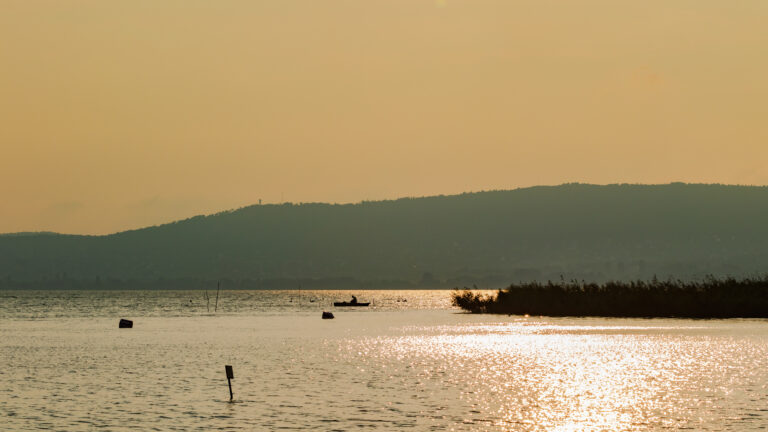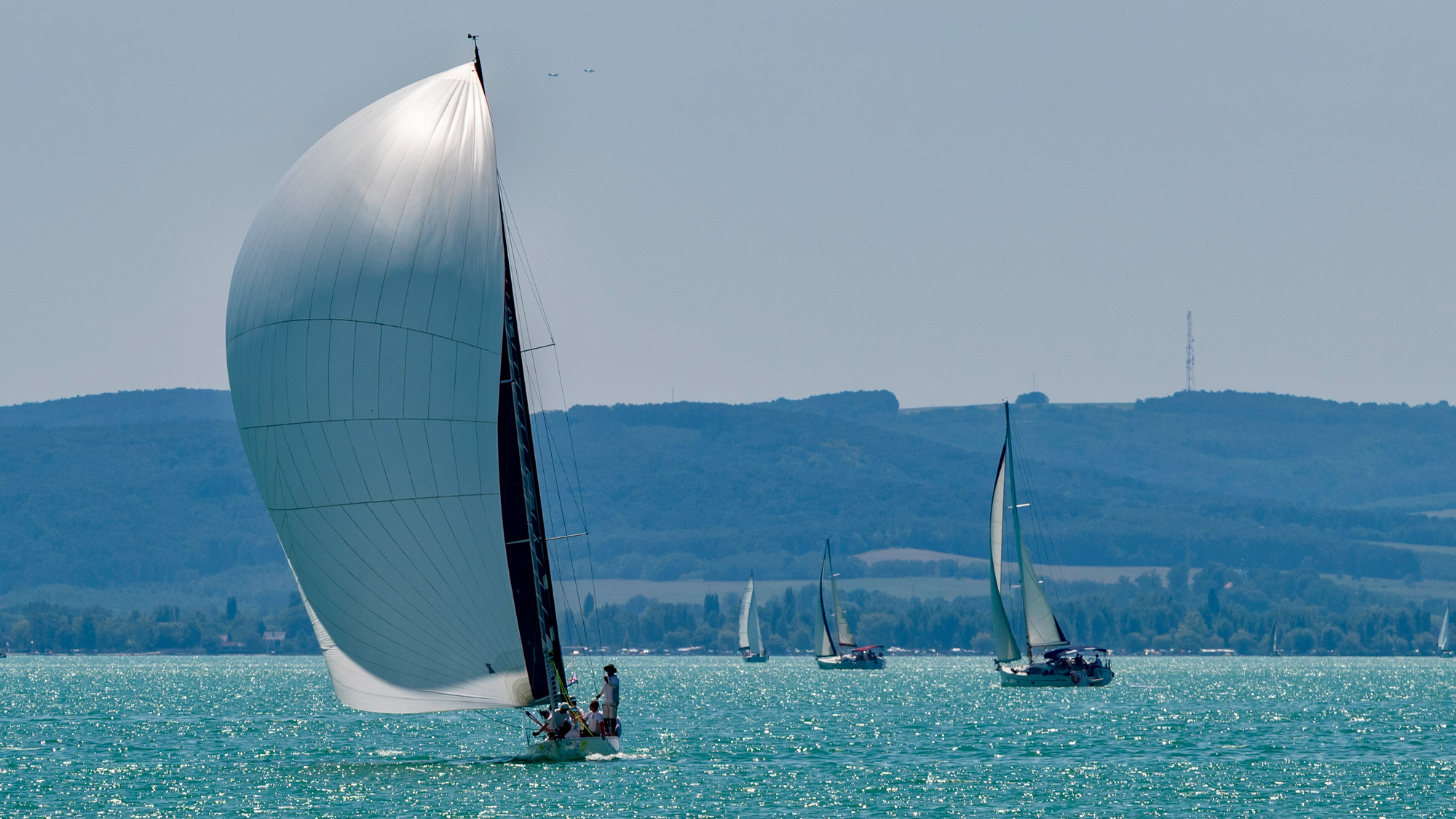
Lake Balaton is showing two very different faces in 2026. In winter, the lake froze hard enough for people to skate on its surface. Now, in the height of summer, the water has retreated so far that parts of the southern shore look almost like a shallow wetland. The contrast reflects the increasingly pronounced variability of the atmospheric circulation over Central Europe, which can produce prolonged periods of both extreme cold and persistent heat, while also affecting the distribution of precipitation.
From Winter Ice to Summer Heat
The contrast at Lake Balaton this year is unusually striking. In January, following a prolonged period of freezing weather, the lake froze over across large areas of its surface. Ice thicker than 10 centimetres persisted for roughly a week, allowing people to walk and skate on the lake. By 10 August, the scene was almost the opposite: the lake’s average water level stood at just 52 centimetres, and along the shallow southern shore visitors could walk far into the lake before reaching swimming depth.
The low water level is the result of a deficit that had built up well before the summer heat arrived. Between November and April, precipitation was 26 per cent below the 1991–2020 average, and by April 2026 the Balaton catchment had accumulated a precipitation deficit of almost 500 millimetres since 2021. The lake therefore entered the summer with its water reserves already substantially depleted.
Persistent heat has since intensified the imbalance. By 10 August, the water level was 68 centimetres below the 120 centimetre regulatory level. At this level, the lake is estimated to be missing around 402–404 million cubic metres of water from its basin, equivalent to more than 21 per cent of the volume it would hold at the reference level. At the same time, water temperatures reached 27°C, while the lake’s nearly 600-square-kilometre surface was exposed to persistent heat and dry winds. Under these conditions, evaporation is estimated to remove around 6 million cubic metres of water per day.
The contrast between the frozen lake in January and the exceptionally low water level in August reflects the very different weather regimes that can develop over Central Europe. Understanding how these regimes arise requires looking beyond individual weather events to the large-scale circulation of the atmosphere, in which the jet stream plays a central role.
The Jet Stream and the Weakening Temperature Contrast
The jet stream is a band of strong westerly winds that circles the Northern Hemisphere from west to east, generally at an altitude of around 9–12 kilometres. It forms where cold air from the north meets much warmer air farther south. The difference in temperature between these air masses helps drive the strong winds of the jet stream and determines how it moves across the Northern Hemisphere.
The jet stream’s position and shape depend on the temperature contrast between the north and south. As the Arctic warms two to three times faster than the global average—a phenomenon known as Arctic amplification—the north–south temperature contrast is changing. This can influence the jet stream’s structure, including the amplitude of its north–south waves, and contribute to more persistent weather patterns.
‘As the Arctic warms two to three times faster than the global average…the north–south temperature contrast is changing’
As a result, cold and warm air masses can move farther north or south than usual. In Central Europe, a pronounced southward bend of the jet stream can allow cold continental or Arctic air to penetrate deep into the region, producing prolonged freezing conditions. This type of persistent cold contributed to the conditions that allowed Lake Balaton to freeze in January 2026. The same circulation can also bring warmer and more humid air northwards from the Mediterranean. When this air meets colder air over Central Europe, substantial snowfall can develop. Winter weather can therefore become more variable, with rapid changes between mild and cold conditions, snowfall, thawing and renewed freezing.
In summer, the pattern can work in the opposite direction. A pronounced northward bend of the jet stream can help bring very warm air towards Central and Southern Europe. When a persistent high-pressure system develops, sinking air warms and suppresses cloud formation. The circulation can draw hot air from lower latitudes, including North Africa, into the region. The resulting heat dome can trap hot air over the region, allowing temperatures to remain exceptionally high for days or even weeks. Because the overall climate is already warmer than several decades ago, the same weather pattern can now result in more extreme temperatures.
The jet stream also affects where precipitation falls by influencing the paths of weather systems and Mediterranean cyclones. This is reflected in a 10–20 per cent decline in average spring precipitation, equivalent to roughly 40–80 millimetres, associated with changes in large-scale circulation and the position of Mediterranean cyclone tracks. This is important for Lake Balaton because spring precipitation is an important part of the lake’s annual replenishment.
At the same time, warming increases the atmosphere’s moisture-holding capacity by around 6–7 per cent for every 1°C of warming, increasing evaporative demand and the potential for greater water loss from the lake. The changing water balance is therefore shaped by both precipitation and evaporation.
Why the Arctic Matters
The changes in atmospheric circulation take place against a much larger transformation of the Arctic climate system. Arctic sea ice has declined markedly since satellite observations began in 1979. In September 2025, at the seasonal minimum, its extent was only 4.6 million square kilometres, more than 40 per cent below the late-summer level recorded in 1979. Furthermore, the thick, multi-year ice that once dominated the Arctic—typically four to seven years old—has virtually disappeared, leaving a much greater proportion of thin, seasonal ice.
This is important because sea ice is an active part of the Earth’s energy balance. Snow and ice reflect a large proportion of incoming solar radiation, while the dark ocean absorbs much more. As the ice retreats, more open water is exposed and more solar energy is absorbed by the Arctic Ocean. The ocean can then release part of that heat back into the atmosphere, altering the exchange of energy and moisture between the surface and the atmosphere.
‘As the ice retreats, more open water is exposed and more solar energy is absorbed by the Arctic Ocean’
The changes extend beyond sea ice. The Greenland Ice Sheet has been losing roughly 271 gigatonnes of ice per year on average, according to satellite observations. The resulting freshwater input is also changing the freshwater balance of the North Atlantic, adding another layer of change to the Arctic and North Atlantic climate system.
The cryosphere is a fundamental component of the Earth’s energy system, regulating how energy and water are exchanged between the surface, ocean and atmosphere. As Arctic sea ice and the Greenland Ice Sheet decline, these exchanges are changing, altering the conditions in which atmospheric circulation develops. Arctic and North Atlantic warming can therefore alter the conditions in which large-scale atmospheric circulation develops, contributing to shifts in European weather patterns. The relationship is complex, and Arctic warming is only one of several factors influencing the jet stream.
From Atmospheric Circulation to the Balaton’s Water Balance
For Central Europe, this can mean longer periods of unusually warm, cold, dry or wet weather. A persistent jet-stream ridge can reinforce heat and dryness, while a deep trough can allow cold air to move farther south. Changes in the pathways of Mediterranean systems can also alter when and where precipitation reaches the Carpathian Basin.
These shifts are particularly important for Lake Balaton, a shallow lake whose water level responds relatively quickly to changes in its water balance. Climate change affects this balance not only through precipitation, but also through evaporation. Recent modelling research on Lake Balaton found that climate change can increase evaporation, while water-level regulation also affects the lake’s thermal dynamics.
The present deficit illustrates the cumulative nature of the problem. It cannot be explained by one heatwave or one dry month. Even the relatively wet months of November and January during the latest hydrological year were insufficient to offset the deficits accumulated elsewhere.
This is also why the distinction between an individual extreme event and a changing climate background matters. A single cold winter can still freeze Lake Balaton, while the longer-term trend can simultaneously involve higher average temperatures, greater evaporation and a less favourable distribution of precipitation. The two are not contradictory; they operate on different timescales and through different parts of the climate system.
What Does the Future Hold?
The long-term outlook makes adaptation increasingly important. Research on sustainable water-level management suggests that climate change could gradually erode the Balaton’s natural water-balance surplus, potentially eliminating it by the end of the century. Because the lake is shallow, its water level is particularly sensitive to climatic fluctuations.
That puts a premium on managing water at the scale of the entire catchment rather than relying on the lake alone. Water arriving during wetter periods needs to be retained more effectively in the landscape, while settlements around the Balaton should reduce their dependence on the lake as a source of drinking water and strengthen alternative supplies. The objective is not simply to maintain a particular water level, but to preserve the ecological and economic functions of the lake under a more variable climate.
The changes already visible at the Balaton are part of a much larger reorganization of the climate system. According to projections, Arctic summer sea-ice cover could fall below 1 million square kilometres—the threshold commonly used to define an ice-free Arctic summer—as early as the 2030s under current warming trends. As the polar climate continues to change, so too will the atmospheric conditions that shape the position and behaviour of the jet stream and, through it, the distribution of heat and precipitation across Europe.
‘The changes already visible at the Balaton are part of a much larger reorganization of the climate system’
The Balaton’s frozen surface in January and its shallow waters in August thus offer two sharply different views of a changing climate: one shows how atmospheric circulation can still deliver intense cold, the other how persistent heat, altered precipitation patterns and rising evaporation can steadily reshape the water balance of one of Central Europe’s most important lakes.
Related articles:
At a time when public debate is increasingly polarized and superficial, Hungarian Conservative remains committed to depth, intellectual honesty, and independent conservative thought.
Producing high-quality journalism requires resources. Your contribution helps us expand our coverage, reach new audiences, and keep our content accessible.

Please consider supporting our mission.