War has always been accompanied by injury and death. Some managed to survive serious injuries, but could these fortunate soldiers truly be considered heroes? Not at all, a heroic death was always what befitted soldiers, and the poets of later generations composed verses in memory of their deaths. Even today, Hungarian schools teach the name of György Szondi, the heroic captain of Drégely Castle, who fought until the very last moment during the Turkish siege of 1552 and whom the victorious pasha buried with great pomp and ceremony. We also remember Miklós Zrínyi as the man who refused to surrender to the Turks in 1566 and who sought his own death during his breakout from Szigetvár Castle. His martyr’s death inspired a multitude of Hungarian and Croatian poets, writers, composers, and painters.
The Latin motto ‘Virtus Vulnere Viret’, meaning ‘Courage grows strong at the wound’, first appeared in humanist literature and became known as the motto of Mary Stuart (d. 1587), but it soon appeared in Hungarian Latin literature as well.[1] Of course, kings had previously taken note of serious injuries and rewarded soldiers, as we can read in a charter from 1403: according to this, János Maróti, Ban of Macsó (today’s Mačva, Serbia), was so severely wounded in the head by a spear thrust from the rebellious rebels that the iron tip of the spear could only be removed four years later. The case of the Hungarian nobleman, however, did not become widely known, unlike that of a 16th-century Hungarian hussar.
The hussar owes his fame to the Habsburgs, who erected a monument to him at Ambras, the castle they built in Innsbruck, Tyrol. At first glance, it is surprising that the portrait of a little-known Hungarian hussar would be placed in the gallery alongside the infamous Romanian prince, Dracula, and the legendary commander of the Hussite Wars, the one-eyed Jan Žižka. This league already suggests that these were not simply heroes, but unique, extraordinary individuals who thus found a place in the collection of curiosities (Wunderkammer). Like contemporary museum collections, this one featured mechanical devices, rare plants and minerals, crocodiles, corals, and Oriental porcelain. For Archduke Ferdinand (1529–1595), an avid fan of hussar tournaments, and his son, Charles (1560–1618), the heroism of the Hungarian hussars must have been appealing, and they consciously collected mementoes of them in their castle.
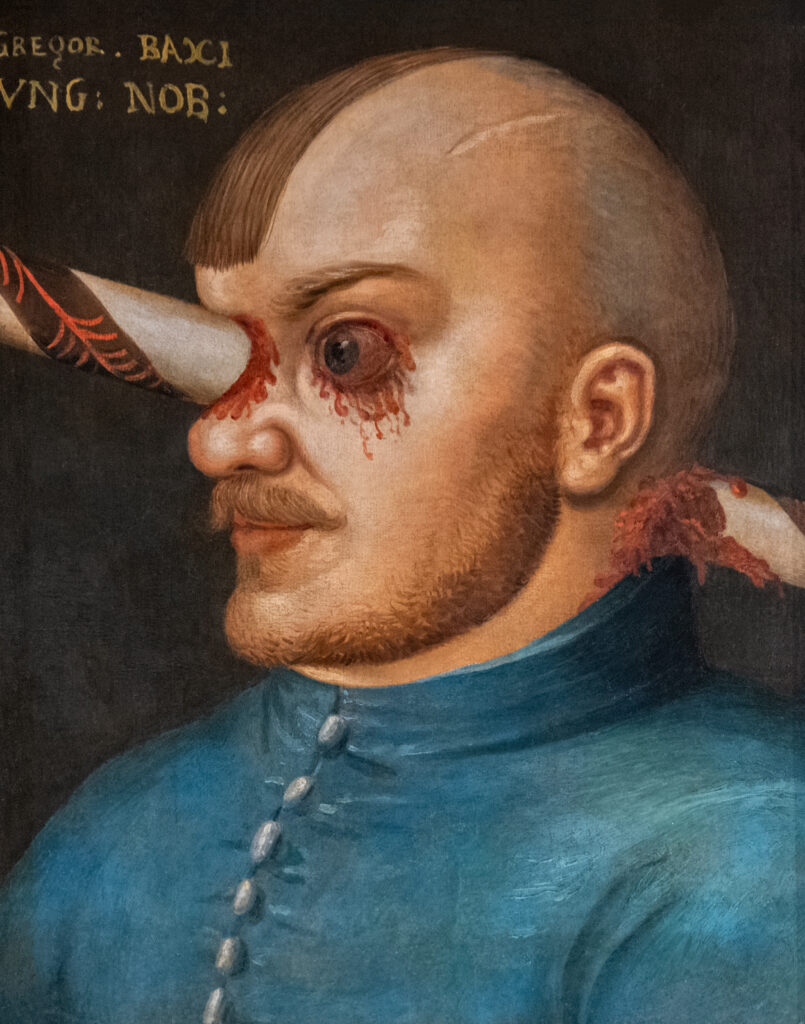
But what actually happened on the battlefield? In 1598 the combined Habsburg and Hungarian forces, led by Adolf von Schwarzenberg (1547–1600) and Miklós Pálffy (1552–1600), recaptured the castle of Győr, which had been seized by the Turks four years earlier and was the last major stronghold defending Vienna on the banks of the Danube. It was then that a Turkish soldier’s lance pierced the skull of a hussar during the successful siege of Győr. The weapon entered the head, shattering the right eye, and its tip pierced the neck below the left ear. The severe injury did not, however, prove fatal, as the soldier was healed by the surgeons’ treatment. It is characteristic that we know little about the soldier’s life and deeds; even his name is uncertain (Márk Baksa or Gergely Baksai). At the exhibition in Ambras, his name is written as Gregor Baci. It is unclear whether the hussar fought again later, but he certainly survived the injury. The soldier’s injury and perseverance became known throughout Europe, but in Hungary, the story remained more of a curiosity in the history of medicine; no literary references to it are known. In 1629 Martin Schödel published an engraving of the injury in his book Disquisitio Historico-Politica de Regno Hungariae. The exhibition currently on view at Ambras features a 3D reconstruction of the skull created in 2012, accompanied by an expert opinion from the University Hospital of Innsbruck that lends credibility to the story.[2]
‘In Hungary, the story remained more of a curiosity in the history of medicine’
Two centuries later, another equally valiant hussar, Dániel Mecséry (1759–1823), received genuine recognition for the wounds he sustained on the battlefield.[3] His nickname, ‘the most hard-headed Hungarian’, was no accident, as during his 46 years of service in the Habsburg army, he sustained 14 injuries, nine of them to the head, several of which could have been fatal. He studied law in his youth but chose the battlefield instead. The talented young hussar officer rose quickly through the ranks, and by 1798, he was already participating in the Napoleonic Wars as a colonel. On 20 October 1805, at Eschenau (now Eckental), Germany, near Nuremberg, the French surrounded and attacked the Austrian cavalry and artillery. At the head of his small force, Mecséry clashed with the enemy, which was vastly outnumbering the imperial-royal army. His units suffered heavy losses, but he managed to secure an escape route for the imperial corps.
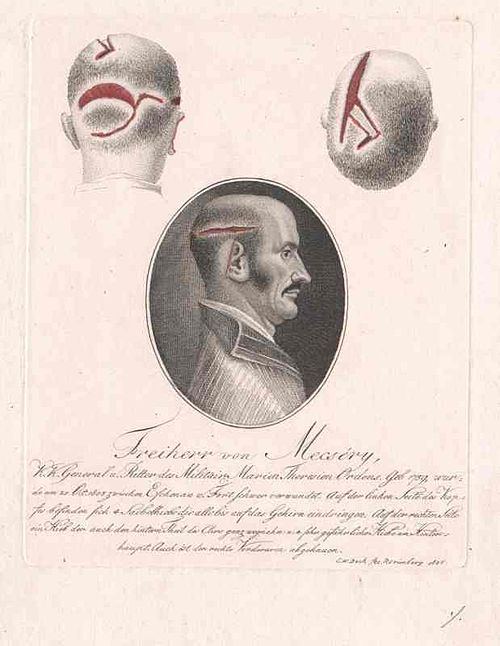
He sustained several life-threatening head wounds in the battle and miraculously survived his injuries. The sword blows inflicted two deep wounds on his head, each 15–20 centimetres long and penetrating to the brain; a third blow severed a piece of bone from the back of his skull. His right ear was partially severed, and he also sustained a severe wound to his right forearm. According to Mecséry’s autobiography, written in German in 1814, the doctors deemed him beyond saving, left him to his fate, and he fell into French captivity. French General Joachim Murat, Napoleon’s brother-in-law, personally reported to the French emperor that, having witnessed Mecséry’s extraordinary bravery, he took pity on his opponent and ordered his own well-trained physicians to attend to the wounded man. The hussar eventually recovered but was unable to continue his military career because his left arm was paralysed.
In 1806 the Austrian emperor received him personally, inspected his healed wounds, and then elevated him to the rank of baron. Later, he received the Commander’s Cross of the Military Order of Maria Theresa, and at the same time attained the rank of lieutenant field marshal (Feldmarschallleutnant). In 1809 he served as military commander of Moravia and subsequently led the Hungarian noble rebels in the lost Battle of Győr–Ménfőcsanak. He reached the pinnacle of his career in 1815, when the emperor appointed him a member of the Imperial War Council. His fame was greatly enhanced by the fact that in 1806, following his medical treatment in Nuremberg, Christoph Wilhelm Bock, a local engraver, published a leaflet depicting Mecséry’s wounds. Mecséry bequeathed his damaged skull to the Anatomical Museum in Vienna, where it remains on display to this day.
In the case of our third hero, Artúr Görgei (or Görgey) (1818–1916), his injury was overshadowed by his life story, his remarkable career, and his subsequent downfall.[4] During the 1848–49 Revolution against the Habsburgs, he served as a general in the Hungarian Army and, on several occasions, as its commander-in-chief. In 1832 he joined the Imperial and Royal Army as a cadet, from which he graduated as a first lieutenant, and later earned a doctorate in chemistry from the University of Prague. In June 1848 he joined the Hungarian Army, where he rose rapidly through the ranks thanks to his unparalleled military talent. In April 1849 Kossuth, the country’s governor, offered him the post of minister of war. Between 4 and 21 May, Görgei’s troops besieged and captured Buda Castle, recapturing the country’s capital. On 2 July, however, Görgei was seriously wounded in the Battle of Komárom. The battle itself was one of the outstanding achievements of his life: with forces outnumbered by the attacking enemy army, he repelled them at every point. However, a fragment of a Russian cannonball tore a 12-centimetre-long gash in his scalp and pierced his skull in several places. Due to his injury, he hovered between life and death for days, but his body ultimately prevailed. On the 9th day following his injury, Görgei set out from Komárom toward Arad with three corps; on the 13th day, he captured Vác, driving out the Russian outposts. Citing his injury, Kossuth removed him from the general command, but his soldiers stood by him. It was then that he carried out his most daring military operation: retreating from Komárom to Arad, he prevented the main Russian and Austrian forces from joining up, despite facing overwhelming odds.
On 21 May, the day Buda was recaptured, the Russian tsar promised the Austrian emperor 200,000 soldiers in Warsaw to suppress the Hungarian uprising. Görgei saw no hope in continuing the fight, and on 13 August, he and his army laid down their arms before the Russians at Világos (today’s Șiria, Romania), trusting that the Russian army would guarantee the lives of those who surrendered. However, the Austrians executed all the Hungarian generals and also took reprisals against the soldiers. Hungarian society still commemorates the executed generals every year on 6 October, the day of the Thirteen Martyrs of Arad. On this day, the officers were executed in Arad (now in Romania), and the first Hungarian prime minister was executed in Pest.
‘He was called a “living martyr”, for by remaining alive, he suffered a fate worse than if he had been executed’
However, all this had an extremely negative impact on the reputation of the most talented general of the Revolution. No one remembered his life-threatening injury or his remarkable recovery; instead, he was increasingly held responsible for the defeat, a situation made even worse by the completely baseless accusation of ‘treason’. At the request of the Russian tsar, Görgei was granted amnesty on 22 August and exiled to Klagenfurt, Austria, from where he did not return to Hungary until July 1867. It was not without reason that he was called a ‘living martyr’, for by remaining alive, he suffered a fate worse than if he had been executed. Lajos Kossuth later called him the ‘Judas of the nation’ for surrendering his arms. The suspicion of treason was reinforced by the fact that Görgei avoided the fate of the martyrs of Arad. He died on 21 May 1916, in the 99th year of his life, on the 67th anniversary of the recapture of Buda. The next stage of the rehabilitation came with the collapse of the Austro–Hungarian Monarchy, and Görgei’s statue was belatedly unveiled on 21 May 1935, on the anniversary of the capture of the Castle and his death. During the Soviet siege of Budapest in 1944–45, the statue was struck by artillery fire and toppled, but its red marble pedestal remained in good condition at the site; it was not dismantled until 1951, and the statue was incorporated into the monumental statue of Stalin in City Park.
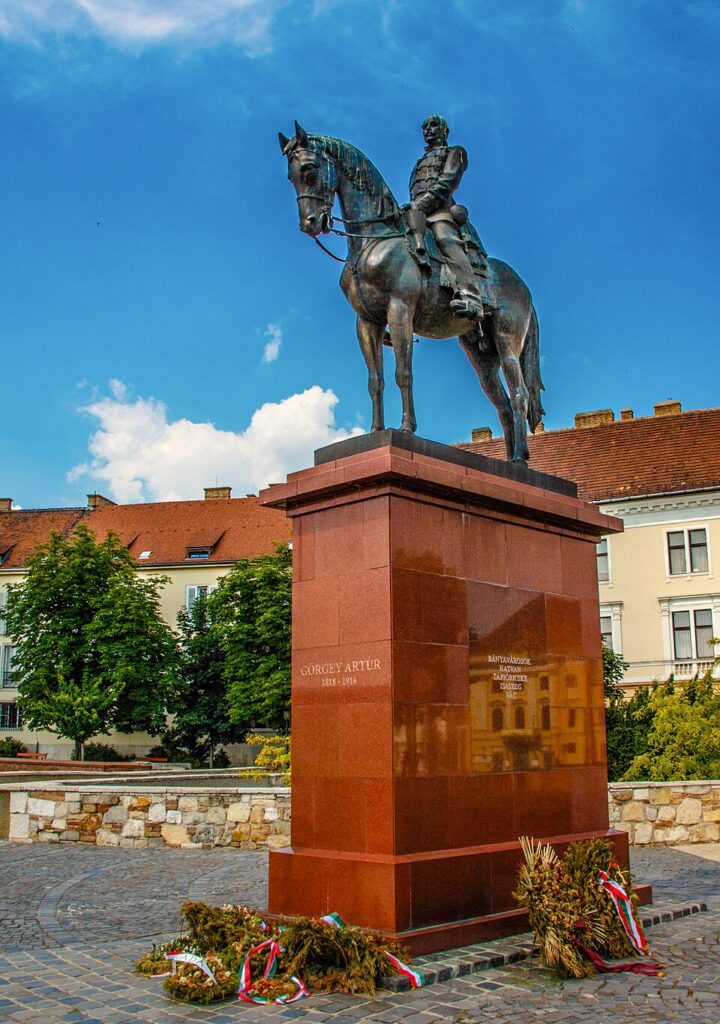
However, the communist dictatorship that took hold after 1948 sought out traitors not only in the present but also in the past; to justify the show trials against high-ranking officers of the People’s Army, they cited the traitorous military officers of the War of Independence, including Görgei. 1989 brought a turning point in this regard as well. Since 1992, May 21 has been Hungarian Defence Day, commemorating the most glorious victory of the 1848–49 Revolution. An equestrian statue identical to the original was unveiled on 21 May 1998 at Buda Castle, though not at the original site. Since 2021, the statue has been undergoing restoration as part of the National Hauszmann Programme. The story came to a close at the Semmelweis Museum of Medical History in 2011, when a highly successful exhibition titled The Wounded Görgei was held, focusing on the general’s wounding at Komárom.
[1] Péter Szabó, ‘“Virtus vulnere viret” – Sebtől díszlik a vitézség’, in István Bitskey et al, Religio, retorika, nemzettudat régi irodalmunkban, Debrecen, 2004, pp. 338–359.
[2] A Nerlich, O Báthory, R Bianucci et al, ‘The portrait of Márk Baksa: Jael syndrome in a 16th century Hungarian hussar, a multidisciplinary investigation’, Ethics Medicine and Public, Health 32, 2024, Article 100979.
[3] Attila Réfi,‘The Field Officer Corps of the Imperial-Royal Hussars in the Age of the French Revolutionary and Napoleonic Wars (1792-1815)’, Budapest–Sárvár, 2014, pp. 358–360.
[4] Róbert Hermann, The Hungarian War of Independence 1848–1849 — An Illustrated Military History, Warwick, 2026.
Related articles:
At a time when public debate is increasingly polarized and superficial, Hungarian Conservative remains committed to depth, intellectual honesty, and independent conservative thought.
Producing high-quality journalism requires resources. Your contribution helps us expand our coverage, reach new audiences, and keep our content accessible.

Please consider supporting our mission.