The Research Institute for Hungarian Communities Abroad organized a workshop on the messages of the famous anthropologist Margaret Mead to the Hungarian community, published in the Toledo weekly newspaper in 1945. The study forming the basis of the discussion co-authored by András Ludányi and Dániel Gazsó published in the 2025 volume of the Hungarian Journal of Minority Studies—is closely related to the issue of internal national integration in the U.S. after World War II; to the dilemmas arising from the opposition between the melting pot theory and cultural relativism; and to the problem of justifying foreign policy objectives formulated on a global scale.
In their joint study ‘Margaret Mead’s Efforts to Instill American Values in the Hungarian Ethnic Community of Toledo’1, András Ludányi, political scientist and professor emeritus at Ohio Northern University and Dániel Gazsó, cultural anthropologist, researcher at the Research Institute for Hungarian Communities Abroad and senior research fellow at the Ludovika University of Public Service, attempt to show how the influence of an eminent social scientist contributed to the broader ‘justification’ of American internal national integration and foreign policy purpose at the global level. Balázs Balogh, ethnographer and director of the Institute of Ethnology at Research Center for the Humanities of the Eötvös Loránd University, and Tibor Glant, historian, associate professor of the Department of North American Studies at the University of Debrecen, and research professor at the John Lukacs Institute of Ludovika University of Public Service, also participated in the discussion.
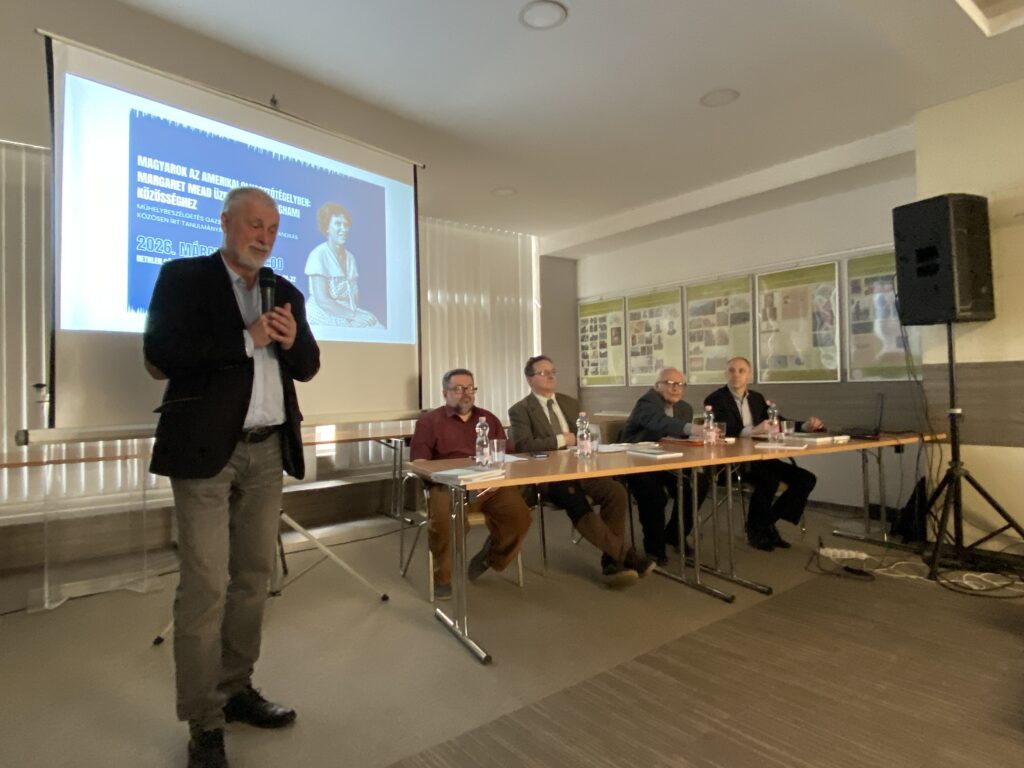
After the welcome speech of Zoltán Kántor, political scientist, associate professor, and director of the Research Institute for Hungarian Communities Abroad, Prof. András Ludányi summarized Margaret Mead’s 1945 articles, which he had previously discussed at the 49th Conference of the American Hungarian Educators Association, held in June 2025 in Pécs, Hungary. He associates the ‘sweet and humanist anthropologist’ with the ‘stark naked power politics’ of American Empire building. During the 1970s, while researching the history of the Birmingham neighborhood in Toledo, Ohio, Ludányi consulted the ethnic Hungarian weekly newspaper Toledo, edited by Géza Farkas, devoted mainly to local news and events, sometimes to national and international developments affecting the local community’s interests or lives.
‘During World War II, the editor was committed to an unwavering loyalty to the U.S. and the Allies’
During World War II, the editor was committed to an unwavering loyalty to the U.S. and the Allies: his writings and editorials reflected support for the neighborhood’s purchases of war bonds and the naturalization of the Hungarian Americans, Ludányi claims. Farkas also took pride in the number of young men who volunteered for military service, as a direct and natural way to demonstrate ‘American identity’ of the community having roots in the political systems linked to the Axis Powers, i.e., the enemy. Many of these young men never returned, paying for their patriotism in blood, while the weekly paid tribute to their sacrifices on the obituary pages and their names were listed on the memorial plaque on the statue in front of St. Stephen’s Church in the neighborhood, added the professor.
He emphasized that the war also had some direct unforeseen consequences for the ethnic communities of Birmingham, not noted by Géza Farkas, despite the fact that they determined the fate of the neighborhood: the extensive wartime employment of the women in industry and the changed cultural perspectives of the veterans. Due to the successful military indoctrination received in boot camps, veterans were transformed into ‘integrated Americans’, who, upon return, felt alien in their former ethnic surroundings, and wanted to be part of the new, characterless suburbs, where they could experience the same equalness their military uniforms had provided them with during the war.
The employment of women broke the bonds of ‘mother-language’ previously taught to their children at home, while public schools—and the English teaching in St. Stephen’s Roman Catholic classrooms—sacrificed the dual language skills of the next generation, the professor explained. The reasons behind the editor’s ignorance, in combination with Mead’s syndicated columns published from 16 February to 8 June 1945, seem to be partly private, Ludányi argued. Géza Farkas was the father of football Hall of Famer ‘Anvil Andy’ Farkas, who helped the Washington Redskins to the NFL championship in 1942, which made him a ‘proud and unquestioning fan of both immersion and assimilation in American life’.
The professor highlighted: the series of six articles was written in quite good Hungarian and reflected a high awareness of Hungarian matters (disputed borders, Vienna–Budapest distance, etc.), inserted either originally or later in the text by the anonymous translator, probably Farkas himself. Moreover, the texts seem to relate to a more global audience—potentially explained by an institution whose address Mead provided to her readers, Ludányi highlighted, adding that the Common Council for American Unity (CCAU) had its headquarters in New York City, and was primarily concerned with the U.S.’s ‘unity’. There was an internal change within the leadership of the CCAU and subsequently in the organization’s approach: from ‘an integrationist policy tolerant of the great diversity that immigrants brought to American shores and a pluralist perspective would best serve the interests of American unity’ represented by the previous leader Slovenian American Louis Adamic to the assimilationist perspective that became the dominant outlook after his withdrawal in 1942. Mead’s articles reflect this changed commitment.
Co-author Dániel Gazsó stated: to understand the most popular cultural anthropologist—the Time Magazine even called her ‘mother to the world’—and to interpret her mentioned columns, it’s necessary to situate her within the history of the discipline and to become acquainted with her work. Mead lived during a crucial period in the development of anthropology and was one of the most influential figures of the second generation of modern American anthropologists; her work is both extensive and diverse, spanning numerous topics and approaches that have left a lasting impact on the field.
At first glance, Gazsó said, one might assume that when writing for Toledo, she set aside her fundamental anthropological approach— developed as an extension of her mentor, Franz Boas’s historical particularism and applied with exemplary rigor to the tribal cultures she studied—when considering European immigrants in her own country. Reading her recommendations in Toledo, it seems as if she had momentarily settled into the ‘armchair of the evolutionists’, as if she too were blinded by the preconceptions of her own cultural context, the American ‘melting pot’ principle, encouraging Hungarians to give up their linguistic and cultural heritage if they wished to succeed in American society.
Yet, knowing Mead’s work, one can feel that something more is at stake, Gazsó argued. First, Mead considered certain behavioral patterns—especially those relating to gender roles—outdated. She believed that these patterns could be changed, specifically through reforming upbringing and the transmission of behavioral norms. For this purpose, she regarded American society as the most suitable context for such transformation. In the same volume, Male and Female, she also points out that this forward-looking attitude can make everyday life particularly difficult, especially for those who retain different cultural roots.
Second, Mead was born and raised in the U.S.; the ideas and values of American society had a strong influence on her, later becoming the subject of her study, Gazsó emphasized. She conducted fieldwork in distant, small communities and used them to reflect on her own society. She developed social critiques addressing issues such as the role of women, child-rearing practices, sexual morality, focusing on topics closer to psychology—personality, emotions, enculturation, gender roles, etc.—less emphasized by the British counterparts.
Third, Mead devoted a great deal of time to ethnographic fieldwork, Gazsó added. She embarked on her first expedition in 1925 to the Samoan Islands. After spending nine months among the Samoans, she published her findings in Coming of Age in Samoa: A Psychological Study of Primitive Youth for Western Civilization. The book quickly became tremendously popular, was translated into multiple languages, and brought Mead widespread fame, but it has also faced several criticisms. Fourth, Mead’s interest was also in exploring how psychological dispositions and individual temperaments develop. She studied the process of enculturation and explained cultural diversity in terms of the socially varying systems of upbringing and enculturation, Gazsó explained.
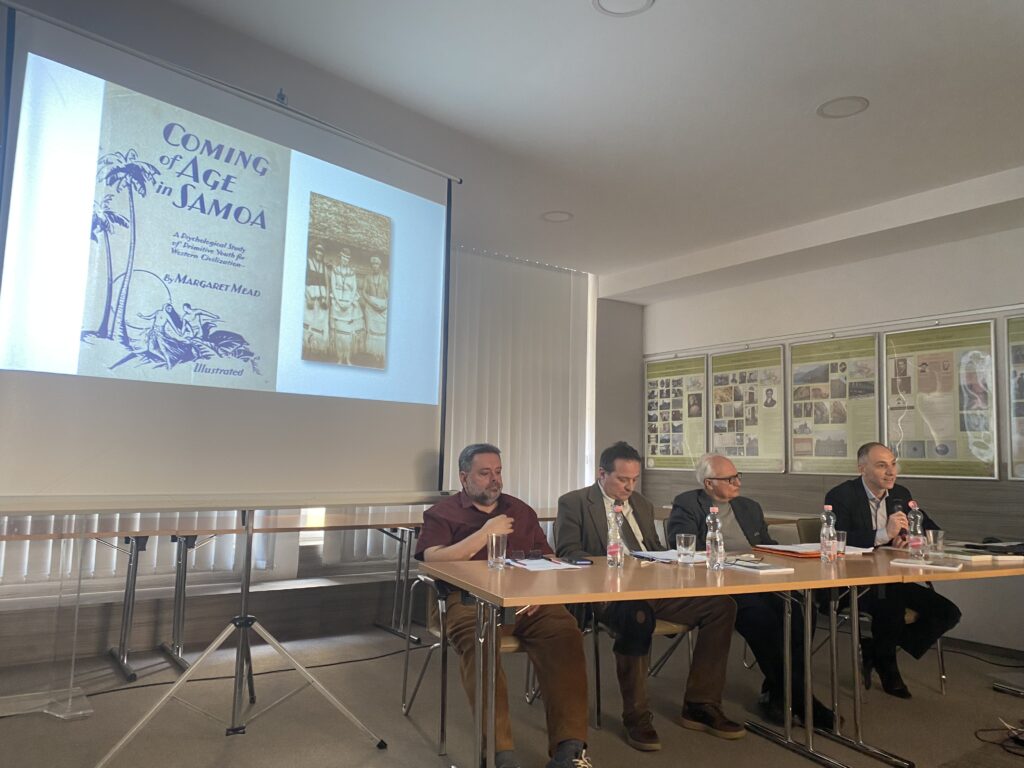
Finally, Mead didn’t merely interpret the cultural patterns of behavior observed; she sought to improve them. Her reform-oriented ambitions were articulated primarily in relation to gender roles and child-rearing practices in American society, summarizing her findings in Male and Female: A Study of the Sexes in a Changing World (1949), in which she examined North American social arrangements, comparing them with the tribal cultures studied in the Pacific.
Based on these, Gazsó concluded in relation to her series in Toledo, Mead most likely classified Hungarians living in the U.S. as part of the ‘new Americans’, and she may have believed that these communities needed to assimilate into the American mainstream to facilitate changes in outdated behavioral patterns, looking toward the future. Professor Ludányi added: although Mead doesn’t state it directly, on the international level global peace justifies blaming the nationalism of individual nations for the outbreak of wars, rather than the political conflicts between major powers and their imperial objectives—which becomes in part the justification for creating a new international order through the UN run by the major powers in the Security Council but guided by the high ideals of American patriotism. This role on the global level foreshadowed certain consequences, including a more assertive presence of the U.S. in almost every part of the world—which, of course, Mead cannot be blamed for.
Balázs Balogh admitted he read these 81-year-old articles with mixed feelings. He also stressed the importance of historical context: after the horrors of World War II, the world longed for change led by the U.S.—an almost utopian vision that also emerges in Mead’s brief writings. However, while the U.S. was meant to set an example, racial segregation persisted for decades, Native Americans lived on reservations, and marriage with Japanese people was banned, he highlighted.
‘While the U.S. was meant to set an example, racial segregation persisted for decades’
Balogh found it utopian that a cultural anthropologist would try to offer cultural models through newspaper articles to Hungarian factory workers living for decades in extremely harsh conditions. He noted that records from a local Hungarian American funeral business—rescued by the sister of former senator Péter Újvági—reveal shockingly high infant mortality and workplace accidents. The contrast between ‘grounded’ European labour and ‘liberating’ American jobs also fails to hold up: in Pennsylvania mines alone, 51,000 miners have died since 1870, including thousands of Hungarians, who thus contributed to America’s rise through industrialization at the cost of their lives. Based on these, Balogh concluded that Mead understood Samoa better than her own society.
Since Mead was mentioned as the ‘mother of anthropology’, Balogh suggested mentioning Edward Ross as the ‘father of sociology’. Though a keen observer, Ross—reflecting evolutionary thinking of his time—saw social progress as a struggle between races and sharply distinguished between earlier (Western and Northern European) and later (Southern and Central-Eastern European) immigrants. The latter included Hungarians, whom he described as inherently inferior even in physical terms. While the first wave of immigrants indeed looked down on the second, Balogh argues Mead’s reasoning is inconsistent, as she classified relatives of first-wave immigrants as part of the second.
On language, he pointed out pitfalls of translation: for instance, ‘small village’ is misleading as the Great Plain in Hungary has farms or market towns rather than small villages. He also criticized parts of the Hungarian translation as weak and suggested examining the syndicated publication of Mead’s text, whether it appeared in other languages, and which audiences it targeted. Balogh agreed with Mead that anti-discrimination laws alone are insufficient; real change must occur in human relations. However, he rejected her implication that this would require abandoning local national identities in favor of a higher American unity and patriotism. Similarly, one must consider the timing when Mead criticized Europeans for clinging to their ‘old homeland’, as this coincided with America’s emerging role as global peacekeeper. Balogh finds her emphasis on education overly idealistic, recalling earlier efforts by Hungarian Catholic communities in the U.S. to convert Hungarian Protestants.
Finally, drawing on years of fieldwork among Hungarian communities in the U.S.—especially in closed mining regions and big industrial cities—Balogh framed his observations theoretically using identity-construction models and the capsule theory. He argued that minority identity can be mapped along three axes: relation to the homeland, the host country, and the immediate minority community. Emigrants, he suggested, live in a time and mentality capsule: they preserve objects and memories of the past while forming social networks with culturally similar people, creating an invisible protective layer shaping behavior. These capsules—like droplets in a sea—vary in thickness and resilience. Their inner core contains elements from the old country, while the surrounding environment reflects the new one; clusters of such capsules form ethnic enclaves that reinforce one another and protect cultural traits from globalizing forces—explaining the still mosaic-like diversity of American culture. Assimilation is never complete in the first generation; over subsequent generations, the capsule walls thin and become permeable, allowing more homogenized American elements in. Full assimilation—when the inner core no longer differs from the environment—depends on individuals and families.
Tibor Glant admitted he was genuinely shocked by Mead’s article series, arguing that it essentially reproduces World War I American government propaganda. He explained that there was strong continuity between the Wilson and Roosevelt administrations: Roosevelt was shaped politically under Wilson, whose government actively sought to influence public opinion through the Committee on Public Information (CPI), a state-funded propaganda agency engaged even in cultural diplomacy, translating and distributing materials, including the President’s speeches abroad. Glant believes Mead’s writings echo this tradition, suggesting they were likely part of a similar effort to shape immigrant attitudes. He pointed to syndicated journalism and historical evidence showing that U.S. authorities actively intervened in the immigrant press, including Hungarian-language newspapers. In his view, Mead may have been used to promote the idea that immigrants should become ‘100 percent American’, a recurring expectation rooted in wartime loyalty concerns. Mead’s work may also fit into New Deal-era initiatives like the Federal Arts Project, which mobilized intellectuals to rebuild national self-confidence, Glant added.
‘When anthropology becomes entangled with politics, it risks losing touch with reality’
He argued that these texts deny reality and function more as ideological programs about America’s global role than as genuine analysis. For example, schools were seen as key tools of assimilation, prompting Hungarian communities to establish their own institutions to preserve identity. He rejected the idea of full first-generation assimilation as unrealistic, noting that many early Hungarian migrants lived in conditions close to white slavery, far from the ‘liberating’ jobs described by Mead. He also criticized the moral tone of Mead’s arguments about tolerance, given the wartime climate of extreme racism and propaganda in the U.S., particularly against the Japanese. More broadly, he highlighted contradictions in expecting immigrants to abandon their cultures while American society itself remained deeply hierarchical and discriminatory, even among white groups. Citing further examples of unethical ‘scientific’ practices in studying Native Americans, as a conclusion, Glant warned that when anthropology becomes entangled with politics, it risks losing touch with reality.
- Dániel Gazsó and András Ludányi, ‘Margaret Mead’s Efforts to Instill American Values in the Hungarian Ethnic Community of Toledo’, Hungarian Journal of Minority Studies, 2025, Volume 8 (pp. 29–49).
↩︎
Related articles:
At a time when public debate is increasingly polarized and superficial, Hungarian Conservative remains committed to depth, intellectual honesty, and independent conservative thought.
Producing high-quality journalism requires resources. Your contribution helps us expand our coverage, reach new audiences, and keep our content accessible.

Please consider supporting our mission.