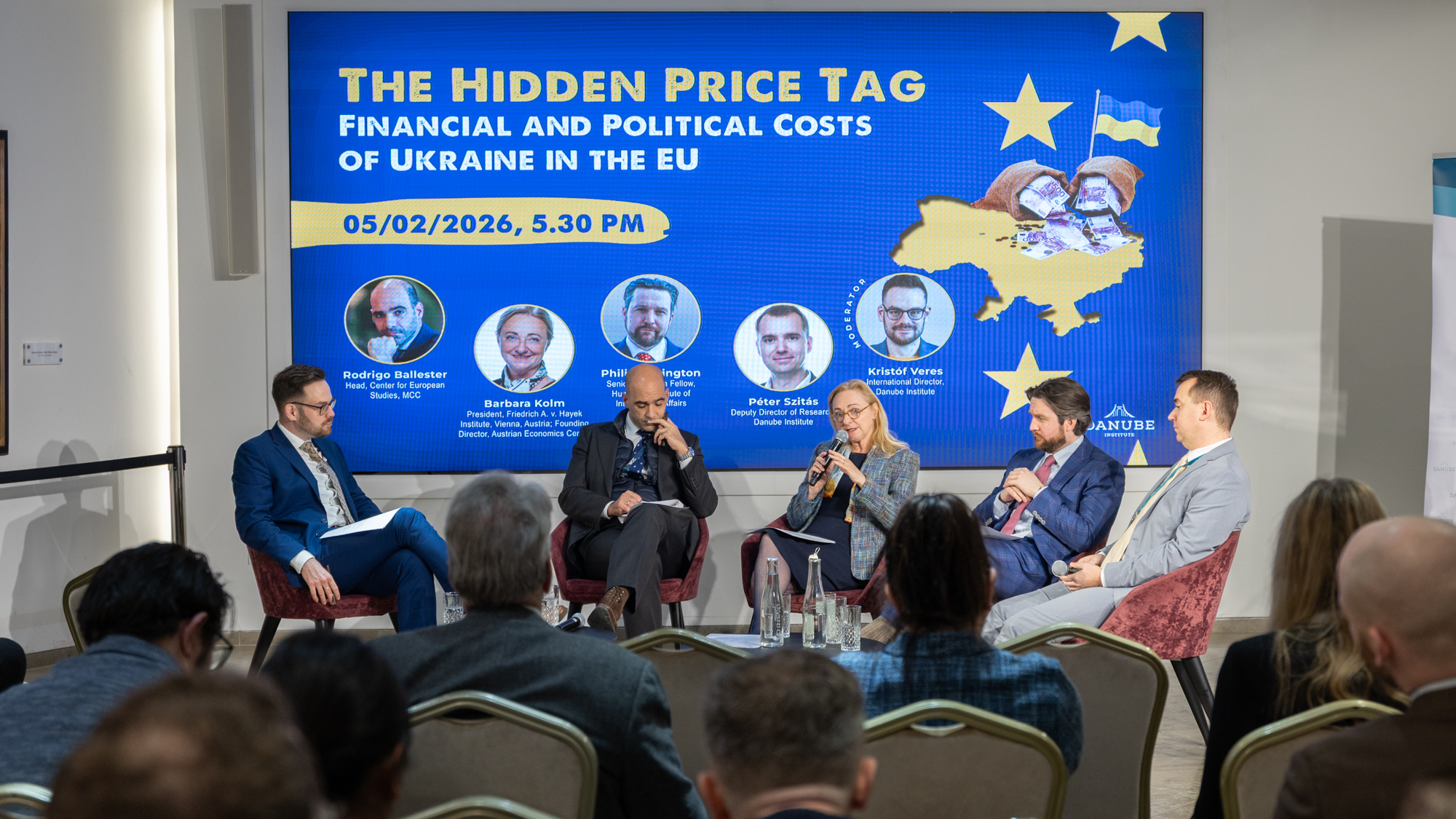
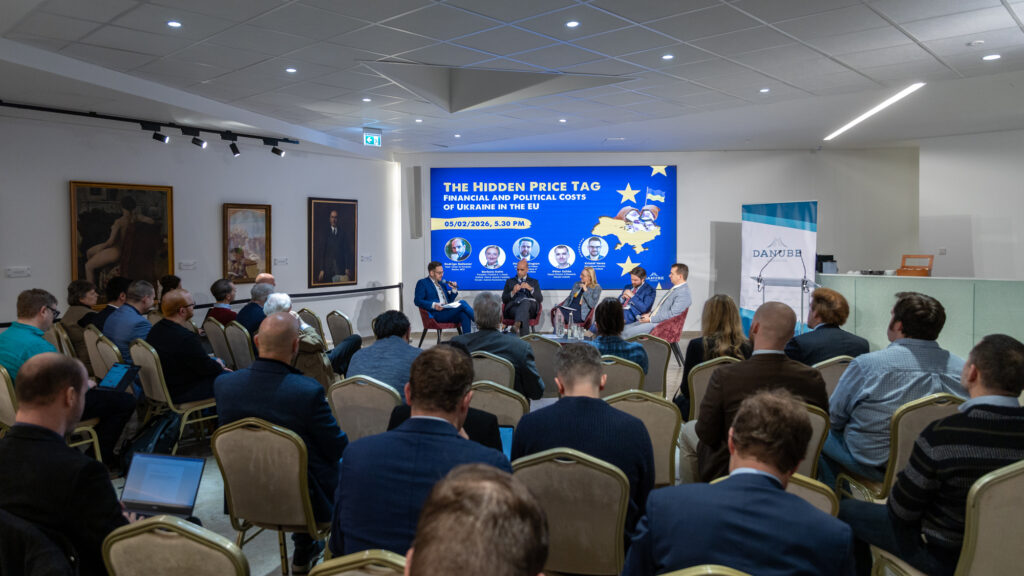
The question of Ukraine’s potential accession to the European Union took centre stage at the The Hidden Price Tag: Financial and Political Costs of Ukraine in the EU panel discussion on 5 February, where experts debated the political momentum, economic implications and societal consequences of fast-tracking Kyiv’s integration into the bloc.
Opening the discussion, moderator Kristóf Veres, International Director of the Danube Institute noted that Ukraine has moved toward EU membership with unprecedented speed since Russia’s full-scale invasion. While Brussels has increasingly discussed pathways to eventual membership, Veres highlighted that EU leaders such as German opposition figure Friedrich Merz have emphasized that Ukraine must still meet the Copenhagen criteria, the foundational political and economic standards required for accession.
Public opinion across Europe appears increasingly cautious about Ukraine’s rapid accession. Barbara Kolm, President of the Friedrich A. v. Hayek Institute in Vienna, Austria and Founding Director of the Austrian Economics Center presented polling data suggesting that initial enthusiasm for unconditional support has significantly declined. According to the data, roughly 75 per cent of EU citizens oppose accelerated membership for Ukraine, with opposition particularly high in Central Europe. Hungary showed the strongest resistance, with 93 per cent of respondents opposing fast-track accession, followed by Austria at 83 per cent. Kolm noted that support tends to increase in countries geographically further from the conflict, but overall unconditional support has fallen to around 35 per cent, reversing trends seen two years earlier.
Head of the Center for European Studies at MCC Rodrigo Ballester argued that the widening gap between public sentiment and EU policy-making raises institutional concerns. He warned that EU institutions have historically shown a willingness to bypass public opinion and even established procedural rules. Ballester stressed that EU enlargement formally requires unanimity among member states, a condition he described as highly unlikely in Ukraine’s case. He also cautioned that framing Ukraine’s accession as a catalyst for EU reform risks politicizing a process that was traditionally merit-based.
Ballester suggested that alternative frameworks, such as deeper cooperation through the European Political Community, could provide Ukraine with closer integration without full membership. He argued that a rapid accession would be unfair to candidate countries that have been negotiating for years. As an example, he cited Serbia, which has spent more than a decade in accession talks and closed only two of the required 35 negotiating chapters. According to Ballester, abandoning the merit-based approach could undermine the EU’s credibility and potentially place Ukraine under expectations it is not yet prepared to meet.
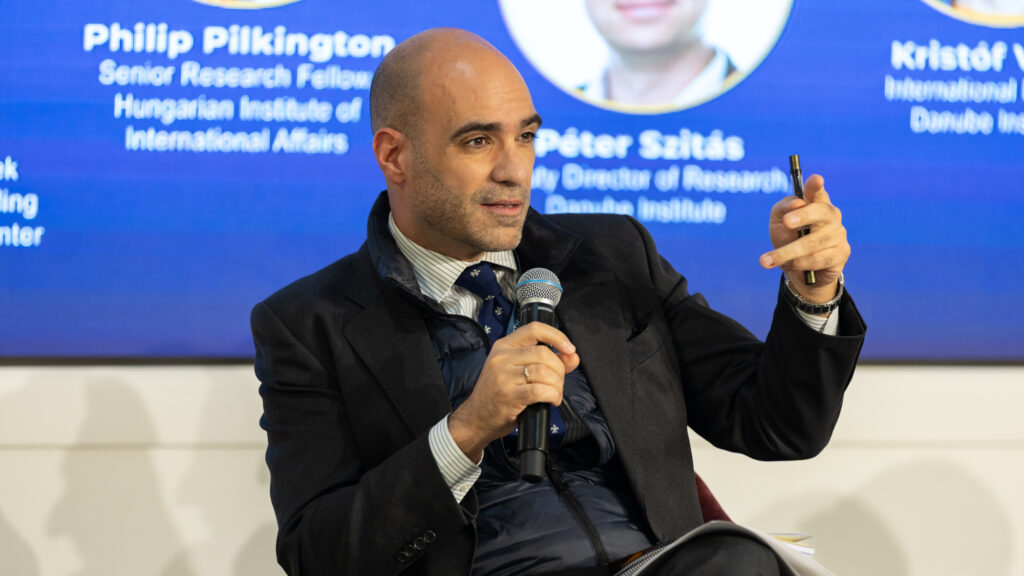
The discussion also addressed economic competition within the EU’s internal market. Deputy Director of Research at the Danube Institute Péter Szitás pointed to recent tensions involving Polish transport companies and agricultural producers following the easing of trade restrictions on Ukrainian goods after the outbreak of war. He explained that regulatory discrepancies allowed Ukrainian producers to enter EU markets with lower-cost products, creating challenges for farmers and hauliers in neighbouring member states. Szitás emphasized that while humanitarian support for Ukraine remains widely accepted, granting candidate status only four months after the invasion represented an unprecedented political step, especially considering that membership discussions had not been seriously advanced prior to the war.
Economic sustainability formed another major focus of the debate. Senior Research Fellow at the Hungarian Institute of International Affairs Philip Pilkington highlighted the enormous financial burden associated with both Ukraine’s reconstruction and eventual EU accession. He noted that estimates for rebuilding Ukraine have already risen from 349 billion dollars in 2022 to more than 500 billion dollars. Looking ahead, Pilkington estimated that combined reconstruction and integration costs could reach 2.5 trillion dollars within the next decade.
For Hungary alone, he suggested the costs could amount to approximately 50 billion euros, equivalent to nearly 10 per cent of the country’s annual budget. Pilkington warned that financing such expenditures would likely require new EU-level borrowing instruments, such as expanded Eurobond programmes, at a time when the bloc is already managing debt accumulated during the COVID-19 pandemic. He added that several major EU economies, including France and Italy, are facing fiscal challenges that could complicate further debt expansion.
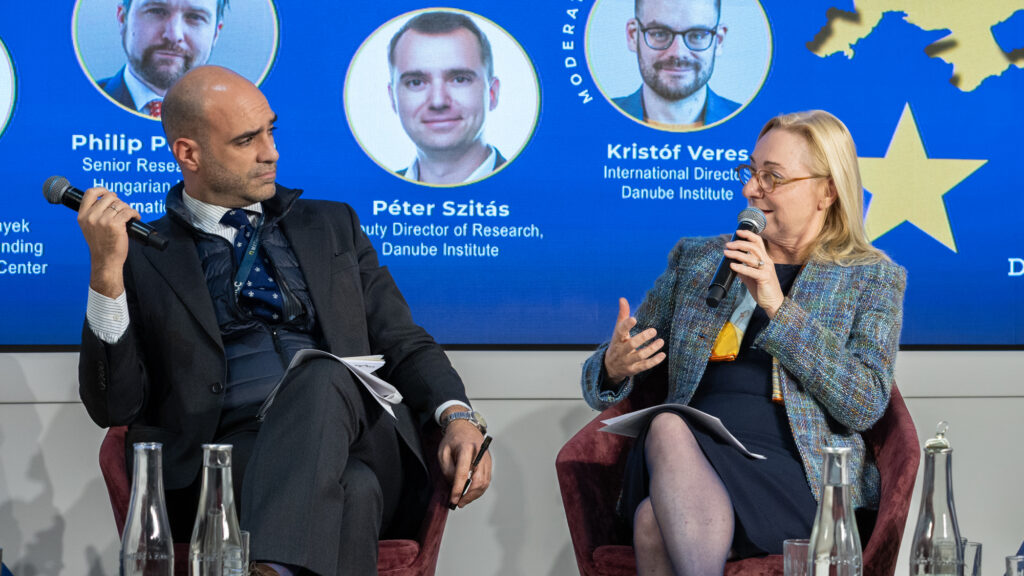
Kolm expressed concern that new joint borrowing initiatives could significantly increase EU-level debt. She argued that Ukraine’s reconstruction may be used to justify additional borrowing mechanisms after traditional tax increases have reached political limits. Ballester added that according to some policy analyses, Ukraine’s membership could fundamentally reshape the EU’s budget structure, potentially turning several current net beneficiaries into net contributors.
The panel also discussed broader fiscal risks. Pilkington warned that pooling additional debt at EU level could revive financial vulnerabilities that the bloc struggled to stabilize following the eurozone debt crisis. According to him, expanding both debt and the EU budget could eventually lead to new taxation mechanisms targeting member states, increasing national fiscal burdens.
Kolm cautioned that large-scale financial injections into Ukraine could create inflationary pressures across Europe, arguing that excessive liquidity risks destabilizing financial markets. She also referenced discussions surrounding a proposed 800 billion euro reconstruction initiative, warning that European taxpayers could bear the bulk of the costs while private contractors and foreign investors capture the primary economic benefits.
Concerns were also raised about governance and corruption risks. Ballester acknowledged that Ukraine had made progress through its association and trade agreements with the EU prior to the war but argued that structural rule-of-law challenges remain. He warned that overlooking these issues for geopolitical reasons could ultimately harm both the EU and Ukraine. Instead, he advocated for a long-term, tailored integration framework focused on sustainable institutional reforms and increased European involvement in reconstruction projects.
Security and migration implications were also discussed. Szitás highlighted the possibility that full membership could significantly increase migration flows from Ukraine into EU member states. Drawing parallels with the post-Yugoslav war period, he warned that large-scale population movements can sometimes be accompanied by increased illicit trafficking and black-market activities, posing additional regional security challenges.
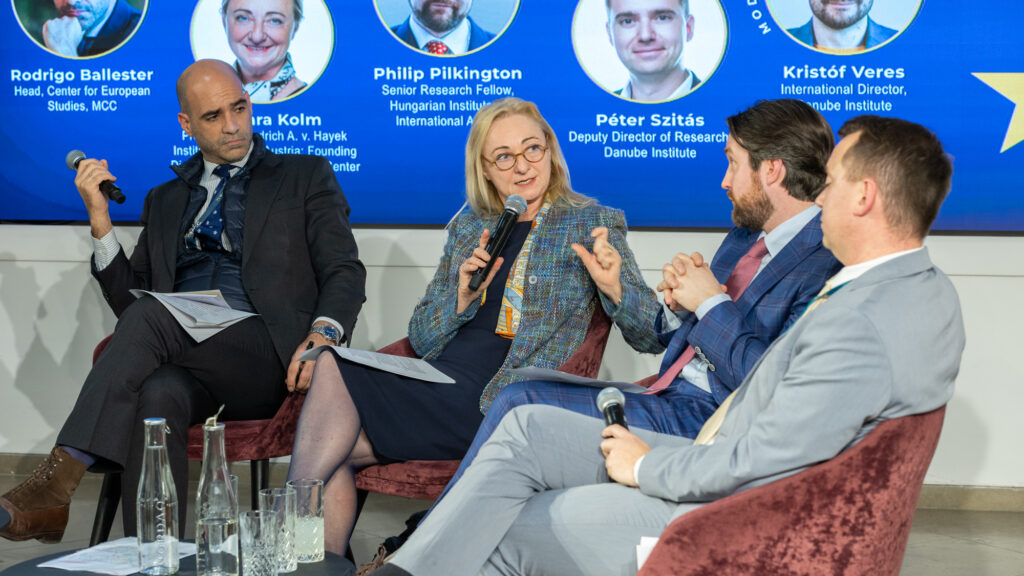
Szitás also raised historical concerns regarding minority rights, particularly for Hungarian communities in Ukraine’s Transcarpathian region. He noted that Hungary was among the first countries to recognize Ukraine’s independence and initially sought close bilateral relations. However, he argued that changes in Ukrainian minority legislation after 2011, particularly following the annexation of Crimea, led to tensions and concerns among ethnic Hungarian communities.
Pilkington concluded by criticizing certain reconstruction proposals as overly optimistic, suggesting they rely on unrealistic assumptions about refugee returns and rapid industrial recovery. He argued that infrastructure rebuilding should prioritize long-term structural stability and involve European expertise, rather than relying primarily on external contractors.
Kolm echoed financial concerns in closing remarks, warning that large-scale reconstruction spending financed by European borrowing could import inflationary pressures into EU economies.
Related articles: