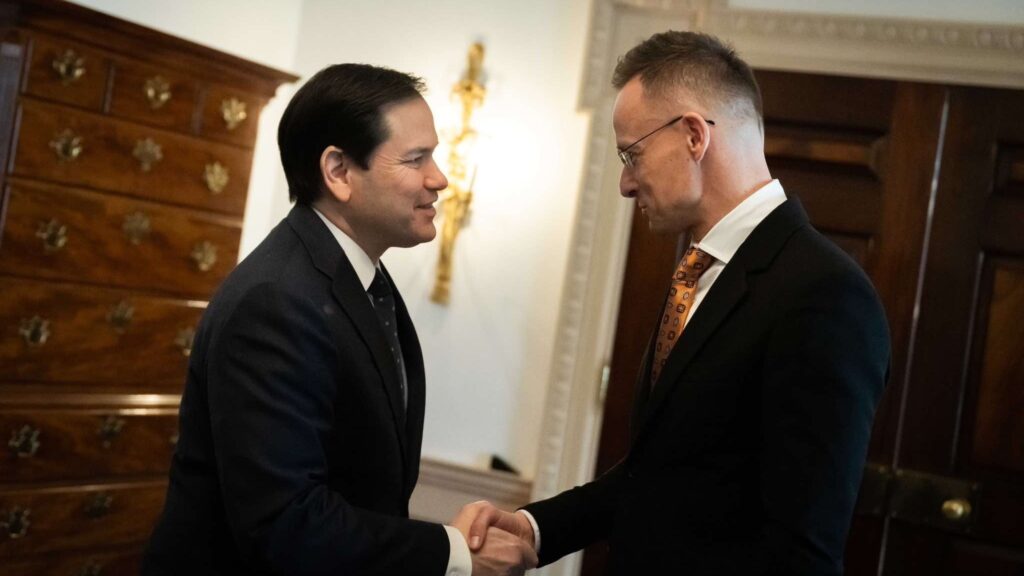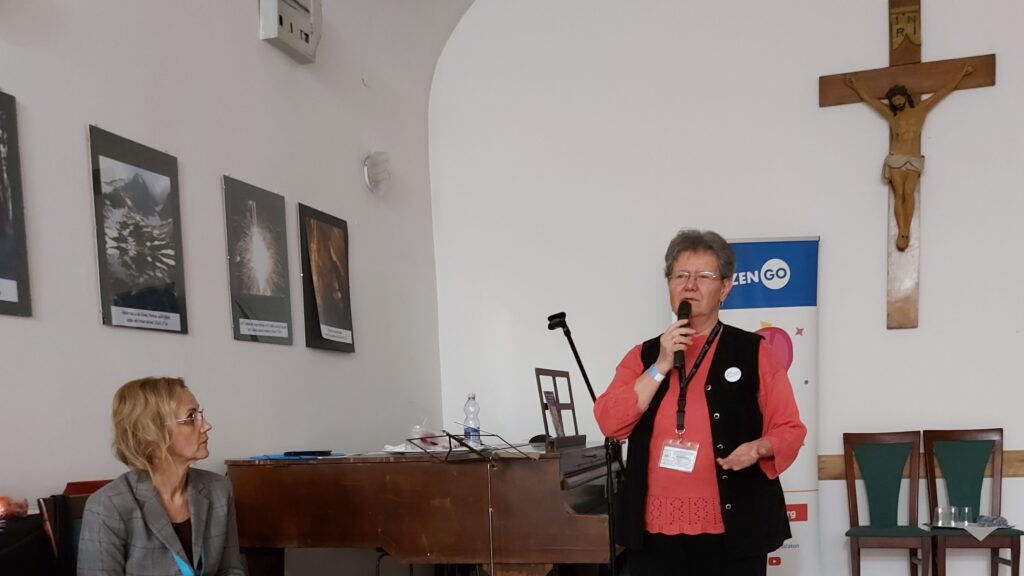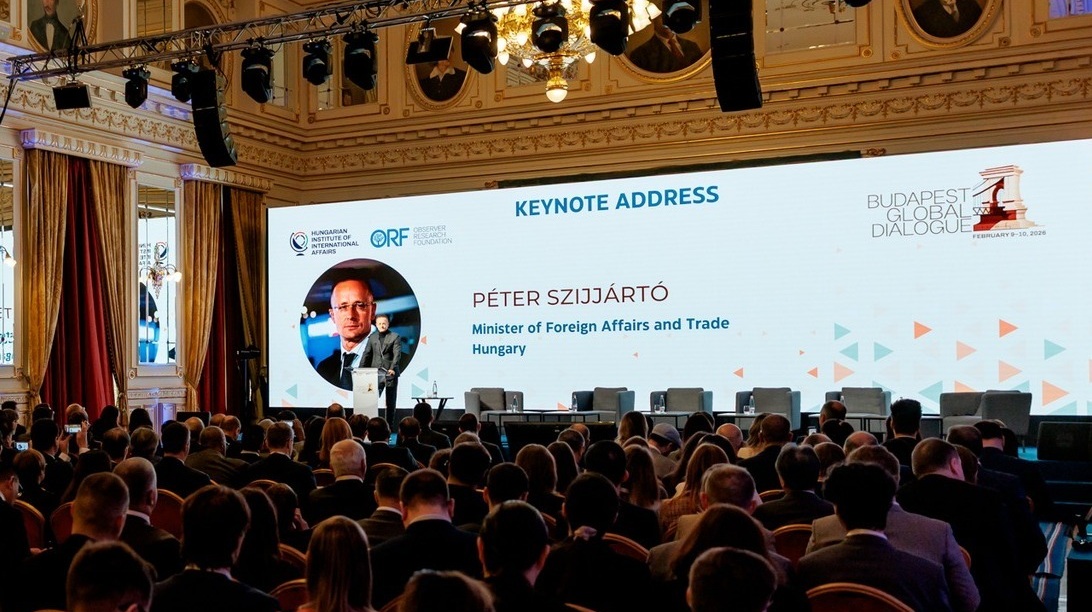
Budapest Global Dialogue 2026, hosted by the Hungarian Institute of International Affairs (HIIA), continued with its Day 2 at the illustrious Corinthia Hotel Budapest in Budapest, Hungary, on Tuesday, 10 February. Minister of Foreign Affairs and Trade Péter Szijjártó of Hungary gave the keynote speech for the day.
Minister Szijjártó started by lauding the fact that what he described as a ‘very timely conference’ was organized in a Hungarian–Indian cooperative effort. Reflecting on the tagline of the event, ‘Back from the brink’, he facetiously said that he was not sure if we actually had stepped back from the brink; he was only sure that there is a brink nearby.
The Minister also stressed the importance of dialogue, for which he opined that Budapest is the perfect venue where freedom of expression is respected, and no censorship is imposed. On a more sombre note, he stated that we are living in the toughest era since the end of World War II for global security. In this era, a new global world order with completely new rules, regulations, and methodologies is emerging. However, no one knows for sure when that process will finalize, he added.
He went on to level heavy criticism at Brussels. According to Minister Szijjártó, the EU leadership has botched its response to all four major crises of the last quarter-century: the 2008 financial crisis, the 2015 migration crisis, the 2020 coronavirus pandemic, and the 2022 start of the Russo–Ukrainian war as well. Meanwhile, Hungary has broken from Brussels in their handling of all four exigencies, and thus has emerged with much better outcomes, the speaker argued, while the EU has become completely isolated and is no longer a major factor in global politics and the economy.
For instance, PM Orbán has been consistently advocating for a ceasefire in the armed conflict in Eastern Europe, while the EU has been constantly undermining US President Donald Trump’s peace efforts, the Minister told the audience. He also boldly declared that the Russo–Ukrainian war is ‘not our war’ and ‘we do not want to send any money’ to either of the belligerent sides.
Prime Minister Orbán is in the unique position of being able to discuss issues with the American, Chinese, Russian and Turkish Presidents as well, the Foreign Minister highlighted. He went on to state that a ‘patriotism-based’ new world order is taking shape, which is the product of a ‘global patriot revolution’ that had started right here in Budapest.
‘Prime Minister Orbán is in the unique position of being able to discuss issues with the American, Chinese, Russian and Turkish Presidents as well’
He also lauded the achievements of the Hungarian government, pointing out the low unemployment rate, low energy prices, and high amount of government-funded family support in the country. Also, he noted that the largest amount of foreign direct investment came to Hungary in the last four years.
FM Szijjártó expressed his gratitude to the Hungarian public that has stood by their government for 16 years, and warned that whether or not Hungary will be able to continue to be sovereign or Brussels will dictate its course is at stake in the upcoming Hungarian parliamentary election.
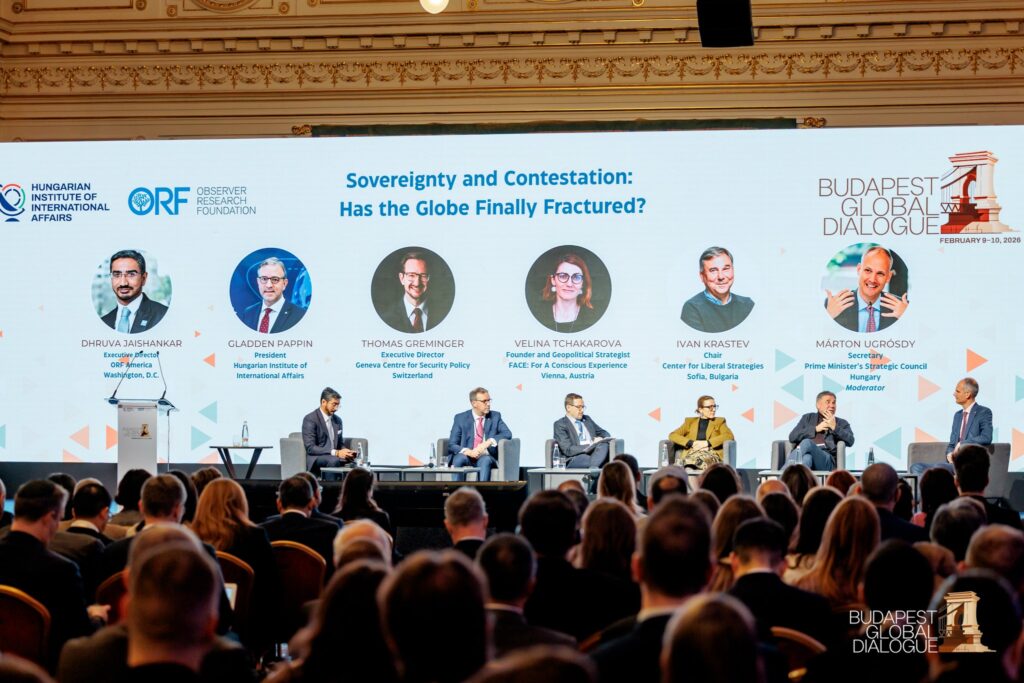
After the keynote address, panellists gathered on stage for a thoughtful discussion. The panel was titled ‘Sovereignty and Contestation: Has the Globe Finally Fractured?’. Meanwhile, the five featured panellists were: Dhruva Jaishankar, the Executive Director for ORF America in Washington, DC; Ivan Krastev, the Chairman of the Centre for Liberal Strategies in Sofia, Bulgaria; Velina Tchakarova, Founder and Geopolitical Strategist of the consultancy company For A Conscious Experience in Vienna, Austria; Thomas Greminger, the Executive Directorof the Geneva Centre for Security Policy in Geneva, Switzerland; and Gladden Pappin, President of the Hungarian Institute of International Affairs in Budapest, Hungary. Márton Ugrósdy, Secretary of the Prime Minister of Hungary’s Strategic Advisory Council, served in the role of the moderator.
Mr Pappin described the current era of geopolitics as an ‘interregnum’ between world orders with no clear rules set yet. He also shared that, after the end of the Cold War, the West overemphasized the importance of its liberal values in its victory over the Soviet Union. This has let that idea ‘go to their heads’, as he put it, which has led to bad decisions. One of the biggest of these bad decisions was letting manufacturing leave the United States, once a great industrial power, and import the vast majority of manufactured goods from China, the speaker pointed out.
Prime Minister Mark Carney of Canada’s speech at the World Economic Forum last month was repeatedly brought up at the panel discussion. Mr Pappin claimed that, unlike what PM Carney has described in his speech, today’s geopolitics is not a dichotomy between the old liberal, rules-based world order and a pure power struggle; he argued that a third alternative could be built. He also characterized President Trump’s newly founded Board of Peace as the Western counterweight to the BRICS alliance.
Mr Krastev reminded all that while the old liberal world order was governed by formal rules, it was also characterized by persistent double standards that favoured the most powerful states. He also noted that President Trump’s foreign policy is based on the economic and military might of the USA, not just its sphere of influence outlined in the Monroe Doctrine. The speaker then challenged some of what FM Szijjártó had said in his keynote address, pointing out that Hungary’s economic successes, as enumerated by the Minister, were achieved in large part due to the country’s membership of the EU and the European single market.
Ms Tchakarova observed that few on the global stage had anticipated the depth of cooperation now seen between Russia and China, describing the two countries as ‘natural rivals’. She argued that Beijing and Moscow have aligned in order to reduce the risk of domestic instability amidst geopolitical turbulence, adding that their partnership is reshaping the global system across multiple dimensions of international relations. Mr Greminger, for his part, described Switzerland as a ‘middle power’ despite its small size and population. Again referencing PM Carney’s speech in Davos, he noted the Canadian Head of Government’s argument that middle powers have the potential to reshape the world order. Mr Greminger added that, despite frequent claims about a rapidly changing global system, most countries still support a rules-based international order, collective approaches to global challenges, and action on climate change. The speaker also urged nations to form bilateral alliances around specific challenges.
Mr Jaishankar started his piece by stating that ‘world orders come to an end’, and pointed out that while there may be nostalgia for the old liberal rules-based system in the European Union, that is not so much the case in his home country of India. He also explained that all previous world orders—such as the colonial world order, the interregnum period between the two world wars, the Cold War order, or the post-Cold War liberal order—needed either a hegemonic power, such as the United States in the post-Cold War era, or concert among many nations, such as the Congress of Vienna in 1814–1815. Right now, however, we have neither—he added.
He then went on to claim that elitism vs populism, mass migration into the West, and the COVID-19 pandemic have all contributed to the fall of the old world order. Mr Jaishankar added that he believes ‘things are coming to a head’ in multiple theatres around the world: in Ukraine, in the Middle East, and in the Indo–Pacific as well.
Watch the Live Stream of Budapest Global Dialogue 2026 ft Péter Szijjártó Below
Related articles: