The United States is gearing up to celebrate the 250th anniversary of its Declaration of Independence. The momentous historic occasion is commemorated in Hungary as well: the Ludovika University of Public Service, in collaboration with the US Embassy in Budapest, the Hungary Foundation, the Hungarian-American Fulbright Commission, as well as the John Lukacs and Thomas Molnar Institutes of Ludovika University, hosted an event titled America and Freedom 250 on Wednesday, 3 June. The venue was the Ludovika Campus in Budapest, Hungary.
Rector of Ludovika University Gergely Deli gave the first keynote address of the day. On top of the 250th anniversary of US independence, Mr Deli also noted the namesakes of the two institutes of his university, Lukacs and Molnar. As he put it, they achieved great things in the United States while having ‘Hungarian hearts’.
As for the 250th anniversary of independence, the speaker stated that at its core, the American experience is about freedom, equality, and order. He then pointed out that these align with the core principles of Ludovika University, as the main mission of Ludovika is to teach good governance.
Mr Deli then described the United States as ‘irreplaceable’ on the world stage; and noted that its Constitution is one of the world’s oldest constitutions continuously in effect, thus it is of great interest for legal scholars around the world. The speaker also stated that American culture has a wide-ranging influence around the world.
Caroline Savage, Chargé d’Affaires a i at the Embassy of the United States of America in Budapest, spoke next. She started by lauding the diplomatic career of Philip T Reeker, an upcoming speaker in attendance. As for the great anniversary, she told the audience that it is an opportunity for Americans to reflect on the founding principles of their nation, as well as on ‘liberty, democracy, and self-governance’.
Ms Savage stressed that the story of America is a living story, to which each generation contributes something of their own. She also noted that President Trump has described the Freedom250 celebrations soon commencing in the United States as a ‘launchpad for the future’.
She then commemorated the Hungarian people who contributed to the history of the great American nation. The speaker highlighted figures such as Michael Kováts de Fabriczy, the ‘father of American cavalry’, scientists John von Neumann and Edward Teller, and filmmaker Adolph Zukor. She stated that these people are examples of times when ‘Hungarian excellence meets American opportunity.’
Ms Savage ended her piece with inspiring words, saying that Americans are celebrating the 250th anniversary of their independence ‘with reverence for the past, confidence in the present, and high expectations for the future.’
Philip T Reeker, Former US Ambassador to Macedonia and Distinguished Fellow for Europe at the Wilson Center followed. He told the audience that few relationships have been as consequential and as complicated in human history as the evolving relationship between the United States and Europe. At the time of the declaration of the United States’ independence, most of the European nations followed the monarchy model of statehood, while the United States was a new experiment in a republic with no guarantee to last, the speaker noted.
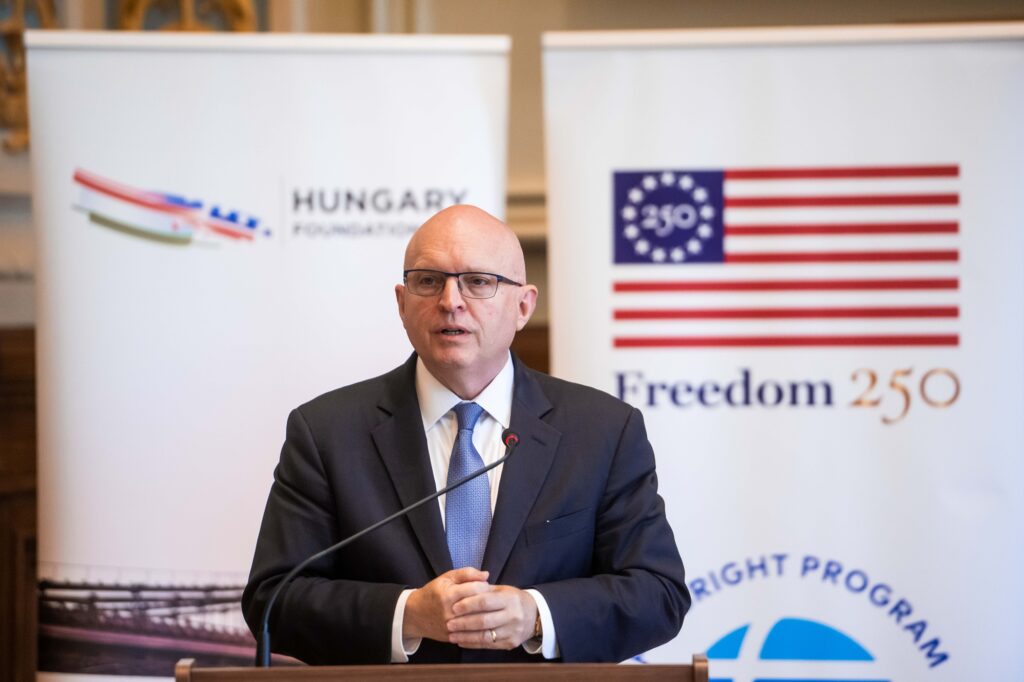
Mr Reeker also took time to note that his first diplomatic mission was to Hungary following the collapse of the Soviet Union.
He then drew historical parallels between the concerns of King George III of Great Britain over the spending required to protect the American colonies in the French and Indian War of 1754–1763, which prompted him to raise taxes on the colonies to collect contributions for their defence, and the current concerns of President Trump over the disproportionate spending of the United States on the collective NATO defence.
On further historical reflections, the speaker stated that NATO was created as a consequence of the United States realizing that instability in Europe affects its own national security during World War I.
He also noted the importance of NATO, which is the first peacetime military alliance the US made with European nations in its history. Mr Reeker went on to point out that the only time the Article 5 collective defence clause has been triggered to date was in defence of the US, following the 9/11 terror attacks in 2001.
Tamás Magyarics, Professor of English and American Studies at ELTE University and Editor-in-Chief of the Hungarian Conservative print magazine, spoke of unilateralism in American foreign policy.
According to the professor, a number of elements need to be present for a nation to be able to engage in unilaterism in the world stage. One, it needs to have a ‘cooperative advantage’ to other nations, meaning other nations need to have incentives to cooperate with it. Two, in the case of the United States, two ‘weak neighbours’ to its North and South, and oceans to its East and West, as 19th-century Chancellor Otto von Bismarck of Germany said. Three, it needs a growing population, which the US is maintaining by being an attractive nation to immigrants. Four, large, strategically advantageous territory. Five, an abundance of natural resources: the US is the world’s #1 producer of crude oil. Six, a collective ideology, for instance, the global missionary vision of President Woodrow Wilson in the early 20th century. And six, an exceptionally strong military, as Mr Magyarics explained.
Gergely Prőhle of the John Lukacs Institute for Strategy and Politics opined that while for most European nations, their relationship with the United States is based on things such as trade, values, alliances, and institutions, for Hungary, it is more emotional than that. That is because in the time of Soviet oppression, the US was a representation of hope and freedom for Hungarians, he explained, despite the US not coming to Hungary’s aid in 1948 during the communist takeover or in the 1956 Hungarian revolution against the Soviets either.
Mr Prőhle then praised Former US Secretary of State Henry Kissinger, who, in his opinion, understood that Europe was not just a geographical region, but a collection of nations with living histories. Within the broader strategy of détente spearheaded by Secretary Kissinger, the Holy Crown of Hungary returned to Budapest in 1978, under President Carter, the speaker pointed out.
He then stressed that US–EU trade accounts for about 30 per cent of global trade, to demonstrate the crucial nature of the relationship. Mr Prőhle also stated that with former nations of the communist bloc joining NATO and the EU, some might argue that ‘the transatlantic mission is complete’.
Gábor Csizmazia, also of the John Lukacs Institute for Strategy and Politics, spoke of the isolationist vs interventionalist dichotomy in US foreign policy. The speaker shared that some experts believe that US foreign policy has been linear since the American Revolution; while others think it is cyclical, with isolationist and interventionalist periods alternating in every 21–28 years.
Related articles:
At a time when public debate is increasingly polarized and superficial, Hungarian Conservative remains committed to depth, intellectual honesty, and independent conservative thought.
Producing high-quality journalism requires resources. Your contribution helps us expand our coverage, reach new audiences, and keep our content accessible.

Please consider supporting our mission.