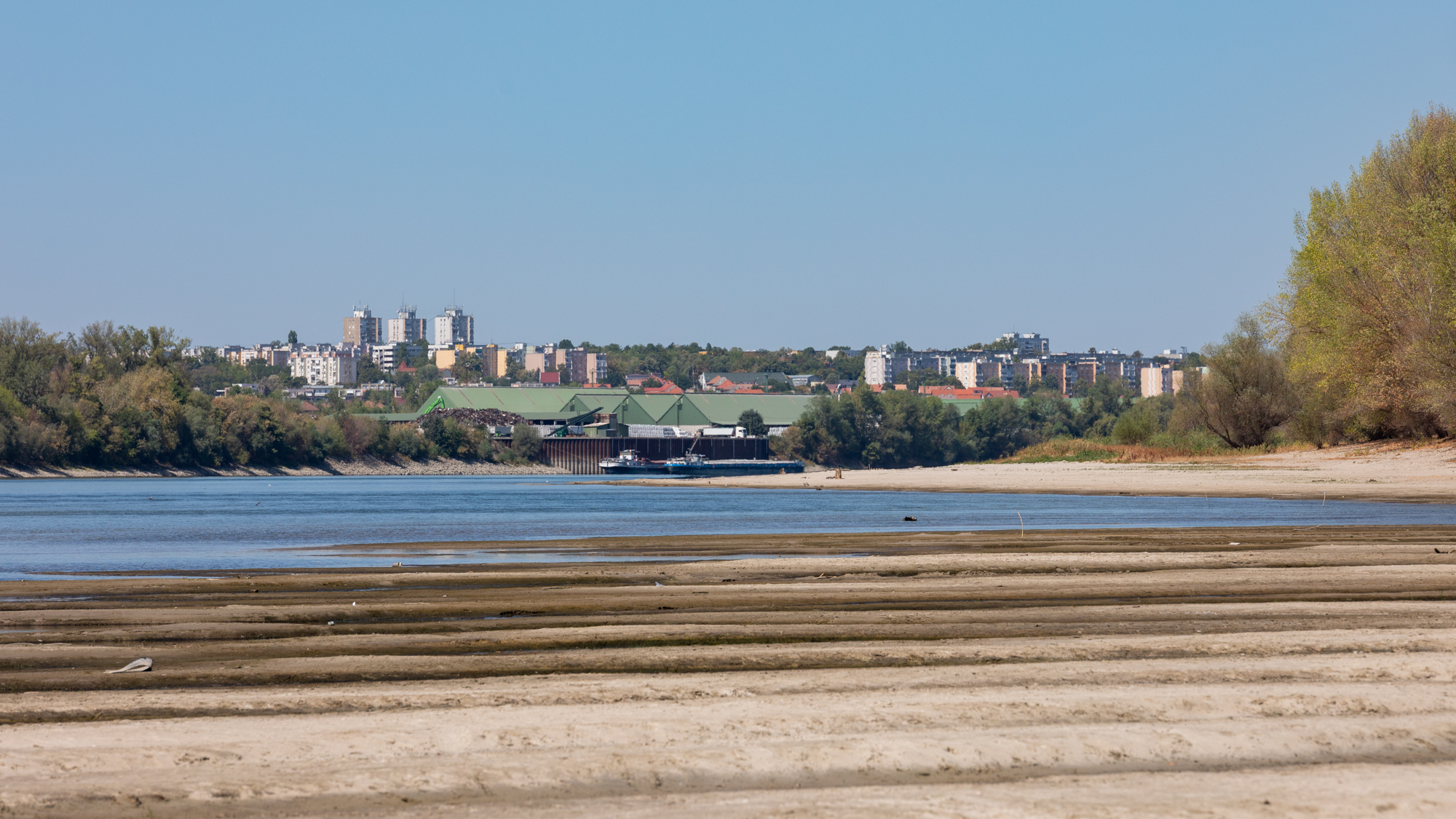
Construction of the emergency riverbed sill at the Paks Nuclear Power Plant has caused severe local scour in the Danube and begun damaging the structure itself, according to an investigation published by the Hungarian outlet Átlátszó on Wednesday. The outlet estimates that the riverbed may have deepened by 8–13 metres at the construction site.
Government videos cited by Átlátszó put the water depth at the deepest points at around 4–5 metres when construction began. More recent official statements referred to depths of 13 metres and later 16–18 metres, as the narrowing of the river dramatically accelerated the current.
The flow also began undermining the construction. Defence Minister Romulusz Ruszin-Szendi said material built during the day was collapsing by evening, while the Defence Ministry confirmed that 117 concrete blocks weighing 2.5 tonnes each were placed into the foundation after the strong current began ‘greatly’ deepening the riverbed.
The National Directorate General for Water Management (OVF) denied that the episode resulted from defective construction. It told Átlátszó that washouts had been expected because of changing construction phases and the ‘necessary acceleration of the schedule’. The Defence Ministry said the intervention had stabilized the riverbed and that no further scour was being observed.
Neither authority, however, answered Átlátszó when asked whether the sill could still be completed according to its original design. The outlet said its sources had raised doubts over whether the originally planned continuous structure remained feasible.
These problems have placed fresh scrutiny on how the project was commissioned from the outset. OVF invited only one company, A-Híd Építő Zrt, to carry out the works under an emergency procurement without open competition, according to Világgazdaság. The authority said the extreme urgency of the situation and the project’s technical requirements made inviting additional bidders impracticable.
‘OVF invited only one company, A-Híd Építő Zrt, to carry out the works under an emergency procurement without open competition’
A-Híd consequently submitted the only offer. Its price was more than HUF 2 billion net, around 30 per cent above the approximately HUF 1.55 billion that Világgazdaság reported OVF had originally identified as available financial coverage.
OVF also acknowledged that the winning offer exceeded the procurement’s estimated value, although it did not disclose the precise estimate. It said the indicative offer used to calculate that value covered a narrower technical scope than the final contract.
The contract was signed on 14 August. OVF handed the construction site to A-Híd immediately that same day. Construction then moved faster than originally planned. Prime Minister Péter Magyar announced on 29 August that the two sides of the sill had met in the middle of the Danube, completing the first phase less than three weeks after works began. The government said the milestone had been reached two weeks ahead of schedule.
Two days later, the Defence Ministry publicly acknowledged the scale of the developing scour. It said the strong current between the two sides had begun to significantly deepen the riverbed and that the concrete blocks were being installed specifically to stop further erosion while also accelerating construction.
OVF told Átlátszó that hydrodynamic and sediment-transport modelling had anticipated possible deepening and that concrete blocks had already been considered as a mitigation measure. The Budapest University of Technology and Economics, which participated in the hydraulic planning, declined to answer the outlet’s questions about whether the observed scour matched the modelling.
The controversy surrounding the emergency procurement and the resulting challenges involving the riverbed sill come amid already controversial procurement practices during the new government’s first months in office.
One of the first cases concerns the organization of this year’s St Stephen’s Day celebrations, where three companies were invited to an emergency tender after the state terminated its contract with Lounge Event Kft, but only Hardrock Kft submitted a bid, winning the roughly HUF 3.1 billion net contract.
‘Átlátszó reported another restricted procurement on 31 August involving two major September sporting events’
Leaked emails later showed that Hardrock managing director Dániel Besnyő had already been in contact with Lounge weeks before the tender opened, obtaining information on the planned budget, subcontractors, and technical requirements. The information was being sought at the request of government commissioner and Tisza vice-president Márk Radnai, who appeared in several later email chains but has denied having authority over the procurement and said he ‘did not read the messages’.
Átlátszó reported another restricted procurement on 31 August involving two major September sporting events. IRUB Kft ultimately became the only valid bidder and won contracts worth a combined HUF 3.7 billion. Transparency International Hungary warned that it would be problematic if the exceptional procedure became routine.
Tisza won a landslide in April on the explicit promise to govern more transparently than Fidesz–KDNP did, especially regarding public procurement. The practice so far is less convincing than the political rhetoric surrounding it.
Related articles:
At a time when public debate is increasingly polarized and superficial, Hungarian Conservative remains committed to depth, intellectual honesty, and independent conservative thought.
Producing high-quality journalism requires resources. Your contribution helps us expand our coverage, reach new audiences, and keep our content accessible.

Please consider supporting our mission.