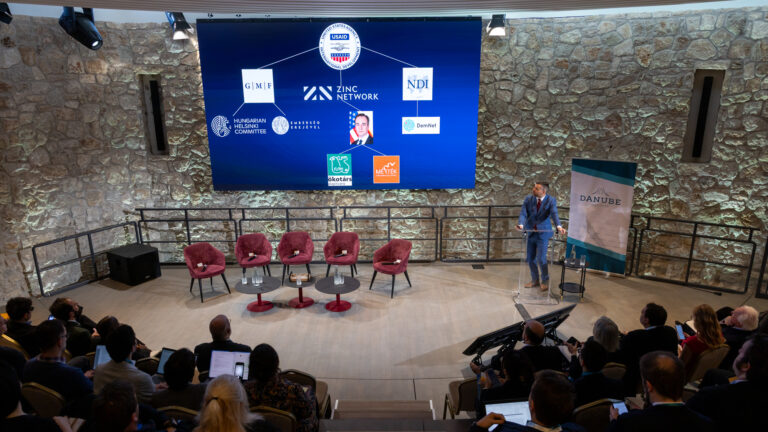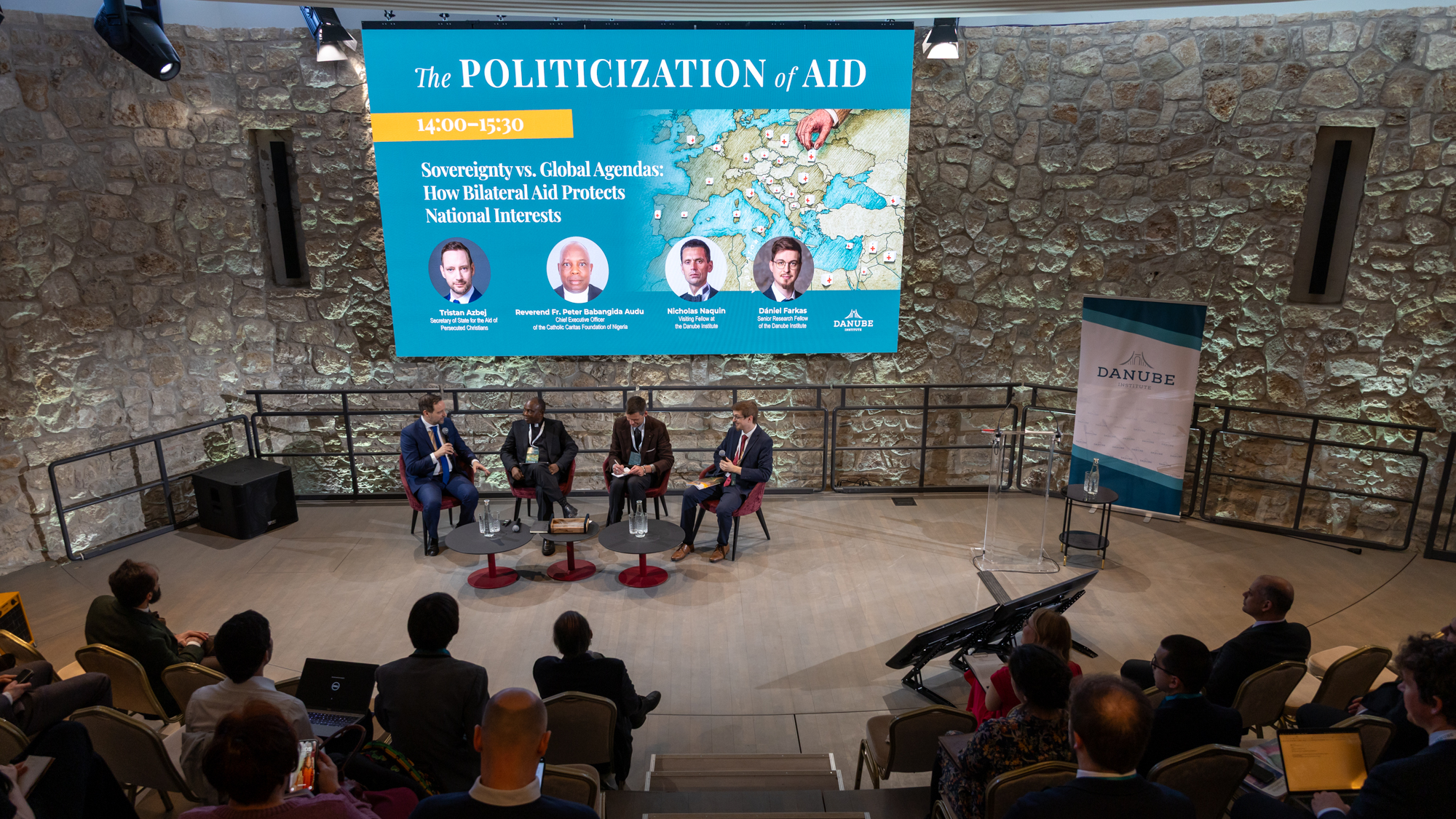
The Politicization of Aid conference, organized by the Budapest-based think tank Danube Institute, concluded with a thought-provoking panel discussion centred on how bilateral aid protects national interests compared to multilateral aid projects. Panellists argued that the Hungary Helps programme can deliver foreign assistance more efficiently than wider multilateral systems because it bypasses the ‘aid industrial complex’, sends funds directly to local partners, and ties projects to clearly defined national interests.
Participants included Tristan Azbej, Secretary of State for the Aid of Persecuted Christians; Reverend Fr Peter Babangida Audu, Chief Executive Officer of the Catholic Caritas Foundation of Nigeria; and Visiting Fellow at the Danube Institute Nicholas Naquin. The discussion was moderated by Research Fellow at the Danube Institute Dániel Farkas.
Starting the discussion, Azbej argued that while Hungary Helps is ‘not the biggest programme’ and ‘definitely not the most resourceful programme’, it is effective because it is designed around a direct, community-first method. ‘We meet with the local actors. We immerse ourselves in the local context. And we ask: “How do we help?”’ he said. ‘And then they answer us. And here comes the very strange, innovative way: then we support that.’
According to Azbej, many Western assistance schemes are constrained by internal rules that require the involvement of intermediary agencies. ‘Their hands are tied by regulations. They have to include a middleman agency, a big UN programme, an intermediary,’ he said. By contrast, ‘the aid goes straight from the Hungarian people, from the Hungarian state treasury, to the bank account of the local church or diocese in Nigeria.’
Azbej said this model is rooted in sovereignty and in ‘walking the extra mile’ to verify partners and needs on the ground. ‘We are not naïve. We know there are bad actors,’ he said, arguing that direct engagement improves accountability while ensuring money reaches intended beneficiaries.
He also contrasted administrative costs. Some implementing partners in multilateral systems ‘can take up to 30 per cent, sometimes 35 per cent’, he said, while Hungary Helps operates with overhead ‘less than 4 per cent’. ‘We want the donation of the Hungarian taxpayers to arrive to the people in need,’ he added.
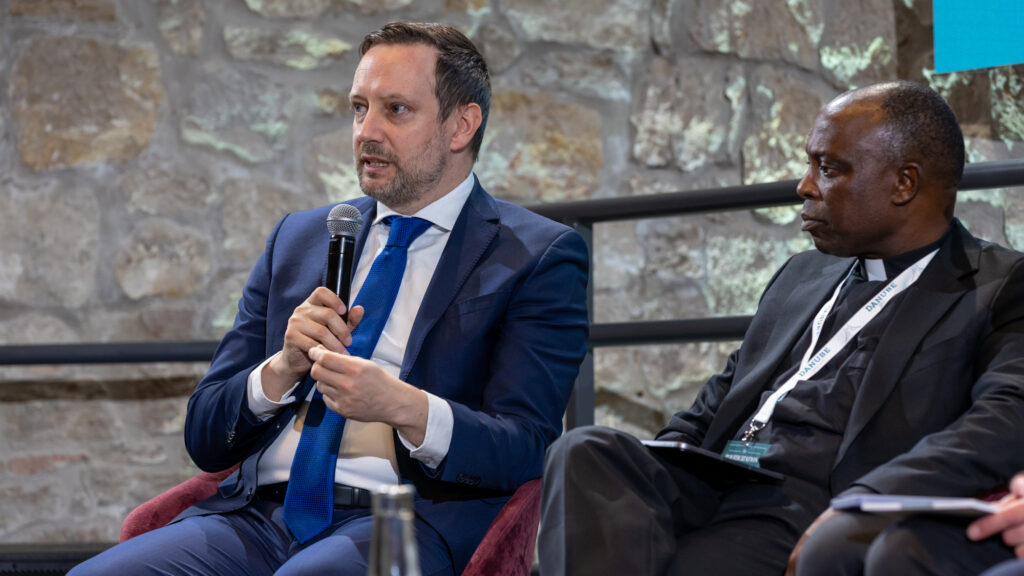
Reverend Audu from Nigeria backed the bilateral approach and criticized the barriers many local organizations face when attempting to access Western funds. ‘The first problem is lack of trust: lack of trust in local NGOs, lack of trust in national NGOs, who many times are seen as not having the capacity,’ he said, arguing that strict intermediary requirements create bottlenecks rather than building competence.
Citing a recent call for proposals, Audu said some donor programmes effectively force applicants to find intermediaries. ‘You need to get an intermediary before you can access it, before you can apply. We haven’t got that capacity,’ he said, adding that debates about ‘localization’ often become rhetorical rather than practical.
He also pushed a ‘people-centred, not business-centred’ approach to aid. ‘Whatever intervention we want to do should be people-centred, not business-centred,’ he said. ‘Partnership means mutual understanding, mutual cooperation.’
Naquin echoed the bureaucracy critique with an American example. He said a sympathetic contact described an opportunity to access a US programme but warned it would require hiring ‘a full-time staffer just to do the paperwork’. ‘You build out a 15 million or 20 million dollar project—but the process is such that it becomes extremely burdensome,’ he said.
Naquin also described visiting Nigeria and seeing aid branding in internally displaced persons camps without apparent oversight. ‘We saw stickers: UN, USAID, all over the place,’ he said. When the delegation asked residents whether they had seen representatives from the agencies listed, the answer was no. ‘So there isn’t a lot of accountability from the global level filtering down to the local level,’ he concluded.
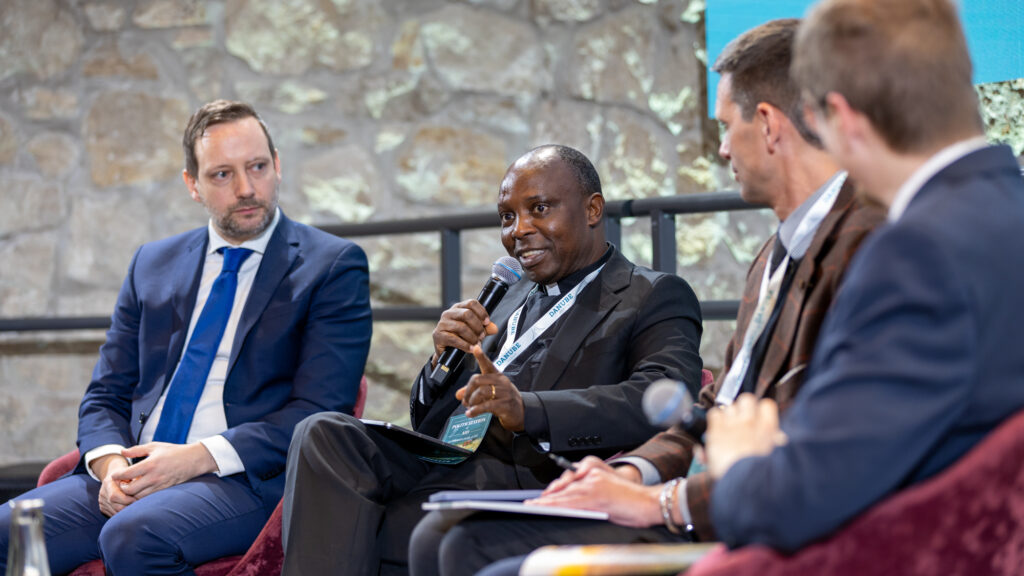
Panellists also argued that large NGOs can have incentives that diverge from recipient communities. Naquin said ‘states have budgets’ and must justify spending to taxpayers, whereas NGOs are ‘beholden to interests’. In his view, bilateral aid gives nation states more oversight and clearer accountability.
Azbej said the broader problem is the politicization of aid through ideological conditionality. He argued that, over time, many development schemes became vehicles for exporting social norms and ‘a globalist ideology’, weakening the ‘sovereignty of development’. He later cited conversations with partners who claimed US assistance had been linked to domestic legislative demands, calling such preconditions culturally intrusive.
Looking ahead, Azbej said Hungary wants a ‘paradigm shift’ towards what he called ‘post-development’, emphasizing ‘immersive engagement’ and ‘equal-to-equal cooperation’ rather than projects designed from Western capitals. He also announced a new cooperation framework with Washington. ‘Three weeks ago we signed a Memorandum of Understanding with the US State Department,’ he said, adding that Hungary Helps and the US administration will work together to support ‘religious freedom, peaceful coexistence, and persecuted communities’ in Africa and the Middle East.
‘Azbej said the broader problem is the politicization of aid through ideological conditionality’
Reverend Audu described Nigeria as ‘a very complex nation’ and said assistance must account for religious sensitivity while prioritizing human dignity. He suggested expanding support beyond one community to ‘any vulnerable group—any oppressed or persecuted group’, warning that perceptions of bias can inflame tensions.
On migration, Azbej said the programme’s logic is to help communities remain in place by building viable local futures, arguing that ‘illegal mass migration is threatening and harmful for all parties involved.’ He offered a cost comparison: integrating and supporting a migrant family in Hungary can cost ‘roughly 9 million forints—around 23,000 euros’, he said, claiming the same amount enabled Hungary Helps to reconstruct ‘five homes in Syria’ and build ‘eight homes in the north of Nigeria’.
Reverend Audu linked migration pressures to insecurity and governance failures, citing kidnappings and violence, including cases affecting clergy. ‘Nigeria is rich, but Nigerians are poor,’ he said, arguing that without security and accountable government, people will continue to seek ‘a better life’ abroad.
Related articles: