The following is an adapted version of an article written by Réka Klementisz, originally published in Hungarian in Magyar Krónika.
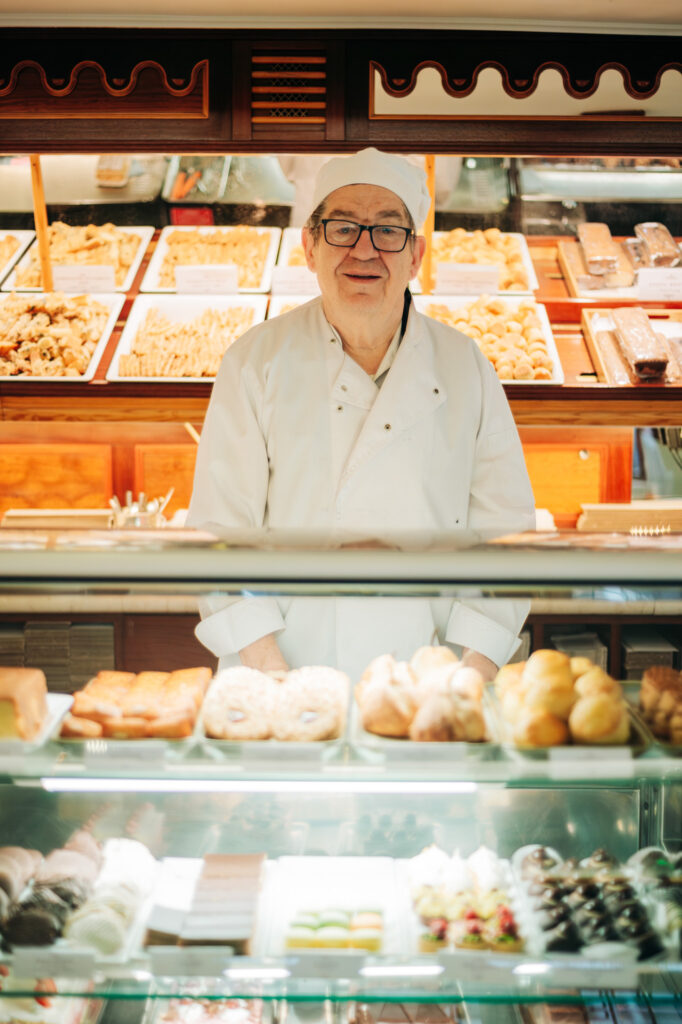
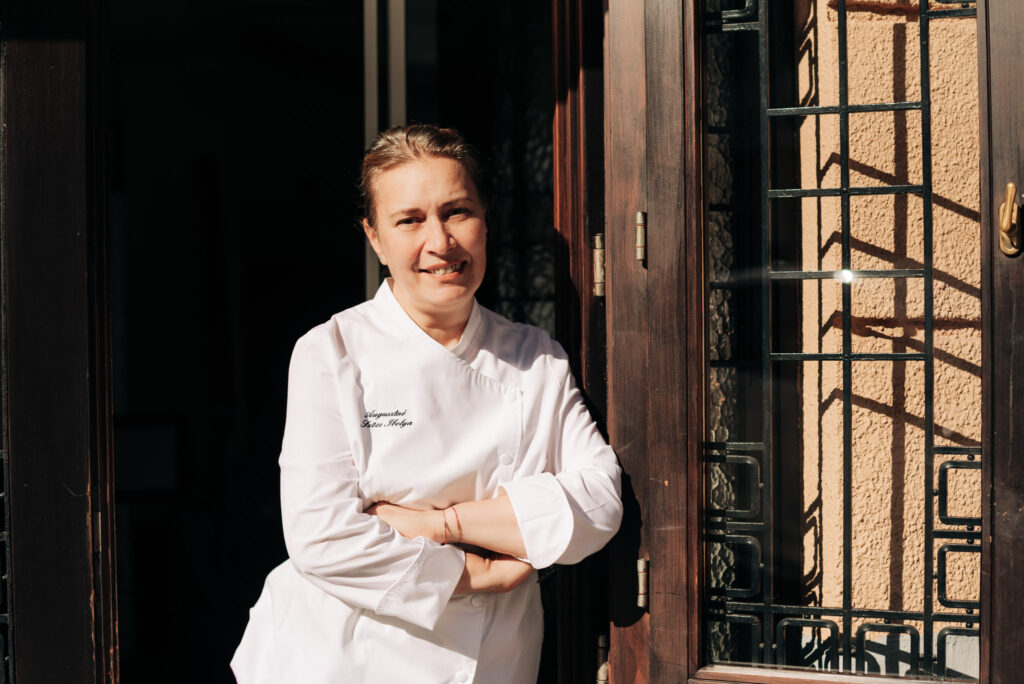
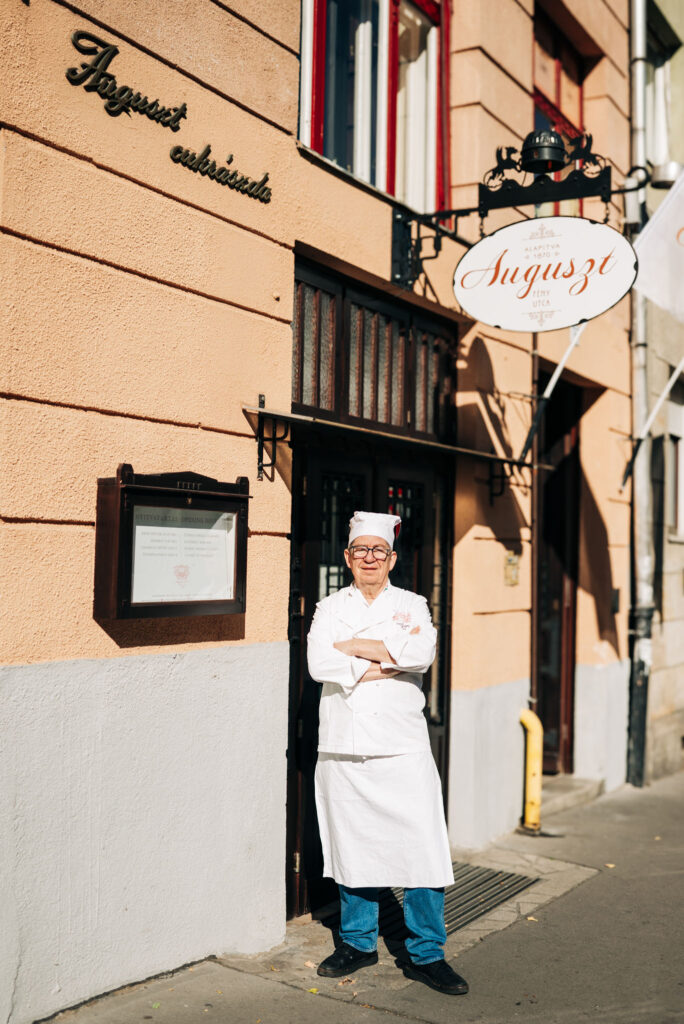
The coffee machine clicks into action; the pastry cream simmers. Almost anything could happen: master pastry chef József Auguszt has started every day this way for half a century. Together with his wife, Ibolya Auguszt, they keep a priceless time capsule alive on Fény Street—and with them, the legendary Auguszt family saga comes to life today. What can be read between the lines: timeless courage and progress—persevering through hardship, striving for the good in all times, and making every sacrifice for it. Read Magyar Krónika’s interview about the history of this 150-year-old pastry shop and the unwavering enthusiasm of its owners, József and Ibolya Auguszt, below.
***
Do you know how many days you’ve worked here on Fény Street?
József: I’d even have to think about the years. How many is it? I’ve been in the shop since 1971. That’s 53 years.
At least 20,000 days. Roughly speaking.
J: I’ve never actually counted. We have a saying here: what does a good pastry shop need? Someone to come in every morning and get the place up and running. That’s me. I’m definitely there by five in the morning every day except Monday. We had a master pastry chef who worked here for 45 years; he recently retired. We still have colleagues who’ve been with us for 20 or 30 years—they’re practically family. Ibolya has been the heart and soul of the Fény Street shop for over 20 years. I don’t even know how many stories, posts, and the like get posted online every day. That’s not my world. This story has been about the same thing for over 150 years: loyalty. I can’t speak for my colleagues, but what drives me is that it’s simply good to do. Even when it’s not financially as rewarding.
There must have been many low points over the past half-century. Did you ever think about giving up?
J: No. Loyalty is a commitment for us. We’re responsible for our customers, who trust us, and we’re responsible for our team. You have to value good employees; you have to keep going for their sake, too. Somehow, we’ve always managed to get through the tough times. Not to mention that my work is also my hobby. I don’t ride motorcycles or sail. Nothing like that. Even in our free time, Ibolya and I enjoy working to make the business more beautiful and better, preserving its values while constantly renewing it.
Do you have to cherish it like a child?
Ibolya: Something like that. You have to be present for everything to work, for the place to have a soul. Our two daughters weren’t even born yet; I remember we once went away for a little over two weeks. By the end, we didn’t know what to do with ourselves. We missed the shop.
Together at home, together in the shop—for decades now. Do you have any rituals to get through the tougher days?
J: Are you asking if we’re tired of each other? (Laughs)
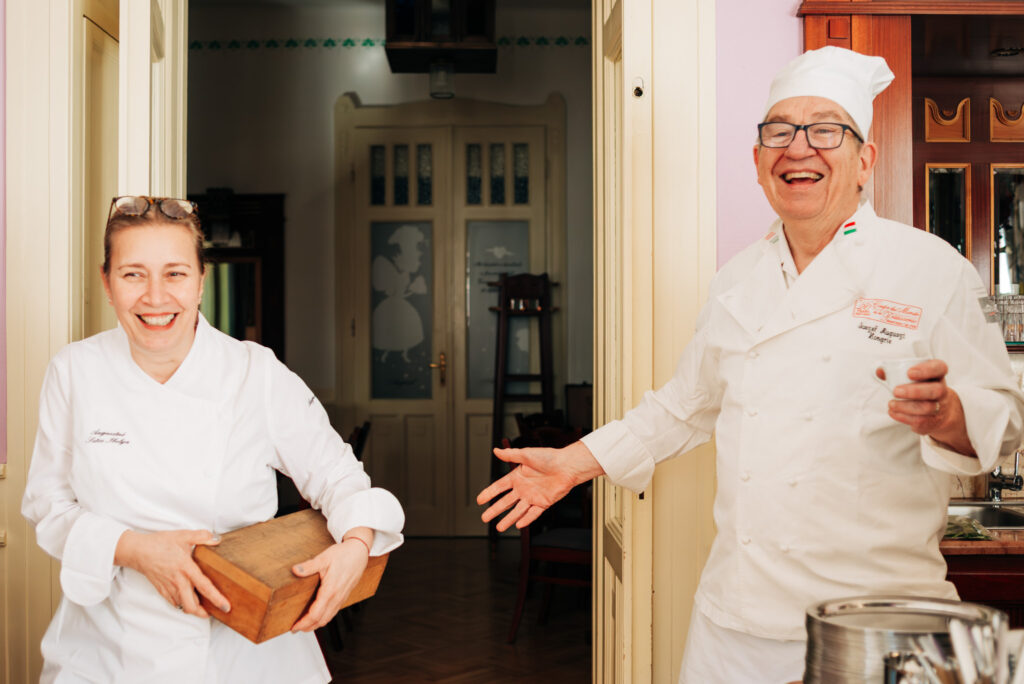
Staying together under this kind of pressure is an achievement already in itself these days.
I: I wake up at dawn, and my mind is already racing with what needs to be done today. We live on the edge of Városmajor. By the time I walk in from there, I’ve already called our daughter, who’s studying abroad, and I’ve filled myself with colours and light. Then the supplier arrives—I have to sign this, restock that, wipe down the things—I get into a groove, carried away by the flow. It really matters what kind of example I set for my colleagues.
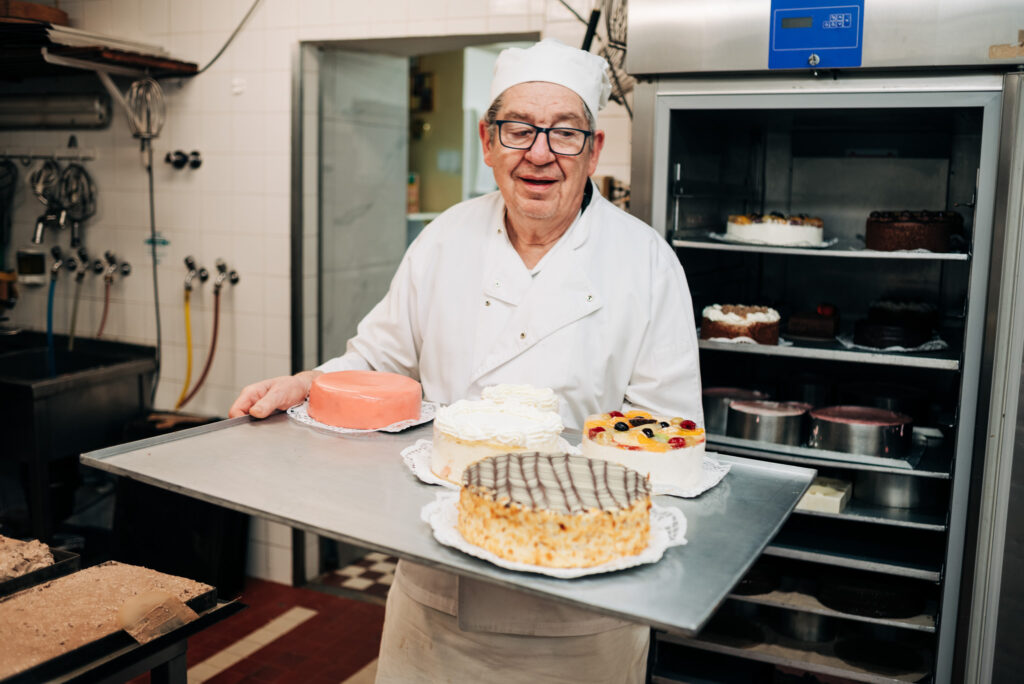
J: I can only keep going. At dawn, I turn on the coffee machine, the oven, the proving oven, brew coffee for my colleagues, and wait for them with it. Every morning, I make the cream for the cream pastries. At 75, I can’t handle as much as I used to, but these are important, sustaining rituals. My father, Elemér Auguszt, was still sitting at the register in this very same shop even when he was over 90. Work keeps me fresh. I never feel a crushing weight of responsibility on my shoulders.
What does this place mean to you? The objects, the scents, the atmosphere.
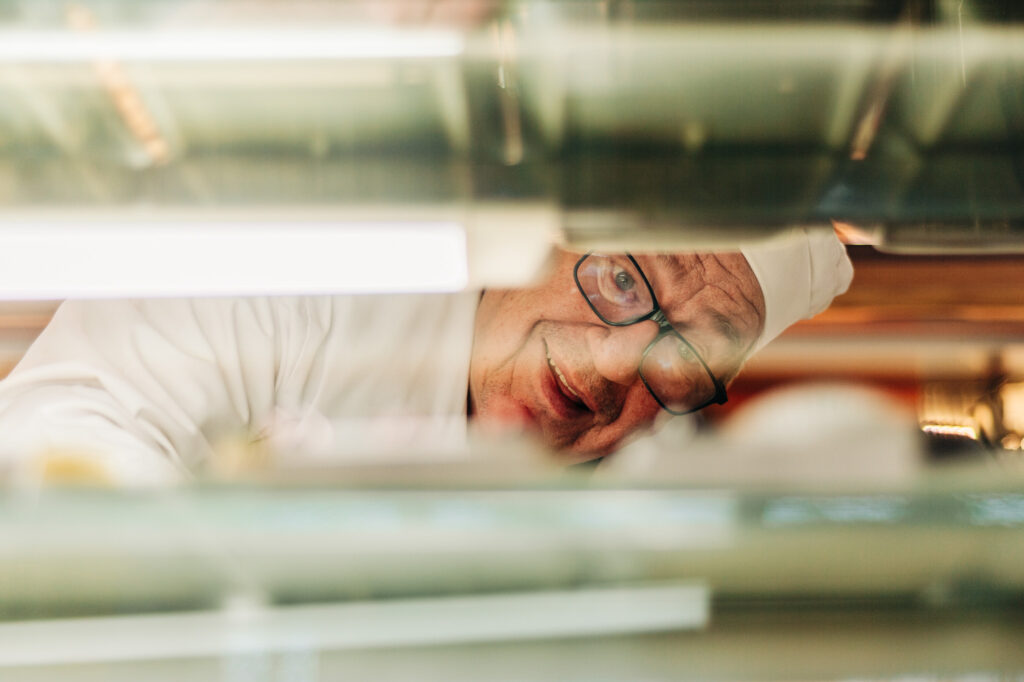
I: It was the scents that drew me to Auguszt as a customer more than two decades ago. I knew nothing about the family or the history of the pastry shop. I was born in Transylvania and moved to Hungary when I was 16. I worked as a nurse at János Hospital—even after work, I could still smell the disinfectant on my skin. Whenever I walked by, the scent of vanilla transported me to another world. After my shift, what often kept me going was shopping at the market, then coming to the pastry shop when it opened, and stocking up on a week’s worth of pastries. Just before Christmas, at the end of a shift, Józsi suddenly walked in with his injured finger, and the words just slipped out of my mouth: ‘Damn it, who’s going to make cream cakes for me now?’ (Laughs) That’s how we met.
J: There was a bit of a backstory, though. A priest friend of mine was transferred to Székelyvarság in the 1970s. I visited him in 1976, but I got lost in this beautiful, charming little town. I stopped by a house where children were running around in the yard. I asked them where the priest lived. Later, Ibolya and I realized that she was among those children! 13 years later, she moved to Hungary.
I: After that fateful accident, I tended to Józsi’s finger for a short while and even dropped by his shop, but then, out of pride—I didn’t need his thank-you pastries—I didn’t go back anymore. Yet I remember how kindly even my father-in-law ‘courted’ me. He had a kind word for every woman, a gallant, affectionate gesture. This was unfamiliar to me; I’d never experienced anything like it, and it felt incredibly good. Then one day Józsi spotted me at the bus stop, lured me away by saying this bus wasn’t running, and asked me to walk with him to the next one. It was just a few minutes’ walk, but enough for him to ask me out to dinner. There’s a 22-year age gap between us. I hesitated about the date, but eventually gave in.
J: It wasn’t that simple! (Laughs) She showed up at dinner in ripped jeans and a T-shirt and started by shoving her Romanian passport into my hand, so that I’d know who I was dealing with. She barely touched her food, either. She pulled out all the stops to try to scare me off.
But it was of no use.
J: I knew she was the one for me.
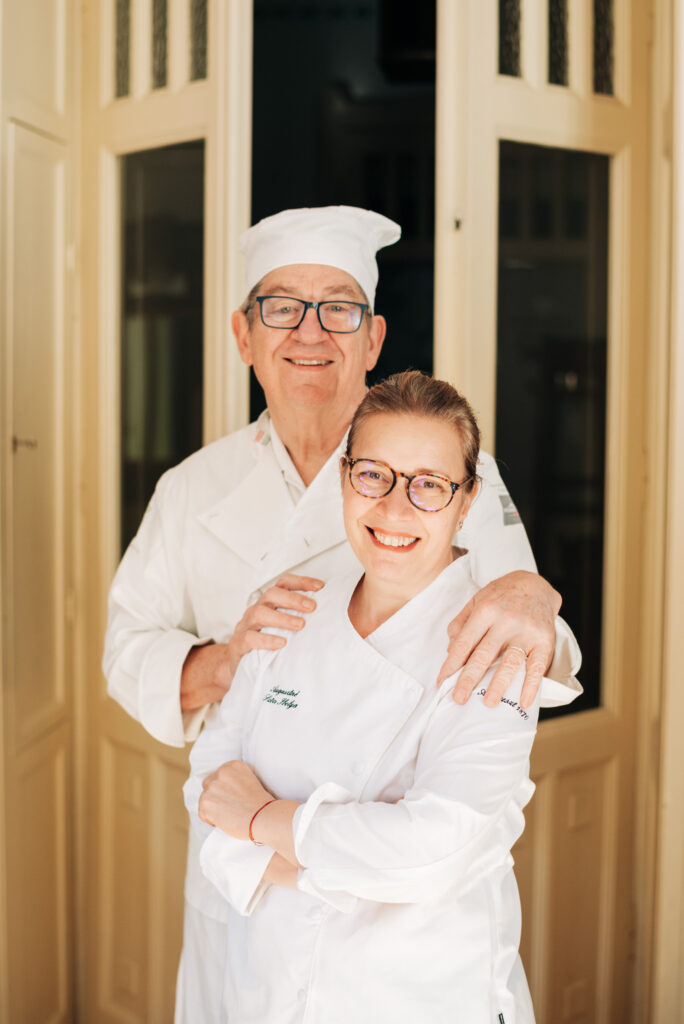
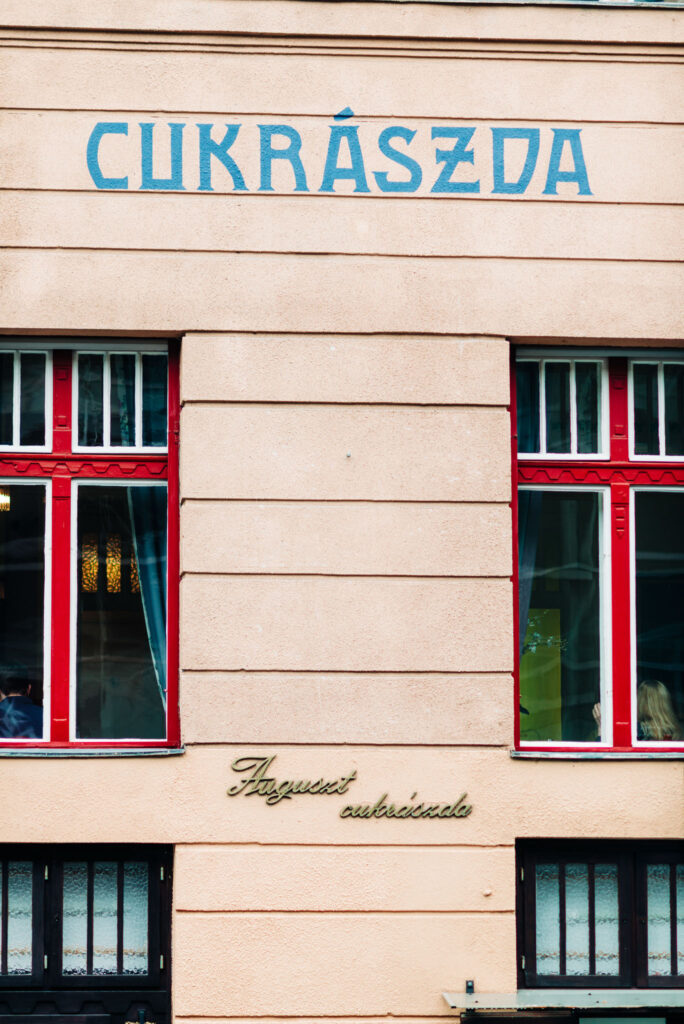
I: And he waited it out while I struggled with a young Transylvanian girl’s inferiority complex, my fears, and my pride. He even waited for me to go to Germany to try my luck.
It couldn’t have been easy to take on the family history and legacy of a confectionery dynasty with such a long history at such a young age. Were you afraid of that?
I: When I realized what the Auguszt name really meant, it weighed heavily on me at first. As someone from Transylvania, I have a different kind of sensitivity to history. I was born into communism; they took everything away from my family.
What spoke to me most about the Auguszt family’s wonderful story was the ceaseless struggle. I sensed all the bitterness and disappointment that preceded their steps toward overcoming adversity.
So many times, they could have given up simply because of that transgenerational experience—why do anything here, since it will be lost or taken away anyway?
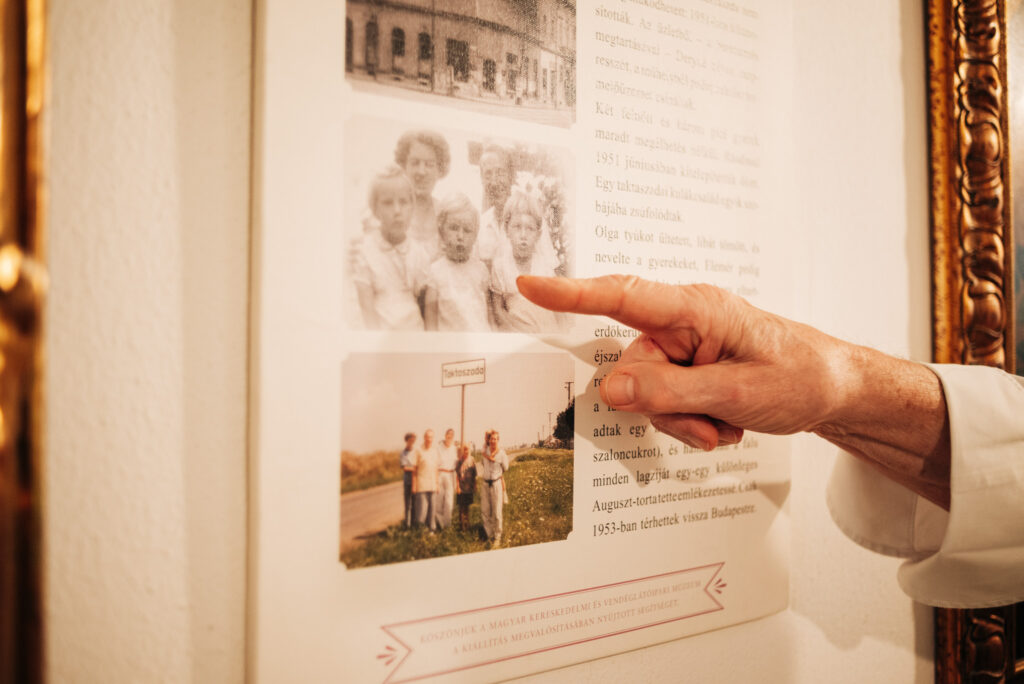
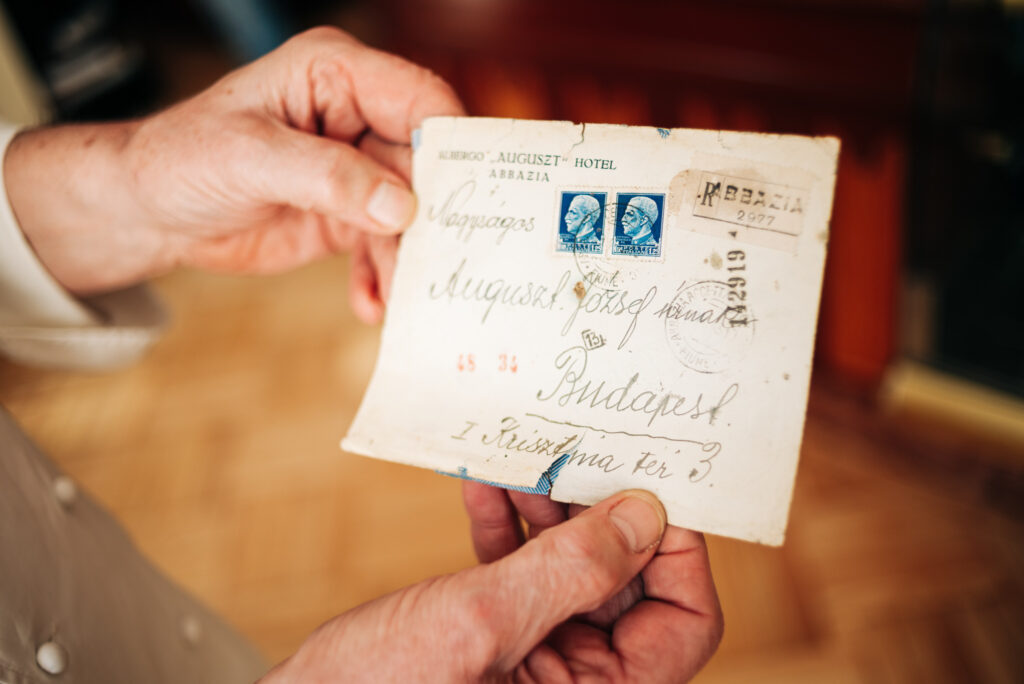
Both of these things happened. József Auguszt’s shop on Krisztina Boulevard was hit by a bomb during World War II, and after the country was rebuilt, József’s father and his entire family were deported in the early 1950s.
J: Yes, I had just been born at the time. I spent my early years in Taktaszada. For three years, my parents walked to the well for water, the outhouse was out in the yard, and my father guarded corn at the collective farm. After the consolidation, the Közért Company suddenly needed a good pastry chef, and someone thought of Elemér Auguszt. My father only accepted the job on the condition that his family could come with him. That’s how we were able to move back into our old apartment, though as subtenants. It lasted ten years; the five of us—my parents and my siblings—had two rooms. But my father had a job, and my mother, Olga Resetka, became the store manager at the Budapest Confectionery Company. After the revolution, my mother was the only one among Budapest’s grocery stores who could fully account for her inventory. This was recognized by her receiving a trading license. So, my parents were finally able to rent a small storefront across from the market on Fény Street—and the pastry shop has been operating there to this day.
What is the most important message of Auguszt’s story today?
J: That behind every lasting value lies a great struggle. It is struggle and perseverance that bring success to fruition. And what is success? It’s when a man walks in with his grandson and says: ‘I ate rice ice cream here already 40 years ago, and it was just as delicious then.’ Once, a man wearing a cowboy hat came in with his Native American wife. He asked: ‘Do you have Russian cream cake?’ As it happened, we did. He hadn’t been to Hungary in 40 years, but he remembered that taste and came back for it. The beautiful thing about it is that he actually found it, right there. These kinds of feedbacks are priceless treasures.
I: Sometimes people bring in old packaging, some tiny ‘fossil’ from the days of the Krisztina Square store. When that happens, my first thought is how we might preserve it and adapt it to today’s context. If only for the sake of historical satisfaction, out of gratitude toward the ancestors. Every physical memento that turns up tells me that a future can be built even from ruins. Auguszt is like a black box, a time capsule from a bygone era that now lives on only in traces. Before the COVID pandemic, the panels telling the family’s story were already up on the wall. It’s interesting that almost only foreigners look at them; this heritage resonates with them. When a retiree and a younger group sit next to each other here, half of the younger crowd is surely on their phones, while the older folks chat, seeking each other’s gaze.
It’s nice to see the regular groups of diners who come to us, but there are fewer and fewer people who come not just for the good pastries, but to truly linger. To connect with each other and with the spirit of the place.
For young people today, the basic experience is that everything is about the moment, everything is fleeting, you can’t trust anything, and loyalty doesn’t pay off. Perhaps they don’t even realize that they’re shopping at the only historic pastry shop that’s still family-owned.
Yet people still come here for the pastries. I wonder why?
J: We don’t use any special ingredients or techniques. We don’t have a secret recipe book either. It doesn’t depend on those things. They held a bejgli competition a few years ago. A bejgli could score up to 100 points, and even the best one only earned 54. The trade association asked me to give a lecture on bejgli, hoping the results would improve. I shared all my tricks; about 60 people listened. Not much changed for the next competition. Do you know why? Because it doesn’t depend on the recipe.
I always say that I can’t lend my hands to anyone.
What are you most proud of? What would you say is associated with József Auguszt’s name in your family’s history?
J: Well, Ibolya.
I: But where would I be without Józsi’s perseverance?
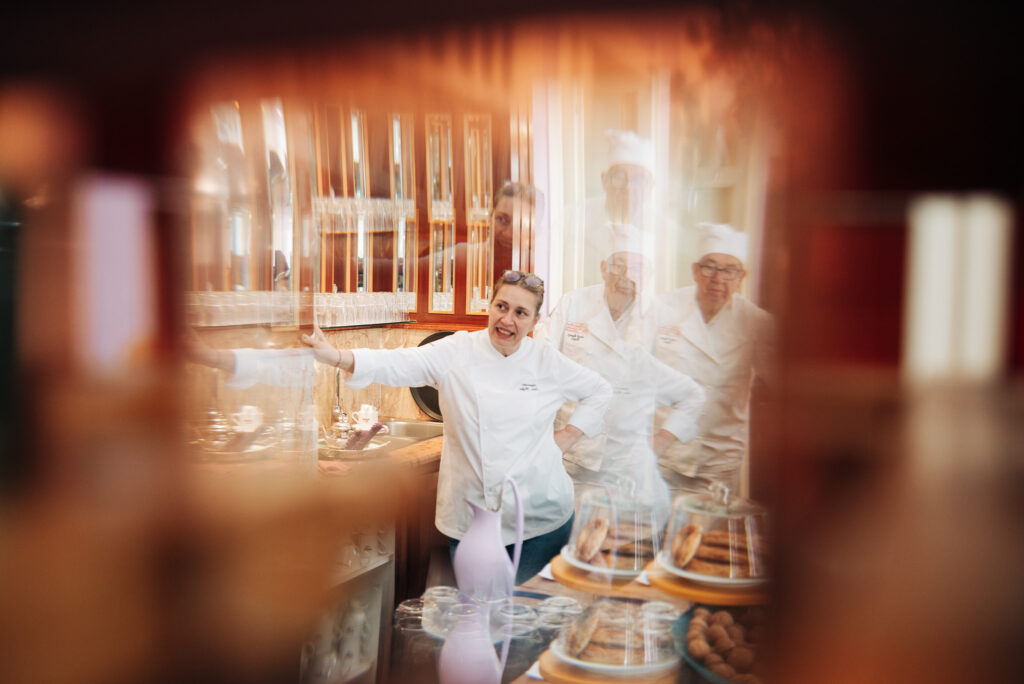
None of the earlier Auguszt pastry shops managed to stay in business as long as the Fény Street location, which has been open since 1957.
J: That’s right, I’m the one who has spent the most time here. I never argued with my father, yet I was still able to make my own innovative changes. My mother never interfered with the workshop issues; her domain was sales.
Yet the Auguszt wives have always played an important role in the family history.
J: Yes. My great-grandmother, Erzsébet Strébek, ran the Tabán shop on her own after my great-grandfather’s death and raised both her sons to be pastry chefs. She was a tough woman. My grandfather, József E Auguszt, loved the fine arts; there wasn’t a single empty spot on the walls of their apartment—only paintings. Thus, the Krisztina Square confectionery attracted the great figures of the era—among the regulars were also Árpád Feszty and Sándor Márai. My grandmother, Vilma Helvey, managed the business from behind the scenes. And the shop on Fény Street wouldn’t exist without my mother’s perseverance. My father always used to say that without her, we’d still be displaced in Taktaszada. Ibolya confirms this list of names. I truly believe I can be most proud of her. She brought that innovative spirit to the 21st-century chapter of Auguszt.
I’ve heard that Auguszt pastries are even served on luxury trains bound for Iran and at diplomatic events. Is that thanks to Ibolya as well?
I: I indeed have a hand in it. Someone recently told me that every tradition was once an innovation. If I just take our E80 cake as an example, it proves the point. It was made for Elemér Auguszt’s 80th birthday, and it was such a success that it has been part of our regular menu ever since. In this spirit, I too am adding new directions to the rich legacy of Auguszt. I love to bring what I do to perfection. I’m sure there’s still a desire to prove myself as someone who came from across the border. Even though I know that, as many say, I’m more of an Auguszt than a real-born Auguszt.
How does it feel to hear that?
I: It feels good. It’s an honour. But I don’t want to rely solely on the legacy of the past to keep the Auguszt name shining. Customers come in just for the atmosphere, the classics, the cherry roll, the chocolate mousse—but it’s important that we can show what we’re putting on the table. There was no question that I had to pass the master pastry chef exam myself; that’s how I can contribute the most to Auguszt’s present. Sometimes chance plays a role in an innovation. Once, before Christmas, instead of regular oranges, a good batch of wonderful, juicy blood oranges arrived from our supplier—we had to do something with them. In a way, necessity gave birth to the white chocolate mousse with poppy seeds and blood orange purée, which has since become a big favourite.
J: Ibolya has outdone me; she even has a Golden Wheat Ear Farmer certificate.
Do you have time to tend to your garden as well?
I: I dream of having my own apricot orchard, because we used to have one. József E Auguszt bought an almond orchard in Budatétény, and he had an apricot orchard on Sas Hill. The almond and apricot pastries were made from our own harvest. I imagined that once I’m no longer needed so much here in the shop—since the kids are taking over—I’ll tend the garden for the benefit of the pastry shop. That’s how I will help them.
Do the girls want to join the Auguszt family business? Will they take over the shop?
J: They’re in their early twenties now, and there’s no pressure on them; we never wanted to push them before either. A few years ago, on Children’s Day, we invited them over for dinner. The older one, Anna, said they wanted to make an announcement. They surprised us. They said that when the time comes, they’d like to take over the business together. All we told them was to focus on their studies, find their own paths, and that the business will be here if they’re really serious about it.
I: One of them is studying food engineering, the other is majoring in agriculture. I’m surprised by how committed they are. My daughter, who is studying management, researched the topic of generational succession in family businesses; she even wrote her thesis on it. Now she’s continuing her work in Tokyo, studying Japanese family histories that go back hundreds of years. Well, that’s where you might find the secret to success.
And what is the secret to success?
I: To persevere through tough times, to seek out and see the deeper meaning and purpose behind things. To always strive for the good. As someone from Transylvania, that’s what I’ve learned, and that’s what I bring to the table.
J: They say smooth seas do not make skilled sailors. I think that’s it.
***
The Power of a Preserved Craft
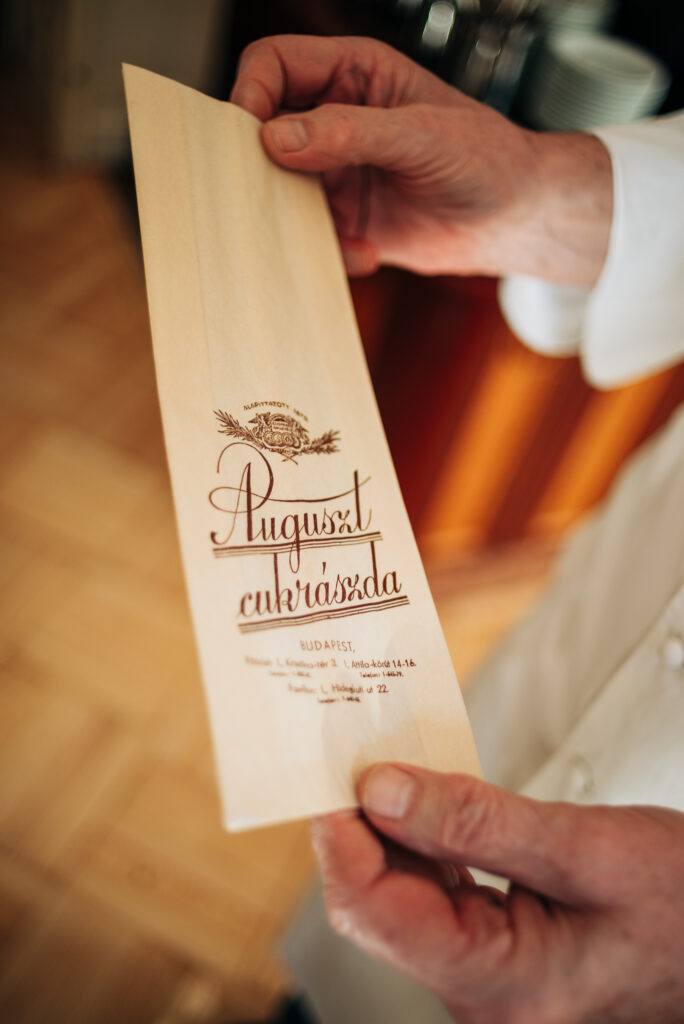
The founder of the confectionery dynasty, Elek Auguszt, was born in 1836. Armed with his letter of release, which he received in 1852, he travelled throughout the Monarchy for 17 years, thereby expanding his knowledge. In 1870 he opened his confectionery in Tabán. This was the family’s first shop, the starting point of a confectionery dynasty spanning more than 150 years. After the founder’s death, his widow continued to run the business, and then his son, József E Auguszt, followed in his footsteps, applying his talent for sculpture to the art of confectionery as well. In the early 1900s, József added pastries he had learned to make abroad to the menu, and the Krisztina Square confectionery soon became famous as the ‘Gerbeaud of Buda’.
The family business opened several shops in Buda, with quality, elegance, and precision becoming its hallmarks. The splendour of the Auguszt Pavilion, which opened on Hidegkúti Road, even surpassed that of the main shop. The confectionery was then nationalized during the Soviet Republic. József’s son, Elemér, modernized the workshop between the two world wars, and after studying abroad, he ran one of the country’s most renowned confectioneries. The bombings of World War II destroyed the shop on Krisztina Square, but in 1947 the family opened a new one. During the nationalization of 1951, they lost their business once again; Elemér and his family were resettled in Taktaszada, where he upheld the honour of the trade even under modest circumstances.
Opened in 1957, the Fény Street pastry shop, under the leadership of József and Ibolya Auguszt, continues to uphold the spirit of its predecessors to this day. József Auguszt’s life’s work was even recognized with the Budapest Award (Budapestért díj) in late November 2025.
Related articles:
Click here to read the original article.
At a time when public debate is increasingly polarized and superficial, Hungarian Conservative remains committed to depth, intellectual honesty, and independent conservative thought.
Producing high-quality journalism requires resources. Your contribution helps us expand our coverage, reach new audiences, and keep our content accessible.

Please consider supporting our mission.