When Pedro Sánchez walked into La Moncloa in June 2018, he sold himself as the man who would clean up Spain. His predecessor, Mariano Rajoy, had just been removed in the country’s first successful no-confidence motion after a massive corruption scandal poisoned the Popular Party’s credibility to govern. Sánchez’s PSOE held just 84 of 350 seats, yet he assembled 180 votes with an extraordinary coalition of leftists, Basque and Catalan nationalists and others. The promise was to root out corruption and bring ‘regeneration’ to Spain’s exhausted political system.
Eight years of Sanchismo, however, have made Spain look less regenerated than even more exhausted. In July, 69.1 per cent of Spaniards told the state-run Centre for Sociological Research (CIS) that they had little or no confidence in Sánchez, a rather unsurprising finding given the scale of corruption in which his circles have become mired. His former transport minister José Luis Ábalos was sentenced in June to 24 years and three months in prison for corruption offences. Sánchez’s brother David was convicted in July of administrative misconduct and barred from public office for nine years, while his wife, Begoña Gómez, is set to face a jury trial on influence-peddling and embezzlement charges, which she denies.
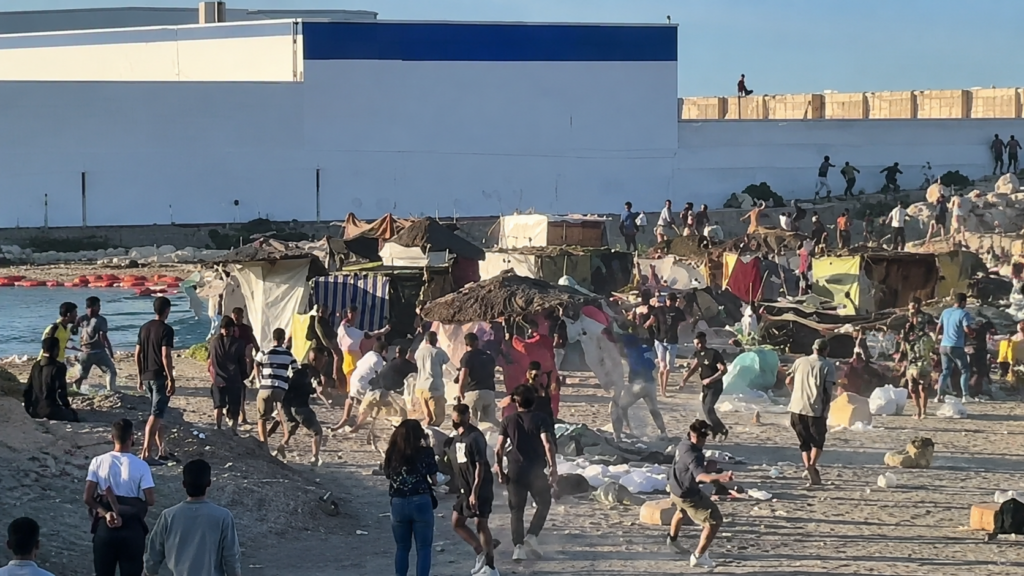
To top all of that, there is now Ceuta, the Spanish enclave in North Africa of roughly 84,000 residents living with the aftermath of an unprecedented mass invasion of more than 80,000 illegal migrants from Morocco at the end of July. Thousands still remain in Ceuta to this day, fuelling a deteriorating security, public-health and political crisis. Sánchez himself claimed at the beginning of August that the situation was under Madrid’s control. Locals protesting for a third consecutive day and attempting to drive out illegal migrants themselves do not agree with him. Ceuta is the end product of Pedro Sánchez’s weird socialist experiment.
Remaking Spain under Sanchismo
Over the past eight years, Spain has been used as a laboratory for social transformation in a country historically and deeply shaped by Catholicism. Sánchez’s governments have deliberately pushed the state into some of the most fundamental questions traditionally governed by religious, familial and biological understandings: the beginning and end of life, the meaning of sex and gender, and the authority of parents over their children.
The trajectory has been clear for years: euthanasia was legalized in 2021; in 2023, abortion rules were expanded so that 16- and 17-year-olds could terminate pregnancies without parental consent, while the mandatory three-day reflection period was abolished. The same year, Spain adopted one of Europe’s most permissive gender-identity regimes: anyone over 16 may request a change of registered sex without medical or psychological evidence, 14- and 15-year-olds can do so with their legal representatives, and 12- and 13-year-olds may seek judicial authorization.
Supporters of Sanchismo call it progress; however, it more closely resembles ideological engineering: the deliberate use of state power to reshape assumptions about life, family, sex and identity that were embedded in Spanish society long before Pedro Sánchez arrived at La Moncloa.
‘Spain has been used as a laboratory for social transformation in a country historically and deeply shaped by Catholicism’
Migration fits perfectly into that experiment. In fact, it is one of its most consequential components. Under Sánchez, migration is not treated primarily as something Spain should limit and control, but as another instrument to transform the country.
This year, his government’s extraordinary regularization process received 1,174,978 applications. On 30 June, Sánchez followed it with a €500 million Integration and Citizenship Plan, promising new legal migration channels, stronger public services and a future State Agency for Human Mobility. He said the ability to ‘welcome, integrate and move forward together’ forms part of what it means to be Spanish.
Ceuta is now living with the consequences. Nearly a month after the border collapsed, thousands of illegal migrants remain, and thousands of Ceutans have taken to the streets demanding the expulsion of the invaders and Sánchez’s resignation. Residents have blocked Red Cross food deliveries and torn down migrant encampments themselves. Madrid keeps asking for calm, but calm is difficult to demand from people who no longer trust the government to protect them. The residents of Ceuta are the first to experience the real-life consequences of Sanchismo’s overly permissive migration policy, and the situation looks increasingly grave by the day.
Betrayal Should Have Consequences
And when things went wrong, Sánchez said there was nothing to see. Madrid claimed that almost every illegal migrant had returned to Morocco in the days following the invasion and that authorities had everything under control. That was despite Ceuta’s local administration, led by mayor-president Juan Jesús Vivas, constantly demanding help from the state over the past month; extensive media reports of a deteriorating security crisis and a growing number of rapes; and officials on the ground confirming that the situation was far from controlled. Sánchez’s response for almost a month was denial, ignorance and betrayal.
Betrayal first of Ceuta, second of Spain, and third of Europe and Western civilization itself. Yes, the consequences of Sanchismo are far from confined to Spain itself, as the example of Ceuta makes clear. The enclave is not merely a frontier for Spain, but for the whole of the EU.
Leaders of 22 EU countries have already condemned Sánchez’s migration policy for acting as a pull factor for mass migration, citing the risk of secondary movement inside Schengen. Italy has already acted by temporarily restoring air and sea border controls with Spain, to which Sánchez responded in the same way he responded to Ceuta’s calls for help: he introduced reciprocal measures and blamed EU member states as ‘selfish’ for speaking up.
However, this is not merely a rhetorical or diplomatic question. Spanish media, citing security sources, have already reported that individuals previously arrested, convicted or investigated in jihadism-related cases were identified among those who crossed. There has been separate reporting that some of the Ceuta invaders have already reached mainland Spain and disappeared from the authorities’ view. While there is no evidence of it, there is at least a possibility that some may already have moved on to another EU country. That represents a clear and serious threat to all of Europe.
‘Sánchez’s response for almost a month was denial, ignorance and betrayal’
Europe can therefore no longer pretend that Sánchez’s migration policy is simply Spain’s sovereign decision. If Madrid cannot secure an external frontier whose collapse threatens the entire Schengen area, other Europeans should stop carrying the risk for him. The Commission and member states should take concrete steps, including Schengen restrictions and the freezing of EU funding through conditionality mechanisms similar to those previously used against Poland and Hungary over rule-of-law concerns.
Sánchez has spent years lecturing other European governments about solidarity and European values; if his policies now endanger the common frontier, Europe should answer with something he understands perfectly well: political isolation and financial consequences. Those who remain silent are complicit in Sánchez’s betrayal as well.
Europe cannot allow one man’s megalomaniacal addiction to power to threaten the security, culture and civilization of an entire continent. Whatever coalition arithmetic Sánchez invents next, whatever pledge he reverses, whatever concession he offers, it should no longer be enough. Sánchez has had eight years for his experiment, and both Spain and Europe have now seen where it leads.
The City That Refused to Surrender
The weird socialist experiment, therefore, must end here, in Ceuta. And when it does, Europe should remember. It should remember the residents who filled the streets because they refused to accept insecurity and abandonment as their new normal. It should remember a city that did not take the knee when its own national government appeared incapable of restoring order.
And we should equally remember leaders like Juan Jesús Vivas. If every leader in Europe possessed even one-tenth of that courage and unwavering commitment to serving their own people, perhaps this continent would still behave like a civilization confident enough to defend itself rather than one constantly apologizing for doing so.
To President Vivas and to the people of Ceuta: Europe owes you a debt it should never forget. You were abandoned on Europe’s frontier, yet you refused to surrender it. In doing so, you became a shield for Spain and an inspiration for all of us.
Related articles:
At a time when public debate is increasingly polarized and superficial, Hungarian Conservative remains committed to depth, intellectual honesty, and independent conservative thought.
Producing high-quality journalism requires resources. Your contribution helps us expand our coverage, reach new audiences, and keep our content accessible.

Please consider supporting our mission.