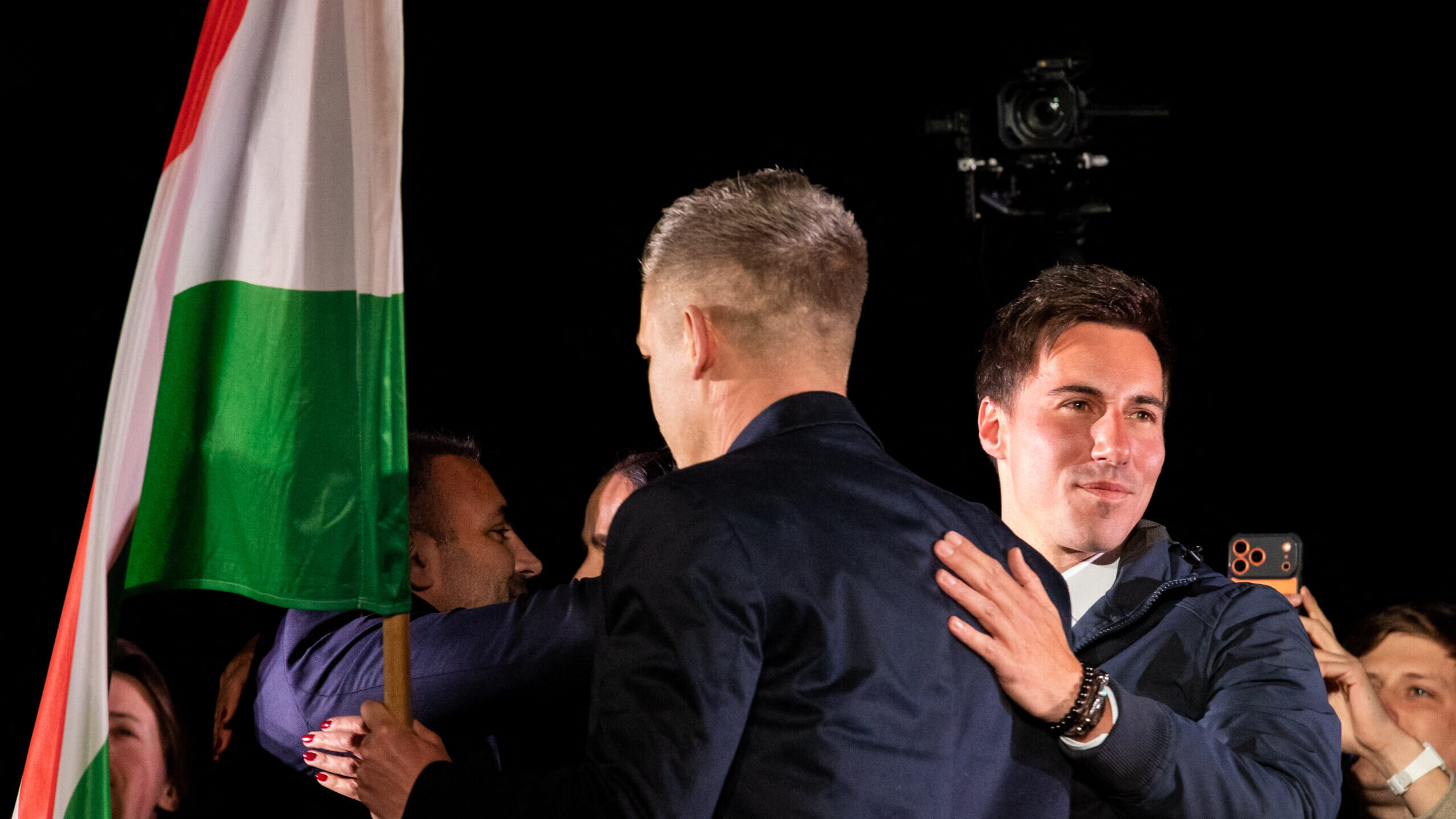
Former independent MP and anti-corruption campaigner Ákos Hadházy published emails on Wednesday that he says expose a manipulated tender behind this year’s St Stephen’s Day celebrations, placing Tisza vice-president and government commissioner Márk Radnai inside the pre-procurement preparations. Hadházy said Radnai appeared on virtually every relevant message and accused the government of reproducing patronage practices it had promised to dismantle.
The dispute concerns the HUF 3.085 billion (€8.52 million) net—about HUF 3.91 billion (€10.79 million) gross—contract awarded to Hardrock Kft after the state terminated agreements with Lounge Event, part of Fidesz-linked communications entrepreneur Gyula Balásy’s group. The National Event Organizing Agency (NRÜ) opened an emergency negotiated procedure on 7 July, inviting three companies. Hardrock was the only bidder.
On 16 June, former Tisza event director Miklós Zelcsényi emailed Lounge chief Dia Wolf, saying he had requested information on the 2026 celebrations ‘at the request of government commissioner Márk Radnai’. Radnai was copied. By 21 June, Hardrock managing director Dániel Besnyő had joined the exchanges and was requesting budget, supplier and technical data.
NRÜ terminated Lounge’s contracts on 23 June, while its procurement chronology says work to determine the new requirement began on 24 June. That day, an email published by Hadházy shows Lounge giving Besnyő the HUF 1.867 billion (€5.15 million) gross value of its NUVU pyrotechnics contract, with Radnai again copied.
The government decided on 2 July to stage a reduced celebration and selected the companies it intended to invite. The two unsuccessful invitees told G7 they first learnt of the tender on 7 July and declined because the deadline was too short. Hardrock had already spent more than two weeks obtaining project-specific information. It submitted the sole offer; the tender closed on 14 July and the contract was signed the next day.
Zelcsényi’s involvement in the negotiations adds another layer of controversy. Before joining Tisza in 2024, he was already linked to a corruption probe. His company organized the 2017 Budapestman triathlon with about HUF 180 million (€497,000) in state support from the Hungarian Triathlon Federation, then led by Béla Bátorfi, known as former prime minister Viktor Orbán’s former dentist. More than HUF 32 million (€88,000) went to companies linked to Bátorfi’s circle. Tax investigators questioned Zelcsényi as a suspect in June 2025 over alleged budget fraud; he denies wrongdoing. He stepped back from Tisza that November.
Radnai initially told G7 that since 9 May he had handled social consultations and had ‘no visibility or influence’ over state event organization. He did not explain why Zelcsényi had invoked his name. On Kossuth Radio on Monday, Radnai said Hungary’s events market had been dominated for two decades and the government could not rebuild it from zero. That defence leaves the central question unanswered: why Hardrock received detailed commercial information before its rivals knew they would be invited.
‘The controversy sparked outrage among a significant part of Tisza’s own supporters’
The controversy sparked outrage among a significant part of Tisza’s own supporters, with many highlighting that ‘these kinds of deals are exactly what we voted against’, warning that repeated cases could produce ‘Fidesz 2.0’. Hadházy himself questioned whether the change in government could still be described as ‘regime change’ if a ‘Fidesz company organized it before and now a Tisza one does’. Defenders of Péter Magyar’s government respond by highlighting the decline in the budget of the St Stephen’s Day programme compared with initial plans under the previous government.
The case, meanwhile, has moved into formal proceedings. Fidesz filed a public-interest notification with the Public Procurement Authority on 24 August, while Mi Hazánk leader László Toroczkai filed a criminal complaint over suspected restriction of competition in a procurement procedure. Hadházy said on Wednesday that he would file separately if the government failed to act.
Related articles:
At a time when public debate is increasingly polarized and superficial, Hungarian Conservative remains committed to depth, intellectual honesty, and independent conservative thought.
Producing high-quality journalism requires resources. Your contribution helps us expand our coverage, reach new audiences, and keep our content accessible.

Please consider supporting our mission.