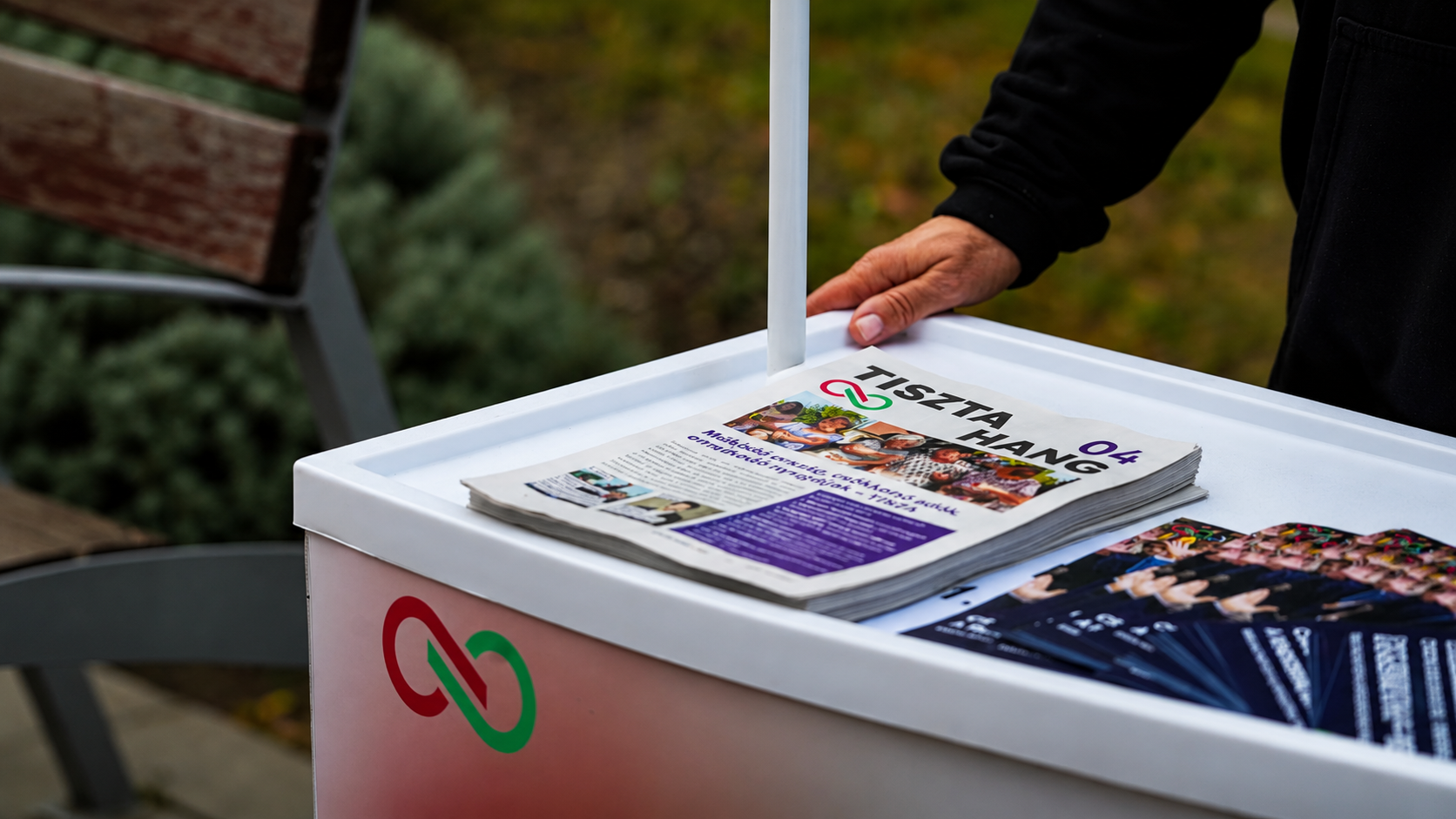
Hungary’s governing Tisza Party has begun financing its Tiszta Hang publication from the state-budget allocation of its parliamentary group, replacing the donation-funded party model used during the election campaign.
The latest issue, No 10, which began to be distributed ahead of St Stephen’s Day, lists the Parliamentary Office, with the Tisza group in brackets, as publisher and names parliamentary group leader Andrea Bujdosó as responsible publisher.
The change cuts directly against Tisza’s campaign positioning. In opposition, the party presented Tiszta Hang as an antidote to the ‘Orbán government’s publicly financed propaganda system’, stressing that it had ‘no state billions’ and that volunteers and donations made the paper possible. Since taking office, Tisza has also promised independent public media and politically neutral media institutions.
The fact that Bujdosó is named as responsible publisher makes the controversy even more sensitive. In May, she co-sponsored legislation reducing MPs’ and parliamentary groups’ state support and pledged to close legal loopholes that had allowed budgetary resources to be redirected ‘in an opaque manner for party-political purposes’. The law also ended the possibility for MPs and groups to transfer unused parliamentary subsidies directly to their parties.
‘The controversy is therefore not primarily legal, but rather a credibility problem for Tisza’
The practice of publishing Tiszta Hang from the parliamentary group’s allocation is, nevertheless, lawful. Parliamentary groups receive state-budget support through the Parliamentary Office, which makes payments but does not determine how groups spend their allocations. HVG, which first reported the funding change, noted that Fidesz previously used parliamentary-group money for campaign-style social-media advertising and films, drawing criticism that such spending could circumvent party-financing limits. The controversy is therefore not primarily legal, but rather a credibility problem for Tisza.
The controversy is amplified by the nature of Tiszta Hang itself: it operates as a party-communications pamphlet. Tisza promotes it as a vehicle for its programme and political message, while No 10 carries the front-page line ‘Purgatory against the Orbán mafia’ and still solicits donations for the party. The latest edition is presented as a summary of government achievements and plans during its first 100 days in power. The party’s own website goes further, describing Tiszta Hang as a means of delivering ‘real news’ and the Tisza programme to people whom ‘the truth’ had previously failed to reach, and says its mission is to ensure that ‘reality’ is heard in every Hungarian home.
The paper had already triggered backlash before the HVG report. One self-described Tisza activist, who said he had delivered more than 10,000 copies during the campaign, called the recent issue ‘simple propaganda’ containing ‘zero useful information’ and said his group would refuse to distribute it. Other commenters said they had volunteered to defeat Fidesz, not to distribute publicity for a governing party.
Prime Minister Péter Magyar entered the Reddit discussion, saying it was ‘strange’ that anyone objected to a party or parliamentary group using ‘its own resources’ to report its achievements. He later told the activist: ‘Nobody is obliged to deliver it’, adding that party leaders and the group would decide how to spend their resources. That description—‘their resources’—became more contentious after the funding change was revealed.
Magyar himself has an unusual relationship with the media. Although he declared after taking office that ‘the free press is not an enemy’ and promised a partnership with journalists, his political communication largely bypasses traditional editorial mediation. During his first 100 days as prime minister, Magyar published 545 Facebook posts—one every four hours and 23 minutes on average—while 444 documented 100 instances of him entering social-media comment sections, frequently beneath reports by independent outlets, to challenge criticism, reframe stories or respond directly to readers. When unfavourable coverage of him or Tisza appears, the prime minister immediately enters the comment section to provide his own framing of what happened.
‘Tisza’s wider media reforms have also become a focus of criticism’
Media researchers interviewed by 24.hu described Magyar as having effectively ‘overtaken the traditional press’. Tiszta Hang extends that same model offline: a party-controlled channel carrying Tisza’s own interpretation of government performance directly into households, without an independent editorial intermediary. Now it does not cost the party a penny, making it a highly effective communications tool.
Beyond Tiszta Hang, Tisza’s wider media reforms have also become a focus of criticism. In July, the National Association of Hungarian Journalists (MÚOSZ), Hungary’s oldest and largest journalists’ organization, protested after being excluded from the process for selecting members of the new Media Council, while organizations already in co-regulatory relationships with the media authority—including a body representing TV2 and HírTV—were given a formal role. This week, seven professional organizations also challenged the selection process for candidates to the new Independent Public Media Board, citing a lack of transparency in the procedures.
Related articles:
At a time when public debate is increasingly polarized and superficial, Hungarian Conservative remains committed to depth, intellectual honesty, and independent conservative thought.
Producing high-quality journalism requires resources. Your contribution helps us expand our coverage, reach new audiences, and keep our content accessible.

Please consider supporting our mission.