This article was originally published in Vol. 6 No. 2 of our print edition.
On a warm summer evening in late August 2024, a 26-year-old Syrian national named Issa al-Hasan carried out a mass stabbing at the ‘Festival of Diversity’ in Solingen, Germany, killing three people and injuring eight others.1 The attack took place in front of the main stage during a live performance by DJ Topic, who later revealed that security personnel had urged him to continue his set to prevent mass panic among the crowd. He kept playing for another 10–15 minutes, until the music was finally stopped. Eyewitnesses reported that al-Hasan, who had been in contact with an ISIS handler on Telegram the day before the attack, had shouted ‘Allahu Akbar’ during the assault.2 One of his victims, Ines Wallusch, a 56-year-old pharmacist, bled to death in the arms of her husband after suffering a fatal stab wound to her carotid artery.
ISIS soon claimed responsibility for the attack,3 describing al-Hasan as their ‘soldier’ who had targeted ‘Christians’ and ‘non-believers’ to avenge Muslims in Palestine and elsewhere. Al-Hasan, who fled the scene and was later captured and convicted of murder and terrorism offences, should never have even been in Germany in the first place: his asylum application was rejected in 2023,4 yet the authorities failed to remove him and he remained in the country. It is a cruel irony that he chose to unleash his murderous rage at an event explicitly promoting multiculturalism and diversity.
The Solingen attack was not an isolated one. Indeed, it followed a grimly familiar script where a migrant had embraced jihadi ideology and sought to murder their hosts. There was a spate of such attacks in 2016, culminating in a horrific ramming attack on a Christmas market in Berlin, when Tunisian Anis Amri killed 12 and injured many more.5 Just months before the Solingen attack, a 25-year-old Afghan national launched an assault on anti-Islam activists in Mannheim, stabbing to death a police officer in the process. He, too, should not have been in Germany: his asylum application was rejected in 2014,6 but he contrived to obtain a residence permit on account of his marriage to a Turkish German woman, with whom he had two children.
It is unfortunate that anyone who notices this pattern or expresses outrage at those who have enabled it runs the risk of being tarnished as a racist or ‘Islamophobe’—not necessarily on account of their substantive views but because they sustain racist or neo-colonialist ‘tropes’ about ‘minoritized’, non-Western others (i.e. that they are naturally violent and predatory). Consequently, there is very little hard data on migrants who become jihadis, and in my own academic specialism of terrorism and security studies the nexus between migration and terrorism is much neglected or, where it is studied, is marked by a sentimental bias towards migrants as well as scepticism, if not hostility, towards anyone who seeks to unapologetically defend borders.7 In response to this ‘knowledge gap’, as academics would euphemistically call it, I spent the last six months building my own dataset on Europe’s migrant jihadis and their violent activities over the last decade.8 This period encompasses the global rise of ISIS in 2015 and the migration crisis, in which hundreds of thousands fled the civil war in Syria and Iraq, seeking refuge in Europe. At the peak of the crisis, in September 2015, when thousands of migrants were stranded in Greece and Hungary, the then German Chancellor Angela Merkel opened Germany’s borders.9 ‘We can do this,’ she famously declared,10 referring to Germany’s capacity to handle the influx. In 2015, around 1.26 million first-time asylum applications were recorded across the European Union,11 with Germany registering nearly a million new asylum seekers by year’s end.12 Now, in 2026, and after a decade of bloodshed committed by migrants on German streets, the mood has shifted: can we not do this seems to be the prevailing feeling.
Migrant-Related Plots
There were 221 jihadi plots—both completed and foiled—in Europe between May 2015 and May 2025, of which 100—45 per cent—involved at least one migrant (i.e. a person who was born outside Europe and had their formative experiences in a non-European country). There were 137 migrant plotters in total. Of the 100 plots involving one or more migrants, 51 per cent were launched, while 49 per cent were foiled (see Table 1). For the other 121 plots that did not feature a migrant, 36 per cent were launched, while 64 per cent were foiled, suggesting that when migrants are involved in plots, those plots are more likely to succeed.
| Plots | Migrant-related plots | Other plots |
| Foiled | 49 (49%) | 77 (64%) |
| Launched | 51 (51%) | 44 (36%) |
| Total | 100 | 121 |
Migrant-related plots killed 279 people and injured 1,192 others (see Table 2), while plots that did not involve a migrant resulted in 107 deaths and 1,449 injuries, which would suggest that when a migrant is involved in a plot it is markedly more deadly, although two migrant-related plots—the November 2015 Paris attacks and the Nice truck ramming attack in 2016—account for 216 deaths combined.
| Victims of launched plots | Migrant-related plots | Other plots |
| Killed | 279 | 107 |
| Injured | 1192 | 1449 |
80 per cent of migrant-related plots were ISIS affiliated, while 76 per cent were organized by a lone individual. Of the 51 migrant-related plots that were launched, 96 per cent were committed by a lone individual (see Table 3), which supports the well-documented finding that jihadi attacks are more likely to succeed if they are carried out by one person.13
| Single-actor or group-launched plots | Migrant-related plots | Other plots |
| Single actor | 49 (96%) | 38 (86%) |
| Group | 2 (4%) | 6 (14%) |
| Total | 51 | 44 |
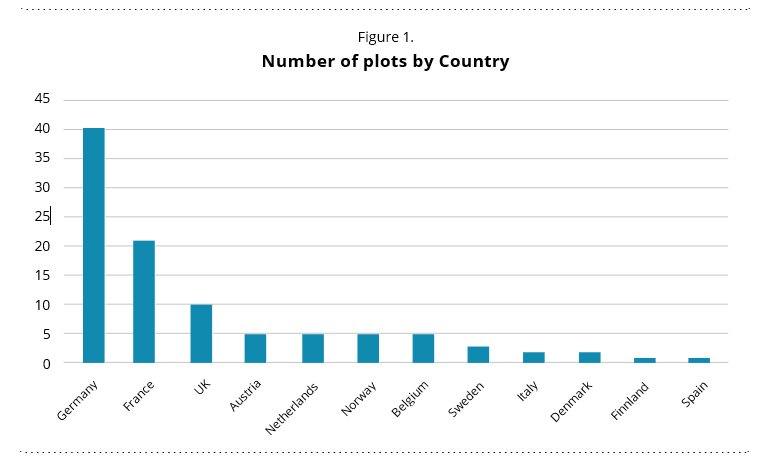
Across 12 countries, Germany was the most frequent incubator and target of the 100 migrant-related plots, accounting for nearly half, followed by France (21 plots) and the UK (10 plots) (see Figure 1). Because global jihadism appears to harbour no special animus towards Germany, the latter’s position in this league table can more reasonably be attributed to the sheer number of migrants that it took in during the refugee crisis than to any particular desire to launch attacks there. Hungary, by contrast, closed its borders to refugees fleeing the civil war in the Middle East and has experienced almost zero violent jihadi activity.14 (It did, however, incur the wrath of the Court of Justice of the European Union, which imposed a €200 million lump sum fine and a penalty of €1 million per day until it complies with EU asylum rules.)15
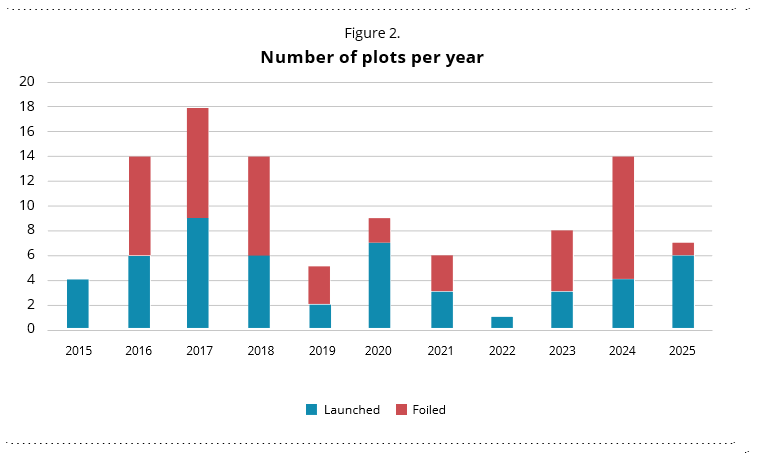
Numbers of migrant-related plots fluctuate over time. Attack activity was subdued in 2015, with the notable exception of the devastating Paris attacks in November, which killed 130 and injured many more. The peak of the migrant crisis was directly followed by a sharp spike in attack activity in 2016 (14 plots) and 2017 (18 plots), followed by a downturn in activity before a new spike in 2024, with 14 plots (see Figure 2). The latter spike is especially striking given that the ISIS caliphate ignominiously collapsed in March 2019,16 when the group lost its last sliver of territory in Baghouz and thousands of ISIS fighters and their families surrendered to the Kurdish-led Syrian Democratic Forces.
This would suggest that ISIS, for some, retains its potency not as an aspirational, forward-looking project with a territorial sanctuary to be defended or sacralized, but rather as a wholly negativistic rebellion against Western multiculturalism. Ironically, this rebellion is expressed by the very people championed by Western multiculturalists, whom it can be reasonably interpreted as meant to hurt and confound.
Relatedly, some jihadi migrants specifically directed their plots against places and symbols that are venerated among Western progressives, but which the jihadis themselves see as wholly decadent and permissive. Thus Zaniar Matapour’s shooting spree in June 2022,17 where he murdered two and wounded over 20 more, was deliberately targeted at Oslo’s annual LGBT pride event, while two years earlier the Egyptian-born Khairi Saadallah fatally stabbed to death three gay men in a park in Reading in the UK. In remarks to the police after the attack, Saadallah boasted that he was ‘going to paradise for the jihad’ he had performed, describing his victims as ‘wrong-uns’ who ‘deserved it’. Other plotters seemed to target their rage against women, like the Algerian Khaled Babbouri, who in 2016 attacked two female police officers with a machete in Charleroi, Belgium. The Moroccan Abderrahman Bouanane similarly targeted women in his knife rampage in Turku,18 Finland, killing two and injuring six others. At his trial, Bouanane, an ISIS supporter, told the court that he was ‘in a war against women’. In more recent plots, particularly in Germany, the preferred target seems to have been Jewish- or Israeli-related, which is likely a response to the intensification of the conflict between Israel and Hamas after 7 October 2023.
More broadly, civilians are the preferred target of jihadi migrant plots: some 68 per cent were aimed at non-combatants, while just 9 per cent are aimed at security personnel (including both the police and the military). Armed assault (with hand-held weapons such as guns or knives) is the most common tactic in plots (45 per cent), followed by bombing (30 per cent), and vehicle ramming (10 per cent).
Migrant Plotters
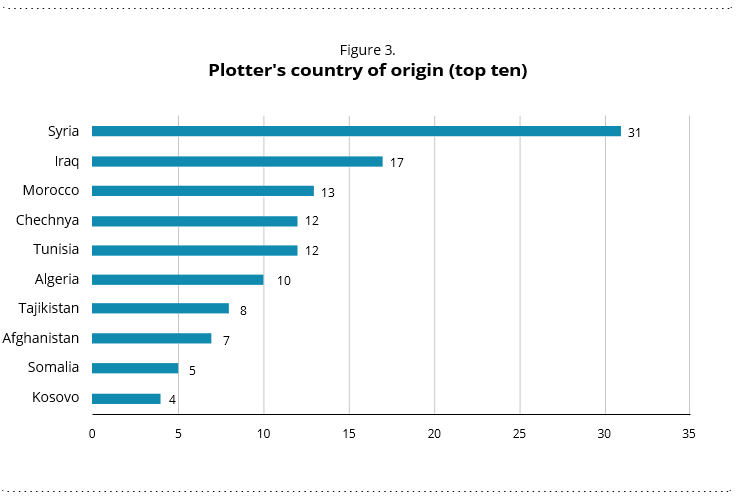
There were 137 migrant plotters in total, linked to 100 plots. There is no single profile of a migrant plotter, but they share some features: the vast majority (97 per cent) are male and in their 20s and 30s. The youngest was 14, while the oldest was 62. Plotters originated from over 20 countries, but the majority came from Syria (23 per cent), Iraq (12 per cent), and Morocco (9 per cent) (see Figure 3).
Of the 137 plotters, 12 per cent had a mental health condition, ranging from the generic ‘psychologically unstable’ to paranoid schizophrenia. (This may well be an underestimate, given that sources on plots often lack details about plotters.) While some researchers would have excluded these cases, I chose to include them, since extremist beliefs and mental illness are not necessarily mutually exclusive and can intersect in complex ways. Some 23 per cent of plotters had a criminal record (for non-jihadi crimes), while a few had convictions for previous involvement in jihadist activity, ranging from the glorification of terrorism19 to an assassination attempt.20
A small number of plotters (9 per cent) came to Europe for the sole purpose of conducting an attack there. For example, two of the commandos who carried out suicide bombings in the Paris attacks of 2015—Ammar Ramadan Mansour Mohamad al-Sabaawi and Mohamad al-Mahmod—were from Iraq and posed as Syrian refugees on their route to Europe, using forged passports.21 The seeming ease with which they (and other returning European ISIS foreign fighters) were able to do so is unsettling, and it is surprising that ISIS did not exploit this weakness in European security with greater zeal. However, the majority of migrant-related plots (79 per cent) were carried out by ‘self-starters’ who had developed an ideological affiliation with ISIS only after their arrival in Europe. A further 10 per cent of plotters were categorized as ‘hybrid’, in that, while they were not sent to Europe by ISIS for the purpose of a plot, instead mobilizing towards violence at a later point, they were nevertheless affiliates of the group. For example, Mohamad Darwish, who was born in Syria and fought for ISIS in 2014, was sentenced to 20 years in prison for his role in a plot to commit a massacre in Brest,22 France, in early 2020; he had arrived in France in the autumn of 2015 as part of a refugee resettlement programme.
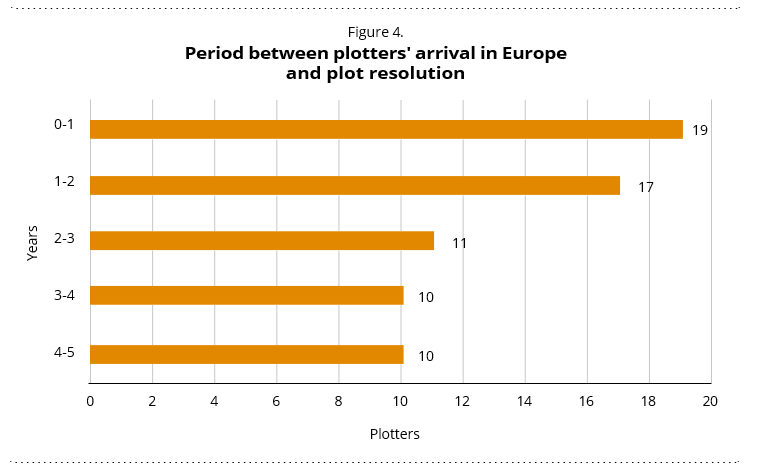
The time span between plotters arrival in Europe and their mobilization towards violence varied markedly between plotters: at one end of the spectrum there is the Egyptian, UAE-based Abdullah Hamamy, who was in France for a week—legally, on a tourist visa—before launching a knife attack on soldiers at the Louvre, while at the other there is the Nice truck attacker Lahouaiej-Bouhlel, who lived in France for at least 11 years before carrying out his atrocity. Just over half of the plotters (51 per cent) mobilized towards violence within five years of coming to Europe, with 36 plotters (28 per cent) mobilizing within two years of their arrival in Europe (see Figure 4). Some 48 per cent of plotters arrived in Europe in the period between 2014 and 2016. For 15 per cent of plotters, this information was not available.
According to researchers Thomas Renard and Méryl Demuynck, the fact that most migrant plotters seemingly radicalize only after reaching Europe suggests that terrorism is a home-grown phenomenon23 rather than ‘an external threat imported through immigration’.24 But that argument itself rests on the assumption that migrants are blank slates when they enter Europe, and that if they radicalize in Europe it must be purely because of European failures and not at all because of any pre-existing ways of thinking on the part of the migrants themselves. In truth, we know very little about how migrants radicalize, because there are so few in-depth accounts of what this process is like. However, it seems reasonable to suppose that radicalization needs to work on a responsive or desiring self and that such a self will have been profoundly shaped by the migrant’s formative experiences in their country of origin. In other words, in thinking about migrant radicalization we need to understand the interaction between Muslim immigrants and their host country, capturing both aspects of the interaction instead of focusing exclusively on one side of the equation or the other. Migrants rarely come to Europe as fully formed terrorists, but nor can they be assumed to be made in Europe out of whole cloth, so to speak.
It is hard to know the exact circumstances in which plotters are radicalized, and what leads them to violently turn against their hosts. In a few cases, the rejection of an asylum application seems to have spurred them on towards violence, as in the case of the Ansbach suicide bomber Mohammed Daleel,25 who ten days before his attack in July 2016 had received notice from the German authorities that he was to be deported to Bulgaria. But almost half (47 per cent) of the 137 jihadi migrants had been given asylum or had residency, which suggests that formal recognition of refugee status is not a firewall against violent extremism.
Despite making up only a very small share of the European population,26 such migrants have been involved in 45 per cent of all jihadi plots in Europe over the last decade. This is additionally noteworthy when we consider that 68 per cent of all jihadi plots between May 2015 and May 2025 were the work of lone plotters. Indeed, we might say that jihadi migrants constitute a fourth wave of jihadism, so pivotal are they. Marc Sageman, back in 2008, described three distinct phases or ‘waves’ of jihad,27 beginning with the so-called ‘Afghan Arabs’ who came to Pakistan and Afghanistan to fight the Soviets in the 1980s. These were followed by elite expatriates from the Middle East who went to study in the West and whose social and cultural displacement led them to seek out al Qaeda, from which they received training and guidance. The Egyptian Mohamed Atta, for example, who studied urban planning at university in Hamburg and led the 9/11 hijackers, personified this generation. The third wave, by contrast, consists of Westernized Muslims with no material connection to al Qaeda but who are inspired by its ideology and who participate in a ‘leaderless’ jihad. These are ‘homegrown’ terrorists:28 the ‘jihadists next door’29 who are born and raised in the West. Mohammed Bouyeri, who murdered the film-maker Theo Van Gogh in 2004,30 typifies this wave: he was born in Amsterdam to Moroccan parents and came to reject their moderate Islam with as much vehemence as he rejected Western secularism.
The fourth wave consists of rootless, nomadic individuals who leave their homes in the Middle East and North Africa to live in Europe, but whose isolation and abasement there, whether real or imagined, hardens into the seeds of their radicalization. Issa al-Hasan, the Solingen attacker, exemplifies this generation of jihadists. This is the jihad of the resentful stranger who is culturally displaced and confined to low-wage employment, yet simultaneously immersed in the intense demands and allure of European capitalist society, which they have come to violently reject.
There is a certain mode of masochistic thinking which holds that only Western societies treated the migrants better and listened to them with greater sensitivity, they would love them more and not want to unleash all this violence and nastiness on their distrustful hosts. But that is naive and fails to capture the implacability of a certain kind of resentful, self-destructive loser whom no amount of accommodation can mollify.31 It also misses something fundamental about the appeal of jihadi ideology, which is that it loathes the West more for what it is than for what it does. Indeed, ISIS was so sensitive to this line of misinterpretation that it felt obligated to publicly rebut it in its glossy English-language magazine Dabiq, spelling out, in an article titled ‘Why We Hate You & Why We Fight You’, that ‘we hate you, first and foremost, because you are disbelievers…, because your secular, liberal societies permit the very things that Allah has prohibited while banning many of the things He has permitted.’32
More specifically, there is a minor cottage industry of liberal advocacy on migrants that seeks to deny that there is relationship between migration and terrorism, and suggests that any attempt to link the two is a ‘far-right trope’ with no empirical basis. One researcher even wrote, in The Washington Post, that ‘[i]mmigrants aren’t committing terrorism in Western Europe. Rather, native citizens appear to be committing terrorism because of their hostility to immigrants.’33 But the actual data tell a very different story, which is that Muslim migrants are disproportionately represented in jihadi terrorism in Europe. This implies that former Hungarian Prime Minister Viktor Orbán was fundamentally correct in anticipating that the 2015 migration crisis would jeopardize European security.34 Such an implication may be inconvenient for the defenders of open borders, who would prefer to talk about the menace of the far right, but it is nonetheless true.
The other liberal impulse, when confronted with the reality of jihadi migrants, is to change the subject or wax lyrical about how most migrants are in fact good people. Thus, in its ‘analysis’ of the Solingen rampage, The Guardian focused on how the attack had come amid a ‘steep rise in knife crime in Germany’.35 The article quoted a criminologist called Dirk Baier, who warned that stricter laws were unlikely to stop knife crime and called instead for youth education to address the problem. What The Guardian article studiously avoided to mention was the immigrant background of the Solingen attacker and his jihadi motives.
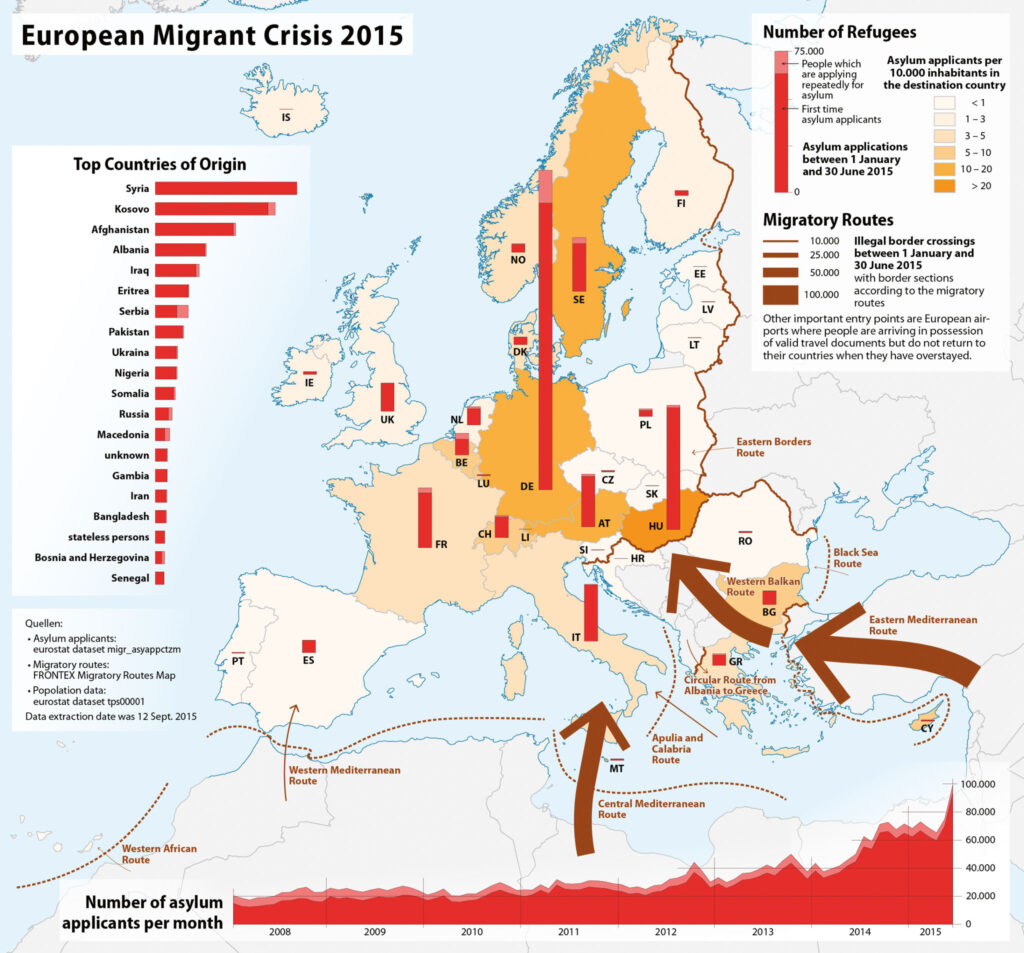
I speak with some authority on this impulse because, for a while, I myself succumbed to it. In the summer of 2015 I visited36 the so-called ‘jungle’ migrant camp in Calais, and opened my heart to the scores of Syrian migrants I met and interviewed in the town. I was sympathetic to their plight, listening intently to them as they told me how they dreamed of a better life in the UK, which was their preferred final destination (see Figure 5). But that sympathy blunted my appreciation of the possible dangers some of them unquestionably posed, and I was all too eager to dismiss this as a ‘moral panic’.37 One of the denizens of the camp, who would have been there around the time I visited, was the Iraqi teenager Ahmed Hassan,38 who planted a bomb on a subway train in London in 2017, leaving scores of people with burn injuries after it partially exploded. Of course one should not exaggerate the threat of jihadi migrants, but to deny the reality of that threat would be perverse.
It is hard to know how long the fourth jihadi wave will last and how it will evolve over the next decade, but the continued mass movement of migrants into Europe from the Middle East and North Africa would suggest that it will have considerable staying power. This latest wave of terrorism will not be easy to contain, but the first step in combating any problem is to acknowledge it and understand how it arose.
NOTES
1 Jaroslav Lukiv, ‘Man Surrenders and Confesses to Germany Stabbing Attack’, BBC (25 August 2024), https://www.bbc.com/news/articles/crlr2z23ykno.
2 Kate Connolly, ‘Syrian Man Gets Life Imprisonment for Stabbings in German City of Solingen’, The Guardian (10 September 2025), https://www.theguardian.com/world/2025/sep/10/syrian-man-gets-life-imprisonment-for-stabbings-in-german-city-of-solingen.
3 Daniel Niemann, and Stephanie Liechtenstein, ‘Islamic State Group Claims Responsibility for Knife Attack that Killed 3 at German Festival’, PBS News (24 August 2024), https://www.pbs.org/newshour/world/police-search-for-knife-attacker-who-killed-3-at-german-festival-cannot-rule-out-terrorism.
4 ‘Germany, Solingen Attack Suspect Named, Remanded in Custody’, DW (25 August 2024), https://www.dw.com/en/germany-detains-solingen-attack-suspect-over-triple-murder-is-links/a-70042662.
5 Georg Heil, ‘The Berlin Attack and the “Abu Walaa” Islamic State Recruitment Network’, Combating Terrorism Center, 10/2 (February 2017), https://ctc.westpoint.edu/the-berlin-attack-and-the-abu-walaa-islamic-state-recruitment-network/.
6 ‘Germany Considers Afghan Deportations After Police Stabbing’, DW (6 April 2024), https://www.dw.com/en/germany-considers-afghan-deportations-after-police-stabbing/a-69268100.
7 Frank Furedi, Why Borders Matter: Why Humanity Must Relearn the Art of Drawing Boundaries (Routledge 2020).
8 Simon Cottee, ‘Europe’s Jihadi Migrants: Mapping Migrant Involvement in Jihadi Terrorism in Europe (2015–2025)’, The Danube Institute (29 May 2026), https://danubeinstitute.hu/en/research/europe-s-jihadi-migrants-mapping-migrant-involvement-in-jihadi-terrorism-in-europe-2015-2025.
9 Adam LeBor, ‘From Keleti Station to Kilburn High Road and Back: Personal Reflections on Europe’s Migration Crisis’, The Danube Institute (9 January 2026), https://danubeinstitute.hu/en/research/from-keleti-station-to-kilburn-high-road-and-back-personal-reflections-on-europe-s-migration-crisis.
10 Peter Hille, ‘“We Can Do This”: Merkel’s Words Five Years On’, DW (31 August 2020), https://www.dw.com/en/merkel-germany-refugees/a-54769229.
11 ‘Record Number of Over 1.2 Million First Time Asylum Seekers Registered in 2015’, Eurostat, https://ec.europa.eu/eurostat/web/products-euro-indicators/-/3-04032016-ap, accessed 10 June 2026.
12 ‘Migrant Crisis: Germany Heads for 1m Asylum- Seekers in 2015’, BBC (7 December 2015), https://www.bbc.com/news/world-europe-35027951.
13 Peter Nesser, ‘Introducing the Jihadi Plots in Europe Dataset (JPED)’, Sage Journals, 61/2 (21 February 2023), https://journals.sagepub.com/doi/10.1177/00223433221123360.
14 ‘Hungarian, 22, Charged with Plotting Islamist Attack, Prosecutors Say’, Reuters (17 November 2021), https://www.reuters.com/world/europe/hungarian-22-charged-with-plotting-islamist-attack-prosecutors-say-2021-11-17/.
15 ‘Hungary Fined €200 Million by ECJ for Breaking Asylum Rules’, DW (13 June 2024), https://www.dw.com/en/hungary-fined-200-million-by-ecj-for-breaking-asylum-rules/a-69348630.
16 Rukmini Callimachi, ‘ISIS Caliphate Crumbles as Last Village in Syria Falls’, The New York Times (23 March 2019), https://www.nytimes.com/2019/03/23/world/middleeast/isis-syria-caliphate.html.
17 ‘Iranian-Born Norwegian Man Gets 30 Years for Oslo Pride Shootings’, Al Jazeera (4 July 2024), https://www.aljazeera.com/news/2024/7/4/iranian-born-norwegian-man-gets-30-years-for-oslo-pride-shootings.
18 Jussi Rosendahl, ‘Knife Attacker Sentenced to Life by a Finnish Court’, Reuters (15 June 2018), https://www.reuters.com/article/world/knife-attacker-sentenced-to-life-by-a-finnish-court-idUSKBN1JB14M/.
19 ‘Macron Condemns “Islamist Terror” After Deadly Mulhouse Knife Attack’, RFI (23 February 2025), https://www.rfi.fr/en/france/20250223-macron-condemns-islamist-terror-after-deadly-mulhouse-knife-attack.
20 ‘Germany Police Shoot Berlin Islamist After Knife Attack’, BBC (17 September 2015), https://www.bbc.com/news/world-europe-34284044.
21 Anthony Faiola, and Souad Mekhennet, ‘Tracing the Path of Four Terrorists Sent to Europe by the Islamic State’, The Washington Post (22 April 2016), https://www.washingtonpost.com/world/national-security/how-europes-migrant-crisis-became-an-opportunity-for-isis/2016/04/21/ec8a7231-062d-4185-bb27-cc7295d35415_story.html.
22 ‘Au procès de la boucherie «conspirative» de Brest, un acquittement et jusqu’à vingt ans de réclusion criminelle (In the Trial of the ‘Conspiratorial’ Brest Massacre, One Acquittal and up to Twenty Years in Prison), Le Monde (11 April 2025), https://www.lemonde.fr/societe/article/2025/04/11/au-proces-de-la-boucherie-conspirative-de-brest-un-acquittement-et-jusqu-a-vingt-ans-de-reclusion-criminelle_6594349_3224.html.
23 Thomas Renard and Méryl Demuynck, ‘Migration- Related Terrorism: Trends, Challenges, and Policy Implications’, International Centre for Counter- Terrorism (June 2025), https://icct.nl/sites/default/files/2025-07/Migration and Terrorism short June.pdf.
24 Thomas Renard, and Méryl Demuynck, ‘The Problem Is Terrorism, Not Migration’, Lawfare (9 June 2025), https://www.lawfaremedia.org/article/the-problem-is-terrorism–not-migration.
25 Gabriel Gatehouse, ‘Germany “Was Warned About Ansbach Suicide Bomber”’, BBC (12 August 2016), https://www.bbc.com/news/world-europe-37059100.
26 ‘Migration and Asylum in Europe – 2025 Edition’, Eurostat, https://ec.europa.eu/eurostat/web/interactive-publications/migration-2025, accessed 15 June 2026.
27 Marc Sageman, Leaderless Jihad: Terror Networks in the Twenty-First Century (University of Pennsylvania Press, 2008).
28 Mitchell D. Silber, and Arvin Bhatt, ‘Radicalization in the West: The Homegrown Threat’, The New York City Police Department, https://info.publicintelligence.net/NYPDradicalization.pdf.
29 Andrea Elliott, ‘The Jihadist Next Door’, The New York Times Magazine (27 January 2010), https://www.nytimes.com/2010/01/31/magazine/31Jihadist-t.html.
30 Simon Cottee, ‘We Need to Talk about Mohammad: Criminology, Theistic Violence and the Murder of Theo Van Gogh’, The British Journal of Criminology, 54/6 (November 2014), https://academic.oup.com/bjc/article-abstract/54/6/981/392247?redirectedFrom=fulltext.
31 Hans Magnus Enzensberger, ‘The Radical Loser’, Sign and Sight (1 December 2005), http://www.signandsight.com/features/493.html.
32 Simon Cottee, ‘No, the Travel Ban Isn’t Being Used as ISIS Propaganda’, Politico Magazine (26 March 2017), https://www.politico.com/magazine/story/2017/03/travel-ban-isis-propaganda-214953/.
33 Richard J. McAlexander, ‘Terrorism Does Increase with Immigration—But Only Home-Grown, Right-Wing Terrorism’ The Washington Post (19 July 2019), https://www.washingtonpost.com/politics/2019/07/19/immigration-does-lead-more-terrorism-by-far-right- killers-who-oppose-immigration/.
34 ‘Orbán Blames Immigration for Rise in Anti- Semitism, Homophobia in EU Speech’, The Jerusalem Post (10 October 2024), https://www.jpost.com/diaspora/antisemitism/article-824092.
35 Deborah Cole, ‘Solingen Stabbing Comes Amid Steep Rise in Knife Crime in Germany’, The Guardian (24 August 2024), https://www.theguardian.com/world/article/2024/aug/24/solingen-stabbing-comes-amid-steep-rise-in-knife-in-germany.
36 Simon Cottee, ‘“I Am Strange Here”: Conversations with the Syrians in Calais’, The Atlantic (17 August 2015), https://www.theatlantic.com/international/archive/2015/08/calais-migrant-camp-uk-syria/401459/.
37 Simon Cottee ‘Europe’s Moral Panic About the Migrant Muslim “Other”’, Los Angeles Times (13 October 2015), https://www.latimes.com/opinion/op-ed/la-oe-cottee-fear-of-refugees-20151013-story.html.
38 ‘In the Criminal Court, The Queen v Ahmed Hassan: Sentencing Remarks of the Hon. Mr Justice Haddon-Cave’, Judiciary of England and Wales, https://www.judiciary.uk/wp-content/uploads/2018/03/r-vhassan-sentencing.pdf, accessed 10 June 2026.
Related articles:
At a time when public debate is increasingly polarized and superficial, Hungarian Conservative remains committed to depth, intellectual honesty, and independent conservative thought.
Producing high-quality journalism requires resources. Your contribution helps us expand our coverage, reach new audiences, and keep our content accessible.

Please consider supporting our mission.