Hungary’s close ties with Russia have come under increased criticism in recent weeks after leaked audio recordings of phone calls between Hungarian Minister of Foreign Affairs and Trade Péter Szijjártó and Russian Foreign Minister Sergei Lavrov revealed a rather ‘intimate’ relationship, coordinating on sanctions and more.
The leaks met with harsh reactions within the European Union, with several leaders—including Polish Prime Minister Donald Tusk, Czech President Petr Pavel, Irish Prime Minister Micheál Martin, and EU foreign policy chief Kaja Kallas—expressing outrage and questioning Hungary’s alignment within the bloc.
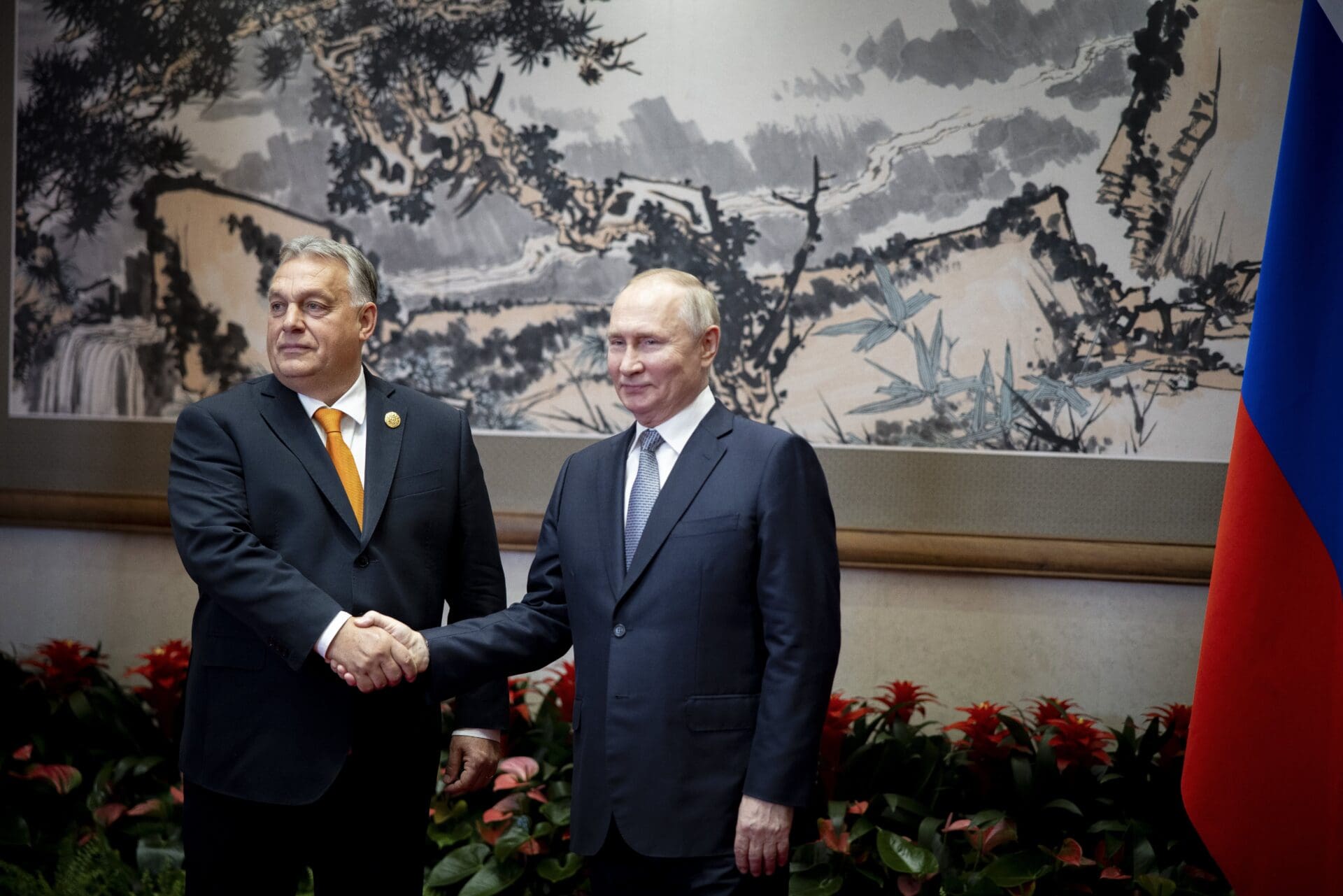
Just after the leaked audio of the Szijjártó–Lavrov call, Bloomberg published transcripts of another phone call between Hungarian Prime Minister Viktor Orbán and Russian President Vladimir Putin. The discussion, which happened around the time when Budapest was floated as the potential venue for a meeting between Putin and US President Donald Trump, is as intimate as the Szijjártó–Lavrov dialogue—which is also not surprising given that the two leaders have met countless times during their more than 15-year-long collegial relationship. According to Bloomberg, Orbán said to Putin that he is at the Russian president’s service in ‘any matter where I can be of assistance’, which yet again caused outrage among EU leaders.
The Orbán government’s close ties to the Kremlin have also moved to the centre of the campaign’s final phase ahead of the high-stakes parliamentary election scheduled for 12 April. Hungarian opposition leader Péter Magyar framed the vote as a referendum on the country’s direction: closer ties with the European Union or Russia. The race will be the closest in the past 15 years, with pollsters showing contradictory standings: opposition-aligned polls put the Tisza Party ahead, some of them with a double-digit margin, while government-aligned surveys show Orbán’s Fidesz–KDNP leading.
The Only Remaining Communication Line
In this tense atmosphere, it is worth examining what would happen to EU–Russia dynamics in the case of Orbán’s electoral defeat. Currently, Hungary is the only EU member state that maintains direct and constant communication lines with Moscow. Since 2022, the EU’s official policy in this regard has been to cut off all lines of communication with the Kremlin, as the bloc threw its full support behind Ukraine following Russia’s invasion. Ad hoc calls and dialogue attempts, however, have remained: in 2025, French President Emmanuel Macron held a two-hour-long phone call with Putin, the first since 2022, while former German Chancellor Olaf Scholz spoke with the Russian president in 2024.
Beyond these contacts, no other attempts have occurred in the past four years. There is no institutional EU–Russia dialogue framework, no regular multilateral EU–Russia summits, and no parliamentary cooperation meetings—the latter effectively frozen since 2014.
Meanwhile, the EU has taken over the financial and military support of Ukraine from the United States and is increasingly moving towards integrating Kyiv into the bloc. At the same time, Brussels has become less interested in a negotiated settlement, as it sees Moscow’s complete defeat as the only viable outcome. Currently, the only country blocking the EU from becoming more deeply involved in the war is Hungary. Without Orbán’s veto, the situation would be significantly more confrontational with Russia.
‘Hungary is the only EU member state that maintains direct and constant communication lines with Moscow’
At the same time, Washington is becoming increasingly less interested in providing protection for European allies through NATO. The divide between the Trump administration and the EU is deepening day by day, as was recently demonstrated after the Iran war broke out and European allies did not respond to Washington’s call to help protect the Strait of Hormuz.
Currently, Hungary is by far the closest ally of the United States within the EU, a position solely based on the relationship between the Orbán government and the Trump administration. While this relationship is more stable than EU–Russia dynamics, losing Orbán could also negatively impact EU–US ties. With Washington increasingly withdrawing from European affairs—particularly in terms of military protection—the continent could soon find itself alone between two nuclear superpowers.
A Clear Path to Nuclear Escalation
This is where Orbán’s role as an intermediary between the EU and Russia becomes significant. Losing Orbán would mean that the EU would lose a direct and open communication channel with an increasingly confrontational nuclear power in its neighbourhood. Since the Cold War, it has been clear that such situations carry serious risks.
It is no coincidence that Washington and Moscow have recently agreed to re-establish high-level military dialogue for the first time in more than four years. Both powers understand, from historical precedent, that the absence of communication between nuclear actors can rapidly lead to escalation with potentially catastrophic consequences.
‘The absence of immediate communication removes one of the last safeguards against miscalculation’
In that sense, losing Orbán would mean losing the only direct communication channel between the EU—which, through France, is itself a nuclear power, albeit with a much smaller arsenal—and Russia, creating a structural security risk. In such a tense environment, the absence of immediate communication removes one of the last safeguards against miscalculation.
History has shown that nuclear crises are rarely the result of deliberate decisions, but rather of misunderstandings under pressure—eliminating such institutionalized and trusted channels as the Hungarian–Russian communication line would therefore significantly increase these risks.
Related articles:
At a time when public debate is increasingly polarized and superficial, Hungarian Conservative remains committed to depth, intellectual honesty, and independent conservative thought.
Producing high-quality journalism requires resources. Your contribution helps us expand our coverage, reach new audiences, and keep our content accessible.

Please consider supporting our mission.