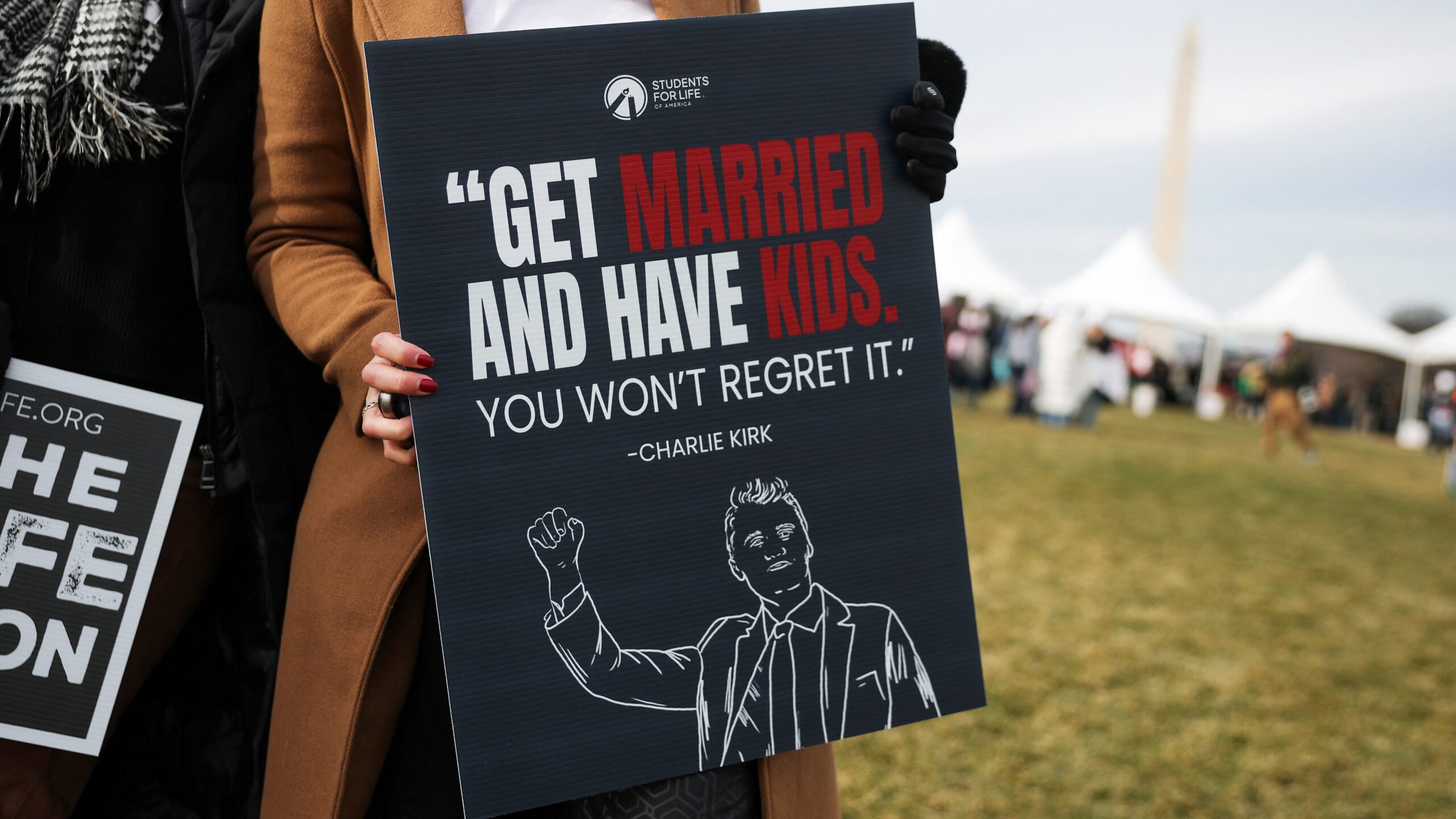
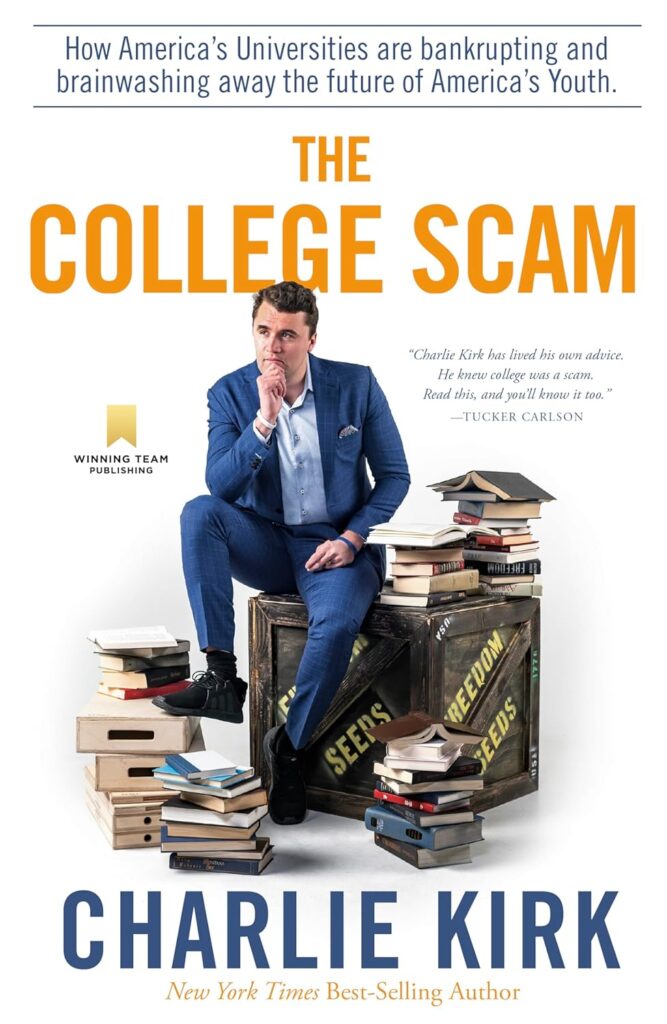
I first heard about this book when, after Charlie Kirk’s brutal murder on 11 September 2025, a 31-point list came my way in which it was included as ‘compulsory reading’. It is not yet available in Hungarian, so I ordered it from the U.S. and read it over the holidays. It intrigued me not only because of its author and subject matter, but also for personal reasons: our sons’ interest in American higher education.
While reading, I realized that everything felt familiar, yet it was presented nowhere else in such a logically structured system, supported by a dense volume of concrete examples, and offering alternative solutions that bypass an utterly corrupt system—a handbook like this cannot be found anywhere else. Lately, I’ve also come to realize that we may soon need not only a Hungarian translation, but a similar volume with Hungarian examples as well.
Charlie Kirk founded Turning Point USA in 2012, and the organization achieved phenomenal growth in less than a decade: it created chapters and activist groups on more than a thousand university (and high school) campuses across the USA. At the time the book was published (in 2022), the organization—with an annual budget of $50 million and employing 160 high school and university students—had become the most influential conservative force in the world of American university campuses.
Although he himself consciously chose not to attend university, through his organization, Charlie became acquainted with a vast number of American higher education institutions, university students, and quite a few professors, many of whom he invited to speak on his radio show and podcast. Through his campus visits, he made contact with millions of students, listening to their stories, complaints, and questions. As he states: ‘I’ve taken the pulse of college life…I know what college students are saying and thinking.’
‘So-called “higher education” is corroding American culture and endangering the country’s future’
What he heard most from them was that university is a scam—something ‘everyone is aware of, from students through professors and administrators to board members and donors.’ Some even admit this privately—yet they asked him not to quote them, because they were afraid to acknowledge and say it loud. They are aware of not receiving real value in exchange for the constantly rising tuition fees—yet they believe they have no other option, because they’ve been made to believe they cannot be successful without a university degree. This is a lie, Charlie claims, adding that this alone would already be a serious problem, but the ‘college industry’ is far worse than that: the so-called ‘higher education’ is corroding American culture and endangering the country’s future.
After clarifying why he strongly believes in education in the classical sense—where colleges and universities are fundamental elements of society, an ethos now found only in traces in the USA—he argues that, with the exception of Hillsdale College in Michigan and a few others, the overwhelming majority of universities reject classical Western culture, the US Constitution, and the foundations of character education, while promoting an aggressively atheist and anti-American agenda. The process that began in the 1960s has now reached a scale beyond any possibility of reform. ‘The pragmatic truth is that it is already too late to turn this ship around,’ he claims, since these institutions are no longer centers of education in the classical sense: instead of making university students stronger, smarter, and better prepared for participation in society, today’s ‘higher education’ has made students ‘indebted, brainwashed, and incapable of critical thinking’. Today, the best education is self-education, Charlie Kirk argues, adding that indoctrination, luring young generations into debt servitude, corrupt administration and radical professors combined are not education—and yet this is what today’s ‘university cartel’ has become.
‘Today, the best education is self-education, Charlie Kirk argues’
In ten points, the author demonstrates why American universities have been lost to the conservatives, and what can and should be done in this situation. In the introduction, he asks for nothing more than that we ‘read with an open mind and listen to the stories, weigh the facts, set aside the assumptions and expectations that culture has imposed on us, and only then make up our minds.’
1. Colleges and universities are running a scam: they promise an education that will prepare the students for a rewarding career, but for the overwhelming majority of them, that promise is a lie: the 40 per cent dropout rate is the proof. Because this fraudulent industry is heavily subsidized by the federal government, it is a scam not only on students, but taxpayers as well.
2. College education is ridiculously overpriced: costs have been artificially inflated to absurd levels. Student loan debt is crushing students and their parents, robbing many of the dream of homeownership and financial security. Federal funding of the student loan industry drives costs even higher and threatens to destabilize the American economy.
3. Universities have become obscenely rich at students’ and taxpayers’ expense: they have become ‘hedge funds with universities attached’, and exist primarily to amass bloated endowments. They exist to provide jobs for academics and administrators, such as ‘deans of diversity, equity and inclusion’. Students, parents and taxpayers get the bill for universities’ obscene profits.
4. Colleges do not educate any more: students go through the college systems and come out the other end not having learned anything. Testing shows conclusively that students do not improve their critical thinking skills in college; employers overwhelmingly say: ‘We can’t hire college grads. They’re not equipped to hold down a job.’ Contrary to repeated claims, college education does not increase career earnings of most graduates.
5. College ruins the ability to think and reason by teaching students to abandon common sense and logic. In this chapter, the author presents numerous examples of professors and students who appear to have lost all sense as a direct result of ‘higher education’. He also lists a range of genuinely absurd university courses that actively promote ideological ‘lunacy’ on campus.
6. Colleges indoctrinate students while repressing free speech. Whereas universities once aimed to broaden minds and encourage open inquiry, today they increasingly weld minds shut. Radical professors engage in practices such as ‘grading activism’, awarding academic credit for political protesting, while punishing nonconforming students with failing grades. At the same time, radical students police their peers through cancel culture and intimidation, quickly teaching dissenters the costs of nonconformity.
‘Colleges indoctrinate students while repressing free speech’
7. Colleges and universities breed violence and hate against conservative, pro-America students. Some administrations have sided with violent campus radicals instead of protecting the rights of the peaceful minority. The author listed several stories about students who have been physically assaulted and threatened with death (!) for peacefully exercising their First Amendment rights on campus.
8. Colleges and universities have been infiltrated by subversive foreign groups: the rise of anti-Israel groups like Jewish Voice for Peace and Students for Justice in Palestine have created an atmosphere of antisemitism and anti-Americanism on many campuses. Simultaneously, the presence of Confucius Institutes has enabled Communist China to infiltrate American universities on a massive scale, threatening national security.
9. Colleges and universities have unleashed waves of woke, anti-American activists: all the destructive ideas that are now eating away the foundation of America originated or were spread on college campuses including the critical Race Theory, Intersectionality, Wokeism, Antifa, Defund the Police, White Fragility, Speech Codes, Cancel Culture, ‘Anti-Racism’, the Green New Deal etc.
10. Many professors are leftist radicals bent on indoctrinating students. In this chapter, Charlie Kirk introduces the Professor Watchlist, through which it shows story after story that college is a massively hostile environment for students who do not conform to the leftist groupthink of academia.
The book doesn’t end with Chapter 10, but continues with two further ones, in which Charlie provides very specific guidance for those who don’t see higher education as the only path to getting ahead in life. In Chapter 11 he lists a large number of well-known and successful people from various fields of life who didn’t attend college or university, supporting their decision with their life stories and debunking several further myths about the necessity of a university degree. In Chapter 12 he offers more specific advice: formulate your life plan; build your skills through alternative ways (e.g. online colleges, work college, vocational training, job corps, apprenticeship); join the military; find a mentor, volunteer; start a business; get employed; apply for an internship; join a startup accelerator; move if you have no opportunities around you; and live modestly.
The author does not leave readers without guidance or concrete tasks. He urges them to spread the message, talk to their children, take a stand for freedom, defend themselves against woke persecution, and boldly uphold the truth. He also calls for support for Professors Watchlist and Divest U. The latter is Turning Point USA’s ‘aggressive effort to make a meaningful difference by attacking the university menace where it is most vulnerable: the bank account’—aimed at cutting off multibillion-dollar endowments that fund ideological indoctrination by persuading alumni donors to redirect their giving away from ‘higher education’ and toward ‘causes that do honorable work’. The final appeal is clear and urgent: act now. The book closes with the words: ‘Let’s end it before it’s too late.’
The end of the book felt somewhat shocking not only because of Charlie Kirk’s death, but also because I realized that I have teenage children as well living in Hungary, meaning that the state of the local higher education will increasingly affect us, too. And it occurred to me that since moving back to Hungary from the U.S., through conversations with several acquaintances, parents and teachers alike, I’ve realized that the situation at Hungarian universities (while on a much smaller scale) may become increasingly similar to what I read in this book.
‘No one…should deceive themselves into thinking that conservative values passed on within the family or local communities will automatically shield their children’
A Hungarian language and history teacher told me about how the students she had prepared for school-leaving exams often sounded sad once they became university students. Some even spoke in tears about the humiliation they had to endure from university lecturers and sometimes from their fellow students if they openly embraced their conservative values and expressed their true opinions. Based on her students’ feedback, she has the impression that one can recognize a conservative professor or student by the fact that they do not engage in politics, while left-liberal lecturers (and students) often conduct party-political agitation, speak mockingly to students who disagree with them, and, by exploiting their positions of power, place them at a disadvantage even by lowering their grades. This phenomenon is most visible at Eötvös Loránd University (ELTE) and the provincial universities associated with it.
Parents, meanwhile, reported that within their circle of acquaintances, young people from thoroughly conservative families often become, within a year, mouthpieces of liberal ideologies—at best seeing their parents as foolish, and at worst avoiding contact with them altogether. No one in Hungary should deceive themselves into thinking that conservative values passed on within the family or local communities will automatically shield their children from the increasingly rampant ideological indoctrination at universities. Soon, we too may need a similar practical, solution-oriented handbook, beyond merely translating the original.
Related articles: