Even most Hungarians are unaware that the Hungarian name Imre (Emeric) derives from the Latin name Henricus, meaning Henry (Henrik in Hungarian), which evolved from Hemericus, then Emricus, Emrich, and Imreh, into its present form. Unsurprisingly, family ties offer an explanation for the origin of the name: between 1002 and 1024, Henry II was King of Germany, and later Emperor, and his sister Gisela became the wife of the first Hungarian king, Saint Stephen (r. 997/1000–1038) sometime in the 990s. Stephen and Gisela had several children, but for a long time, only their son Emeric, who was canonized in 1083, was known. Surprisingly, in the 2000s, an unknown early Latin chronicle appeared, which preserved the name of their firstborn son, Otto. It can be assumed that Otto, who died at an early age, was born during the lifetime of Emperor Otto III (d. 1002) and was named after his imperial relative, while Emeric was logically born after Henry II ascended the throne. There are many examples of similar naming practices in the Middle Ages, which were often linked to the role of godfather, but we have no sources for this in the Hungarian case.
Contemporary data and sources reporting on Emeric’s life are almost completely lacking; we only know the year of his death, 1031, and the circumstances surrounding it from a contemporary German yearbook. According to that, the prince lost his life on 2 September during a wild boar hunt in the royal hunting grounds. He was the first member of the royal family to be buried in the dynastic cult centre established in Fehérvár (today’s Székesfehérvár). As heir to the throne, he received a courtly and deeply religious upbringing, which may have been influenced by Emperor Henry II’s zealous religiosity and generosity toward the churches. The legend of St Gerard, a knowledgeable, martyred bishop from Venice who was also canonized in 1083, credibly names him as the heir’s teacher, which made it easier to popularize him among young students in modern times. The Admonitions attributed to King St Stephen do not mention Emeric by name, but the work, written in the style of the Carolingian mirrors for princes (Editor’s note: didactic texts offering moral, political, and practical guidance for rulers), most likely served as a guide and source of good advice on how to rule for the heir to the throne.
‘He was the first member of the royal family to be buried in the dynastic cult centre established in Fehérvár’
The prince’s marriage is a more complicated issue. Although the legend, which originated in the first half of the 12th century, emphasizes his vow of chastity, sources also mention his wife, although she is not named. A wife/bride may be mentioned only to provide a witness to the prince’s chastity. Emeric’s legend only states that his wife was of royal descent; according to a 13th-century source, she was a Byzantine princess, while later tradition has her as a Croatian or Polish princess. The Byzantine marriage connection may be justified by the fact that King Stephen founded a Greek nunnery near Veszprém, the city of Hungarian queens, while the Polish connection may be supported by the fact that Emeric is also venerated in Poland at the Benedictine Abbey of the Holy Cross in Łysa Góra in the Kielce region, to which, according to local tradition, Emeric donated a relic of the Holy Cross.[1]
Researchers have long wondered why the prince, about whose life little information was available, was canonized in 1083. The canonization of the first king, Stephen, in 1083 established the sanctity of the Árpád Dynasty, which was followed by the canonization of King Ladislaus I in 1192. The late legend of the prince, who died young, distinguishes him with monastic virtues, but these were also abundant in Andrew and Benedict, the two hermits canonized in 1083, as well as Gerard, the martyred bishop. Emeric’s presumably exemplary Christian life would have been insufficient for canonization.
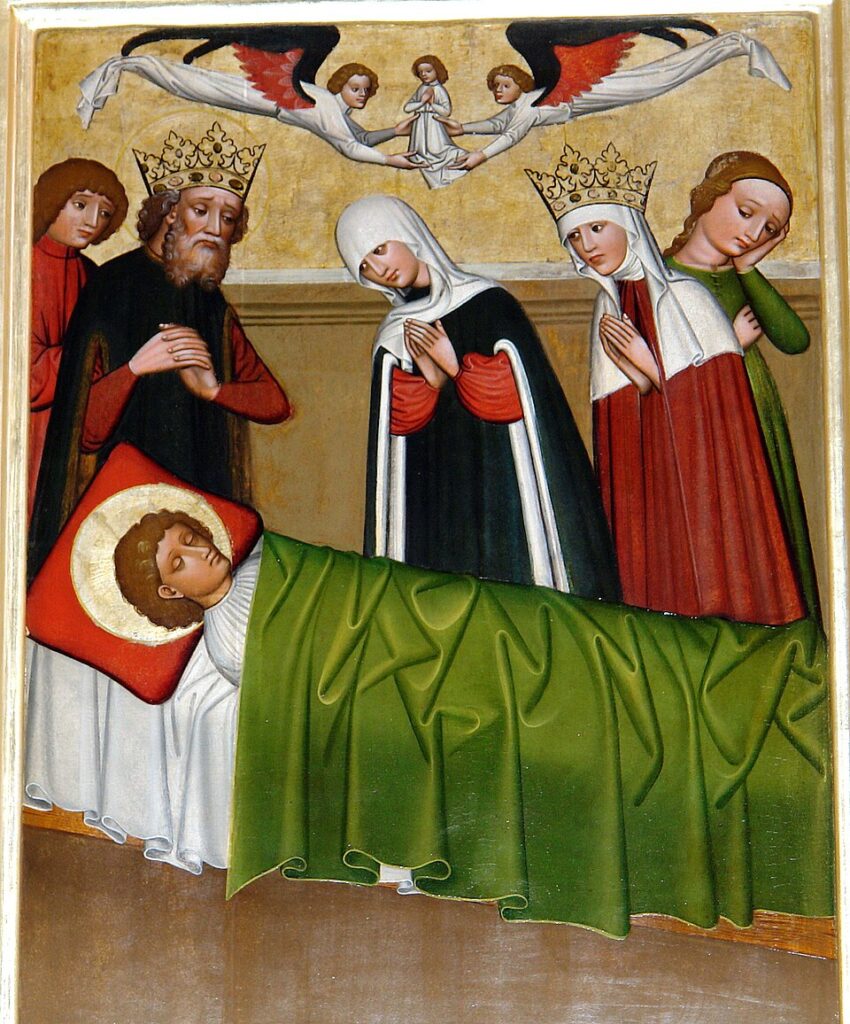
It is more likely that after the prince’s death, a divine explanation had to be found for the king’s unexpected childlessness, as it was obvious to his successors that this would have tragic political consequences, such as civil war and pagan rebellion. The loss of the heir to the throne and his cruel death could easily have been interpreted negatively, as is often seen in medieval chronicles. Presumably, between the reign of Andrew I (r. 1046‒1060), who embraced the memory of the first king, and the canonization in 1083, the memory of the prince living in a ‘Josephine marriage’ was developed, thus diverting attention from his unexpected death and the weight of divine punishment that struck Stephen with the loss of his son. Emeric’s death was a typical ‘bad death’: torn apart by a wild animal, without any preparation for death or last rites. This was in stark contrast to his father’s ‘good death’ in 1038, for which he had prepared himself in every respect in an exemplary manner.
‘After the prince’s death, a divine explanation had to be found for the king’s unexpected childlessness’
Church writers were very critical of death at a young age. Nicholas of Lyra, the famous Franciscan teacher, saw it as God’s punishment. At the same time, early Bible commentators often quoted from the Book of Wisdom, also used in the legend of Emeric, to oppose this. St Jerome writes in one of his letters: ‘And are we outraged that someone leaves the body, who was perhaps taken away so that wickedness would not corrupt his judgment? For his soul was dear to God; therefore, He hastened to remove him from the midst of wickedness.’ The Hungarian Illustrated Chronicle also feels compelled to excuse Emeric’s death: ‘By God’s inscrutable wisdom he was taken from the world, lest wickedness should alter his understanding or deceit beguile his soul, as is written concerning untimely death in the Book of Wisdom.’[2]
In King Stephen’s greater legend, Emeric’s death appears as part of ‘divine punishment’ that had to be neutralized. The author of the Emeric legend thus saw the fulfilment of divine providence in the death of the prince, who had already committed himself in his earthly life to the virginal virtues inspired by heaven, and whose death was thus ‘not as a day of mourning, but of joy’.[3] According to Stephen’s legend, Emeric immediately joined ‘the company of those in heaven’, as if foreshadowing that the same would happen to his father. Of course, contemporaries could find another good example of this depiction not so far away.
King Henry II’s exemplary lifestyle was well known to his contemporaries thanks to German court propaganda. On 1 November 1007, at the Synod of Frankfurt, the king announced that he could not expect any descendants: ‘For future compensation, I choose Christ as my heir, since I have no hope left of increasing my offspring…’[4] In his charters, Henry considers the Almighty to be his heir, from which it was concluded in the second half of the 11th century that Henry lived in a ‘Josephine marriage’ with his wife and therefore had no children. It is characteristic that contemporary chronicler Rudolfus Glaber (d. 1047) reported in his chronicle written in the 1020s—in a laudatory manner—that despite his childlessness, Henry did not reject his wife. We can rightly assume that if the legendary motifs of Henry’s life story were known throughout Europe in the 11th century, then the news could have also reached the Hungarian court, which had ties with Bamberg, a city favoured by Henry.
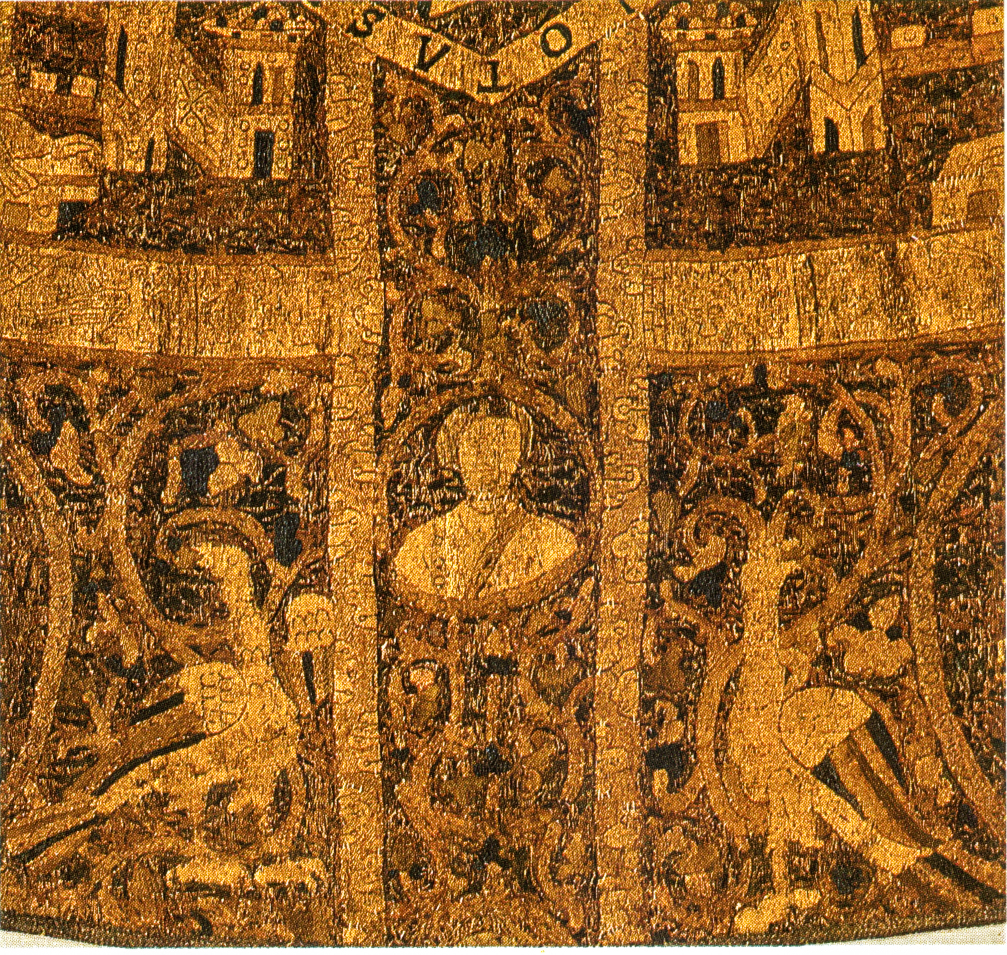
In the decades following his death, Prince Emeric was quickly endowed with the emperor’s most well-known virtue, that of chastity. It was only natural that the virtues of the Hungarian Henry should be enriched with those of his imperial relative Henry, so that Emeric would become worthy of his illustrious predecessor not only in name but also in lifestyle.
However, the Josephine marriage of the ruler was still a novelty in the 11th century; it was not a current ideal for rulers, and it was particularly undesirable for a ruler sitting on the throne. The mirror for princes, written for Prince Emeric, makes no mention of this either. It is no coincidence that in the decades following his canonization in 1083, the prince’s veneration—unlike that of his father, St Stephen—remained local, limited to his burial place in Fehérvár, Veszprém, and the first Benedictine abbey in Pannonhalma, where the prince may have visited several times in the company of his father.
The situation changed at the beginning of the 12th century, when the promotion of priestly celibacy became one of the main goals of the ecclesiastical reform movement. In Hungary, the ecclesiastical synod of Esztergom made priestly celibacy mandatory in 1112. The legend of Henry, emphasizing his virginal virtues, was prepared for his canonization in 1146, just as was done for Edward the Confessor (r. 1042–1066) in his 12th-century legend. Emeric’s liturgical prayers, written at that time, highlight the prince’s contempt for the joys of earthly life, in keeping with the legend of his early death.
‘Prince Emeric was quickly endowed with the emperor’s most well-known virtue, that of chastity’
The joint depiction and veneration of the ‘holy kings’ of the Árpád Dynasty, namely Stephen I, Emeric, and Ladislaus I, has been continuous since the last decades of the Árpád era, elevating Emeric to the rank of king even as a prince. He also appears as a national saint who aids in battle, as in 1278, when Hungarian King Ladislaus IV went to war and prayed to the three holy kings. The fashion for depicting the holy kings has been unbroken since the Anjou era. In Várad (now Oradea, Romania), Bishop Demetrius Futaki (d. 1372) commissioned standing statues of the holy kings. Here, Emeric held a sceptre in his hand, along with his sword, dagger, and shield bearing a double cross.
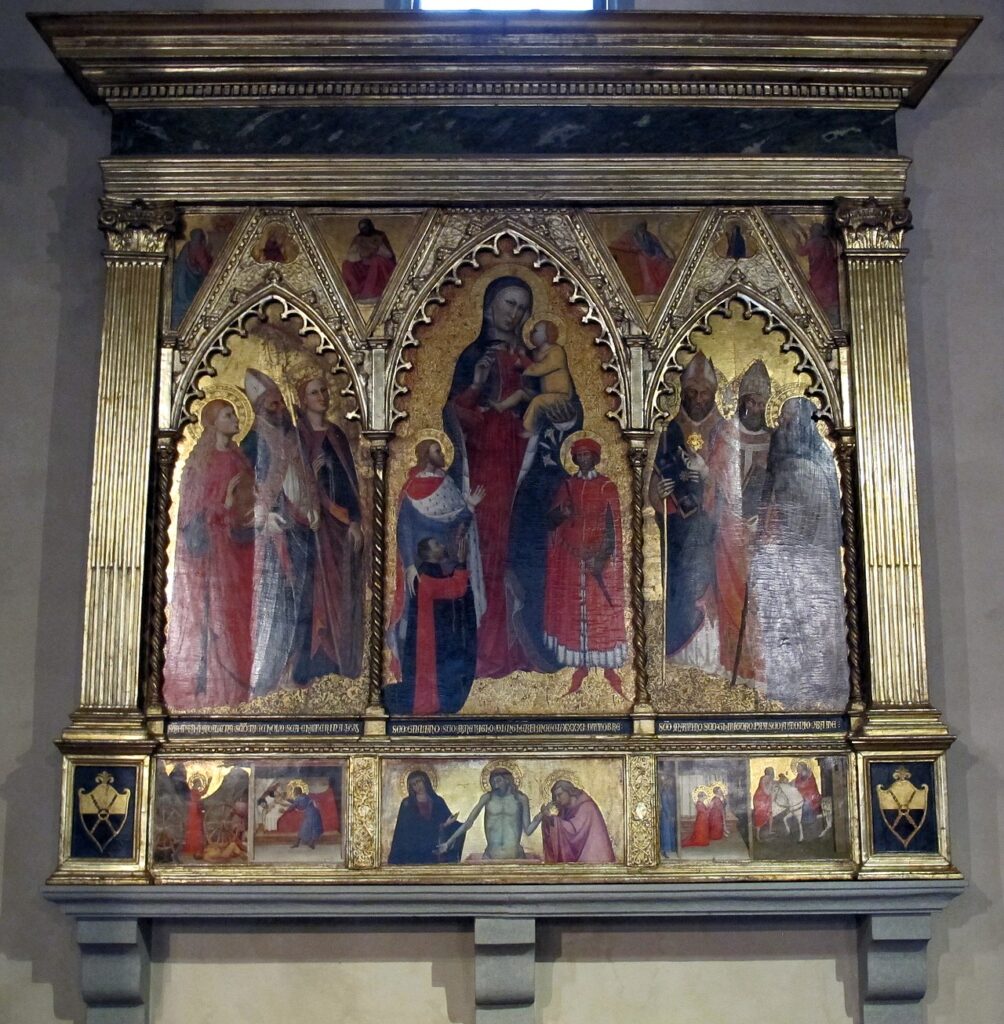
Besides, Hungarians are convinced that Amerigo Vespucci (1454‒1512), after whom America was named, received his name in honour of Emeric.[5] This may be true insofar as Florence knew about the Hungarian saint (Amerigho d’Ungheria), and in 1391 Giuliano Amerigo Zatti (Tatti), a member of a merchant family with Hungarian connections, had an altar erected in his honour in the church of San Martino a Mensolá.
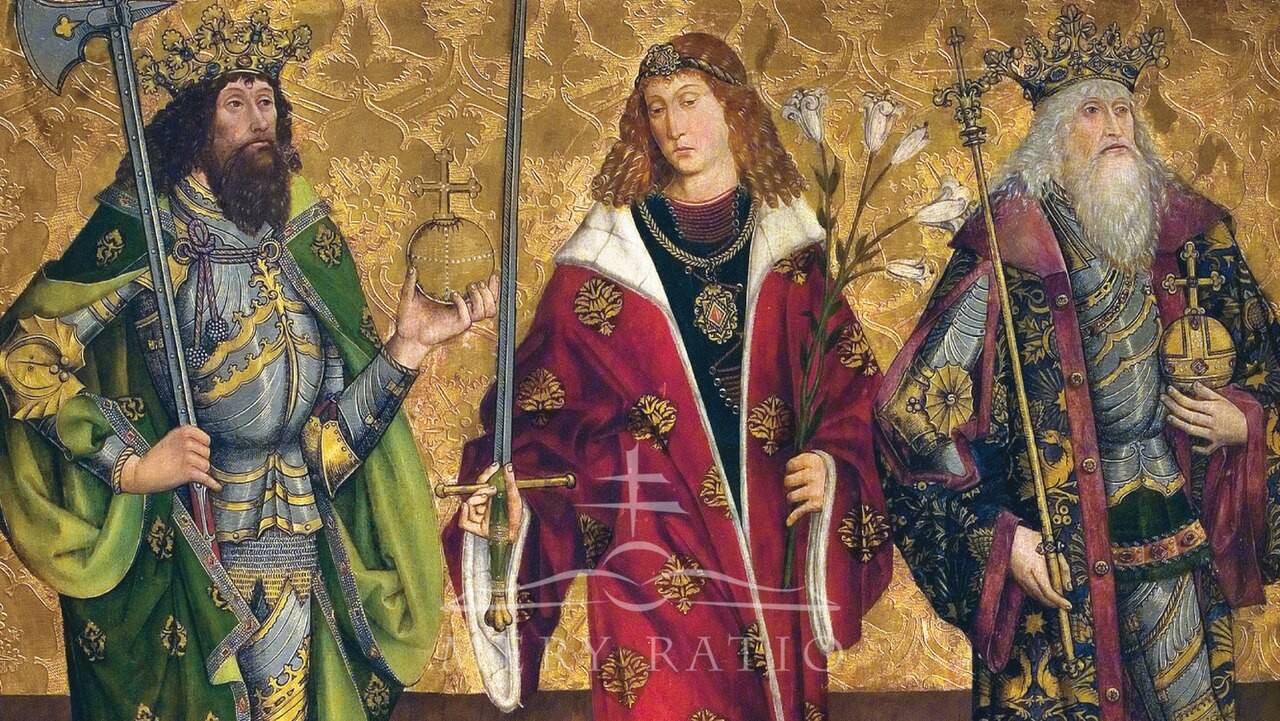
Emeric was the youngest of the holy kings, so the group also symbolized three ages: Stephen, the elderly, wise ruler; Ladislaus, the middle-aged warrior, the embodiment of the knight king; and Emeric, the young heir to the throne, holding a lily, considered a symbol of innocence, representing hope for the future.
Emeric’s role expanded in early modern church school education: he was held up as a role model for young people, and from this point on, he can be considered the patron saint of Catholic Hungarian youth. After 1617 dozens of Latin plays about Emeric were performed on Jesuit school stages, focusing on his virginity. In addition to his role as patron of the country, the prince who died in an unfortunate accident had to wait centuries to find his place among the Hungarian saints, so that his legend could be used to inspire young schoolchildren and promote Catholicism to them.
‘He was held up as a role model for young people, and…can be considered the patron saint of Catholic Hungarian youth’
During the modern era of church political struggles, Emeric became increasingly important in the fight against left-wing movements and ideologies. Anniversaries provided an excellent opportunity for this: in 1907, the 900th anniversary of Emeric’s presumed birth, and then in 1930, the 900th anniversary of his death, made the prince a part of state political representation. By this time, the Emericana Catholic student association and movement, named after the prince, had been operating since 1921 in the country’s higher education institutions, dormitories, social institutions, and monthly magazines.
In the neo-baroque system between the two world wars, the cult of St Emeric reached its peak in 1930, when, after the millennium celebrations of 1896, a series of historic celebrations mobilizing the entire country was organized for the first time. That year, the papal nuncio arrived in Budapest with six other cardinals and nearly 100 foreign bishops. Nearly 130,000 believers participated in the meetings in the capital alone. Publications and propaganda films were produced, museum exhibitions were opened, public statues and churches were erected, and a festive boat parade was held on the Danube. By then, it was already clear that this would be a dress rehearsal for the even larger-scale St Stephen’s Day celebrations in 1938 and the International Eucharistic Congress to be held between 25 and 29 May 1938.
[1] Gábor Klaniczay, Holy Rulers, Blessed Princesses. Dynastic Cults in Medieval Central Europe, Cambridge, 2002, pp. 129–130.
[2] János M Bak, László Veszprémy (eds.), Chronicle of the Deeds of the Hungarians from the Fourteenth-century Illuminated Codex, Budapest–New York, 2018, p. 109.
[3] ‘Life of Duke Saint Emeric’, transl. by Cristian Gaşpar, in Gábor Klaniczay, Ildikó Csepregi, and Bence Péterfi (eds.), The Sanctity of the Leaders. Holy Kings, Princes, Bishops and Abbots from Central Europe (11th to 13th Centuries), Budapest, New York, 2023, p. 212.
[4] Theodor Graff, Johann Friedrich Böhmer (eds.), Die Regesten des Kaiserreiches unter Heinrich II. 1002–1024, Vienna, 1971, Nr. 1646.
[5] For medieval variants of the name Emeric–Almericus, see Dictionary of Medieval Names from European Sources, https://dmnes.org.
Related articles:
At a time when public debate is increasingly polarized and superficial, Hungarian Conservative remains committed to depth, intellectual honesty, and independent conservative thought.
Producing high-quality journalism requires resources. Your contribution helps us expand our coverage, reach new audiences, and keep our content accessible.

Please consider supporting our mission.