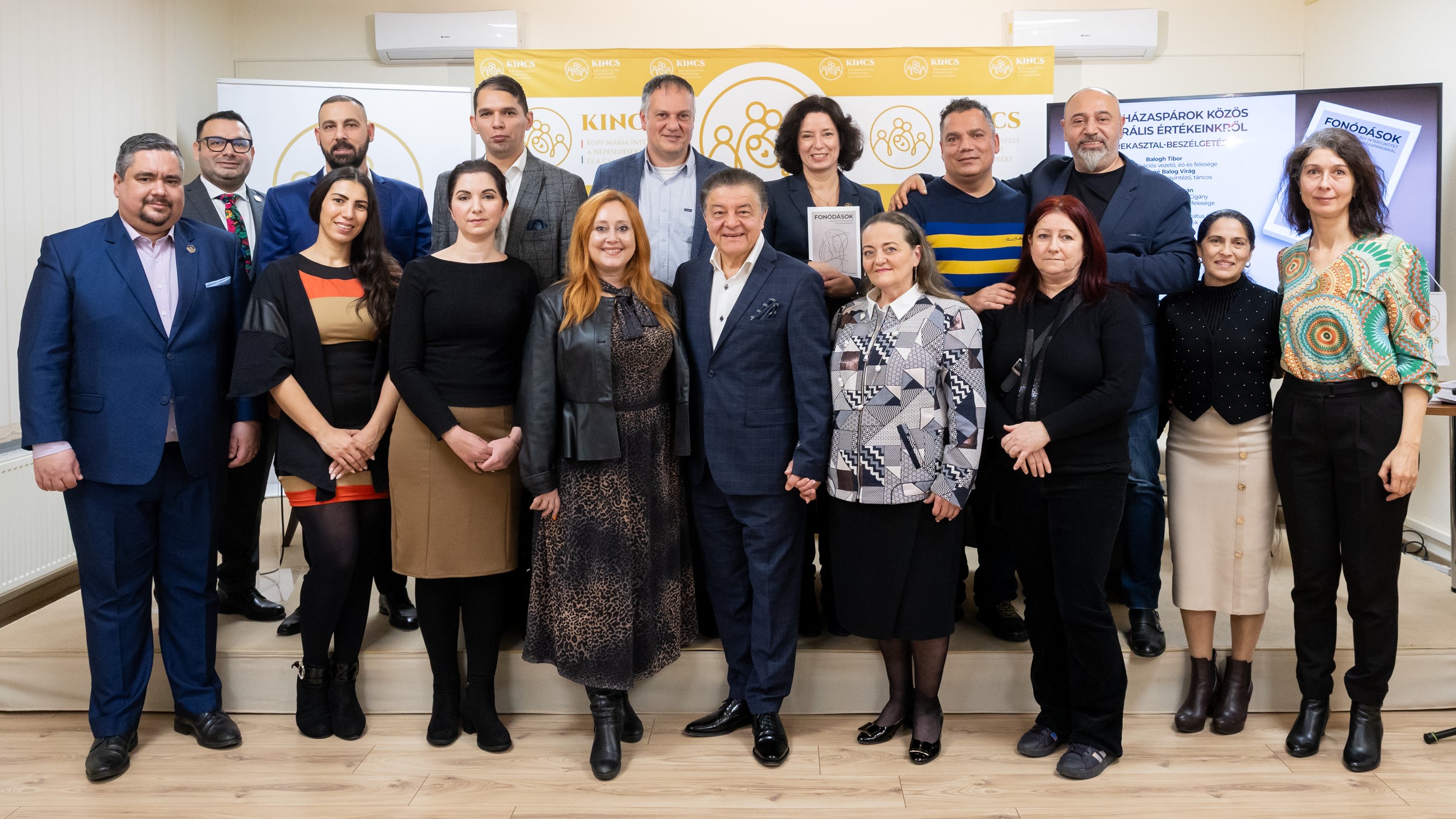
The Fonódások book launch in Budapest continued with two roundtable discussions featuring couples whose life stories appear in the new interview volume. Moderated by the Mária Kopp Institute for Demography and Families (KINCS) communications colleague Ferenc Papinót, the first panel explored how family backgrounds, personal histories and cultural differences shape relationships. Journalist Béla Baranyi and his wife, Judit Regős, president of the Szülők Háza Foundation, shared the unusual story of how they met and reflected on the lessons they learned from their mixed marriage. Researcher and teacher Tímea Mezei and her husband, Roland Markócs, spoke about the evolution of their partnership and the challenges that emerged from their different cultural roots.
The couples agreed that every family experiences difficulties, sometimes even tragedies. The real strength of a marriage, they said, lies in learning to overcome hardship, adapting to one another and maintaining commitment.
Asked what they had brought from home and what they had to change, Regős said she grew up in a family where divorce was a common method of resolving conflict, in contrast to Baranyi’s upbringing, where separation was not an option. Over 16 years of marriage, she learned that conflicts must be faced together rather than avoided. Baranyi added that neither divorce nor open conflict had been part of his own family culture, and he had to learn from Judit how to address disagreements directly.
Mezei and Markócs, who have known each other since the age of 15, described the cultural differences that shaped their early years. After drifting apart in their twenties, they reconnected eight years later with more aligned values. Markócs recalled struggling at first to adapt to Mezei’s busy social rhythm, but once they moved in together, both decided to prioritize family life.
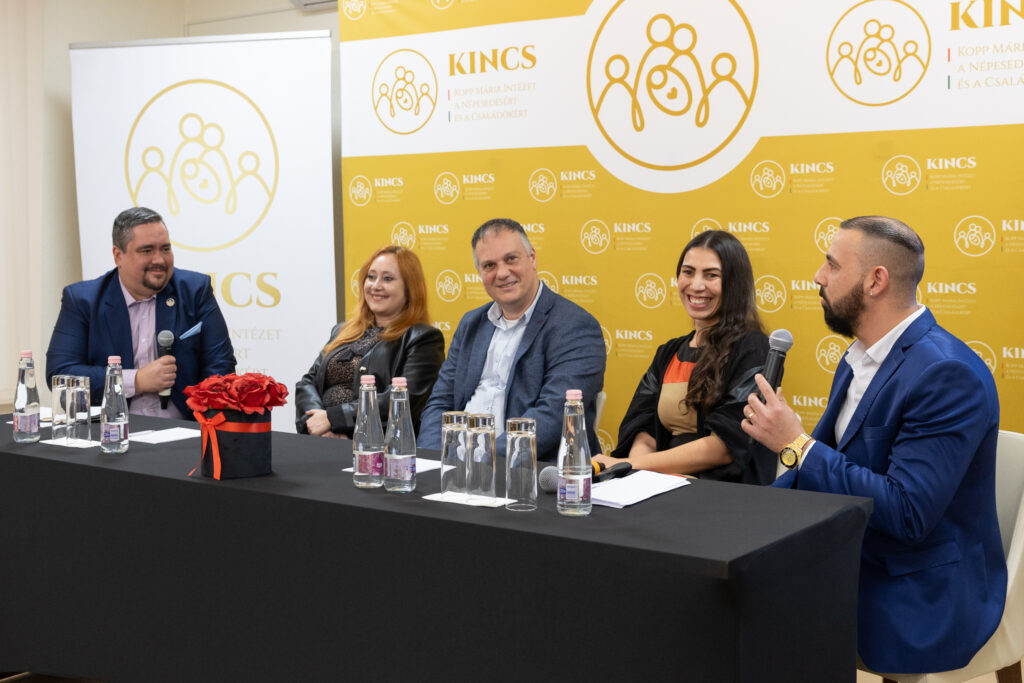
When discussing hope and difficult moments, Baranyi recalled meeting Judit shortly after being widowed and left alone with a two-year-old daughter. Regős’s support played a crucial role in rebuilding his life. Regős said she always felt that they were meant to remain together and that challenges could be overcome. With four children between them, including from previous relationships, and one child together, she prefers to remember the good rather than dwell on low points. Mezei pointed to the exhaustion of balancing early motherhood with writing a dissertation, praising Markócs for his patience and reliability. Markócs said it was not difficult for him despite their daughter being very attached to her mother, noting that they handled every low point together.
Family networks also played an important role. Regős and Baranyi reflected on their shared experiences of exclusion in childhood, despite coming from different backgrounds. Baranyi noted that his own family, shaped by a father who was a traditional Roma musician and a mother from a rural Hungarian background, had already navigated many of the cultural dilemmas that younger Roma Hungarian couples face today. For Mezei, her mother and siblings remain central figures, while her interest in Roma culture has been strong since childhood, even leading her to learn the language to an advanced level. Markócs described how traditional customs in his family have softened over time, though many cultural elements remain present.
‘The interviews are not idealized but demonstrate that progress comes from setting small goals, appreciating everyday achievements and not giving up’
Asked how the Fonódások series might help readers, Baranyi said that the stories show that every family faces hardships, but that perseverance is worth it. Regős noted that while each story contains something uniquely tied to Roma identity, the situations are universal. Mezei added that the interviews are not idealized but demonstrate that progress comes from setting small goals, appreciating everyday achievements and not giving up.
The second roundtable focused on cultural values and the question of what Roma couples pass on to their children and to society. Moderated by KINCS researcher and editor Mónika Raffael, the discussion featured jazz pianist Károly Nyári and his wife, music teacher Edit Lányi; Kálmán Káli-Horváth, director of the Budapest Reformed Roma College, and his wife, pedagogue Marianna Borkó; as well as communications professional Tibor Balogh and his wife, child-protection officer Virág Baloghné Balog.
All three men described the moment they first saw their future wives as decisive. Nyári recalled falling in love at first sight at a school event in their teens, a moment he still carries with him after 42 years of marriage. Káli-Horváth, who grew up in state care, remembered noticing Marianna and immediately deciding to pursue her. Balogh recounted spotting Virág at an event and later connecting through a mix of online messages and shared interests in art and culture. Their wives reflected on these beginnings with humour and affection, describing gradual trust, shared experiences and parallel personal histories.
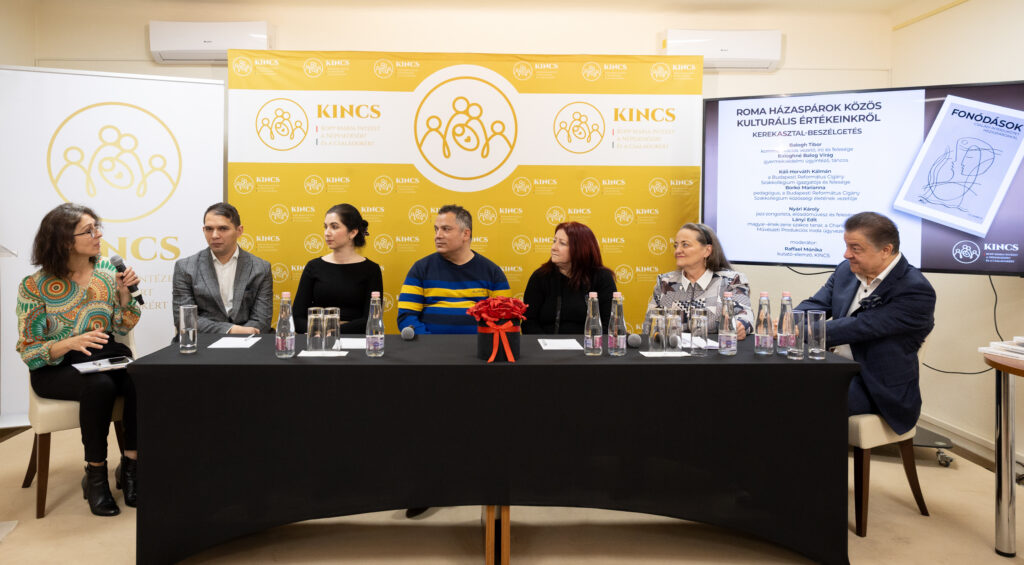
The couples then discussed what cultural values they aim to pass on. Káli-Horváth emphasized faith as the only value he consciously seeks to transmit, explaining that their adopted children arrived with already formed personalities that parents must respect. Borkó added that while they exposed their daughter to music, they did not force her to pursue it, noting that each child’s talent emerges differently.
Nyári, who grew up in a family of musicians, emphasized the power of example: his children saw him practising daily and naturally gravitated toward music, though he and Lányi tried to shield them from the difficulties of a professional artistic career. Lányi insisted that the children also obtain academic degrees to ensure security beyond the arts, though ultimately all pursued music at a high level.
Balogh and Balog highlighted the importance of books, storytelling and the cultural richness of their extended families. While dance and artistic traditions were part of their upbringing, they did not pressure their daughter to follow them, trusting instead that whatever children see at home shapes their interests organically.
Across both panels, a shared message emerged: culture, resilience and family bonds grow stronger when supported by honesty, adaptability and the freedom for each generation to find its own path.
Related articles: