Hungary and the US became almost instant and natural allies after the fall of Communism. The Hungarians saw America as ‘the shining city upon a hill’ maybe even more so than Americans themselves. The small country was offering cooperation in every form. Even when the Americans asked to set up a base in Hungary.
It was because of the Yugoslav war. Due to the atrocities committed by Bosnian Serbs against Bosniak Muslims, NATO bombed Serbia into submission during the summer of 1995.
After the NATO victory, a peacekeeping force was formed from NATO units to be deployed into the war-torn Balkans under the auspices of the UN-approved Implementation Force (IFOR). The force needed nearby bases in friendly countries—and Hungary, an aspiring NATO member and a consolidating democracy, seemed to be a good spot for that.
The Hungarians approved the measure quickly and the first Americans arrived precisely 30 years ago today, on 9 December 1995.
Basing foreign soldiers in Hungary, however, had uneasy overtones. When basing US soldiers was approved on 28 November 1995, it was only a bit more than five years since the occupying Soviet soldiers left Hungary. Obviously, the Americans came as invited friends; but still, they were an army of a great power in little Hungary.
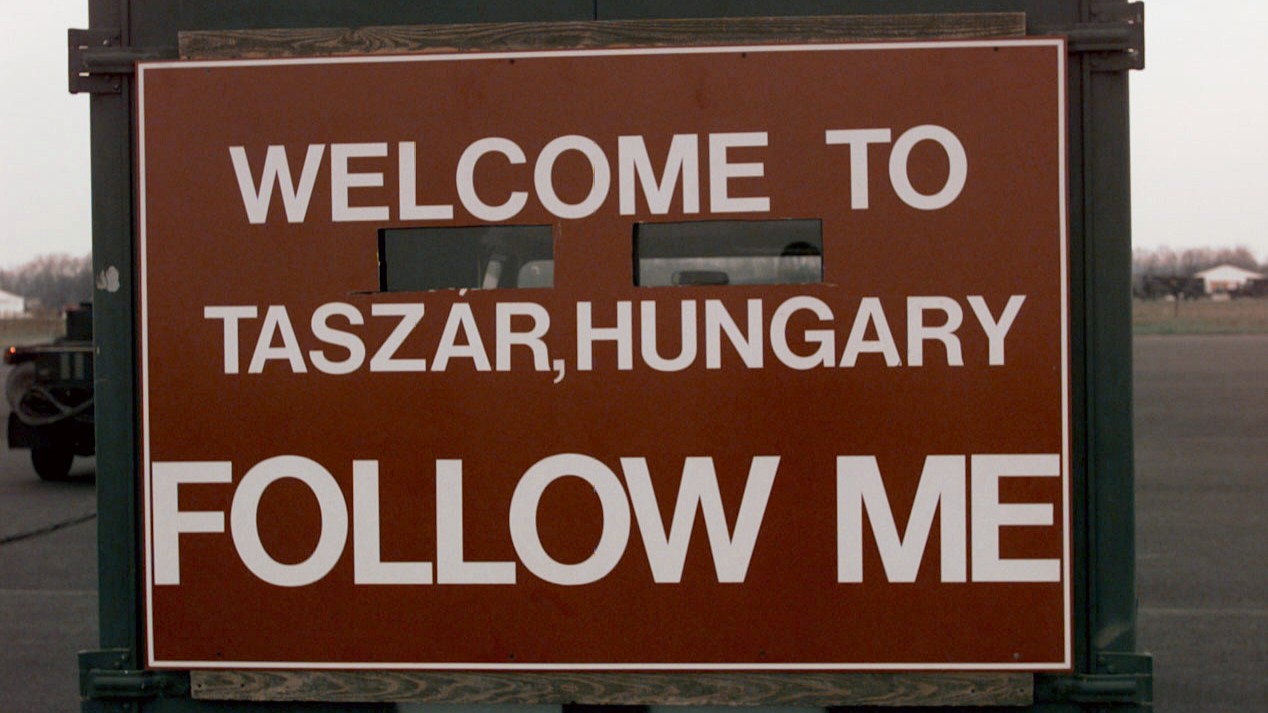
They did not occupy a former Soviet base either, but an active Hungarian airbase, Taszár, in Somogy county—which, in turn, caused turmoil as well. A Hungarian air group needed to move over to another airbase, and then, in November 1996, was disbanded in turn, partly because of the lack of basing space.
The arrival of the Americans disturbed local weekdays as well. Taszár is a small town in the middle of Somogy county, with only 2400 inhabitants in 1995. The Hungarian air regiment that was based there originally was well integrated into the town, but now, total foreigners appeared out of nowhere, with huge vehicles, constantly moving aircradt and strange-looking altogether. The road pavement was damaged by the hulking American vehicles, resulting in traffic accidents, and the relationship became a bit strained.
‘The American base integrated into Somogy county in a way, and found its identity as a foreign enclave’
Still, the American base integrated into Somogy county in a way, and found its identity as a foreign enclave. It was a unique economic opportunity for Hungarian companies, given that suddenly, in the economically bleak mid-1990s, 5500—by Central European standards—well-off Americans materialized and moved into a tent city in the snow-covered Hungarian fields.
A whole range of services appeared just because of the Americans. Hungarian companies hauled Americans to nearby towns, and food places sprang up in the small village. But it wasn’t just the economy: contemporary newspaper accounts quote local grandmas who were eager to invite American youngsters for dinner. They thought the young Americans must be lonely so far away from their homelands and parents.
The base also provided a special occasion for a US president to visit Hungary. Bill Clinton visited the base on 13 January 1996, a couple of weeks after the first American planes landed there, and announced the launch of the IFOR medal for the NATO forces participating in the peacekeeping operation.
The role of the airfield in American operations in the region was even more pronounced by 1999. In that year, the US was hitting Serbia again, this time because of its conflict in Kosovo. US aircraft were launched from Taszár to bomb Serbian targets.
In late 2002, the Americans launched an even more interesting project in the small base. They were training Iraqi insurgents ahead of their planned 2003 intervention in order to deploy them as the new armed forces independent of Saddam Hussein. The best option for this seemed to be the base in the middle of the Hungarian countryside, where no Western press was lingering around in the immediate distance.
However, this was the last time it was used by Americans for substantial purposes. The Yugoslav crises, eventually, were off. The focus was on the Middle East, and they needed such minor airfields no more. They packed up next year and on 30 June 2004, left Taszár.
The only thing remaining behind them is an American chapel that looks as if it could have been built in the Midwest. Its wooden frame now holds the rich memories of the Socialist-era air group, while the airport remains in the limbo of unrealized investments. The Americans left Somogy county, but they left behind the tradition of American–Hungarian cooperation and friendship—making it possible, perhaps for the first time in Hungary’s history, to host the army of a great power not as occupiers, but as guests.
Related articles: