This article was originally published in Vol. 5 No. 4 of our print edition.
About the Czech Political System
According to the Czech Constitution,1 the state’s legislature is the Parliament of the Czech Republic (Parlament České republiky). This bicameral assembly comprises the Chamber of Deputies (Poslanecká sněmovna) and the Senate (Senát). The Chamber of Deputies (also referred to as the ‘lower house’) consists of 200 members elected for four-year terms through a system of proportional representation. Elections are conducted on the basis of national party lists, providing political parties a platform to compete throughout the country’s 14 regions. Unlike in Hungary, the sequence of aspirants on these lists is not fixed, allowing voters to express preferences for up to four individual candidates. Seats in the lower house are allocated according to the votes cast in national elections, aiming to ensure that the ratio of members of Parliament (MPs) representing each party reflects the political composition of society as a whole. This system typically results in a fragmented legislature, where no single party is able to secure an outright majority; consequently, coalition governments are the norm. The most recent election proved to be no exception. The minimum age for eligibility to serve as an MP in the lower house is 21. The Chamber of Deputies functions as the primary legislative body, where the most significant political decisions are made. The government is accountable to this house and derives its mandate from it. The president appoints the prime minister; however, the appointed government must secure a vote of confidence from the Chamber of Deputies. If the lower house passes a vote of no confidence, the government is required to resign. Under the Constitution, a motion of no confidence may be introduced only against the government as a whole.2
In contrast, the Senate (also known as the ‘upper house’) consists of 81 members, elected in single-member constituencies for six-year terms. Elections are held on a rotational basis: one-third of the seats are contested every two years. The Senate’s principal function is to provide checks and balances on the lower house, thereby ensuring the stability and fairness of the legislative process. Thus, the upper house does not play a politically dominant role; rather, it serves primarily as a body of review and oversight, exercising corrective and balancing functions within the legislative process. The minimum age for eligibility to serve as a senator is 40. Unlike the Chamber of Deputies, the Senate cannot be dissolved by the president. Consequently, the government is accountable solely to the lower house.3
Cooperation between the two chambers is ongoing; bills are generally debated and first adopted by the Chamber of Deputies. They are then referred to the Senate, which may approve, reject, or amend the measure, and has also the right to decide not to deliberate on it (in which case the bill is automatically considered approved). If the Senate either rejects the bill or proposes amendments, the legislation is returned to the Chamber of Deputies. This may override the Senate’s decision by absolute majority—that is, by the votes of more than half of the members. This means that, ultimately, the final word rests with the Chamber of Deputies. There are certain matters, however, in which the Senate plays a stronger role. When it comes to amending the Constitution, for instance, the approval of both chambers is required, and neither can override the other’s decision. The same rule applies to the ratification of international treaties, which also requires the consent of both chambers. In the event of the Chamber of Deputies being dissolved, the Senate temporarily assumes some of its functions, including the adoption of urgent measures. If a bill has been passed, the speaker of the Chamber of Deputies refers the approved act to the president for signing. In the event that the president returns the bill to the Chamber of Deputies within 15 days of its referral, the Chamber of Deputies votes on it again (and the bill is passed if the Chamber of Deputies overrides the president’s veto by a simple majority of all deputies). After the prime minister has signed the act, it is promulgated in the Collection of Laws.4
The Outcome of the Elections
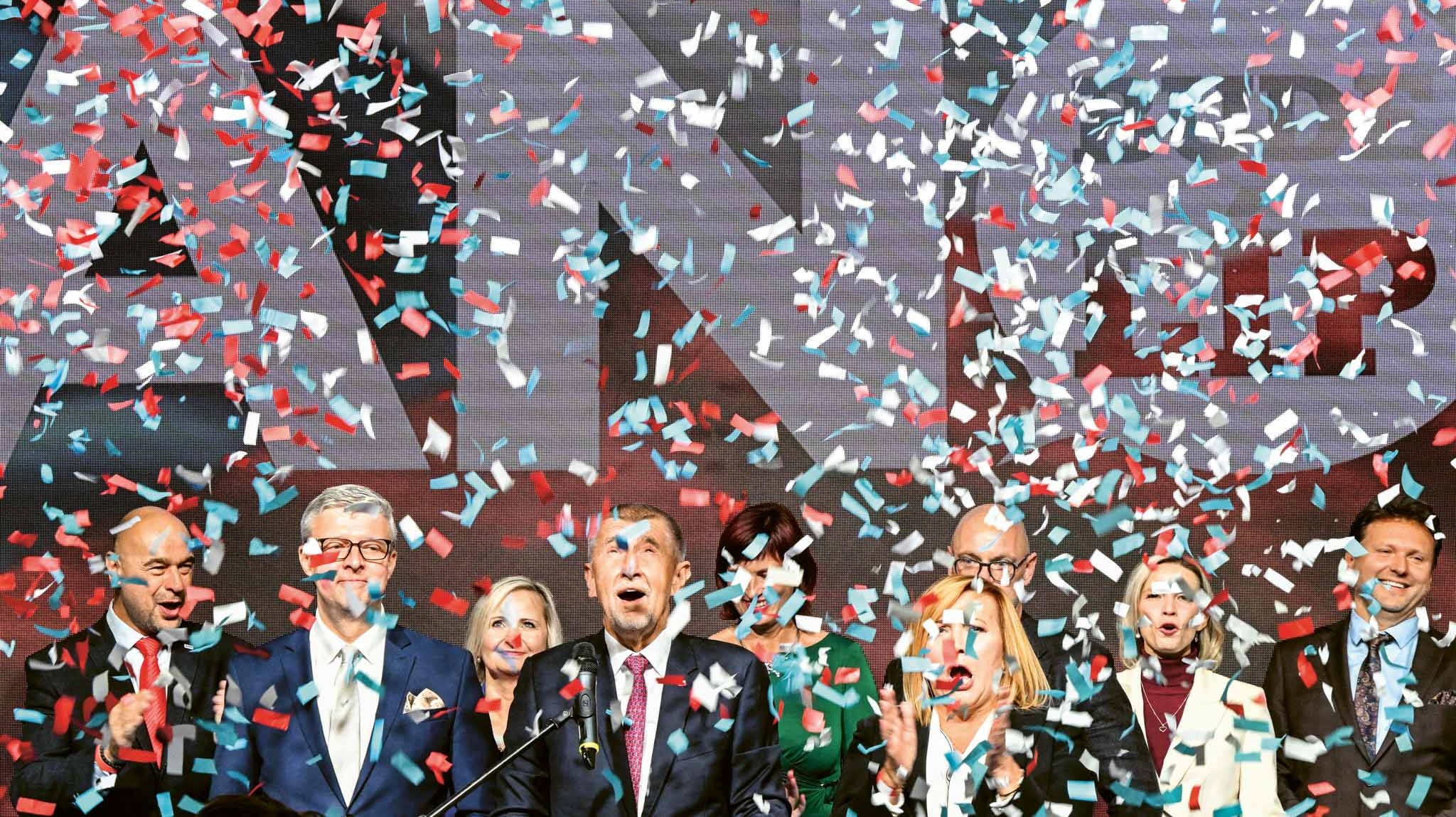
Returning to the recent elections in October this year, according to the final results released by the Czech Statistical Office, Andrej Babiš’s opposition movement ANO 2011 (Akcia nespokojných občanov – Action of Dissatisfied Citizens) won 34.51 per cent of the vote. The Spolu (Together) coalition—comprising the three governing parties ODS, KDU-ČSL, and TOP 09—came in second with 23.36 per cent, followed by another coalition partner, STAN (Starostové a nezávislí – Mayors and Independent Personalities), which secured 11.23 per cent. In fourth place was the Česká pirátská strana (Czech Pirate Party) with 8.97 per cent, followed by the SPD (Sloboda a priama demokracia – Freedom and Direct Democracy) movement with 7.78 per cent. Finally, the Motoristé sobě (Motorists Themselves – AUTO) party crossed the parliamentary threshold and entered the lower house with 6.77 per cent of the vote.5 The distribution of seats in the 200-member Chamber of Deputies is as follows: ANO, 80 seats; Spolu, 52; STAN, 22; the Pirates, 18; SPD, 15; and AUTO, 13 seats.6
The New Coalition and Its Members
Although Andrej Babiš repeatedly stated—both before the elections and after the results were announced—that he wished to form a (minority) government composed solely of members of his own party and independent experts, it has now been confirmed that during the next parliamentary term, a coalition government will lead the Czech Republic.7 Unsurprisingly, both AUTO and the SPD have expressed a strong interest in joining the executive branch. Their direct participation in the cabinet entails obtaining specific ministries, providing these parties with an excellent opportunity to strengthen and expand their political influence over the coming years. The parties that suffered defeat in the elections, as well as the liberal press, have repeatedly voiced concern that if foreign policy were to be directed not by an ANO nominee or a career diplomat, but by a representative of either the AUTO Party or the SPD movement, it would immediately create a new dynamic in Czech–EU relations—one that would go beyond the objectives of even Babiš’s own party. This concern was particularly plausible given that the two smaller coalition members are sceptical of the EU and have previously advocated for a referendum on the Czech Republic’s EU membership. However, it has now become clear that such a referendum will not take place during the upcoming parliamentary cycle. In a relatively rapid manner, only one month after the elections to the Chamber of Deputies, the parties forming the new Czech government have already agreed on a coalition framework. On behalf of the ANO movement, the document was signed by its chairman, Andrej Babiš, and the head of its parliamentary group, Taťána Malá; from the SPD movement, the signatories were Tomio Okamura and the head of its parliamentary group, Radim Fiala. On behalf of the AUTO Party, the signature was provided by the chairman, Petr Macinka, and the head of their parliamentary group, Boris Šťastný.8
Although negotiations over the government’s programme are still ongoing, it has already been confirmed that the Czech Republic will have a 16-member cabinet. Under the leadership of Andrej Babiš, ANO will provide the prime minister and take charge of eight ministries: Industry and Trade, Finance, Health, Justice, Labour and Social Affairs, Education, Regional Development, and the Interior. The AUTO party will lead the Ministries of Foreign Affairs, Culture, Environment, and the newly established Ministry of Sports, Prevention and Health. Meanwhile, the SPD movement will be represented by three ministers—heading Defence, Agriculture, and Transport—and the party leader, Tomio Okamura, will serve as Speaker of the Chamber of Deputies.9
But what should we know about the parties of the forming coalition? The most powerful actor of this new-born triumvirate is the ANO 2011 movement, which won the most votes in the Czech Republic’s latest elections to the lower house. The origins of the party date back to the early 2010s, when the Prague-based, Slovak-born tycoon Andrej Babiš launched his Action of Dissatisfied Citizens (Akce nespokojených občanů) initiative. In 2012, when it was transformed into a political movement under the name ANO 2011, its stated goal was clear: to change entrenched political practices and bring practical solutions into politics. The movement presented itself as an alternative to traditional parties, emphasizing transparency, professionalism, and efficiency.10 Since its founding, ANO has become one of the most significant political forces in the Czech Republic. After winning in 2017,11 it once again emerged as the strongest party in the 2025 lower house elections. ANO’s success has extended beyond national politics. Its candidates have consistently earned voter trust in European Parliament elections—out of 21, they won four seats in 2014,12 six in 2019,13 and seven in 2024.14
‘The Czech Republic’s new coalition government…marks a shift towards a sovereignty-focused, security-conscious, and state-centred model of governance’
Initially, the movement positioned itself on the liberal side of the political spectrum. Between 2014 and 2019, its representatives sat with the Alliance of Liberals and Democrats for Europe15 (ALDE), and from 2019 to 2024 with Renew Europe.16 One of ANO’s vice-chairs was Věra Jourová, later a European Commissioner, who became one of the Hungarian Prime Minister Viktor Orbán’s fiercest critics in Brussels. Babiš later remarked about her: ‘Mrs Jourová, who went to Brussels as a normal person, went completely mad.’17 Tensions between ANO and the progressive bloc eventually led to a split, driven mainly by the Czech party’s anti- migration stance, its opposition to expanding EU competences, and its rejection of the Green Deal.18 In 2024, together with Hungarian Prime Minister Viktor Orbán and Austrian Freedom Party leader Herbert Kickl, Babiš co-founded the Patriots for Europe group in the European Parliament.19
The second-strongest party in the new-born coalition is the SPD (Freedom and Direct Democracy), which has been a part of Czech politics for years. The movement represents a joint list of four protest actors—SPD, Trikolóra, Svobodní, and PRO—aimed primarily at voters who have lost trust in the traditional political establishment. The declared mission of the formation, which is often labelled as far-right nationalist in the progressive press, is to defend freedom and national sovereignty while giving a political voice to those who feel excluded from public decision-making. The alliance is built on shared scepticism toward the EU; they strongly oppose migration and consider the Green Deal a ‘crazy neo-Marxist plan’.20
Throughout its campaign, SPD pledged to return to common sense, reduce bureaucracy, and increase domestic decision-making. This electoral coalition is founded on shared values: the defence of Czech sovereignty, resistance to the centralization of power of the European Commission, the promotion of direct democracy, national conservatism, and the protection of freedom of speech. Their campaign emphasized public security, rejection of illegal migration, and the reduction of dependence on European regulations. The joint candidate list is led by the SPD movement, which has maintained stable representation in the Chamber of Deputies for several years. The bloc’s leader and most prominent figure is the former senator21 Tomio Okamura, who has just been elected as Speaker of the Chamber of Deputies. Born in 1972 in Tokyo to a Japanese–Czech family, Okamura spent most of his childhood in Czechoslovakia, with a few years in Japan. While his background might suggest openness toward other cultures, in reality, despite having experienced discrimination himself, he strongly advocates preserving the Czech Republic as a state of and for its citizens. Accordingly, he firmly rejects the promotion of Islam in Europe, opposes migration policies, and has been critical of the growing Ukrainian diaspora in the Czech Republic. He characterizes the Green Deal as ‘neo-Marxist’ and supports the Czech Republic’s withdrawal from the European Union.22 Many see these messages as nothing more than political marketing.
‘The government programme emphasizes strengthening domestic institutions, protecting civil liberties, ensuring energy independence through nuclear expansion, and pursuing pragmatic economic and foreign policies’
Interestingly, Tomio Okamura’s brother, Hayato Okamura, is also a member of the Chamber of Deputies and now serving his second term. As a Catholic theologian, he represents the Christian Democratic Party (KDU–ČSL),23 which ran on a joint ticket with the SPOLU coalition, ANO’s main political rival. In the lower house debate on 5 November 2025,24 he openly spoke out25 against his brother’s election as speaker of the House, calling him a national security risk. Their younger brother, the openly homosexual26 architect Osamu Okamura, is likewise active in public life as a member of the Green Party (Zelení).27
The smallest and youngest member of the coalition is the Motorists Themselves (AUTO), whose origins date back to 2017, when the party was registered under the name Referendum on the European Union (Referendum o Evropské unii). Two years later, in 2019, it was renamed the Party of Czech Independence (Strana nezávislosti České republiky, SNČR). Its current leader, Petr Macinka, has led the movement since 2022, at which time he once again renamed it, this time to Motorists Themselves, often referred to simply as ‘AUTO’. Macinka initially sought to oppose what he described as ‘cycle-terror’ and the Prague leadership’s long-standing hostility toward drivers and motorcyclists—a criticism aimed primarily at the Pirates and the Prague for Itself movement.28 Although the party performed weakly in the municipal elections29 in the capital city, it achieved a surprisingly strong result in the 2024 European Parliament elections, finishing third with 10.26 per cent of the vote, behind ANO 2011 (26.14 per cent) and SPOLU (22.27 per cent).30 This result secured the movement two seats in the European Parliament.31 Although the party is often labelled in public discourse as simplistic or even radical, its electoral programme32 in fact demonstrates a remarkably well prepared, professionally grounded policy background. While it originally emerged as a reincarnation of a classic protest movement, it has clearly outgrown that role. Indeed, upon entering government, it succeeded in incorporating many of its original commitments into the government programme.
Plans for the Future
The new government’s programme statement has now been unveiled,33 outlining the guiding principles and strategic priorities for the next four years. Comprising 18 chapters and a preamble, the document serves not merely as a policy blueprint but as a political manifesto that translates the campaign’s central promises into governing practice. Its themes—emphasizing sovereignty, social stability, and national resilience—closely mirror the rhetoric that dominated the recent elections. Notably, several of its proposed measures echo policies already implemented in Hungary, suggesting a regional convergence towards a more state-centred, security-conscious model of governance. According to the document, the Czech Republic is entering a critical period in which it must rebuild citizens’ trust in the state, its institutions, and its ability to ensure a fair, safe, and prosperous society for all. The government envisions a country where honest work is rewarded; young people can plan for the future, start families, and access affordable housing; the elderly can live with dignity; and every citizen can rely on high-quality public services. All this in a safe, modern and supportive environment where the state is there for the citizen and not the other way around.
Make Czechia Democratic Again
Restoring public trust in the state is central to the government’s agenda, particularly in the realm of civil liberties.34 According to the document, the Ministry of the Interior must no longer serve as an instrument for curbing free expression or acting as a surveillance authority. Instead, it should function as a protector of citizens’ rights, ensuring that state power is not misused to intimidate or silence dissent. In this vision, the ability to speak freely without fear is not merely a legal guarantee but a cornerstone of a healthy, resilient democracy. The government places particular emphasis on building strong, modern, and professional security forces, adequately funded and equipped to safeguard both citizens’ daily lives and the state’s internal order. It has pledged to close the widening pay gap between soldiers, police officers, and firefighters, raising salaries to reflect the demands and responsibilities of their service. Starting pay for police officers and firefighters will be set at no less than 50,000 CZK (approximately $2,378), signalling a non-abstract commitment to valuing frontline personnel.
Migration and asylum policy is another central priority for the government, which has signalled a zero-tolerance approach to illegal migration, rejecting the EU’s migration pact and preparing a new law that will grant asylum only in narrowly defined, exceptional cases. Policy will be guided by both the labour market and national security needs. Foreigners who commit crimes will face strict consequences, with law enforcement and immigration authorities given expanded powers to ensure the swift and consistent expulsion of offenders. In this framework, the state asserts its prerogative to maintain complete control over who resides within its borders, underscoring a broader emphasis on sovereignty, security, and rule of law.
Just as happened in Hungary, the new Czech government is also exploring lowering the age of criminal responsibility, signalling a tougher stance on juvenile offending. At the same time, it emphasizes that interventions for young offenders must be educational and rehabilitative, fostering accountability and encouraging reintegration into society. Parole conditions for repeat offenders will be tightened, while programmes aimed at reducing recidivism will focus on supporting a successful return to the community. In parallel, the government underscores its support for transparent and fair rules on self-defence. Citizens, it asserts, have the right to protect their homes, lives, and property from unlawful attacks without fear of subsequent criminal prosecution. This stance extends to firearm ownership, a topic of ongoing public debate. The government has committed to preserving the rights of lawful gun owners, signalling an attempt to balance individual liberties with broader public security concerns.
Sovereignty and the Rebirth of the Visegrad Group
The document frames the Czech Republic as a sovereign member of the EU and a committed NATO ally.35 At the same time, it underscores the government’s view that the EU has limits, and must not infringe upon the internal sovereignty of its member states. The Czech government envisions a different kind of Europe—a community of confident, sovereign nation states that cooperate pragmatically while retaining authority over matters within their exclusive competence. Strengthening relations within the Visegrad Group is a key priority, guided by mutual respect, shared interests, and effective regional cooperation. In line with this vision, the government seeks to prevent further transfers of national powers to the EU, safeguard energy independence, and avoid participation in environmental or other regulatory measures that could undermine the competitiveness of the domestic economy. Border security and the preservation of a free information space are also emphasized, alongside a commitment to maintaining the principle of unanimity within European decision-making. Transparency in the financing of non-profit organizations is another stated priority. The government pledges that institutions funded from the state budget, as well as those receiving foreign support, will operate under publicly accessible financial procedures, reinforcing accountability and trust.
The government aims to pursue a pragmatic, professional, and realistic foreign policy grounded in Czech national interests while maintaining respect for international partners. The document reaffirms the Republic’s commitment to international law and state sovereignty, and pledges to support diplomatic efforts to end the war in Ukraine and reduce the risk of conflict elsewhere in Europe. Economic policy is closely linked to this strategic vision: the government will actively diversify Czech exports and strengthen ties with markets across Asia and the Pacific, Latin America, the Middle East, Africa, Australia, and beyond. This intention closely aligns with Hungary’s connectivity policy. By opening new markets, promoting foreign direct investment, and fostering business cooperation, the government seeks to reduce reliance on any single partner while expanding the country’s global economic footprint.
Nuclear Dominance in Energy Policy
The new government of the Czech Republic, just like its Hungarian counterpart, believes that a strong and resilient economy rests on affordable energy, fair pricing, and a predictable business environment. The government aims to position private enterprise as the principal driver of growth, to stimulate long-term investment. This strategy rests on energy self-sufficiency, underpinned by the modernization of transmission networks and an expanded reliance on nuclear power as a stabilizing pillar of the national energy mix. The programme36 also pledges to shield households and firms from excessive costs, streamline regulatory burdens that have long constrained competitiveness, and reinforce the role of domestic industry in the country’s economic architecture. The overarching ambition is to cultivate a prosperous, innovation-driven economy built on added value, robust domestic production, and an autonomous energy policy capable of insulating the Czech Republic from external shocks and geopolitical vulnerabilities.
To achieve these objectives, the government rejects the EU’s ETS2 emissions quota system, is reducing distribution and transmission fees, and supports both nuclear and domestic energy sources to bolster self-sufficiency and national energy security. Nuclear energy, in particular, is framed as the future of the Czech energy sector. The administration plans to initiate construction procedures for Units 5 and 6 of the Dukovany Nuclear Power Station while preparing the projects for Units 3 and 4 at the Temelín Nuclear Power Plant, ensuring substantial involvement of local industry in these developments. Simultaneously, the government will establish the legislative and financial framework for investments in small modular reactors (SMRs) and the domestic production of SMR components, signalling a long-term commitment to advanced nuclear technology as a pillar of energy independence and economic stability. These are exactly the directions that the Orbán government set for Hungary in the energy field after 2010.
No More Ideological Interference in Transportation
The new Czech government also signals a break from what it sees as ideological intrusions into transport policy—particularly measures that, in its view, threaten citizens’ freedom of movement and economic access.37 It therefore rejects the EU’s planned 2035 ban on internal combustion engines as well as the introduction of carbon taxes on fuels, framing both as disproportionate burdens on households and industry. Domestically, the government plans to tighten professional standards in the transport sector. Taxi drivers will be required to demonstrate proficiency in Czech language, and regulations governing taxi services and digital transport platforms will be harmonized to establish clear qualification criteria and ensure safe, reliable service provision. More broadly, the programme promises a balanced approach to transportation development. No single mode—including cycling—will be elevated at the expense of others. Instead, investment will be directed according to the actual mobility needs of citizens and regions, with an emphasis on connectivity and the complementary functioning of road, rail, and other transport networks.
Excellent Education Is the Key to a Successful Future
The government emphasizes38 that education must be free, accessible to all, of high quality, and safe, while remaining free from ideological influence or the interference of political nonprofit organizations. Schools are tasked with fostering learning, knowledge, and critical thinking, rather than serving as platforms for political or activist agendas. Support for free school meals for children from disadvantaged families will be expanded, and access to school sports will be increased—not only through backing sports clubs but, more importantly, by investing in modern school sports infrastructure to ensure every child has the opportunity for healthy, active development. Modern technologies, including artificial intelligence, are recognized as valuable educational tools, but their use must always occur with teacher oversight. Meanwhile, mobile phone and social media addiction are explicitly discouraged, with children encouraged to spend breaks actively engaged with the real world.
‘The coalition aims to restore public trust, improve social services, modernize education and healthcare, and reinforce national security’
Teacher compensation is a central focus for the new government. Starting salaries for university-educated teachers will be set at 50,000 CZK (approximately $2,378), with an average salary of 75,000 CZK (approximately $3,567) guaranteed by the end of the electoral term. In place of a rigid pay scale, the government plans to implement a structured career progression system for teachers and principals, providing clear pathways for professional development and evaluation based on objective, performance-based criteria. Higher education is also being prioritized. The government will ensure that there are enough places at university to give talented students the opportunity to study, regardless of their financial circumstances. Targeted support will focus on sectors of high societal need—such as healthcare, modern technologies, and psychology—while professional training and academic programmes will be designed to prepare students for practical, workforce-relevant careers.
Healthcare and Social Policy
The government prioritizes high-quality, free, and accessible healthcare for all citizens.39 Its objectives include reducing waiting times for examinations and procedures, ensuring the availability of medicines, strengthening the prevention of cancer and cardiovascular diseases, and paying particular attention to mental health. The government will support the modernization of hospitals, the digitalization of the healthcare system, and the reinforcement of workforce stability within healthcare professions.
As in other countries in the region, housing costs in the Czech Republic have risen significantly in recent years. In response, the government has made affordable housing a key priority.40 It seeks to accelerate and simplify building procedures, support the construction of rental and cooperative housing, and provide state assistance to help young families and workers in essential professions secure housing. The government will also support the construction of student dormitories and housing for the elderly. The programme also addresses the needs of the older segments of society. The goal is to ensure a financially sustainable and equitable pension system, based on merit and solidarity, for those who have worked and contributed throughout their lives. Unlike the previous government, which set the retirement age at 67, the new policy will limit the pension age to 65. Additionally, a fair system of pension indexation will be reinstated to ensure that pensions do not lose their purchasing power and that retirees can maintain a dignified standard of living even during periods of inflation. In this way, the government is seeking to correct changes introduced by the previous administration that had restricted and reduced indexation. The government aims to strengthen the accessibility of social services, ensure dignified care for the elderly and people with disabilities, and improve coordination between the healthcare and social service sectors so that support for those in need is comprehensive and predictable. At the same time, the social benefits system will be reviewed to prevent abuse of support, while promoting work incentives and encouraging active participation in society.
Conclusion
Based on an examination of the data published by the Czech Statistical Office, it can be stated that no political party in the history of the independent Czech Republic has ever received as many valid votes as the ANO 2011 movement did in 2025: 1,940,507 in total.41 The previous record was held for nearly three decades by the Czech Social Democratic Party (Česká strana sociálně demokratická – ČSSD), which won 1,928,660 valid votes in 1998.42 Babiš’s mandate is therefore exceptionally strong, and the contents of the government programme suggest that the winning coalition’s determination to improve the country’s trajectory is indeed substantial. Recent decades have demonstrated that the main key to the success of the Central and Eastern European region lies in close cooperation among its states. Should efforts to revitalize the cooperation within the Visegrad Group prove successful, and should the region’s interests be represented with firm unity in the European Council, then the ambitious commitments set out in the government programme may indeed be realized.
NOTES
1 ‘Constitution of the Czech Republic (Ústava České republiky)’, usoud.cz, www.usoud.cz/fileadmin/user_upload/Tiskova_mluvci/Ustava_EN_ve_zneni_ zak_c._98-2013.pdf, accessed 24 October 2025.
2 ‘The Chamber of Deputies, Parliament of the Czech Republic, Legal Framework’, pspen.psp.cz, https://pspen.psp.cz/chamber-members/legal-framework/, accessed 24 October 2025.
3 ‘Senate of the Parliament of the Czech Republic, Senate activities’, Senat.cz, www.senat.cz/cinnost/index-eng.php?ke_dni=13.11.2025&O=15, accessed 24 October 2025.
4 ‘Senate of the Parliament of the Czech Republic, Frequently Asked Questions (FAQ)’, Senat.cz, www.senat.cz/informace/faq/index-eng.php, accessed 24 October 2025.
5 ‘Volby do Poslanecké sněmovny Parlamentu České republiky konané ve dnech 3.–4. 10. 2025’, Volby.cz, www.volby.cz/app/ps2025/cs/results, accessed 24 October 2025.
6 ‘Volby do Poslanecké sněmovny Parlamentu České republiky’, Volby.cz, www.volby.cz/app/ps2025/cs/home, accessed 24 October 2025.
7 Ketrin Jochecová, ‘Czech President Petr Pavel Hints Tapping Andrej Babiš as PM; Urges Parties to Keep Ammunition Aid for Ukraine’, Politico.eu (6 October 2025), www.politico.eu/article/czech-president-petr-pavel-hints-tapping-andrej-babis-m-urges-keep-ammunition-aid/.
8 ‘České strany ANO, SPD a Motoristi podpísali koaličnú zmluvu’, Trend.sk (3 November 2025), www.trend.sk/spravy/ceske-strany-ano-spd-motoristi-podpisali-koalicnu-zmluvu.
9 ‘ANO, SPD and Motoristé Reach Agreement on Ministerial Portfolios for Prospective Government’, Prague Daily News (11 October 2025), www.praguedaily.news/2025/10/11/ano-spd-and-motoriste-reach-agreement-on-ministerial-portfolios- for-prospective-government/.
10 ‘Politické hnutie ANO – história a vznik’, Stavkynavolby.sk, https://stavkynavolby.sk/profil/ politicke-hnutie-ano/#historia, accessed 8 November 2025.
11 ‘Výsledky voleb do Poslanecké sněmovny Parlamentu České republiky 2017’, Volby.cz, www.volby.cz/app/ps2017nss/cs/results, accessed 8 November 2025.
12 ‘Výsledky voleb do Evropského parlamentu 2014’, Volby.cz, www.volby.cz/pls/ep2014/ep144?xjazyk=CZ, accessed 8 November 2025.
13 ‘Výsledky voleb do Evropského parlamentu 2019’,Volby.cz, www.volby.cz/pls/ep2019/ep144?xjazyk=CZ, accessed 8 November 2025.
14 ‘Výsledky voleb do Evropského parlamentu 2024’, Volby.cz, www.volby.cz/pls/ep2024/ep144?xjazyk=CZ, accessed 8 November 2025.
15 ‘Breakdown by National Parties and Political Groups, 2014–2019 Outgoing Parliament’, European Parliament, https://results.elections. europa.eu/en/breakdown-national-parties-political-group/2014-2019/outgoing-parliament/, accessed 8 November 2025.
16 ‘Breakdown by National Parties and Political Groups, 2019–2024 Outgoing Parliament’, European Parliament, https://results.elections.europa.eu/en/breakdown-national-parties-political-group/2019-2024/outgoing-parliament/, accessed 8 November 2025.
17 ‘Babiš zhanil a hodil přes palubu Jourovou. Stála u začátků hnutí ANO’, Novinky.cz, www.novinky.cz/clanek/domaci-babis-zhanil-a-hodil-pres-palubu-jourovou-stala-u-zacatku-hnuti- ano-40467509, accessed 10 November 2025.
18 Martin Horička, ‘Hnutie ANO vystúpi z europarlamentnej frakcie Obnovme Európu – čo to znamená podľa Martina Horičku’, Týždeň (21 June 2024), www.tyzden.sk/svet/111288/hnutie-ano-vystupi-z-europarlamentnej-frakcie-obnovme-europu-co-to-znamena-podla-martina-horicku/.
19 Aneta Zachová, ‘Orbán, Babiš, Kickl Create New “Patriotic” Alliance to Redefine EU Policies, Eye New Parliament Group’, Euractiv (30 June 2024), www.euractiv.com/news/orban-babis-kickl-create-new-patriotic-alliance-to-redefine-eu-policies-eye-new-parliament-group/.
20 Aneta Zachová, ‘Tokyo-born Czech Nationalist Revives Czexit Ahead of National Election’, Euractiv (7 July 2025), www.euractiv.com/news/tokyo-born-czech-nationalist-revives-czexit-ahead-of-national-election/.
21 ‘Senate of the Parliament of the Czech Republic, “Tomio Okamura”’, Senat.cz, www.senat.cz/senatori/index.php?lng=en&par_3=263&ke_dni=26.10.2013, accessed 8 November 2025.
22 ‘Czexit-kavalkád: a japán származású, szélsőjobbos cseh politikus kiléptetné Csehországot az EUból’ (Czexit Cavalcade: The Japanese-Born, Far-Right Czech Politician Who Wants to Take the Czech Republic out of the EU), Euronews (7 July 2025), https://hu.euronews.com/my-europe/2025/07/07/czexit-kavalkad-a-japan-szarmazasu-szelsojobbos-cseh-politikus-kileptetne-csehorszagot-az-.
23 ‘Mgr. Hayato Okamura, poslanec’, KDUČSL, www.kdu.cz/o-nas/nasi-lide/poslanci/okamura, accessed 14 November 2025.
24 ‘Poslanci zvolili nového předsedu Poslanecké sněmovny’, The Chamber of Deputies, Parliament of the Czech Republic (5 November 2025), www.psp.cz/zprava/21337.
25 ‘Hayato Okamura varuje před svým mladším bratrem, šéfem SPD Tomiem Okamurou’, iDNES.cz (5 November 2025), www.idnes.cz/zpravy/domaci/hayato-okamura-varuje-poslance-pred-svym-mladsim-bratrem-sefem-spd-tomiem-okamurou. A251105_164107_domaci_kop.
26 Filip Titlbach, ‘Tomio občas přiživuje obavy běžných lidí. Že jsem gay, mu ale nevadí, říká Osamu Okamura’, Deník N (7 November 2019), https://denikn.cz/229006/tomio-obcas-prizivuje-obavy-beznych-lidi-ze-jsem-gay-mu-ale-nevadi-rika- osamu-okamura/.
27 ‘Osamu Okamura’, Zelení, www.zeleni.cz/osamu-okamura/, accessed 14 November 2025.
28 ‘“Strana anticyklistů”, zkratka AUTO a štědří sponzoři. Co víme o Motoristech sobě?’, Zpravy.cz (5 October 2025), https://zpravy.aktualne.cz/domaci/strana-anticyklistu-zkratka-auto-a-stedri-sponzori-motoriste/r~9e943e48a21111f0801c0cc47ab5f122/.
29 ‘Výsledky komunálních voleb 2022 – Obec Praha’, Seznam Zprávy, www.seznamzpravy.cz/p/vysledky-voleb/2022/komunalni-volby/obec/554782-praha, accessed 14 November 2025.
30 ‘Výsledky voleb do Evropského parlamentu 2024’, Volby.cz, www.volby.cz/pls/ep2024/ep11?xjazyk=CZ, accessed 14 November 2025.
31 ‘Výsledky voleb do Evropského parlamentu 2024’, Volby.cz, www.volby.cz/pls/ep2024/ep144?xjazyk=CZ, accessed 14 November 2025.
32 ‘Program 2025: Motorismus, svoboda pohybu a doprava’, Motoristé sobě, https://motoristesobe.cz/programme2025#motorismus-doprava, accessed 14 November 2025.
33 ‘Dokument: Programové prohlášení vlády Andreje Babiše’, iDNES.cz, www.idnes.cz/zpravy/domaci/dokument-programmeove-prohlaseni-vlady-andreje-babise.A251103_110559_domaci_hejj, accessed 14 November 2025.
34 ‘Dokument: Programové prohlášení vlády Andreje Babiše’.
35 ‘Dokument: Programové prohlášení vlády Andreje Babiše’.
36 ‘Dokument: Programové prohlášení vlády Andreje Babiše’.
37 ‘Dokument: Programové prohlášení vlády Andreje Babiše’.
38 ‘Dokument: Programové prohlášení vlády Andreje Babiše’.
39 ‘Dokument: Programové prohlášení vlády Andreje Babiše’.
40 ‘Dokument: Programové prohlášení vlády Andreje Babiše’.
41 ‘Volby do Poslanecké sněmovny Parlamentu České republiky konané ve dnech 3.–4. 10. 2025’, Volby.cz, www.volby.cz/app/ps2025/cs/results, accessed 14 November 2025.
42 ‘Výsledky voleb do Poslanecké sněmovny Parlamentu České republiky 1998 – volební okrsek U4’, Volby.cz, www.volby.cz/pls/ps1998/u4, accessed 14 November 2025.
Related articles: