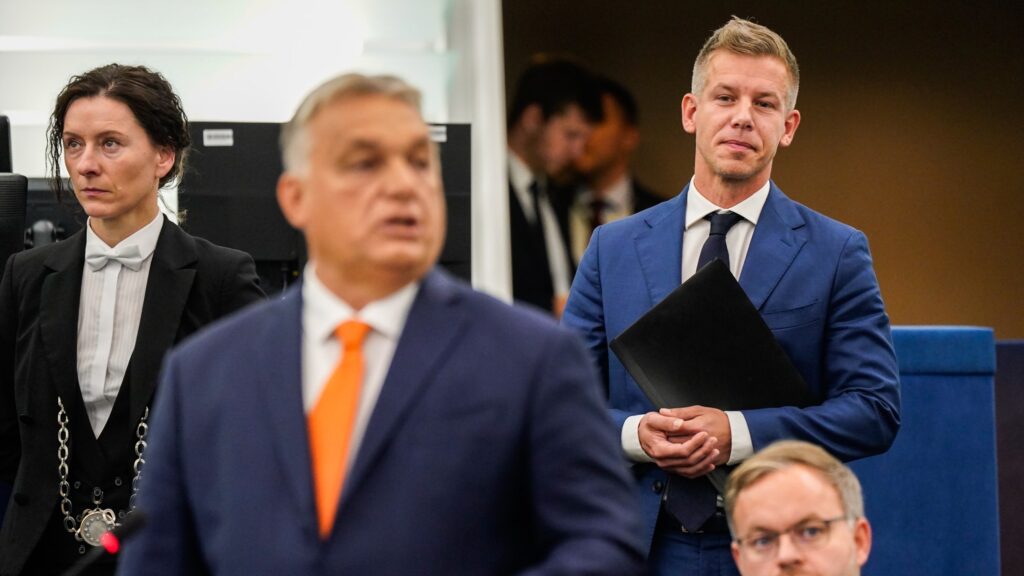
Foreign trips by political leaders are always interesting to observe: by analysing choreography, non-verbal communication, and other subtle signals, one can sometimes learn more about countries’ leaderships and their relations with one another than from the official statements themselves. This is especially true when one of Europe’s most popular leaders visits one of the least approved leaders in the bloc, which is exactly what happened on Tuesday, 2 June, when recently elected Hungarian Prime Minister Péter Magyar travelled to Berlin to meet German Chancellor Friedrich Merz.
Magyar and the Tisza Party secured a landslide victory on 12 April, winning a constitutional supermajority with more than 3 million votes—an unprecedented result in Hungary’s modern history. According to recent polls, their popularity has continued to grow in recent weeks, with Prime Minister Magyar’s approval rating standing at 52 per cent. This is accompanied by an equally unprecedented level of social media engagement and activity, including constant Facebook livestreams followed by hundreds of thousands of Hungarians.
By contrast, Merz and his Christian Democratic Union (CDU) are facing a deep popularity crisis. While the governing party continues to poll in the low twenties, Merz’s personal approval rating is even lower, having fallen to 14 per cent—almost as low as French President Emmanuel Macron’s 11 per cent. Magyar is meeting Macron today.
Nevertheless, this does not change the fact that the Hungarian economy remains highly dependent on Germany, particularly in the automotive sector, nor does it alter Germany’s position as the leading member state of the European Union.
Based on this, it would have been reasonable to expect Merz to dominate the pair’s joint press conference, which ultimately did not happen. Rather than projecting the image of the ‘stronger’ leader, Merz instead experienced several awkward moments, largely due to Magyar’s remarks on a number of issues.
The first concerned Ukraine. Speaking about the war, Merz stated that, as a result of the change in government in Hungary, there was now an opportunity to discuss military support for Ukraine with the country’s new leadership. ‘We will not reduce our commitment to Ukraine,’ the German chancellor declared, adding that ‘in this respect, the sanctions, just like the military support for Ukraine, are the right instruments to bring this war to an end as quickly as possible.’
At that point, Magyar quickly intervened, reaffirming the government’s earlier position of not supporting Ukraine militarily. ‘I would like to make it clear once again that Hungary will send neither soldiers nor weapons to Ukraine. Not even under the new government,’ he declared, effectively contradicting what Merz had told reporters only moments earlier. Judging by his facial expressions, Merz appeared less than satisfied with the intervention.
From Magyar’s perspective, however, this was likely inevitable in order to prevent political attacks from the opposition Fidesz, which during the campaign accused the Tisza Party of planning to fully align itself with Kyiv, including through military support. At the time, Magyar largely distanced himself from the Ukraine issue, essentially repeating Orbán’s talking points, albeit while being significantly more critical of Russia than the previous government. That position remains the official policy of the Tisza government, which has tied support for Ukraine’s EU accession bid to the settlement of minority rights issues affecting Hungarians living in Transcarpathia.
Magyar’s Ukraine policy even recently received praise from the Kremlin, with spokesman Dmitry Peskov arguing that peace would come sooner if other countries adopted a ‘similar approach’.
Another awkward moment for Merz came when journalists asked Magyar how the Tisza Party had managed to defeat Viktor Orbán. Magyar highlighted the importance of direct interaction with voters, grassroots politics, and an extensive social media presence, through which the party was able to counterbalance its broad exclusion from Hungary’s public media and what he described as a ‘heavily imbalanced’ political environment.
While initially this appeared unrelated to either Merz or Germany, the way Magyar described confronting Orbán’s Fidesz and the strategies used by the former governing party against Tisza bore striking similarities to the way the German establishment treats the right-wing anti-immigration Alternative für Deutschland (AfD).
Despite consistently polling around 5–7 percentage points ahead of the CDU, making it the most popular party in Germany, the AfD continues to face systematic exclusion from major television debates, hostile media coverage, and constant labelling as ‘far-right’, while also being heavily demonized in German public media.
The party has additionally been designated a ‘proven right-wing extremist’ organization by Germany’s domestic intelligence agency, making it a target of increased state surveillance. Meanwhile, establishment parties continue to apply an informal cordon sanitaire against the AfD, excluding it from legislative cooperation and positions within the Bundestag—although that strategy appears to be gradually crumbling as the party’s support continues to grow.
‘The strategies used by the former governing party against Tisza bore striking similarities to the way the German establishment treats…AfD’
The similarities were likely recognized by many Germans—and, judging once again by his facial expressions, by Merz himself as well. This placed him in an awkward position once more, given that only moments earlier he had praised Magyar’s victory as a triumph of liberal democracy over Orbán’s illiberal model. Yet he then found himself listening to an argument that many AfD supporters would likely recognize as mirroring their own grievances against the German establishment, led by Merz himself.
The meeting nevertheless produced several tangible results, particularly in the fields of economic cooperation, regional diplomacy, and Hungary’s position within the European Union. Magyar and Merz agreed on the need to deepen bilateral economic ties, discussed measures aimed at attracting further German investment to Hungary, and reaffirmed cooperation on key European challenges ranging from competitiveness to migration. The Hungarian prime minister also secured German support for closer political dialogue, while announcing Hungary’s backing for Germany’s bid for a non-permanent seat on the United Nations Security Council and expressing optimism about progress in talks concerning the rights of the Hungarian minority in Ukraine.
Related articles:
At a time when public debate is increasingly polarized and superficial, Hungarian Conservative remains committed to depth, intellectual honesty, and independent conservative thought.
Producing high-quality journalism requires resources. Your contribution helps us expand our coverage, reach new audiences, and keep our content accessible.

Please consider supporting our mission.