This article was originally published in Vol. 6 No. 1 of our print edition.
Personal Reflections on Europe’s Migration Crisis
Introduction
One reason why I became a foreign correspondent was to see new places and have adventures. I have been shot at, teargassed, and arrested as a suspected spy in a war zone. But the most surreal scenes of my career unfolded somewhere far more prosaic: the forecourt of Keleti Railway Station in the summer of 2015. Keleti was the epicentre of Europe’s migration crisis. Tens of thousands of people, many claiming to be from Syria, were traipsing on foot from Türkiye, through Greece, Bulgaria, and Serbia into Hungary. The station, its immediate surroundings, and the nearby streets and park had become an urban refugee camp. Thousands of people were gathered there amid the detritus of their nomadic lives. The area was carpeted with cigarette ends, half-eaten sandwiches, mineral water bottles, biscuits, and fast-food wrappers.
It was estimated that at least 150,000 people had entered Hungary. Few intended to stay, but entering Hungary was one of the most difficult steps on their great trek north and west: once inside the country, the migrants had entered the Schengen Area and so could, in theory, travel west to Portugal or north to the Netherlands with no border controls. The exodus may or may not have been organized—a decade on, it is still unclear why, and how, Europe’s borders collapsed so quickly—but it was evident that the migrants were tech-savvy. They plotted their routes through Europe on WhatsApp groups and via Google Maps.
The migrants came from Iran, Iraq, Syria, Afghanistan, Pakistan, Africa, and other countries. At that time, as the country was consumed by a savage civil war, there was widespread sympathy for Syrian refugees. Some were well educated and fluent in English, scrolling through their iPhones as they waited for news. One morning after talking to a young man in his twenties, who said he was Syrian, an elderly man in a dark green suit sidled up to me. He had a thin, hawkish face, spoke with an Arabic accent and was clearly not Hungarian. ‘Everything these people are telling you is a lie,’ he announced, then walked off and quickly disappeared into the crowd. Looking back, I wish I had followed him and asked him more questions. How did he know? And who was he? Was he lying? Or the young man who said he was Syrian?… A lot of people were lying that summer.
The Unanswered Questions
A decade after the refugee crisis, so many questions still linger unanswered. How had Europe’s borders collapsed so quickly? How had hundreds of thousands of people simply trekked through the southern part of the continent? And why was my coverage, and that of so many reporters, then so sympathetic? In part because some of the scenes at Keleti and the stories of the migrants were genuinely moving. It was hard not to be sympathetic to young teenagers travelling alone, with just a small backpack. But among many of the journalists covering the migrant crisis, there was a sense that somehow those arriving at Keleti had right on their side. That it was acceptable to be there, with the expectation of eventual sanctuary in Western Europe, where the migrants would eventually become citizens and contribute to the greater good. But events after 2015, as we now know, did not turn out like that. It was our job as reporters not to stand around feeling sorry for people, but ask the tough questions, ones that might garner uncomfortable answers.
This was, after all, an organized invasion of Europe—one with powerful, influential supporters. Some were human traffickers, bringing the refugees from the Middle East. Others were liberal NGOs. People-smuggling had become a multi-billion-dollar industry. The traffickers provided fake papers, guides, accommodation on the route, and rubber boats for those crossing the Mediterranean. The migrants ran up huge debts they could not repay and so entered servitude. This aspect of the story garnered much less attention. Looking back, it seems a miracle that there was no public health crisis or violent disorder at Keleti. Thousands were gathered in an open space with inadequate sanitation and a lack of infrastructure. There were plenty of police officers around, but mostly making sure that the migrants did not enter and get on trains out of Hungary. I asked a government official why the authorities were not doing more to provide basic services there. The official replied that the government did not want to ‘institutionalize an illegal situation’.
Hungary responded to the migrant crisis by building a secure border fence and deploying well-trained, determined border guards to stop the migrants from entering illegally. Hungary then was protecting the Schengen Area from unknown people, many of whom had torn up their identity cards and passports. But instead of support, Hungary received a barrage of criticism. Somehow, a nation defending itself from waves of invaders, many of them men in their twenties, had become an affront to democracy. That was the start of a process, now ongoing and embedded across Europe and Britain through legal mechanisms, that often puts the human rights of migrants, including those arriving illegally, above the security of the populations where they would soon be relocated—especially the security of young women and girls.
In September 2015, I was one of a small group of journalists to interview Prime Minister Viktor Orbán. Hungary was once again Europe’s ‘bad boy’, and it was clear that the prime minister was enjoying the world’s attention, but also puzzled at the level of criticism. What, exactly, was Hungary doing wrong by defending the southern border, not just of Europe, but the whole Schengen Area, against tens of thousands of unknown people? ‘We are the only country in the last month to take seriously and put real effort into following the Schengen regulations. For that, we are criticized. That is the strangest story I have seen since we joined the EU.’1
‘Hungary then was protecting the Schengen Area from unknown people…but instead of support, Hungary received a barrage of criticism’
It seems more likely that Hungary’s real sin was to not merely disagree with Merkel’s famous statement about coping with the refugee crisis—‘Wir Schaffen das’ (We can do it)—but instead to believe, and state clearly, that ‘we don’t want to do it’. Orbán was clear that Hungary would remain a Christian majority country and that there would be no large-scale Muslim migration. If Germany, France, Austria, Sweden, or their neighbours wished to admit tens or hundreds of thousands of Muslim migrants, well, that was their right. But Hungary would not be taking that path.
A decade on, with the rise in violent attacks and sexual assaults carried out by migrants, street crime, gang violence, and the explosion of anti-Semitism across Britain and Europe, Orbán’s observations seem more prescient than ever. At the time, Hungarian officials also warned that it was impossible to know who was entering the country and moving across Europe. Later, it became clear that Europe’s collapsing borders provided easy entry to Islamist terrorists. Seven of the nine terrorists who carried out the November 2015 terror attack in Paris passed through Hungary, according to Hungarian officials. A total of fourteen members of ISIS terror cells used Hungary as a gateway to Western Europe. Some took part in the Brussels terror attacks in March 2016 that killed 32 people.
The Balkanization of North London and Sweden
The 2015 migrant crisis changed Europe forever in numerous ways: demographically, politically, culturally, and in terms of public safety. It led to the rise of anti-migration parties, such as the Alternative für Deutschland (AfD) in Germany, the Swedish Democrats, and Reform in Britain. Many of these changes are measurable. The transformation of Sweden from a high-trust, previously largely homogenous and socially cohesive society to one torn asunder by migrant and gang violence has been sharp. During the 2015 refugee crisis, Sweden received 163,000 migrants. Five years later, a Swedish 2020 study showed that 73 per cent of suspects for murder, manslaughter, and attempted murder were migrants, as were 70 per cent of suspects for robbery. By 2017, the murder rate in Sweden had quadrupled. The following year, a Swedish television programme researched every individual registered for rape or attempted rape between 2012 and 2017, and found that 58 per cent were foreign-born. That same year, a newspaper researched those involved in group rape—a relatively new phenomenon in Sweden—and 73 per cent were foreign-born.2
Sweden now has one of the highest rates of gun homicide in Europe, with about four deaths per million per year. The average is about 1.6 deaths per million.3 Not all armed attacks involved guns. In recent years, migrant gangs have used hand grenades in hundreds of attacks in their struggles for control of territory and smuggling operations. In 2014, there were 317 explosive attacks, while by 27 January 2025, criminals had carried out 27 bombings in that month alone.4 The Swedish police report for 2025 showed the country had around 17,500 active gang-affiliated criminals, and a further 50,000 people are considered likely to be involved with gang violence—an increase of around 5,500 from 2024.5 Gangs increasingly recruit children to carry out attacks, including attempted murders, as they are judged to be below the age of criminal responsibility.6 The situation has become so dangerous that in October 2025, the Swedish police issued an advisory statement calling on the public to be vigilant, with detailed instructions on what to do if they encounter a suspected hand grenade or explosive device. (These include staying away from windows, seeking shelter behind a concrete wall, warning others, and calling the emergency services.)7
In Sweden, as in other modern Western liberal democracies, to highlight such statistics or question why they exist is often to be branded a racist or far-right-winger. Yet there is nothing inherently ‘right-wing’—whatever that may mean—about believing in national sovereignty, controlled borders and being opposed to soaring crime rates and the widespread social changes brought about by mass migration. Across Europe, Britain, and the United States, much of the modern left has shifted away from safeguarding the rights of everyday people in favour of welcoming newcomers who may infringe on their safety and security. Somehow, as migration expert Göran Adamson, the author of the 2017 Swedish study, notes, ‘a silent revolution has occurred at the heart of the reformist left. […] Now, diversity is said to give us prosperity, while defending the rights of a unified population is fraught with imminent political risks. Social democratic views of the 1960s are now considered far right-wing—a psychological trauma as if straight out of an Ingmar Bergman movie.’8
The surge in migrant violence has not been confined to Sweden. Perhaps not surprisingly, the mass admission of young men in their twenties and thirties from highly unstable, violent, and underdeveloped countries, many of which are at war, with medieval attitudes to women, girls, and Jewish people, has increased the risk of violent crime and sexual assault across much of Western Europe. The long-term trend of migrant crime in Germany has parallels with Sweden, although without as many grenade attacks. According to German police statistics, of the 3.2 million recorded offences in 2023, around 345,000, or more than one in ten, had at least one suspect classified as a Zuwanderer, broadly defined as a migrant, refugee, or illegal immigrant. The number of such crimes rose by almost 27 per cent.9
A Teacher Forced into Hiding
Not all of the corrosive effects of mass migration can be traced to the 2015 crisis. Some have much deeper and more resilient roots. In May 2021, a group of young men travelled from Blackburn, Lancashire, a northern town and its surrounds that are now 35 per cent Muslim, to London as part of a convoy of 200 cars. The vehicles, some draped in Palestinian flags, drove through sections of the city with a large Jewish population, including Finchley Road, a main artery into Central London. Several men allegedly shouted from a megaphone, ‘Fuck the Jews… Fuck all of them. Fuck their mothers, fuck their daughters and show your support for Palestine’. Finchley Road is extensively monitored by police CCTV cameras. It has a speed limit of 20 miles per hour (32 kilometres). This is a difficult speed to drive at, and miscreants, who may take their eye off the speedometer and inadvertently creep up to 24 or 25 miles an hour (the previous limit was 30), can expect swift justice in the form of a penalty notice. However, Britain’s two-tier justice system, it is increasingly clear, has one rule for middle-class drivers and quite another for convoys of young Muslim men of mainly Pakistani background who may proceed freely with their vehicles, Palestinian flags, and megaphones. Some hours later, the police arrested four men on suspicion of a racially aggravated public order offence. All four pleaded not guilty. By November 2022, the Crown Prosecution Service had dropped all charges against all four men, saying there was no realistic prospect of a conviction.10
It was no coincidence that the convoy drove to London from Yorkshire. In parts of that region, residents are experiencing a form of Islamic governance and its consequences. In March 2021, a teacher in a school in Batley, a town in Yorkshire with a high Muslim population, gave a lesson about free speech. Ironically, considering later developments, the class explored different ways to respond to religious disagreements. The teacher reportedly showed the class a caricature of Muhammad wearing a turban containing a bomb. A group of self-appointed Muslim community activists and self-appointed leaders sensed an opportunity. They organized protests at the school against the teacher and named him. Instead of defending their staff member against outside intimidation, the school suspended him and apologized. Death threats followed, and the teacher and his family went into hiding, where, more than four years later, they remain.11
At this point, it is worth taking a step back and considering this situation as coolly and objectively as possible. A British teacher and his family are in hiding because he showed his pupils a cartoon of Muhammad. What should be a national scandal and a catalyst for serious soul-searching is nothing of the sort. In fact, his fate is barely mentioned outside the pages of conservative media and by some supportive MPs. In any case, several Islamic traditions include images and representations of Muhammad, including those of Iran, Türkiye, and India. The problem for Batley, and Britain, is that the authorities repeatedly, and cravenly, surrender to a hardline, highly puritanical strain of Islam that assumes it is the sole representative of a multi-threaded religion.
The failure of the British authorities to defend a citizen who had committed no crime or illegal act, but merely offended self- appointed Islamic leaders, was duly noted and approved by those leaders. Almost two years later, in February 2023, four pupils were suspended from a school in Wakefield, seven miles away, after a copy of the Quran was damaged. A detailed report on the BBC noted that the book sustained a ‘slight tear to the cover and smears of dirt on some of the pages’.12 Soon after the incident, one of the boys, a 14-year-old who had received death threats, and his mother were summoned to a session at a local mosque. Incredibly—or perhaps not in today’s Britain—the kangaroo court was also attended by an imam, two senior police officers, and two teachers. There, the mother, wearing a hijab, pleaded for forgiveness for her son. The host of this grotesque spectacle, the Imam of the mosque, declared: ‘When it comes to the honour of the Quran, we will stand and defend the honour of the Quran, no matter what it takes.’13
Yorkshire: Britain’s Heart of Darkness
It is no coincidence that Yorkshire is also the epicentre of the greatest state failure and the biggest scandal in modern British history, one directly caused by mass migration. For decades, gangs of mostly Pakistani men raped, assaulted, and trafficked thousands, possibly tens of thousands, of vulnerable young girls while the authorities stood by and watched.14 The girls, many of whom lived in care homes or orphanages, frequently asked the authorities for help, but craven officials, fearful of being branded racist, decided that ‘community relations’ and ‘community cohesion’ mattered more than the victims’ safety.
Barely pubescent girls were subjected to sustained sexual attacks, sometimes lasting days, while they were incarcerated in flats or hotels, by groups of men. They emerged bruised, traumatized, and sometimes covered in bite marks. Many were picked up by the gangs after school or from the children’s homes where they lived. The teachers and staff at the homes did not intervene. Groomed, a searing documentary by Channel 4, recounted how social workers somehow regarded the young girls as youthful prostitutes instead of abused children. On one occasion, the mother of one girl took her to a police station, covered with bite marks and her knickers full of semen. The police took no action. Victoria Agoglia, a fifteen-year-old who was being abused, wrote to the authorities detailing her torture, a desperate plea for help from an abused and vulnerable child. No action was taken. In September 2003, she was injected with heroin by a fifty-year-old man and later died.15
Many of the local authorities, councillors, and MPs for the affected constituencies represented the Labour Party. The politicians, dependent on Pakistani community block-votes often directed by self-appointed leaders and elders, readily abandoned the trafficked girls. Some officials, such as police officers or social workers, even blamed the victims for being assaulted. Eventually, after vast public outrage and pressure, the government reluctantly committed to a statutory national enquiry—one led not by a judge but a Labour member of the House of Lords. Baroness Longfield will resign the Labour whip to chair the enquiry.16
Meanwhile, the boatloads of illegal migrants keep arriving, often escorted or rescued by the Royal Navy or Border Force. In 2025, 41,427 people crossed the Channel on small boats—enough to populate a small town.17 Britain once stood alone against Nazi Germany, but nowadays is unable to defend its borders against migrants in rubber boats. Once safely landed, many are housed in comfortable hotels. There, they receive three meals a day, free medical and dental care, and pocket money, while being guarded by security staff. Any children arriving may attend school, but around two-thirds of those arriving on small boats are men in their twenties and thirties. Dropped into a culture with radically different attitudes towards women than their home countries, many have extreme difficulty adjusting to Western norms.
The British state, so efficient at arresting those who post unacceptable thoughts on social media or WhatsApp, has proved incompetent at protecting its female citizens. Indeed, it imports those who seek to harm them and provides them with sanctuary. In October 2024, an asylum seeker from Sudan killed Rhiannon White, who had been working at the hotel in Walsall where he was staying. She was stabbed twenty-three times with a screwdriver. In a particularly horrific case, two teenage asylum seekers from Afghanistan were imprisoned in December 2025 for more than nine and ten years for the rape of a fifteen-year-old girl in Leamington Spa in Central England. Mobile phone footage showed the girl screaming for help, but one of her attackers put his hand over her mouth and forced her into the parkland.18
Hamas Supporters Empowered Across Europe
The aftermath of the October 7 attack, when Hamas terrorists killed 1,291 people, including 38 children, and took 254 people hostage, reanimated and empowered the world’s oldest hatred. Some even celebrated the slaughter while it was still unfolding. In Neukölln, Berlin, Hamas supporters joyfully handed out baklava, a sticky dessert. Such groups are now so empowered that in November 2024, Barbara Slowik, the Berlin police chief, warned Jewish and gay people to be careful when travelling in areas with large Arab populations. ‘Unfortunately, there are certain neighbourhoods where there are mostly Arab people who also have sympathy for terrorist groups.’19 In the year after October 7, Berlin police opened investigations into 6,200 hate crimes against Jews, including 1,300 physical assaults or cases of resisting arrest.20 Eighty years after the end of the Second World War and the defeat of the Third Reich, the German capital once again has no-go areas for Jews and minorities.
The British authorities’ repeated failures to protect its Jewish community laid the ground for an explosion of anti-Semitism after the October 7 terror attacks. A toxic alliance formed between sections of the Muslim community and much of the ‘Woke’ progressive left. The streets of Central London were soon filled, week after week, with tens, sometimes hundreds of thousands of people calling for the destruction of the state of Israel. Ancient images and slurs reappeared as if from the medieval era: of blood-soaked babies, twisted stars of David, and worse. The Metropolitan Police were unable or unwilling to take control of public space, thus ceding it to the radicals.21
In Britain, like Germany, the months after October 7 saw anti-Semitism soar to record levels. In 2023, the Community Security Trust (CST), the Jewish community’s security organization, recorded 4,103 incidents of anti-Jewish hate across the country, its highest-ever annual total. That figure was a 147 per cent rise from 2022. Incredibly, two-thirds of these incidents were recorded after October 7, with 1,330 incidents in October 2023 alone—a rate of 44 per day. Thus, the worst slaughter of Jews since the Holocaust triggered the longest and most intense burst of anti-Semitic attacks in Britain since records began. The CST also recorded 266 assaults for the year. Another 2,185 incidents were reported to the CST but were not included. Many involved suspicious activity, such as potential hostile reconnaissance of Jewish locations or criminal activity that did not include anti-Semitic targeting.22
Where all this led was made manifest on Yom Kippur, the Day of Atonement and the holiest days in the Jewish calendar, on 2 October 2025. Jihad al-Shamie, a Syrian-born terrorist, drove into the gates of the synagogue, running over a security guard. He then stabbed two security volunteers. One, Melvin Cravitz, 66, died from his injuries. The terrorist then ran at the synagogue doors, brandishing a large knife. Inside the synagogue, worshippers barricaded the entrance. Police arrived quickly and opened fire, killing al-Shamie. Tragically, one of their bullets passed through the door and hit one of the worshippers, passing through his chest and killing a man standing with him.23 Meanwhile, Yahya, the Arabic name shared with Yahya Sinwar, the Hamas leader and mastermind of the October 7 attack, arrived in Britain’s top 100 British boys’ names for the first time. The most popular name in 2024 was Muhammad, with two spelling variants also making the top 100. Yahya jumped in at 93, with 583 parents choosing it for their son, the biggest increase in popularity of any name.24
A New London, but One Never Voted for
The demographic change in my home city of London has been less violent, but is almost certainly irreversible. By 2021, about 40 per cent of Londoners were foreign-born.25 The city was home to around 270 nationalities and 300 languages, bringing a wealth of new cuisines, music, cultures, and faiths—but also a lingering sense that a once familiar cityscape was being dramatically remodelled.26 Such changes are often difficult to discuss. Those objecting to or questioning them are likely to find themselves dubbed ‘far-right’ or ‘racist’. But it is neither far-right, nor racist, to question how and why such a rapid, thorough transformation has taken place. No party included this demographic change in their manifesto, and the population has never been meaningfully asked for their views on mass migration. It has simply happened, or been imposed by a series of Labour and Conservative governments.
Yet the question is less one of race and colour than integration. It would be unimaginable to think of today’s London without Brixton, the city’s vibrant centre of Afro-Caribbean culture that is now a vital part of the modern British capital. Or Golders Green as a centre of Jewish life, with its numerous synagogues, as well as Jewish and Israeli restaurants. However, it is also evident that some serious social problems remain with sections of the second and third generations of those of immigrant background. Young black males, for example, are substantially over-represented as both perpetrators and victims of knife crime. Around 13.5 per cent of London’s population is black. Yet 45 per cent of the 726 offenders sentenced for carrying knives between 2013 and 2023 were black. So were 49 per cent of the 739 people fatally stabbed in that decade.27
These changes have implications beyond demography—for public safety and simply feeling at home on the streets where Londoners such as myself were born and grew up. Perhaps the German word unheimlich says it best. The word literally translates as ‘unhomely’ but means something like ‘unsettled’ or ‘uneasy’. This is certainly the case in, for example, Whitechapel, an area of East London with a substantial population of Pakistani and Bangladeshi heritage. A century ago, Whitechapel was a centre of Jewish life. Many newly arrived immigrants settled there, including my own grandparents. But it would, after October 7, be a brave or foolhardy Jewish person who walked on those same streets wearing a kippah, or skullcap. Doubtless emboldened by the failure of the authorities to take control of Central London since the October 7 attacks, Islamic radicals of Pakistani or Bangladeshi descent now declare who will and who will not be allowed to enter the area.
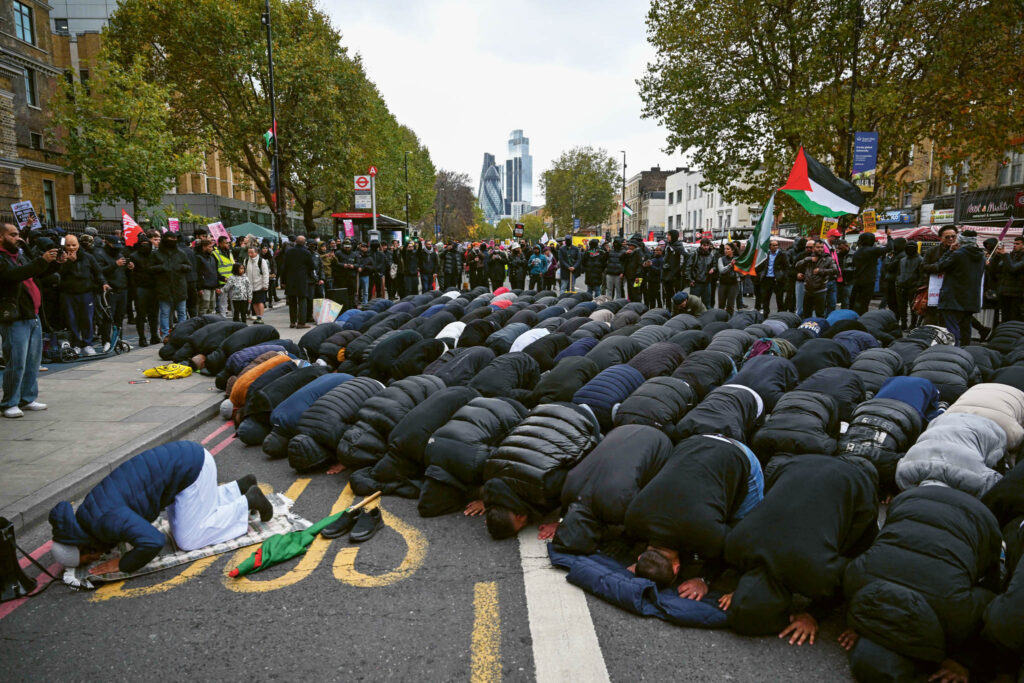
After the Metropolitan Police banned a planned march by members of the United Kingdom Independence Party in Whitechapel in October 2025, masked local young Muslim men took to a stage in a counter-protest. Their chants included ‘Zionist scum, off our streets’ and ‘With our souls and our blood we will redeem you, oh Al-Aqsa’, referencing the Al-Aqsa Mosque in Jerusalem, a chant often used by Hamas leaders—even though the planned UKIP protest had no Jewish or Israeli connection whatsoever. Many of the masked protestors then prayed in the streets, blocking the thoroughfare. Not surprisingly, the police later said that no action would be taken against anyone.28
I grew up in Kilburn during the 1960s and 1970s, then a lower-middle-class quarter of North West London. The long streets of Edwardian terraced houses were home to so many Irish people that it was affectionately known as ‘County Kilburn’. It was said that the many public houses on the High Road, some dating back to the fifteenth century, were popular collection points for those raising money for Irish republicans. Nowadays, many of the Irish families have migrated further out, to Harrow and Wembley. Kilburn has, for decades, been home to substantial Black Caribbean and Black African communities, who are well integrated. The area’s population is now around a quarter to a third white British, lower than the London average, but not untypical.
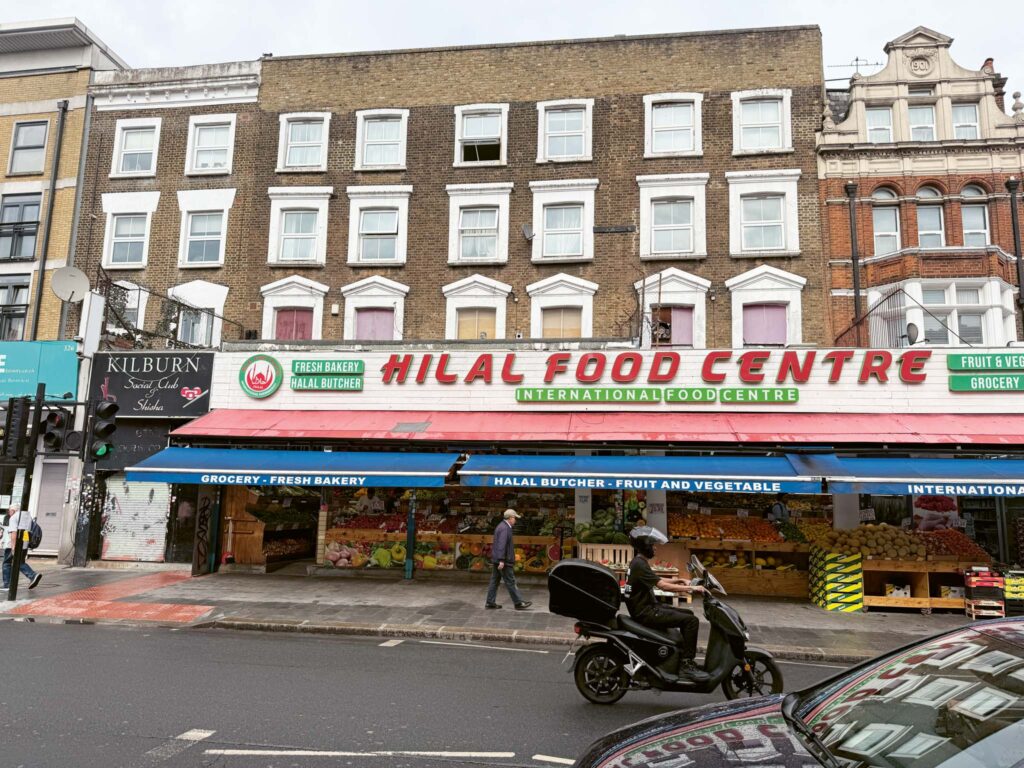
The most surprising change is what we could call, for want of a better term, the Arabization of Kilburn High Road. Much of it is now unrecognizable from the street I knew so well when I grew up. On a recent walk along its length, I counted just one Irish butcher. The small family shops—the newsagents, hardware stores, toy emporiums and others—had been replaced by a legion of chicken shops, nail salons, and Arab enterprises. Most have large Arabic script alongside English on their storefronts. At number 332 was the Hilal Food Centre, with an in-house Halal butcher. Next to it was the closed-looking Kilburn Social Club and Shisha. Across the road at 339 was Baghdad Shawarma. At number 292 was the black and glass-fronted Kilburn Islamic Centre. Number 282 was Barakat Jewellers, its sign in English on one side and Arabic on the other. A few doors away was the Taaj money exchange and mobile telephone shop. Across the road in a clutch of three shops stood the Halal Kilburn Meat Village and Faris fishmonger, both with signs in English and Arabic on their shopfronts, next to the Khyber Afghan carpet shop and Al Rasool Mall, also in English and Arabic. Across the road was Transfer East, a money transfer shop, next door to the Al Quds supermarket, both also emblazoned with Arabic writing. Nearby, the corner of Messina Avenue and part of the High Road had been taped off by the police, and a police car was parked. The officers declined to say what had happened, but it seemed very likely that a violent altercation had taken place. Further down the road were the Basil Bakery, again with large Arabic script; Hijaboo, selling hijabs and Islamic clothing for women; and the Al Rouche supermarket. Even the Beaulaze beauty parlour shopfront was bedecked in Arabic calligraphy. Further down the road was the Dubai Shawarma grill and the Al-Mahdi supermarket, again with large Arabic writing on its front.
London, of course, has always been a city of migration. Much of my own family arrived here more than a century ago from Russia, fleeing Tsarist terror and pogroms. I understand that modern urban life is always in a state of flux. Cities and streets, like Kilburn High Road, adapt and evolve. I was reminded of the cricket bat philosopher’s paradox. When the handle is replaced and then the blade, is it still the same cricket bat? Was I still in London or an imagined version of somewhere in the Middle East? The old shops of Kilburn High Road had clearly been replaced, but in the same buildings which still stood, now bedecked in Arabic calligraphy. I could only trust my instincts and the evidence in front of me. The High Road of my youth, and even my twenties and thirties, it was clear, was long gone, unlikely to ever return. Now at least I understood the meaning of unheimlich—the feeling, the moment when a once-familiar place finally becomes something else, unfamiliar and unsettling.
Wir Schaffen Das Nicht—And Europe Is Paying the Price
‘Wir schaffen das’ (We can do it), said Angela Merkel that fateful summer of 2015, speaking about the migration wave. Merkel was wrong, and Europe continues to pay the price for her mistake. The reality of the new Europe, from child assassins in Sweden, no-go areas in Berlin for Jews and gay people, the rise in crime and gang-rapes, the surrender of Central London to those screaming for the destruction of Israel, the explosion in anti-Semitism, the remodelling, or colonization, of our city high streets, all these show that we—or Western Europe—cannot do it.
I returned to Keleti recently. The station and its surroundings have weathered the migration crisis better than Kilburn High Road. There is nothing there to indicate that the terminus was, just over a decade ago, the centre of the world’s attention. The nooks and alleys of the station complex that were once temporary homes to thousands of people are once again clean and orderly. The small plaza where I watched teenage boys play football while their elders drank coffee is now quiet and empty. So too are the small glass-fronted side rooms where volunteers handed out food and doctors provided rudimentary medical care to the migrants. Commuters and schoolchildren no longer pick a wary path through lines of burly police officers or legions of sleeping migrants. The 2015 migrant crisis reshaped Europe forever. But Hungary, at least, is safe and at peace.
NOTES
1 Adam LeBor, ‘We Must Keep Europe Christian, Says Hungarian PM’, The Times (17 September 2025).
2 Adamson, ‘Migrants and Crime in Sweden in the Twenty-First Century’.
3 ‘Shootings and Violence’, National Council for Crime Prevention, https://bra.se/english/statistics/shootings-and-violence, accessed 10 December 2025.
4 Charles Szumski, ‘No Control: Sweden Grapples with Bomb Violence Wave’, Euractiv (30 January 2025), www.euractiv.com/news/no-control-sweden-grapples-with-bomb-violence-wave/.
5 ‘Polisen: Så många är gängkriminella i Sverige’ (Police: So Many Gang Criminals in Sweden), Sveriges Television (7 November 2025), www.svt.se/nyheter/inrikes/sa-manga-ar-gangkriminella-i-sverige.
6 ‘Kartläggning: Unga rymmer från HVB-hem – och rekryteras av gäng’ (Survey: Young People Run Away from HVB Homes and Are Recruited by Gangs), Sveriges Television (14 January 2023), www.svt.se/nyheter/inrikes/kartlaggning-unga-rymmer-fran-hvb-hem-och-rekryteras-av-gang.
7 ‘Explosions’, Krisinformation.se (10 October 2025), www.krisinformation.se/en/hazards-and-risks/disasters-and-incidents/2023/gang-related-violence/explosions.
8 ‘Explosions’.
9 Denis Fengler, ‘Nur wenn wir dies ändern, werden wir unsere Art und Weise zu leben erhalten können’ (Only If We Change This Will We Be Able to Preserve Our Way of Life), Welt (2 September 2025), www.welt.de/regionales/hamburg/article68b531fd861a6b0577ff65c0/10-jahre-wir-schaffen-das-nur-wenn-wir-dies-aendern-werden-wir-unsere-art-und-weise-zu-leben-erhalten-koennen.html?utm_source.
10 ‘UK Drops Charges Against Two Participants of Antisemitic Convoy’, i24News (13 July 2022), www.i24news.tv/en/news/international/europe/1657690084-uk-drops-charges-against-two-participants-of-antisemitic-convoy.
11 ‘Freedom of Expression (Religion or Belief System)’, Hansard, Vol. 768: debated on 10 June 2025, 1.47pm Nick Tomothy (West Suffolk) (Con).
12 ‘Four Wakefield Pupils Suspended after Koran Damaged at School’, BBC News (24 February 2023), www.bbc.com/news/uk-england-leeds-64757799.
13 Neil Johnston, and Gabriella Swerling, ‘Koran Row Imam Suggested Muslims Could Be Punished for Celebrating Christmas’, The Daily Telegraph (12 March 2023), www.telegraph.co.uk/news/2023/03/12/imam-discusses-punishing-muslims-celebrating-christmas/.
14 ‘The Grooming-Gangs Scandal Is a Stain on the British State’, The Economist (18 June 2025), www.economist.com/britain/2025/06/18/the-grooming-gangs-scandal-is-a-stain-on-the-british-state.
15 Andrew Norfolk, ‘Grooming Scandal: Failings Are a Stain on Manchester Police Force’, The Times (15 January 2020), www.thetimes.com/uk/crime/article/grooming-scandal-failings-are-a-stain-on- manchester-police-force-k5c00395l.
16 Maia Davies, ‘Ex-Children’s Boss to Lead Grooming Gang Enquiry’, BBC (9 December 2025), www.bbc.com/news/articles/ckgk2pj2ygko.
17 ‘Track UK’s Latest Migration Numbers—Including Asylum, Visas and Small Boats’, BBC, www.bbc.com/news/articles/c70989jrdweo, accessed 10 December 2025.
18 James Bovill, and Tanya Gupta, ‘Rhiannon Felt Safe Working at Asylum Hotel, Her Death Will Haunt Us Forever’, BBC (24 October 2025), bbc.com/news/articles/cvgkwep7x3xo; ‘Two Afghan Teenagers Jailed for Raping Girl in England’, Reuters (8 December 2025), reuters.com/world/uk/two-afghan-teenagers-jailed-raping-girl-england-2025-12-08/.
19 ‘Berlin Police Chief Warns Jews, Gay People to “Be Careful” in Arab Neighborhoods’, The Times of Israel, (19 November 2024), www.timesofisrael.com/berlin-police-chief-warns-jews-gay-people-to-be-careful-in-arab-neighborhoods/.
20 ‘Berlin Police Chief Warns Jews, Gay People to “Be Careful” in Arab Neighborhoods’.
21 Elizabeth Haigh, ‘This is sick behaviour!’: Outrage at Palestinian protestor filmed clutching blood-soaked effigy of dead baby in London triggering ‘hate-crime’ probe, Daily Mail, (29 October 2023), dailymail.co.uk/news/article-12684359/Palestinian-protester-effigy-dead-baby-London-hate-crime.html
22 ‘Anti-Semitic Incidents Report 2023’, CST Blog (15 February 2024), cst.org.uk/news/blog/2024/02/15/antisemitic-incidents-report-2023.
23 Jonny Humphries, ‘Synagogue attack victim ‘killed by single bullet’, BBC, (29 October 2025), bbc.com/news/articles/c5yl07ve2jpo.
24 ‘Year After Oct. 7, Yahya Saw Biggest Rise in Popularity Among Baby Names in UK’, The Times of Israel (2 August 2025), www.timesofisrael.com/year-after-oct-7-yahya-sees-biggest-rise-in-popularity-among-baby-names-in-uk/.
25 ‘International Migration, England and Wales: Census 2021’, UK Census 2021, www.ons.gov.uk/peoplepopulationandcommunity/populationandmigration/internationalmigration/bulletins/internationalmigrationenglandandwales/census2021, accessed 10 December 2025.
26 ‘270 Nationalities and 300 Different Languages: How a United Nations of Workers Is Driving London Forward’, The Standard (12 April 2012), www.standard.co.uk/hp/front/270-nationalities-and-300-different-languages-how-a-united-nations-of-workers-is-driving-london-forward-6572417.html.
27 David Woode, ‘Met Police Chief: Black Teens Dying on Streets Risks Becoming “Normal”’, The Times (16 January 2025), www.thetimes.com/uk/crime/article/met-police-commissioner-mark-rowley-knife-crime-dtwnl3s69.
28 Lorin Bell-Cross, ‘Chants About “Zionist Scum” at “Anti-Racist” Rally Won’t Be Investigated, Met Police Say’, The Jewish Chronicle (29 October 2025), www.thejc.com/news/politics/chants-zionist-scum-police-whitechapel-svizddtv.
Related articles:
At a time when public debate is increasingly polarized and superficial, Hungarian Conservative remains committed to depth, intellectual honesty, and independent conservative thought.
Producing high-quality journalism requires resources. Your contribution helps us expand our coverage, reach new audiences, and keep our content accessible.

Please consider supporting our mission.