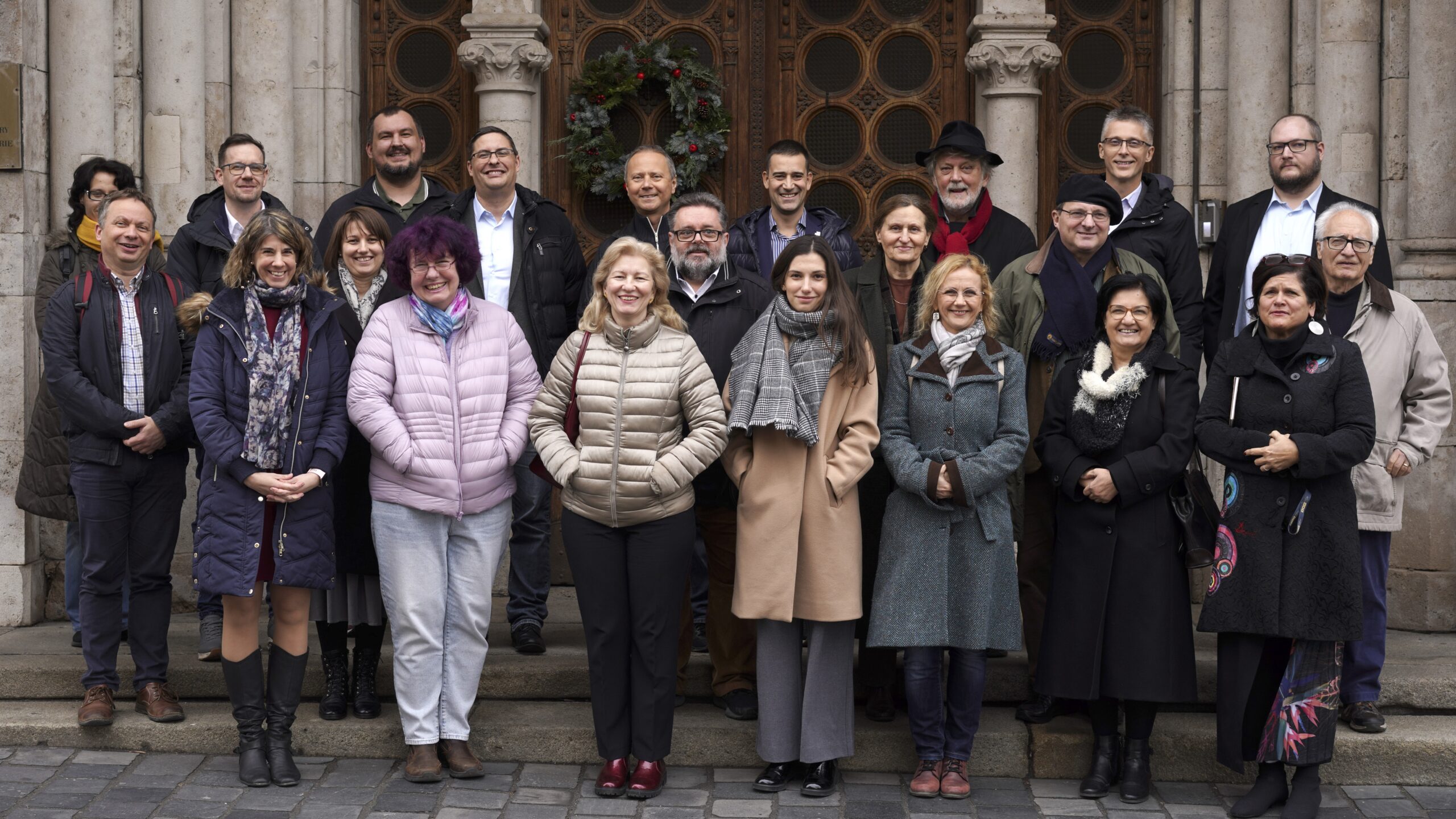
A workshop in June 2025 exploring the latest findings and future directions of research on Hungarian emigration to and diaspora life in North America was followed by another professional forum on 8 December at the National Archives of Hungary (Magyar Nemzeti Levéltár, MNL). In addition to presenting currently ongoing research projects and initiatives, a joint, inter-institutional project was also launched: a bilingual, virtual and physical exhibition planned for the 250th anniversary of the USA and 70th anniversary of the 1956 Revolution, showcasing Hungarian American (family) life stories and locations. The participants discussed in length the concept, proposed structure, and planned timeline of the exhibition.
The workshop was opened by Director General of the National Archives of Hungary Dr. Csaba Szabó, who noted in his welcome speech that migration is as old as humanity itself, yet scholars still do not fully understand its impact on both the sending and the receiving countries’ societies. As mentioned, MNL is planning a major international conference in the near future on the second half and end of the 18th century, centered around the four-continent travels of the famous Hungarian world traveller, Móric Benyovszky.
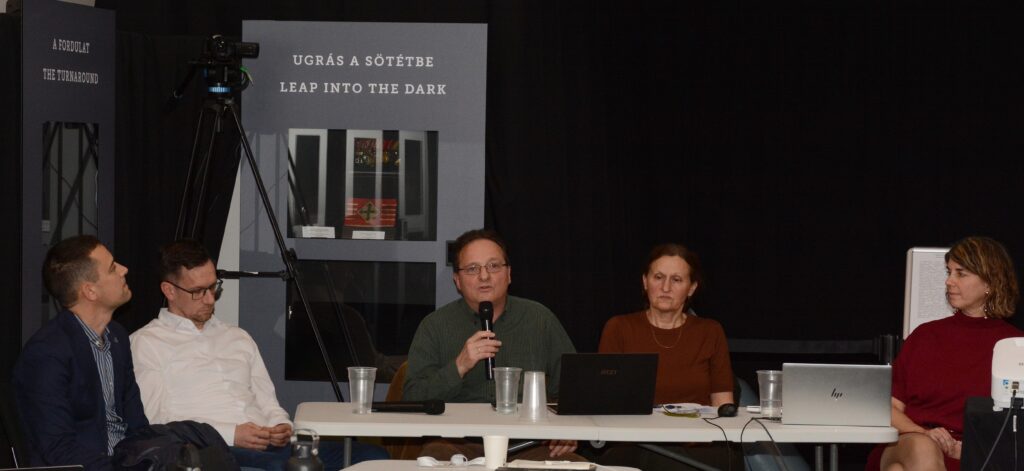
Archivist Csaba Géza Vass (National Archives of Hungary) gave a presentation on the materials collected during the Kelemen Mikes Program, organized between 2014–2023 by the State Secretariat for National Policy, and professionally coordinated by the National Széchényi Library (Országos Széchényi Könyvtár, OSZK). The MNL joined the program in 2015 as a professional partner, taking on the archival coordination. The goal of the program was to collect and repatriate the heritage of Hungarian communities overseas (primarily in the USA, Canada, Australia, and South America). We learned that the approximately 27.5 linear meters of materials (correspondence, diaries, economic and organizational documents related to events, photographs, albums, etc.) mainly document the experiences of Hungarians who emigrated after World War II and the 1956 Revolution. This rich material represents Hungarian stories from receiving countries that were previously scarcely documented by the MNL. The majority of this material still awaits expert review and processing.
Documentary Filmmaker & Producer Réka Pigniczky (Co-Founder of 56Films) briefly introduced the Memory Project, a visual archive of Hungarian emigration containing more than 150 life-history interviews with Hungarian refugees, created together with President Andrea Lauer Rice of the Hungarian American Coalition (HAC). She also spoke about her other documentaries on the 1956 Revolution. She then presented plans for the Bridges of Greatness docuseries to premiere as part of the large-scale HAC Gala Dinner in Washington, D.C., on 27 April 2026. The series aims to highlight the significant role of Hungarian Americans in U.S. history on the occasion of the country’s 250th birthday. They plan to interview representatives of ten professional fields (such as science, business, sports, politics, the arts, and community life). A pilot episode is scheduled for December 2025, with the first full episode premiering at the above-mentioned HAC Gala Dinner on 27 April, followed by biweekly releases online until 4 July 2026.
‘Migration is as old as humanity itself, yet scholars still do not fully understand its impact on both the sending and the receiving countries’ societies’
Associate Professor Róbert Péter of the University of Szeged gave a lecture titled Digital Source Criticism and Text Mining: Analysis of the Magyar Bányászlap with the AVOBMAT Research Tool. He presented his analysis—using the AVOBMAT (Analysis and Visualisation of Bibliographic Metadata and Texts) research tool—of the Magyar Bányászlap (Hungarian Miners’ Journal), a periodical published between 1913 and 1962, with 2,157 issues (97 per cent accessible) and containing about 40 million words. Previously unprocessed and unexplored by the OSZK, the newspaper served for nearly five decades as one of the most important forums for maintaining contacts and preserving Hungarian identity. In addition to news related to Hungarian Americans and the homeland, it published opportunities such as job and housing advertisements, community announcements, letters, personal stories, and even literary works—it was far more than a regular journal for miners. Through concrete examples (name-entity recognition, most frequent names, topic modelling, context analysis of the word ‘Hungary’, etc.), we learned AVOBMAT works as a text-mining tool capable of large-scale, data-driven, interactive, and AI-based analysis of bibliographic metadata and texts, in 24 languages and in a user-friendly environment.
Dr. Zsolt Máté, Lecturer in Administrative Law at the University of Pécs, reported on his research trip to the Columbia University manuscript archive, focusing on sources related to the 1947 emigration wave, which was the smallest in numbers, but probably the most active politically. He highlighted materials related to Hungarians who arrived during this period, especially the papers of former Hungarian Prime Minister Ferenc Nagy, their peculiarities (e.g., boxes consisting only of empty envelopes, Christmas cards, advertisements, or financial records), and some ‘blind spots’ (lectures, the return of the Holy Crown, CIA connections, etc.). He also discussed the published and planned uses of these materials (e.g., Ferenc Nagy and the Third World; Ferenc Nagy and the 1956 Revolution; a feature film).
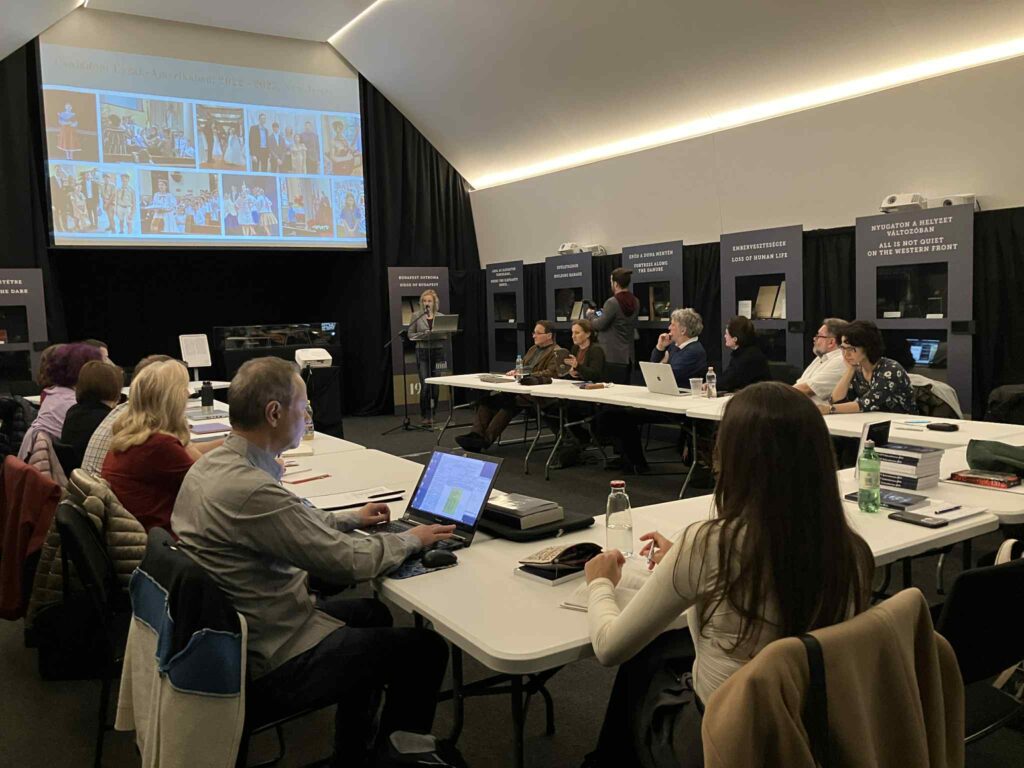
Linguist and Photographer Gergely Tóth presented his website containing tens of thousands of geographically organized photographs of Hungarian material heritage, collected through roughly 1.5 months of volunteer work each year. His aim is to reconstruct the lives of Hungarian communities through his photography, and he showcased traces of three ‘peripheral’ Hungarian American communities through photographs (memorial plaques, gravestones, newspaper articles, etc.): Pueblo, Colorado (‘the Pittsburgh of the South’ with its steel mill); Rock Springs, Wyoming (‘a mining region in the Wild Western desert’); and Elk River, Minnesota (a place with ‘neither mines nor steelworks’).
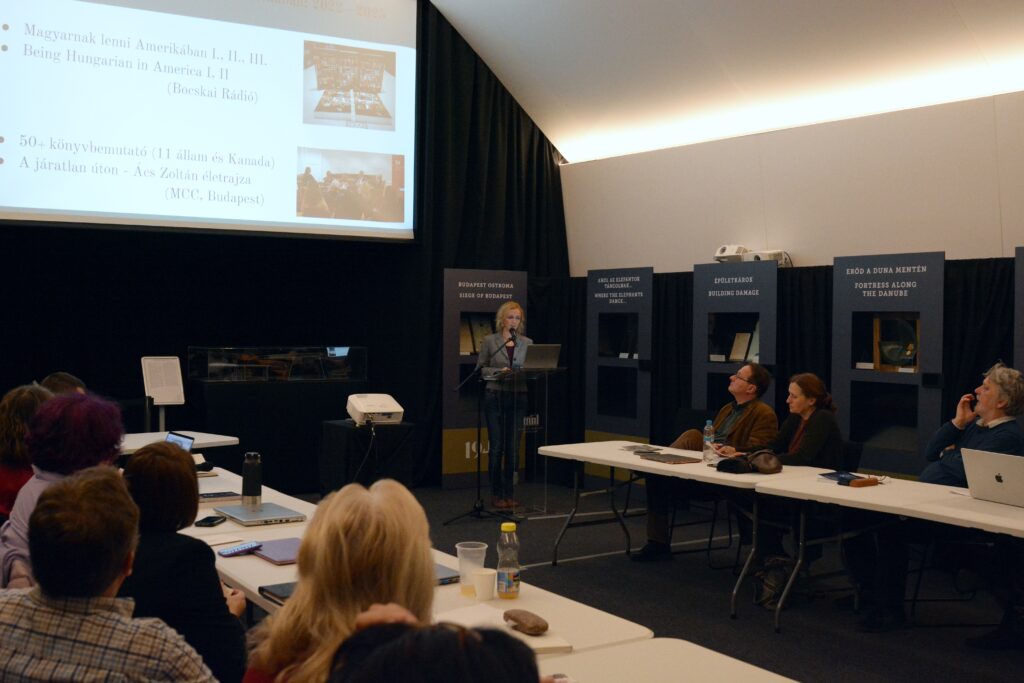
Freelance Journalist Ildikó Antal-Ferencz summarized the key lessons and experiences from her three volumes of interview books (in Hungarian), Being Hungarian in America I–III, written during her family’s three-year stay in North America and published by Bocskai Radio in Cleveland, OH. The books contain 106 in-depth interviews conducted across nearly 20 U.S. states and Canada, featuring Hungarians of various ages, professions, emigration backgrounds, and geographical origins. They share life stories and experiences within diaspora communities and organizations, and describe how they live and pass on Hungarian identity (language, culture, and folk traditions) within their families and through Hungarian weekend schools, scouting troops, church communities, folk-dance groups, and civil organizations.
‘The author revealed that her original intention had been to learn about the lives of these dedicated individuals and communities’
The author revealed that her original intention had been to learn about the lives of these dedicated individuals and communities and to introduce these experiences to readers in Hungary and the Carpathian Basin. However, based on feedback, her extensive and intensive work (including nearly 100 other reports, 50+ book events, 10+ diaspora-wide radio interviews, and the organization of an online conference) as well as her personal experiences yielded further fruits: deeper mutual understanding, increased knowledge of other local/state-level communities, organizations, best practices, and scholarships; as well as invitations to use her materials as sources for further research.
Director Réka Bakos of Hungarian Roots & American Dreams, Linguist Anna Fenyvesi of the University of Szeged, and Éva Szabóné Rácz form the National Archives of Hungary at their presentation titled Hungarian Roots & American Dreams: The Legacy of Returning Emigrants, introduced the parts of the program that focus on Hungarian immigrants who eventually returned home. They explained that the book series preserving the personal and family stories of emigrating Hungarians grew out of the Facebook community, Óhazából az Újvilágba – Hungarian Roots & American Dreams. The group was created to capture memories, and 106 of the stories shared there have already been published in the first two volumes. Although Hungarian emigration to the U.S. has been widely researched, far less attention has been given to the hundreds of thousands who, after spending years abroad—often returning with savings, new skills, and cherished objects—eventually came back to Hungary. The program aims to highlight this lesser-known heritage and call attention to the rich family archives, documents, and memories that still exist but remain unexplored.
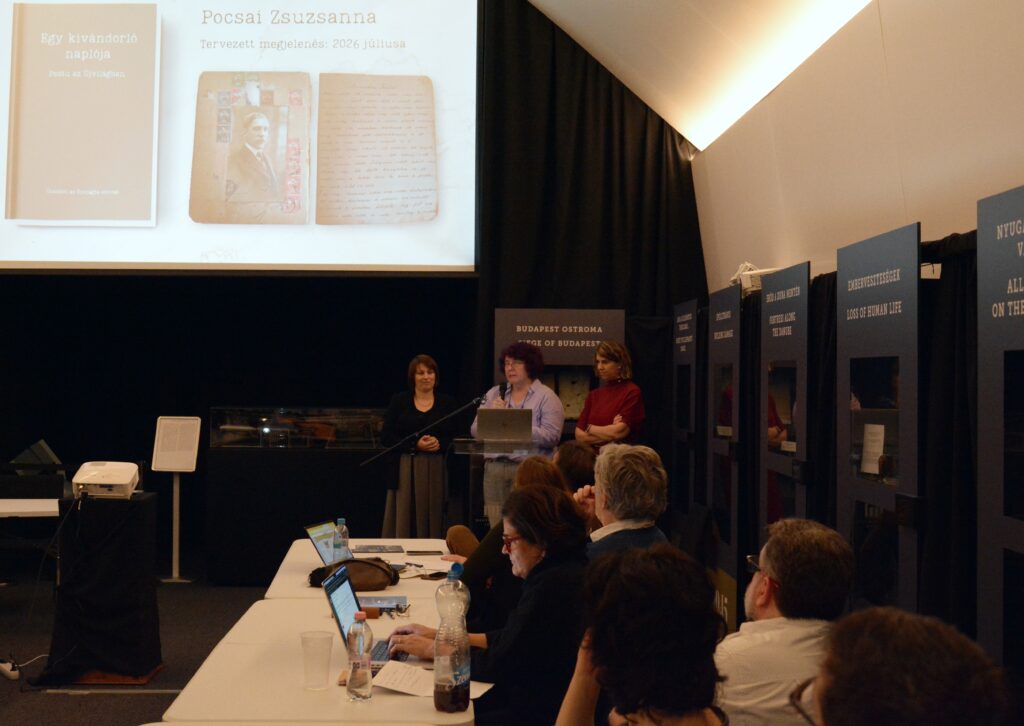
Of the five planned volumes, three focus specifically on returnees: Zsuzsanna Pocsai’s grandfather kept a diary during his 1914–1918 journey and stay in America. His notes bring to life the great migration wave at the turn of the century and provide insight into the everyday experiences of Hungarian immigrant communities. Éva Szabóné Rácz spoke about the 2027 volume that will present the history of Dollártanya (Dollar Farm) in Borsod County, inspired by the emigration story of her great-great-grandfather, Gyula Bártfai. The book is based on extensive archival and local research, complemented by oral history interviews with descendants. While researching her own family, Ibolya Török-Sándor discovered that in the early 20th century, over 100 people emigrated from her native village, Homoródalmás in Székelyföld, and most later returned. This forthcoming volume will introduce the family stories and surviving objects connected to these Homoródalmás villagers.
Historian, Communications Associate Csaba Katona from the National Archives of Hungary presented the history of the 1956 memorial in Boston, MA, created by the Hungarian Society of Massachusetts. His account was based on his month-long on-site historical research and the resulting book, We Preserve the Bridges. He recounted that by late 1984, $16,000 had already been raised for the statue planned for the 30th anniversary of the Revolution and freedom fight—from 26 U.S. states, several Canadian provinces, and even from Greenland and Saudi Arabia, including many non-Hungarian donors. The sculpture committee, led by Iván Kristóffy, selected Hungarian American sculptor György Hollósy’s Aspiration for Liberty. To win over American public opinion, the statue bears a plaque quoting a speech about the 1956 revolution delivered by President John F. Kennedy in 1960 in New York—Kennedy being particularly popular in Boston’s Irish Catholic community. We heard details about the intense work leading up to the first dedication ceremony held on 26 October 1986, at Faneuil Hall, attended by the wife of Democratic Governor Michael S. Dukakis (presidential candidate in 1988). The statue was later temporarily removed due to renovations to Liberty Square and was rededicated on 7 May 1989, in the presence of Mayor Raymond R. Flynn and Senator John Kerry (presidential candidate in 2004).
After the presentations, the program moved into a true workshop session led by Director General Balázs Balogh of ELTE Research Center for the Humanities; Senior Research Fellow Ágnes Fülemile of the Institute of Ethnology ELTE; Director Balázs Venkovits of the Institute of English and American Studies, University of Debrecen; Director of Development and Preservation István Hegedűs of the National Archives of Hungary, and Réka Bakos. They introduced the initial concept for a bilingual exhibition planned in connection with the 250th anniversary of the USA and the 70th anniversary of the 1956 Revolution, presenting Hungarian American life stories and key locations. Participants discussed how their institutions and areas of expertise could contribute to the joint development of the project and explored possibilities for collaboration. A highly valuable professional dialogue unfolded about the exhibition’s thematic direction, laying a solid foundation for the shared work that will continue in the coming months. The workshop concluded with a speech by Deputy State Secretary for National Policy Péter Szilágyi, who congratulated the presenters and assured the project’s initiators of the State Secretariat’s support.
Related articles: