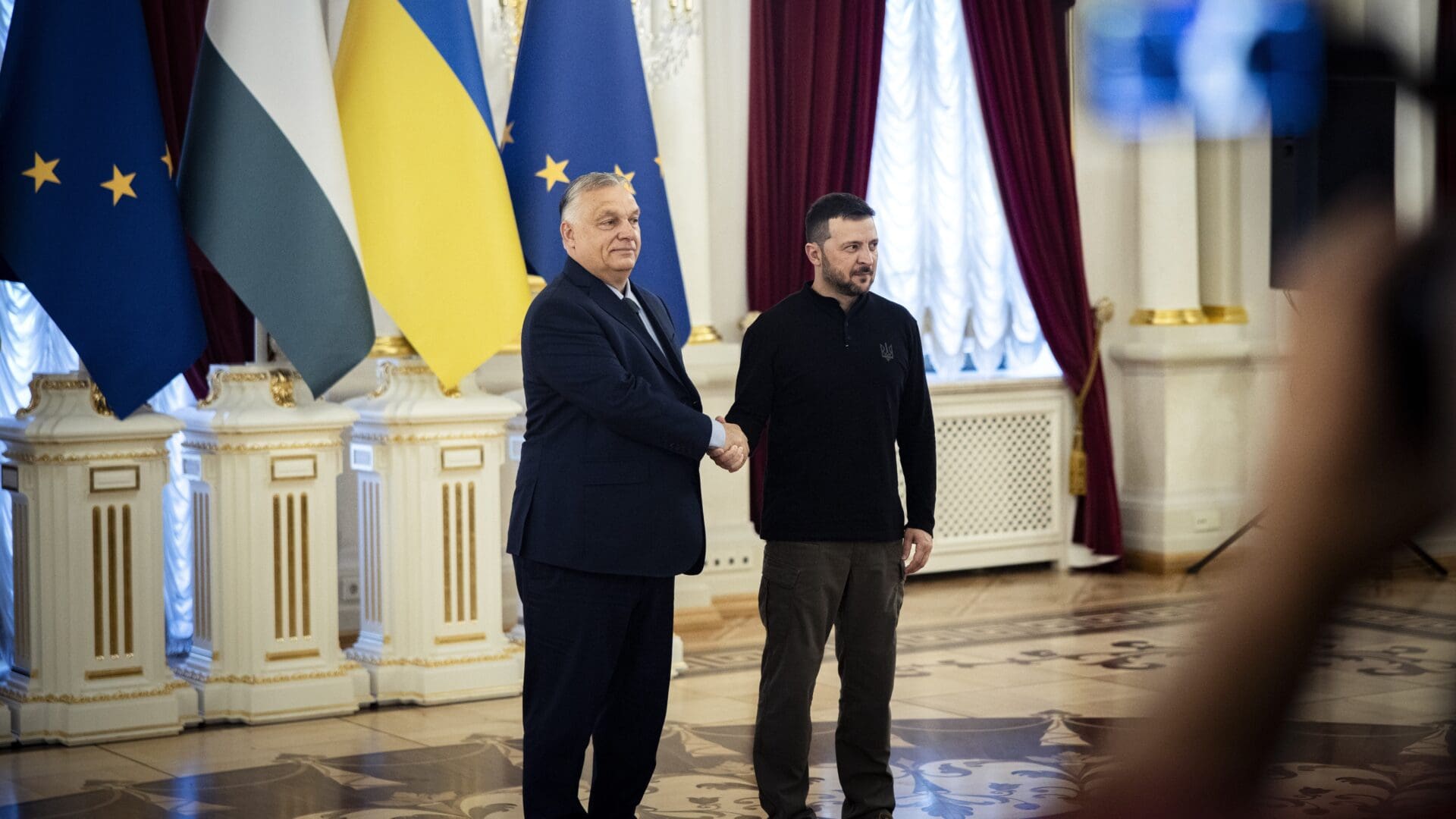
Ukrainian President Volodymyr Zelenskyy has firmly rejected a German proposal that would grant Ukraine an ‘associate membership’ status in the European Union without full voting rights, reaffirming that Kyiv seeks full membership rather than what many in Ukraine increasingly describe as a potential ‘second-tier membership’.
‘There can be no complete European project without Ukraine, and Ukraine’s place in the European Union must also be complete—full and equal,’ Zelenskyy wrote on X on Saturday, 23 May, responding directly to a proposal floated earlier this week by German Chancellor Friedrich Merz.
No Appetite for Associate Membership
In a letter to EU leaders seen by Reuters, Merz suggested creating a new ‘associate member’ category for Ukraine as an interim step towards future accession. Under the proposal, Kyiv would gain access to several EU institutions and programmes, including participation in European Council and Commission meetings, but without formal voting rights.
Merz reportedly framed the idea as a pragmatic compromise that could accelerate Ukraine’s integration while acknowledging that full EU membership remains a lengthy and politically difficult process, especially amid the ongoing war with Russia. The German proposal would also reportedly allow broader participation in EU structures such as the single market, customs union, Erasmus, and Horizon programmes.
The proposal, first reported by Reuters on 21 May, triggered immediate backlash both in Kyiv and within parts of the European Union itself. Zelenskyy warned that any arrangement leaving Ukraine ‘voiceless’ inside the bloc would be ‘unfair’, particularly given what he described as ‘Ukraine’s role in Europe’s security architecture’ since the outbreak of the full-scale war in 2022.
‘Merz suggested creating a new “associate member” category for Ukraine as an interim step towards future accession’
In a letter addressed to European Council President António Costa, European Commission President Ursula von der Leyen, and Cypriot President Nikos Christodoulides, Zelenskyy argued that Ukraine was defending Europe ‘fully, not partially, and not with half-measures’.
The European Commission, reacting cautiously to the proposal, warned that any ‘innovative solution’ must still respect the bloc’s traditional merit-based accession process, signalling concerns that a special arrangement for Ukraine could undermine enlargement rules or establish precedents for other candidate countries.
According to Euronews, several EU diplomats privately questioned whether Merz’s proposal would even be legally feasible without treaty changes. One diplomat quoted by the outlet argued that granting a non-member country participation rights in EU institutions through political agreements alone would be extremely difficult under the current treaties. Others fear that the creation of a permanent ‘outer circle’ of semi-members could further weaken the credibility of the enlargement process itself, which already faces criticism for prioritizing Ukraine and Moldova over long-standing Western Balkan candidates, some of which have been negotiating accession for many years or even decades.
Orbán Was Never the Only Obstacle
The current controversy surrounding Ukraine’s EU membership is also particularly revealing from a Hungarian perspective. Former prime minister Viktor Orbán’s government had long been portrayed as the sole obstacle to Ukraine’s full EU accession—a narrative strongly promoted by Kyiv, Brussels, numerous EU member states, and much of the Western media. Following Orbán’s departure and the arrival of Péter Magyar’s administration, however, it has become increasingly clear that the issue is considerably more complex.
Speaking to POLITICO Brussels, Ukraine’s ambassador to the EU, Katarina Mathernova, acknowledged that while ‘Viktor Orbán’s fall’ may have created ‘fresh momentum’ for Ukraine within the EU, ‘he was not the only obstacle to Kyiv’. ‘There were others hiding behind him,’ Mathernova stated.
That argument had frequently been raised by the previous Hungarian administration as well, with former Foreign Minister Péter Szijjártó repeatedly claiming that officials from other EU member states privately thanked Hungary for vetoing certain sanctions targeting Russia on their behalf.
Now that Orbán has left office and those governments no longer have a convenient scapegoat to point towards, it is becoming increasingly apparent that not only is Ukraine’s fast-track accession unrealistic, but the country may ultimately face a negotiation process as long—or potentially even longer—than that experienced by Western Balkan candidates. Recent polling data also suggest that several major Western European member states are becoming increasingly sceptical about the rapid accession of Ukraine.
With France preparing for a presidential election next year, Friedrich Merz facing historically high disapproval ratings, and anti-establishment political forces continuing to strengthen across Western Europe, governments are understandably reluctant to aggressively push Ukraine’s accelerated EU accession against increasingly cautious public opinion.
Similar dynamics are visible in Hungary as well, despite Orbán’s departure. According to a recent poll by Europion, more than 30 per cent of Hungarians believe that ‘opening towards Ukraine’ should not be a top foreign policy priority, making it the most divisive issue measured in the survey.
Against that backdrop, Prime Minister Péter Magyar and the Tisza government—while visibly pursuing a less confrontational approach towards Ukraine than Orbán’s administration—also appear increasingly cautious regarding Kyiv’s EU bid. Since taking office, Magyar has repeatedly stated that Hungary will support the opening of key accession negotiation clusters only if Ukraine restores full linguistic, educational, and cultural rights for the Hungarian minority living in Transcarpathia, one of the central demands previously emphasized by the Orbán government as well.
Expert-level talks on minority rights between Kyiv and Budapest are already underway, and Magyar is expected to meet Zelenskyy in early June as part of broader efforts to normalize relations between the two neighbouring countries.
Related articles:
At a time when public debate is increasingly polarized and superficial, Hungarian Conservative remains committed to depth, intellectual honesty, and independent conservative thought.
Producing high-quality journalism requires resources. Your contribution helps us expand our coverage, reach new audiences, and keep our content accessible.
Please consider supporting our mission.