Recently released Home Office data showed that Pakistani nationals granted Skilled Worker visas were accompanied by almost six times as many dependants as main applicants, intensifying criticism from the right of Home Secretary Shabana Mahmood’s recently announced immigration and asylum reform package.
According to Home Office visa statistics, 1,029 Pakistani nationals received Skilled Worker main-applicant visas in the year to March 2026, while 6,155 dependant visas were granted under the same route. Including dependants, the Pakistani Skilled Worker category accounted for 7,184 visa grants—almost seven people for every main-worker visa.
The figures form part of a wider pattern across Britain’s skilled-work system. The Home Office also recorded 110,725 visas across the Health and Care Worker and Skilled Worker routes, of which 40,254 were granted to main applicants and 70,471 to dependants. On the Skilled Worker route alone, there were 29,745 main applicants and 38,322 dependants, while the Health and Care Worker route recorded 10,509 main applicants and 32,149 dependants. The data, however, remain far lower than in 2023 and 2024, when the Conservatives were in government.
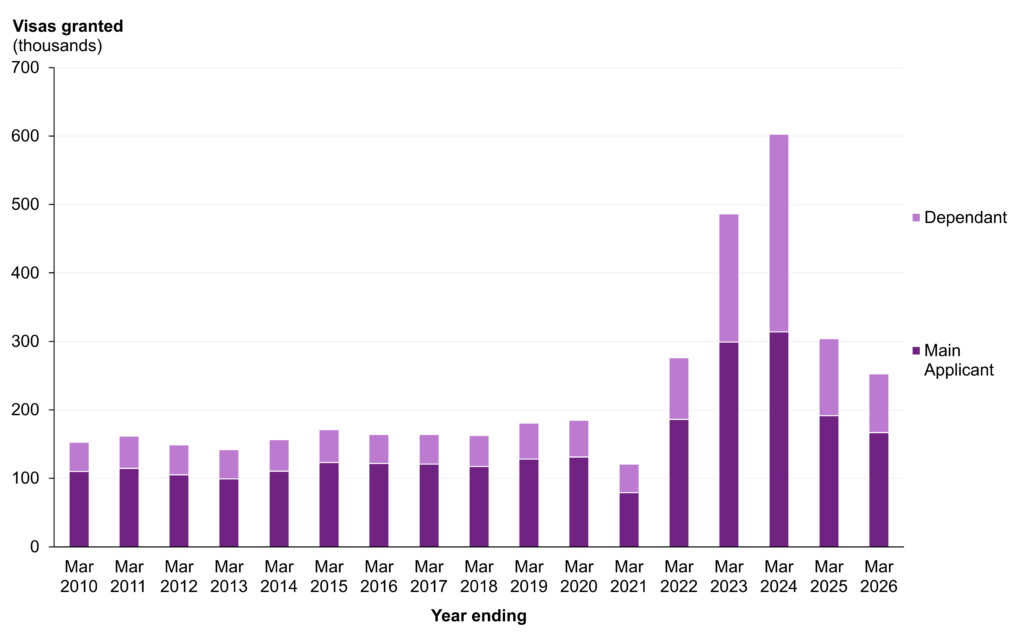
The Pakistani figures have attracted particular political attention because they illustrate the family multiplier effect beyond the Health and Care Worker route. While several striking cases involved care workers—12 Cameroonian Health and Care Worker main applicants alongside 180 dependants, 15 times as many dependant visas; 257 Ghanaian workers alongside 2,131 dependants; and 2,395 Indian workers alongside 10,504 dependants—the Pakistani case concerns the broader Skilled Worker route. Nigerian Skilled Worker figures showed a similar pattern, with 230 main applicants and 1,114 dependants.
The Skilled Worker route requires a Home Office-approved sponsor, a Certificate of Sponsorship, an eligible job, minimum pay at the relevant threshold or ‘going rate’, and English-language ability. Partners and children can apply separately as dependants, usually with visas expiring alongside the main worker’s permission, turning one sponsored job into a potential family migration route.
‘The highest long-term stay rates among migrants from African, Western Asian, Southern Asian, and non-EU European countries’
Research by the Migration Advisory Committee found that five-year stay rates among Skilled Worker migrants have risen sharply: 85 per cent of those who started their first Skilled Worker visa in 2019 still held valid UK immigration status five years later, suggesting that they remained in the country, compared with 74 per cent of the 2014 cohort. The study found the highest long-term stay rates among migrants from African, Western Asian, Southern Asian, and non-EU European countries.
Reacting to the Home Office data on X, Reform UK chairman Zia Yusuf described the Health and Care Worker visa programme as ‘an industrial-scale scam on the British people’. Listing the examples of Cameroon, Pakistan, Nigeria, Ghana, and India, Yusuf wrote: ‘ENOUGH IS ENOUGH!’ before adding: ‘Reform will NOT allow them to stay.’
The figures have also intensified scrutiny of Mahmood’s recently unveiled asylum and immigration reform package, which seeks to combine tougher enforcement with new legal migration pathways. According to the Home Office, applications will open this autumn for organizations to sponsor refugees, with the first arrivals expected in autumn 2027.
The new model will operate outside the UK Resettlement Scheme and is intended to function at ‘a much higher capacity’ once established. Trusted universities will also be able to sponsor refugees through a dedicated study route, while a refugee work route is expected to follow next year.
Ministers have presented the plan as a controlled alternative to illegal migration. The Home Office says arrivals under the new routes will undergo biometric, criminality, and health checks, while refugee status will be determined in partnership with the UNHCR. Mahmood has argued that the reforms will expand legal pathways for genuine refugees while closing loopholes and preventing abuse of the asylum system.
Critics, however, argue that the latest visa data tells a different story. The high ratio of dependant visas to main-worker visas suggests that sponsor-led migration routes, originally presented as controlled, targeted, and economically necessary, can generate substantially larger secondary migration flows through family reunification and eventual settlement.
The record of abuse associated with existing sponsorship schemes has further reinforced those concerns. In May 2025, the government announced that overseas recruitment of care workers would end after concluding that too many workers had been subjected to abuse and exploitation, including debt bondage, unfair treatment, and cases in which the promised jobs did not exist. The Home Office said more than 470 care providers had had their licences to sponsor overseas staff suspended since 2022, affecting around 40,000 workers.
Hard-right anti-immigration Restore Britain leader Rupert Lowe also criticized the new sponsorship scheme, saying his objective was not to create alternative legal routes but to ‘deport every single one’. Speaking to GB News, Reform UK’s Zia Yusuf said the party would abolish Mahmood’s refugee sponsorship programme, promising ‘the biggest mass deportation this country has seen by some distance’.
Related articles:
At a time when public debate is increasingly polarized and superficial, Hungarian Conservative remains committed to depth, intellectual honesty, and independent conservative thought.
Producing high-quality journalism requires resources. Your contribution helps us expand our coverage, reach new audiences, and keep our content accessible.

Please consider supporting our mission.