One of the most influential conservative American thinkers’ most famous work is now available in Hungarian. The Conservative Mind by Russell Kirk, originally published in 1953, has been translated into Hungarian by Miklós Pogrányi Lovas and Péter Lengyel Balikó, and published by the conservative think tank Center for Fundamental Rights. It bears the Hungarian title A konzervatív eszme.
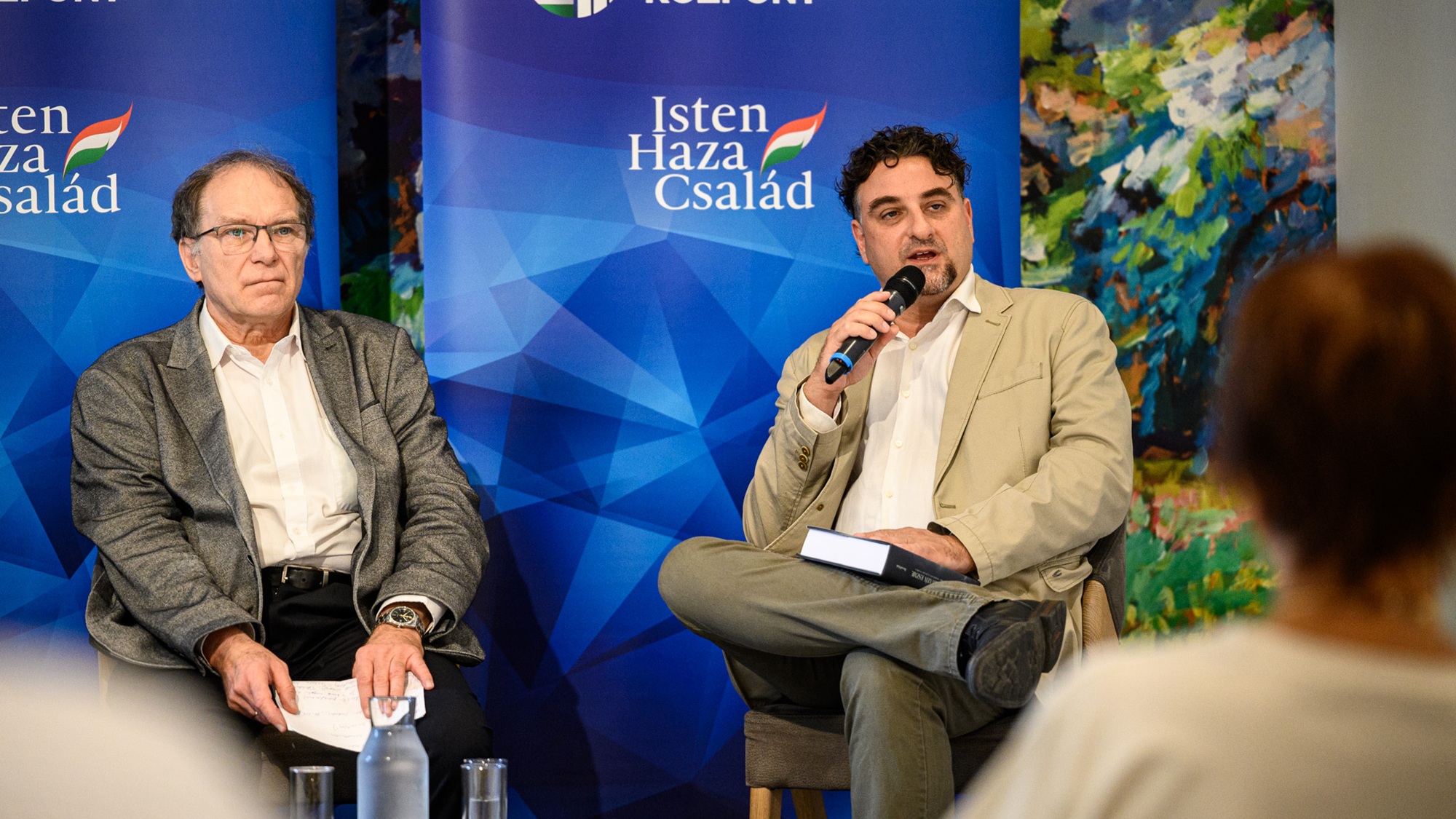
It was one of the translators of the book, Mr Pogrányi Lovas, who hosted philosophers Dr Zoltán Frenyó and Dr Zoltán Turgonyi for a panel discussion about Kirk’s work at a book launch event in Budapest, Hungary on Tuesday, 7 July.
Mr Lovas spoke first, sharing that Russell Kirk grew up in the Midwest, in the state of Michigan, and some of his relatives were Swedenborgian spiritualists.
His early experiences originally pushed Kirk away from religion, Mr Lovas continued. However, upon marrying his wife, the Catholic Annette Courtemanche in 1964, he converted to Catholicism. The speaker also told the audience that Kirk loved Hungarians, as he did all nations that rose up against the Soviets; so much so that he and his wife housed Hungarian refugees of the 1956 Revolution in their home.
The translation of Kirk’s speech about the Hungarian Revolution is also included in the new publication, Mr Lovas announced, along with a foreword written by Former Speaker of the House László Kövér of Hungary.
Taking over the word, Mr Frenyó described the publication as a significant milestone, saying Hungarian readers can now access the magnum opus of one of the foremost representatives of a major tradition within conservative philosophy. He argued that the ‘reform conservative’ current of Anglo-Saxon conservatism has historically been more easily received in Hungary than some other branches of conservative thought.
Mr Turgonyi pointed out that The Conservative Mind is essentially a historical overlook of conservative philosophy, starting with Sir Edmund Burke in the 18th century to the contemporary thinkers of Kirk, such as George Santayana. However, through the way the author presents the historical overview, the reader gets to know his way of thinking as well. He also added that Kirk’s philosophy is ‘not the mainstream way of thinking in the Western world today.’

On the process of translation, Mr Lovas explained that in the Hungarian literary tradition, translators can have quite a lot of artistic licence with a work’s title. Thus, he and his partner decided not to go with the closest dictionary equivalent of ‘mind’; rather, with the word ‘eszme’, which is closer in meaning to the English words ‘idea’ or ‘concept’.
He also noted that Kirk viewed the American philosophical tradition as resting on four foundational cities: Athens, representing the philosophy of wise governance; Rome, the philosophy of law; Jerusalem, the philosophy of Christianity; and London, embodying both the English common law tradition and the civilization’s medieval heritage.
Mr Frenyó argued that conservatism is more complex than the two other major modern political ideologies, liberalism and socialism. Rather than constituting a single school of thought, he explained, conservatism encompasses several distinct traditions, including Anglo-Saxon, French, and German strands. He added that even within the United States, the ideology has evolved into multiple currents, such as paleoconservatism and neoconservatism.
Meanwhile, Mr Turgonyi shared a quote from John Adams, the second President of the United States, who wrote that the US Constitution was ‘made only for a moral and religious People’ and was ‘wholly inadequate to the government of any other’. According to the speaker, this remark illustrates that the founders could hardly have envisioned the extent to which contemporary Western societies would move away from the Christian tradition.
Related articles:
At a time when public debate is increasingly polarized and superficial, Hungarian Conservative remains committed to depth, intellectual honesty, and independent conservative thought.
Producing high-quality journalism requires resources. Your contribution helps us expand our coverage, reach new audiences, and keep our content accessible.

Please consider supporting our mission.