Matthias Corvinus Collegium held its eighth Carpathian Basin Education Conference under the title The Key Figure of the Future: the Teacher, with a particular focus on the tenth anniversary of the MCC Young Talent Programme. The event concentrated on the changing world of education, the future of the teaching profession and, the new challenges of talent development.
In his opening remarks, Director-General of MCC Zoltán Szalai emphasized that among conferences dedicated to teachers, this year’s event is particularly timely, as the processes of teaching and learning will fundamentally change in the coming years. He noted that MCC’s mission of talent development rests on the historical continuity of the teacher–student relationship, while technology can only serve education if it remains a tool rather than a goal.
MCC’s Director of Academic and Educational Affairs Milán Constantinovits outlined the most important challenges facing contemporary education. He highlighted the alpha generation’s distinct learning, reading and language-use patterns, as well as rising loneliness and increasing mental burdens. The diversification of knowledge pathways, the expansion of artificial intelligence and the disruption of the online–offline balance, he argued, create a fundamentally new situation. He emphasized the sustaining force of live communities, the need to relearn social skills after Covid, and stressed that genuine talent development cannot exist without personal presence.
Mathias Corvinus Collegium – MCC
A jövő kulcsembere: a pedagógus – Az MCC VIII. Kárpát-medencei Oktatási Konferenciája 📘 Hogyan lehet ma pedagógusnak lenni egy világban, amely gyorsabban változik, mint valaha? 🧭 Mi kell ahhoz, hogy…
Constantinovits called for the reintegration of rhetoric into education, the development of the ability to create ‘here and now’ in the age of AI, and the conscious shaping of interpersonal relations. He underscored the importance of living language as a form of self-identity, the renaissance of book culture and the rediscovery of classical knowledge. He said education must clarify pathways to knowledge and adapt to a changing world, because without human connection, no school can be effective. The teacher educates through their personality, and therefore their role will remain essential in the future.
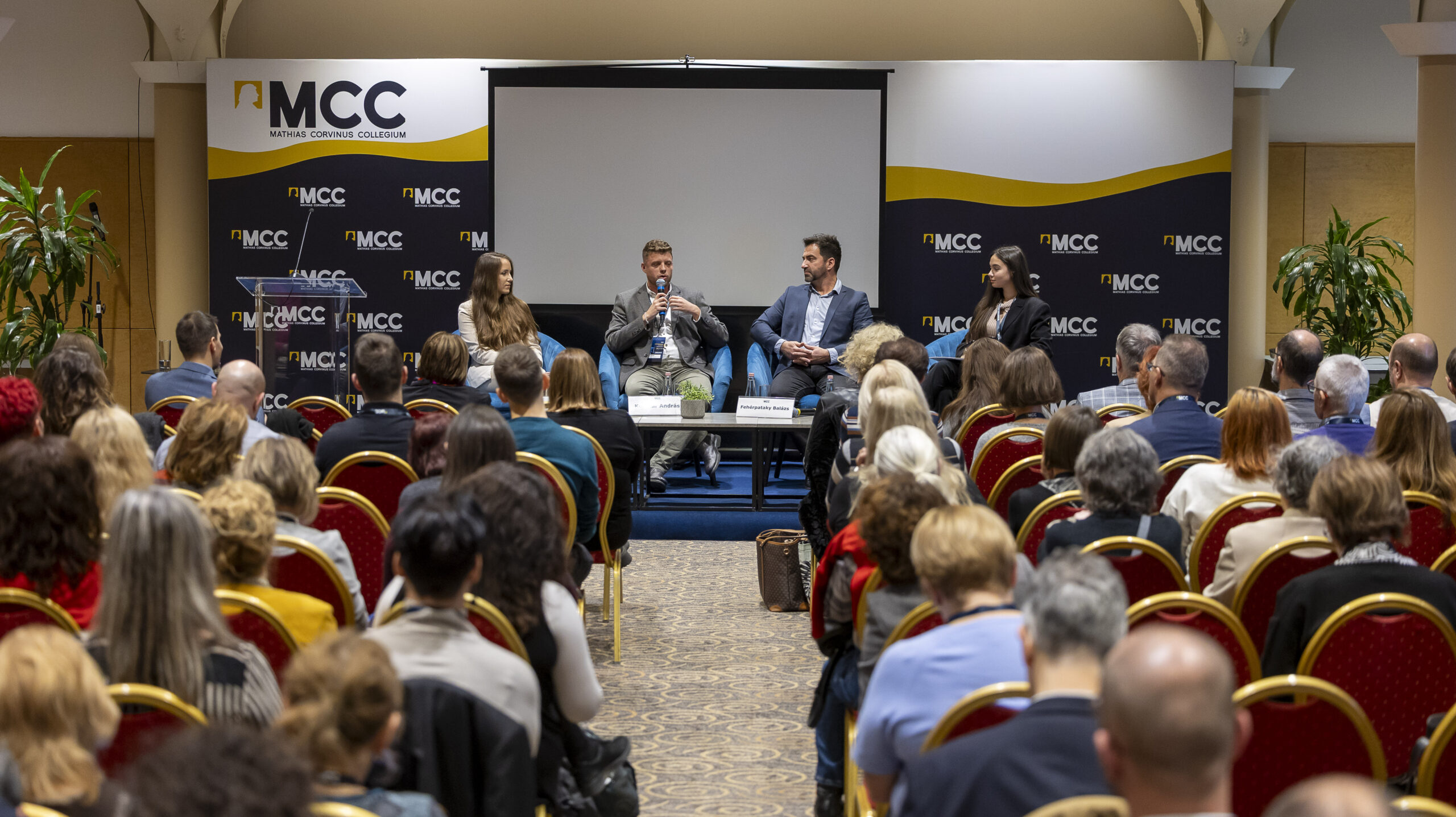
The following part of the conference focused on the ten-year anniversary of the MCC Young Talent Programme (FIT). Head of the programme Balázs Fehérpataky said that FIT had undergone its largest expansion in the past four years, with the number of participants now exceeding four thousand. The 37 weekend courses designed for upper primary pupils build on the public education curriculum, but also include communication-focused language teaching and summer camps.
‘FIT had undergone its largest expansion in the past four years’
Mentor instructor András Kunstár presented the practice-oriented methods of the financial literacy course, which include numismatics, the history of money, family budgeting and investment simulations. Eszter Baumgartner spoke about the importance of experiential education. Fehérpataky underlined that during the eight-hour Saturday sessions, both group and individual projects are created, and pupils always return home with a tangible product. In FIT, the traditional teacher’s role is divided: regional leaders perform form teacher tasks, while instructors focus on professional development.
In the remaining part of the day, participants had the opportunity to engage in practical workshops, inspiring presentations and panel discussions.
Related articles: