The latest issue of Polgári Szemle, a Hungarian journal focusing on economic and social sciences, was presented at a press event that brought together policymakers and academics to assess Hungary’s trajectory over the past 16 years. The discussion covered family policy, economic governance, and international relations, with a particular emphasis on long-term structural changes since 2010.
Head of the Kopp Mária Institute for Population and Families Tünde Fűrész presented her study on Hungary’s family policy model, describing the period since 2010 as a ‘golden age’ in this field. She argued that Hungary had to build a comprehensive system from scratch, driven by demographic decline, economic competitiveness, and broader societal well-being.
According to Fűrész, the model rests on stable principles that have remained unchanged for over a decade, including separating family policy from social policy and offering flexible support tailored to different life situations. She highlighted that the system spans the entire life cycle, from prenatal support to long-term financial stability, while prioritizing mothers and promoting childbearing as a social and economic advantage rather than a burden.
She also stressed that Hungarian family policy is integrated into broader economic strategy and focuses on internal demographic renewal rather than migration. Measures such as tax exemptions for mothers, housing support schemes, and subsidized utilities were presented as key pillars ensuring predictability for families even during crises such as the pandemic, war, and energy shocks.
‘Tisza politicians suggest…that they do not agree with tax exemption for mothers’
She also highlighted that these key pillars should not be taken for granted, as recent leaks and official statements from Tisza politicians suggest that the party would abolish most of these policies. She added that communication from the opposition suggests that they do not agree with tax exemption for mothers, with government-mandated price-cuts on groceries, and the recent leak underlines that they would dismantle the utility price cuts in less than two weeks, if they get elected.
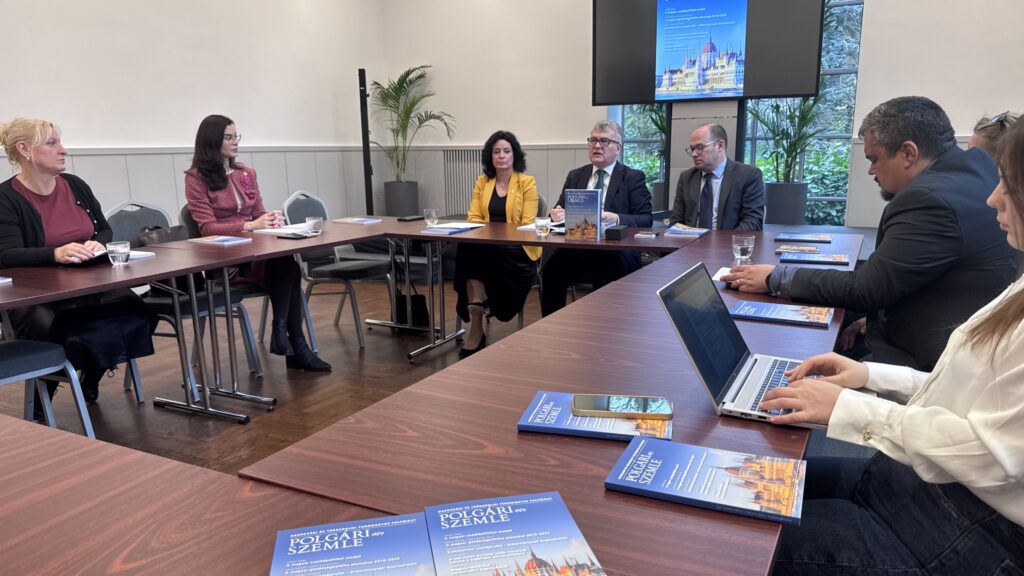
Director of the Hungarian–German Institute at MCC Bence Bauer placed Hungary’s policies in an international context, particularly in relation to Germany. Drawing on his personal and professional experience, he argued that Western European countries increasingly rely on migration to address demographic challenges, a strategy he described as flawed.
He argued that current German narratives about Hungary often reveal more about Germany’s internal political struggles than about Hungary itself. According to Bauer, a key historical factor shaping these perceptions is the enduring ‘myth’ surrounding Gyula Horn, whose role in 1989 has been interpreted in ways that, in his view, distort historical reality while reinforcing a particular political lens in Germany. This, he suggested, contributed to a long-standing imbalance in how different Hungarian political traditions are understood abroad.
Bauer also highlighted structural issues within Germany’s media and political landscape, pointing to what he described as a dominant ideological orientation that makes balanced discourse on Hungary difficult. He noted that a large share of reporting on Hungary in German media carries a negative tone, which complicates efforts to build mutual understanding.
At the same time, Bauer emphasized that the bilateral relationship is far from purely conflict-driven. He pointed to deep historical, economic, and cultural ties, while also identifying new dynamics emerging from recent years. One such trend, he argued, is a growing interest among Germans in relocating to Hungary, motivated by factors such as public safety, family policy incentives, and dissatisfaction with migration-related developments in Germany.
Looking ahead, Bauer suggested that Hungary’s distinct policy model, particularly its rejection of migration as a primary demographic solution, could increasingly attract attention in Western Europe as countries reassess their own strategies.
Economic policy and its intellectual underpinnings were addressed in detail by Editor-in-Chief of Polgári Szemle Csaba Lentner, who presented a broader theoretical interpretation of Hungary’s post-2010 transformation. He described this period as a decisive break from earlier economic orthodoxy, with Hungary adopting a model centred on an active, state-driven approach.
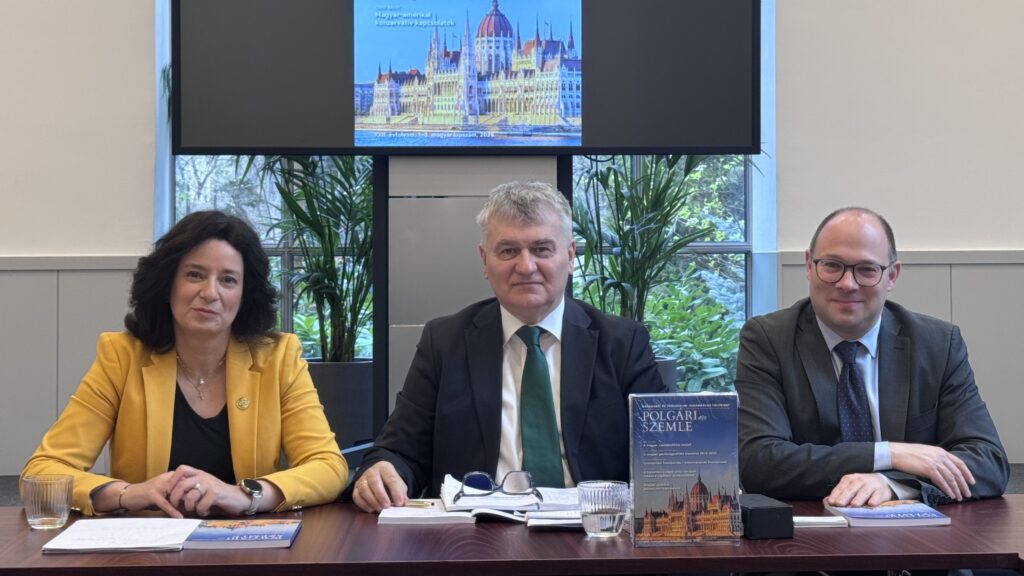
According to Lentner, this model combines strong family support policies with targeted labour market interventions and a diversified foreign economic strategy. He highlighted the expansion of employment, which has surpassed 80 per cent, as well as the development of a multi-directional foreign relations system that includes not only Western partners but also ties to the Far East and neighbouring regions.
Lentner placed Hungary’s approach within the context of wider global changes, arguing that the 21st century is characterized by fragmented globalization, disrupted value chains, and increasing regionalization. In such an environment, he said, purely market-driven models are insufficient, and states must take a more active role in shaping economic outcomes.
A key element of his argument focused on the relationship between economic policy and societal acceptance. He stressed that policies can only be effective if they are understood and supported by the public, warning that disconnects between academic discourse and government strategy can undermine this process.
In this regard, Lentner was critical of parts of the Hungarian academic sphere, particularly the Hungarian Academy of Sciences, which he believes does not adequately support or reflect the country’s economic policy direction. He argued that this gap contributes to misunderstandings among younger generations, especially those under 40, who may be more exposed to critical interpretations of government measures.
He called for the development of a stronger intellectual framework aligned with Hungary’s state-driven economic model, suggesting that platforms like Polgári Szemle can play a role in fostering such discourse. According to Lentner, a more cohesive academic and policy environment would help improve public understanding and strengthen the long-term sustainability of Hungary’s economic strategy.
The event underscored the role of Polgári Szemle as a platform for debate, with contributors emphasizing that the publication aims to foster diverse academic discourse rather than promote a single viewpoint. The journal is available online and in print, reaching universities, libraries, and international audiences.
Overall, the presentation framed Hungary’s recent trajectory as a coordinated effort linking family policy, economic governance, and international strategy, with speakers arguing that these elements together form a distinct national model in an increasingly uncertain global environment.
Related articles:
At a time when public debate is increasingly polarized and superficial, Hungarian Conservative remains committed to depth, intellectual honesty, and independent conservative thought.
Producing high-quality journalism requires resources. Your contribution helps us expand our coverage, reach new audiences, and keep our content accessible.

Please consider supporting our mission.