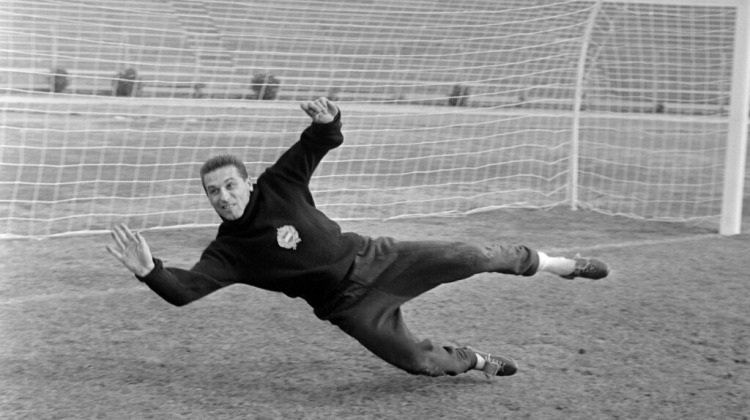
Gyula Grosics was in goal for the national team during the most formidable years of Hungarian football. The line-up started with his name in the final for the men’s football event at the 1952 Helsinki Olympics, at Wembley in November 1953 during Hungary’s legendary 6–3 win over England, and at the bittersweet World Cup final in Bern, Switzerland against West Germany in 1954.
Grosics was born on 4 February 1926, exactly a century ago today. His actual name was György Gyula Grosics. However, in kindergarten, he was made fun of by a fellow student of his who asked him: ‘Why are you called Gyuri [common diminutive form of the Hungarian first name György]? Don’t you know that when a pig squeals, it says Gyu-ri, Gyu-ri?’ This stuck with him so much that he ended up going by his middle name throughout his life.
The young Gyula’s mother was eager to have her son become a priest. This is what later inspired his signature all-black match kits. He was in goal for the Dorog youth team as a teenager, with sometimes also playing outfield on the wing to utilize his faster than average speed. However, he was not really a stand-out talent: Grosics recalled even being told by his coach not to come near the football pitch again after he conceded nine goals in one game.
His fortunes in goal soon changed dramatically—in such an unlikely turn of events that Grosics himself attributed it to divine intervention in his late memoir. During World War II, in 1940, the Dorog senior team lost both of their goalkeepers to the military draft. The team only found out about it as they were bound for a second division league game in Komárom. 14-year-old Grosics just happened to ride his bike past the train station, and stopped to gawk at the senior team. The team captain recognized him as a youth keeper and told his teammates: ‘If we have no priest, an altar server will do.’ This was a reference to the last name of their first-choice keeper Pap (meaning ‘priest’ in Hungarian), and Grosics, who often served as an altar boy at local church services. The Dorog team ended up winning the game 2–1, and Grosics gave such an impressive performance in goal that he stuck with the senior team.
Dorogi Bányász got promoted to the first division in 1945, with Grosics in goal. In the top division, he made such an impact that he got to make his national team debut in October 1947, in a 3–0 victory over Romania away from home.
Grosics played an unusual style for a keeper at the time. Taking advantage of his speed, he often left his line to pick up or clear loose balls. He was not exactly a towering giant: he stood at 5’10 (178 cm), short for football goalkeepers in Europe, even at the time.
‘Grosics played an unusual style for a keeper at the time. Taking advantage of his speed, he often left his line to pick up or clear loose balls’
He was transferred to the Budapest team MATEOSZ in 1947, before finding his way to the dominant Hungarian club at the time, Budapest Honvéd FC in 1950, where he played with other national team heroes such as József Bozsik, Sándor Kocsis, and—the most famous of them all—Ferenc Puskás. He won the Hungarian league four times with the team.
In the 1952 Olympics final in Helsinki, he kept a clean sheet against Yugoslavia during the 2–0 win. The first European Championship (called European Nations’ Cup then) was not held until 1960, thus the football event at the Summer Olympics had a lot more attention and prestige than today, when it is held in the same summers as the Euros.
On 25 November 1953, Hungary faced an England team at Wembley that had not lost to a team coming from the continent on their home turf in 90 years. Given the Hungarians’ reputation, the English press hyped the game as ‘the Match of the Century’ in the lead-up. That term stuck with Hungarian football fans to this day, although it refers to different games in some other European countries.
Puskás and his boys gave a masterclass to the inventors of modern football: they beat England 6–3 at Wembley, in front of over 100,000 people! Given the lopsided scoreline, Grosics even had the luxury to feign an injury to give some playing time to his understudy Sándor Gellér (back then, substitutions were only allowed in cases of injury).
In May 1954, Hungary hosted England for a rematch in Budapest. The English ended up catching an even bigger beating that time, losing 7–1–evidently, with Grosics in the Hungarian goal.
The same year, head coach Gusztáv Sebes’ boys travelled to Switzerland for the World Cup as the clear favourites. As expected, they cruised through the group stage with an 8–3 victory over West Germany and a 9–0 win over South Korea (due to the strange format, each team only played two games in a four-team group, based on power seeding). Hungary lost their star man Puskás to an injury against West Germany, who did not return until the final.
The Mighty Magyars beat out Brazil and defending World Champions Uruguay in the quarter-final and semi-final, respectively. In the last game for the coveted Jules Rimet Trophy, they had to face West Germany again.
If the Hungarians were favourites to win the tournament coming into it, they were even more expected to win against the team they had battered in the group stage already. However, that is not how things turned out.
The returning Puskás and Czibor gave Hungary an early two-goal lead, but the Germans equalized quickly. By the 19th minute, there was already a four-goal scoreline, standing at 2–2. Hellmut Rahn found the upset winner for West Germany in the 84th minute. In the final minutes, Puskás found the net again, but the goal was disallowed due to an obviously erroneous offside call.
West Germany – Hungary WORLD CUP 1954 final | AI colourized 60 fps |
AI colourized highlights of the miracle of Bern. The legendary final between hungary and Germany at the 1954 World Cup in Switserland. Pleasse like and subscribe for more 🙂 Website: http://vintagehdtv.com/ Instagram: https://www.instagram.com/vintagehdtv/ Second channel: https://www.youtube.com/channel/UC0rbs9nJDM-8-q0_orB3f5w
Grosics was blamed by the Hungarian fans for the second and third German goals, although neither was a classic goalkeeping howler. Despite that, three different major sports publications put him in their tournament all-star team (El Gráfico in Argentina, ESPN Deportes in the United States, and RCS in Italy).
The public discontent after the football team’s loss in the World Cup final made the communist regime change its attitude towards the players, who were treated with special privileges until that point. Smuggling goods from the capitalist West after away games had been tacitly supported by the Party before, but now earned Grosics more than a year-long suspension. He did not play any league or national team games between late 1954 and the summer of 1956.
He was also transferred to the newly promoted club Tatabánya Bányász without his consent. Grosics dreaded the move first, but later realized it was a blessing in disguise: given Tatabánya’s proximity to his hometown Dorog, he was treated as a local hero, as opposed to the more scornful looks he got in the big city Budapest after the lost WC final.
After the Soviets crushed the 1956 Budapest Revolution, Grosics was among the players who stayed in the country and did not defect, despite having the opportunity to play for clubs in far-away South America and neighbouring Austria as well. He eventually got his second chance in the national team, this time from mid-table Tatabánya.
‘After the Soviets crushed the 1956 Budapest Revolution, Grosics was among the players who stayed in the country’
He represented Hungary at the 1958 and 1962 World Cups, which ended in a group stage exit and a quarter-final showing for the Hungarians. After the communist sports leadership refused to approve his transfer to Ferencváros in 1962, he decided to retire at age 36 instead. He only returned in goal for his final, 86th game for Hungary in October 1962, playing a couple of minutes in his farewell game against Yugoslavia. He remains the second most-capped goalkeeper in Hungarian football history, only behind Gábor Király with 108 appearances.
After hanging up his gloves, Grosics coached Tatabánya Bányász and Salgótarjáni BTC for brief spells–he led the latter team to the first flight. With the Party’s approval, he also worked in Kuwait for a few years, running a national football programme for university students. However, his homesickness, which did not allow him to leave the country after the 1956 Revolution either, led him home once again.
He spent most of his post-playing career as an executive at Volán SC in Budapest. Grosics even had a brief political career, running as an MP candidate for the right-wing MDF party in the first democratic election after the regime change, in 1990. While the party won, and thus József Antall was elected the first Prime Minister of the Third Hungarian Republic, the former national team goalie himself fell short of winning a seat.
Gyula Grosics passed away on 13 June 2014, at age 88.
Related articles: