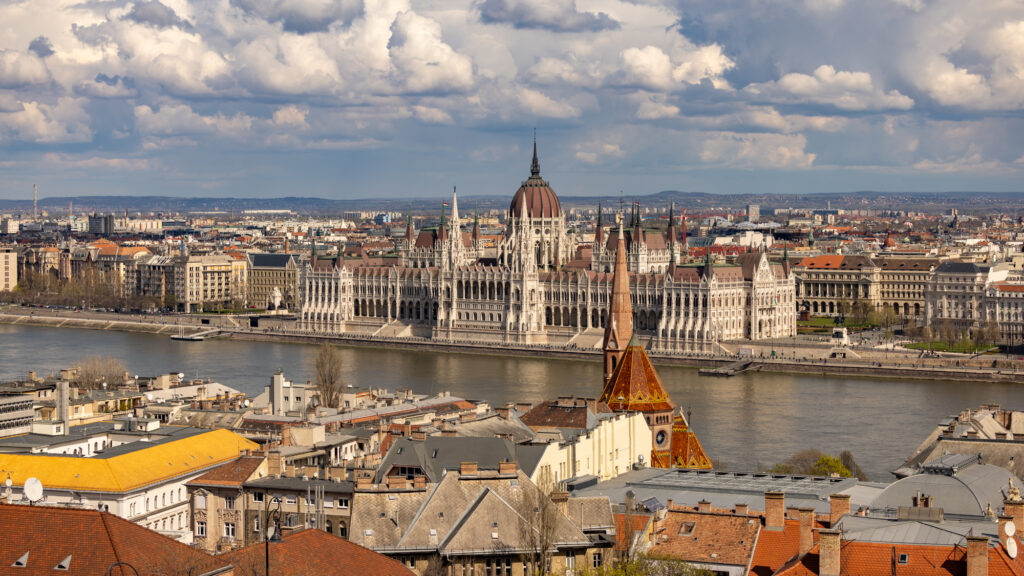
Standing on Szent György Square in the Buda Castle District, the Carmelite complex has witnessed centuries of Hungarian history. Although many today associate the building with the Prime Minister’s Office, its story stretches far beyond contemporary politics. Over the centuries, it has served as a monastery, theatre, casino and military warehouse.
The Carmelites in Hungary
The Carmelite Order, formally known as the Order of Our Lady of Mount Carmel, was founded in the Holy Land during the 12th century on Mount Carmel, in present-day northern Israel. The order arrived in medieval Hungary under the patronage of King Louis the Great, whose family maintained close ties with the Carmelites.
In Buda, the monks established a monastery in the area once known as Taschental. Besides Buda, the Carmelites maintained only a handful of monasteries in medieval Hungary, including houses in Eperjes, Pécs and Privigye.
From Monastery to Theatre
Before the Ottoman conquest, the site itself belonged to the Franciscans, whose church was destroyed following the capture of Buda in 1541. During Ottoman rule, a mosque and other buildings occupied the site, only to be destroyed again during the recapture of the city in 1686.
The Carmelites acquired the property in 1693 and completed their monastery and church during the 18th century. Yet the monks enjoyed their new home only briefly. In 1784, Emperor Joseph II dissolved several religious orders, including the Carmelites.
Soon afterwards, the former church was transformed into the Castle Theatre. The redesign was connected to the polymath Farkas Kempelen, remembered across Europe for his inventions and scientific achievements. By 1787, theatrical performances were already being staged within the rebuilt interior.
The theatre quickly became one of the cultural centres of Buda. The first Hungarian-language theatrical performance was held there in 1790, while Ludwig van Beethoven also performed in the building during his visit to Hungary in 1800.
At roughly the same time, parts of the monastery complex were converted into a casino frequented by imperial officials relocated to Buda. The building even contained bowling alleys for the entertainment of the city’s administrative elite.
Military Headquarters and Neglect
The casino period proved short-lived. By the end of the 18th century, the complex had become the seat of military administration, housing imperial command offices and later the headquarters of the Hungarian General Staff during the Horthy era.
After the closure of the theatre in 1924, the building once again served military purposes and suffered serious damage during the Second World War. Although parts of the complex were restored in the post-war decades, the monastery gradually faded from public attention.
In the socialist era, different state institutions occupied the building, including departments connected to the Hungarian Academy of Sciences. The theatre itself reopened in 1978, while other sections housed various administrative bodies.
The Carmelite Today
A new chapter began in 2014, when the complex came under the management of the Prime Minister’s Office and underwent extensive renovation. The restoration sought to preserve the historical character of the building while adapting it for contemporary governmental use.
After seven years of being closed to the public, the Carmelite Monastery has once again opened its gates to visitors. People are now able to see the inside of the nearly 300-year-old building, which was originally built as a monastery but spent most of its history serving government and administrative purposes.
Related articles:
At a time when public debate is increasingly polarized and superficial, Hungarian Conservative remains committed to depth, intellectual honesty, and independent conservative thought.
Producing high-quality journalism requires resources. Your contribution helps us expand our coverage, reach new audiences, and keep our content accessible.

Please consider supporting our mission.