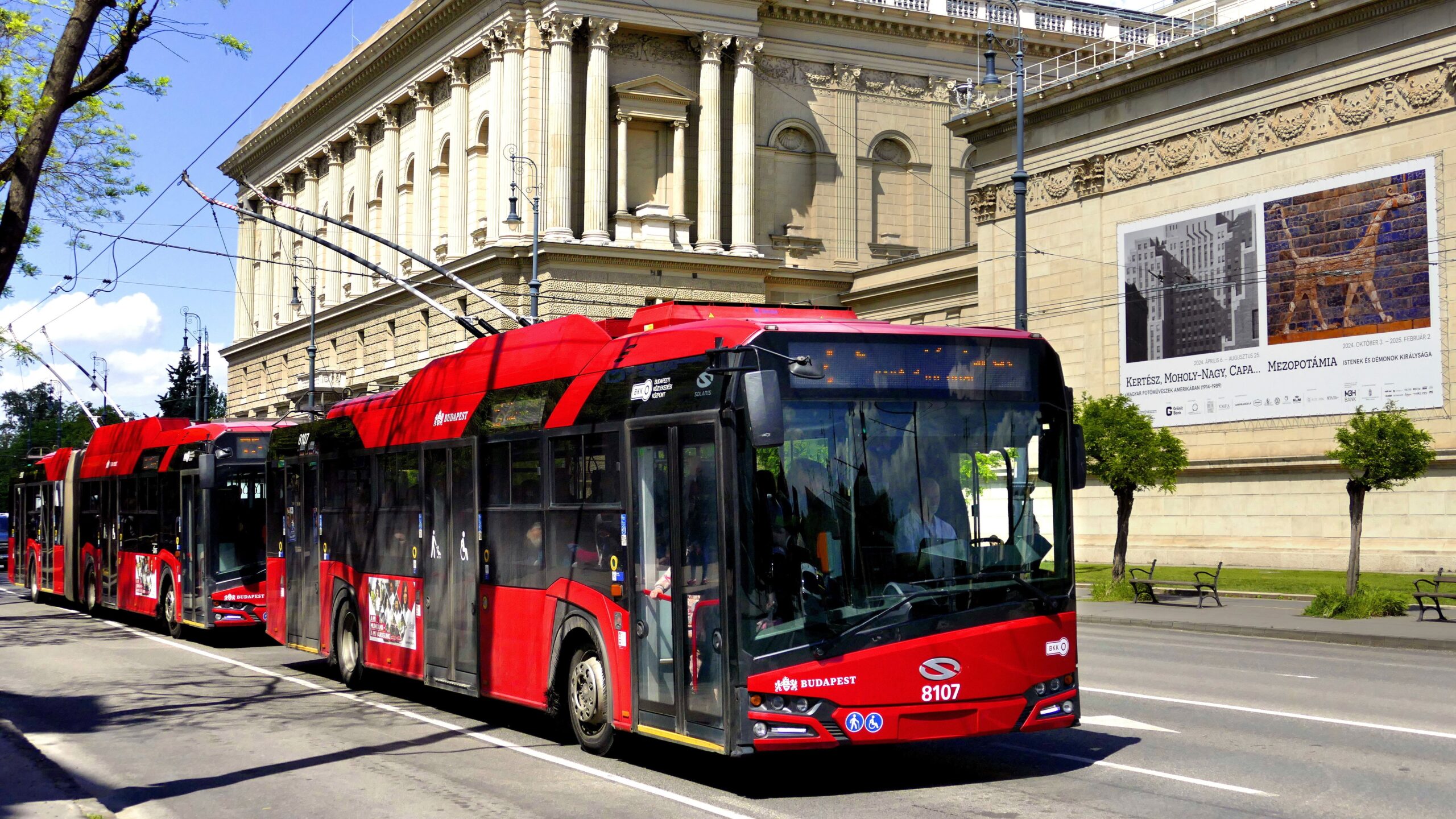
Budapest’s public transport operator BKK has signed a funding agreement with the managing authority that secures European Union financing for 38 modern trolleybuses, the company said on Thursday.
The vehicle purchase is part of the project titled Budapest trolleybus procurement phase III and construction of the zoo delta junction, financed through EU funds with co-financing from the Hungarian state. The non-refundable support amounts to 8.8 billion forints.
In recent years, Budapest has already taken delivery of 48 low-floor, modern Solaris–Škoda Trollino trolleybuses under its fleet renewal programme, including 12 single and 36 articulated vehicles, all of which have been operating in the capital since 2023. These vehicles were pre-financed by the Budapest Metropolitan Municipality, allowing the manufacturer to be paid on time.
BKK has now finalized the subsidy agreement, which retrospectively provides EU funding for 38 of the trolleybuses already in service. According to the company, the gap between the vehicles entering operation and the signing of the funding contract was bridged thanks to a forward-looking decision by the city administration.
The municipality’s pre-financing also made it possible for BKK to exercise an option included in a contract signed with the manufacturer back in 2014, enabling the purchase of the vehicles under particularly favourable conditions. This approach also ensured that EU funds could later be drawn down securely and smoothly.
All of the newly supported trolleybuses are air-conditioned, low-floor vehicles equipped with onboard batteries, allowing them to travel at least four kilometres without overhead wires. This flexibility has already enabled several network upgrades and supports plans for new trolleybus lines and route extensions across different parts of Budapest in the coming years.
As part of the EU-funded project, overhead line construction and refurbishment works are also under way in Budapest’s 14th district, at the Kacsóh Pongrác Road–Állatkerti Boulevard–Hermina Road junction. The so-called zoo delta will modernize trolleybus infrastructure and create new options for network expansion by allowing vehicles to turn between key routes in both directions.
BKK said it remains committed to environmentally friendly public transport and sustainable operations. In line with the city’s broader climate and mobility objectives, the company views trolleybus development as one of the most efficient and cost-effective ways to green urban transport. If funding becomes available, Budapest could eventually add up to 160 more modern, low-floor, zero-emission trolleybuses to its fleet.
Related articles: