With the Iran conflict still raging on, the Danube Institute hosted an event exploring the potential solutions to the pressing issues in the Middle East. The conference titled The Abraham Accords and IMEC: Securing the Future of the Middle East took place on Tuesday, 19 May, at Danube’s headquarters in the historic Castle District of Budapest, Hungary.
International Director for the Danube Institute Dr Kristóf Veres was first to address the audience. He called the situation with Iran ‘unsettling’, especially the fact that, at the time of the conference, the IRGC regime was still demanding sovereign control of the Strait of Hormuz as part of the peace settlement, despite this violating the UN convention on freedom of navigation in international waters.
The speaker said that this predicament reminded him of the Russo–Ukrainian war: international observers often noted that Russia does not have the right to determine whether or not Ukraine joins NATO. Yet, after four years of war, it is apparent that they have a ‘de facto’ right to do that, as any peace settlement with a reasonable chance of holding water stipulates that Ukraine does not join NATO as a condition. Mr Veres then returned to the topic of the day, and opined that the IMEC corridor would present a viable alternative to the Strait of Hormuz as a trade route.
Visiting Fellow at the Danube Institute Sean Nottoli, a former director of Donald Trump’s 2024 presidential campaign, spoke next. He started by telling the audience that, while he is an expert in the Indo-Pacific region, lately, he keeps having to talk about the Middle East and Iran. For instance, when Iran struck a South Korean commercial vessel, that became the topic of his meeting about South Korea.
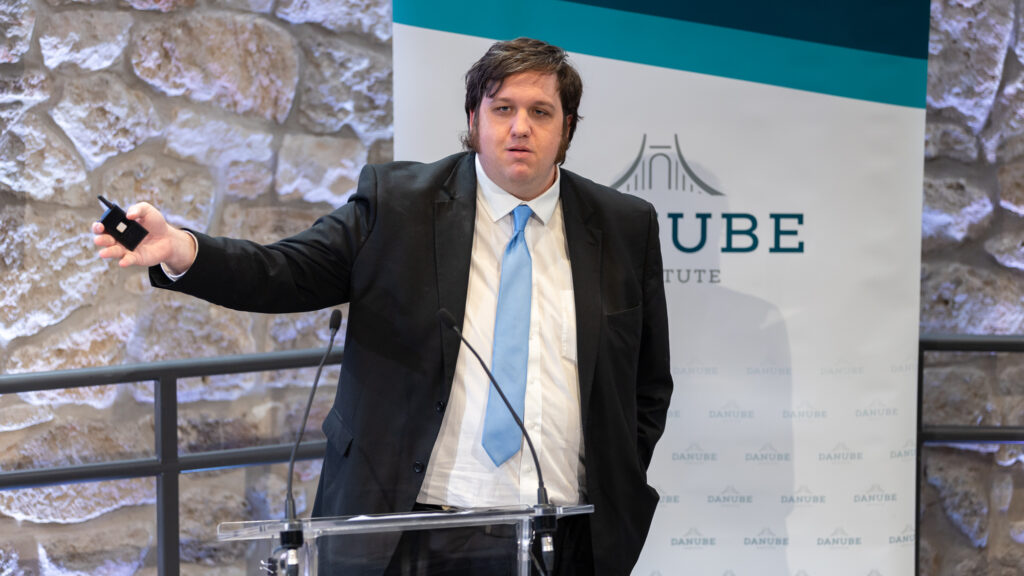
He then gave a brief timeline of the major events in the Middle East, starting with 1979, when US President Jimmy Carter got Egypt to recognize Israel as a sovereign state. The Tanker War in 1987–1988 under President Reagan, he continued, had very similar events to today, with the US Navy having to protect oil tankers in the Strait of Hormuz from Iranian attacks.
Mr Nottoli called Iran ‘the single biggest roadblock to have any sort of permanent peace in the Middle East.’ He suggested that the IMEC economic corridor—running from India, through the UEA, Saudi Arabia, Jordan, Israel, and Italy, to France—would greatly undermine the regional influence of Iran.
Israeli legal scholar Eugene Kontorovich joined the conference via video call. He stated that, given the current situation, IMEC and the Abraham Accords are ‘optimistic topics’ for the conference. However, he also described the latter as ‘a vision of hope’.
He then stressed that the West Bank and the Gaza Strip are not the central issue of the Middle East, which threatens the ideologues promoting the ‘land for peace’ idea—that is, that Israel needs to give territorial concessions to Palestine for stability. Instead, he argued, ‘peace for peace’ is the right approach, which the Abraham Accords signed in 2020 proved. However, the 7 October attacks by the Hamas terror group on Israel in 2023 ‘broke that momentum,’ Mr Kontorovich stated. In a silver lining, diplomatic relations between Bahrain and Israel, as well as Israel and the UAE, remain active even in a time of war, he added.
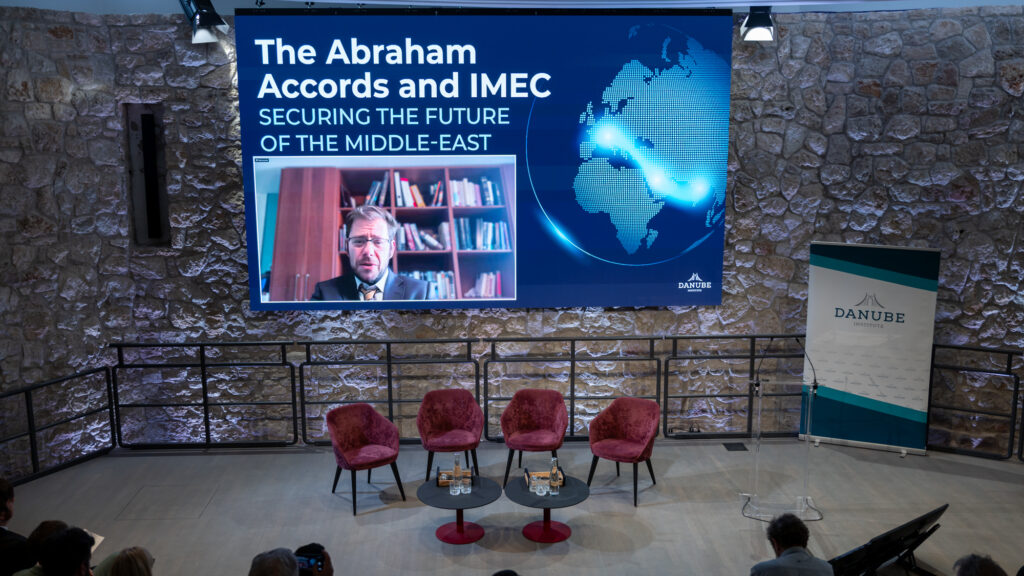
Mr Nottoli was then joined by Deputy Director of the Danube Institute Melissa O’Sullivan; Or Yissachar, founder of the David Institute in Modi’in-Maccabim-Re’ut, Israel; and Visiting Fellow at the Danube Institute Farid Shukurlu for a panel discussion.
Mr Yissachar started by stating that, despite what Former US Secretary of State John Kerry said, peace cannot be achieved only through Palestine in the Middle East. Echoing the sentiments of Mr Kontorovich from earlier, he too noted that the Abraham Accords were achieved without land concessions by Israel. He also noted that Hungary was the only country to send a representative to the signing of the Abraham Accords, as a testament to the European bloc’s misgivings about both US President Donald Trump, the primary facilitator of the Accords, and Israel. The speaker then went on to state that the Arab countries are beginning to view Iran as a threat to their national security as well.
When asked by Mr Nottoli if the IMEC corridor would create economic competition, thus further tensions in the Middle East, Ms O’Sullivan replied that she believes that economic competition is ultimately good for every country, and nations in the Middle East are not afraid of competition either. She also noted that the United States would not be the only country to make investments into the IMEC corridor’s infrastructure, as many other countries would also need to ‘pick up that bill’.
Meanwhile, Mr Shukurlu argued that the aggressive actions of the Iranian regime are in part guided by a ‘Shia Muslim superiority complex’. However, other nations in the region are now much friendlier to the US and Israel, he pointed out. For instance, he shared his belief that Saudi Arabia could be the next to join the Abraham Accords. Since the country is home to the two holiest Muslim sites, Mecca and Medina, it would have a major effect on other Islamic countries in the region.
Related articles:
At a time when public debate is increasingly polarized and superficial, Hungarian Conservative remains committed to depth, intellectual honesty, and independent conservative thought.
Producing high-quality journalism requires resources. Your contribution helps us expand our coverage, reach new audiences, and keep our content accessible.

Please consider supporting our mission.