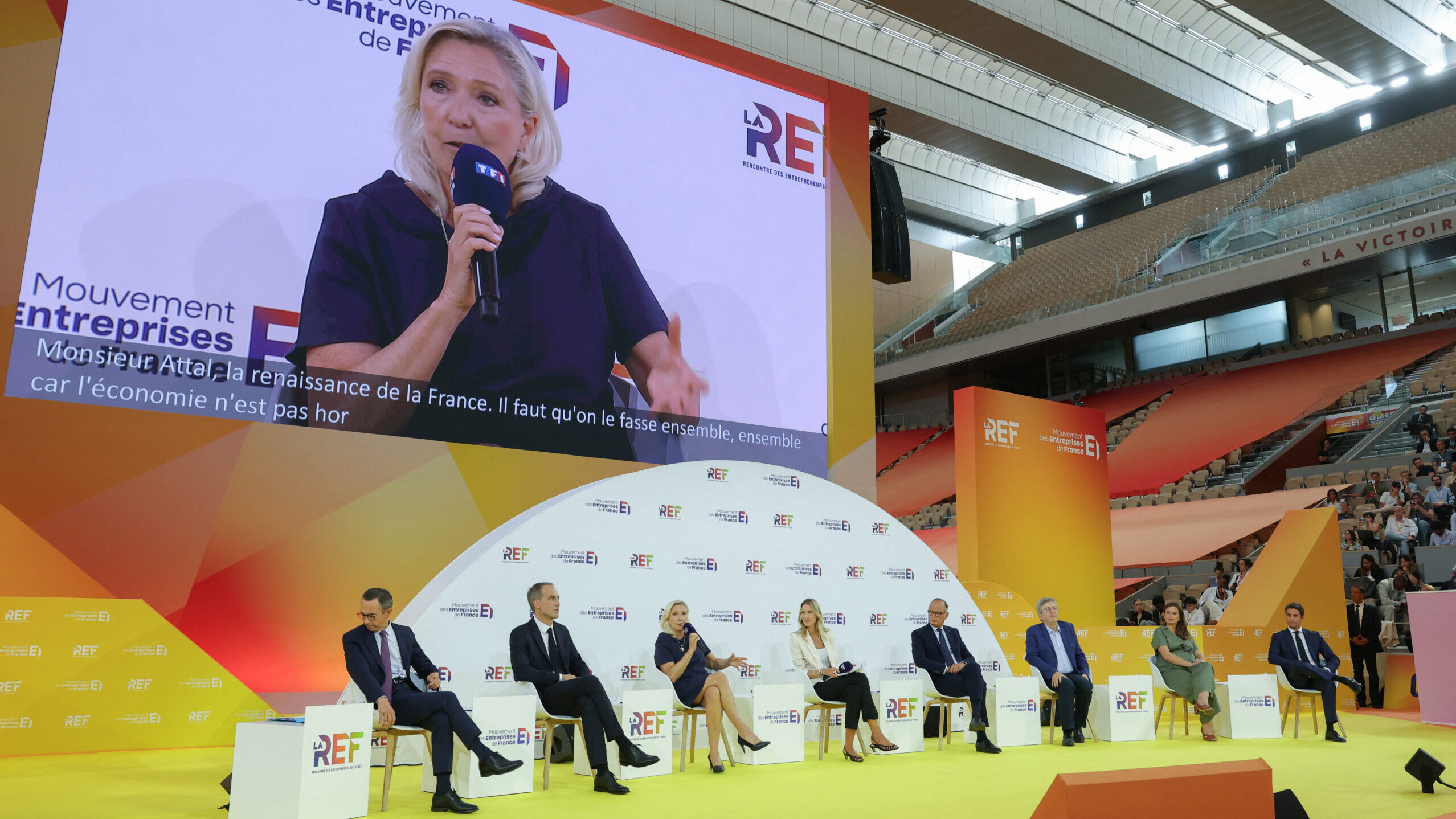
Marine Le Pen would win France’s 2027 presidential election against every major opponent currently tested, according to a new Elabe poll that gives the right-wing anti-immigration National Rally candidate between 34 and 35.5 per cent in the first round and victories over all four potential rivals in a runoff.
The survey, published on 29 August by BFMTV and La Tribune Dimanche, puts Le Pen comfortably ahead of the field eight months before the election. She would defeat Jean-Luc Mélenchon by 69.5 to 30.5 per cent, Raphaël Glucksmann and Gabriel Attal by 57 to 43 per cent, and former prime minister Édouard Philippe by a much narrower 52.5 to 47.5 per cent.
Philippe remains the only tested opponent within striking distance, but even that result represents a fundamental change from the previous two presidential elections, when Le Pen entered the second round as the clear underdog and the anti-RN ‘republican front’ remained capable of mobilizing a majority against her.
The first-round polling shows how far that realignment has progressed since 2022. Le Pen now attracts 34–35.5 per cent across the different candidate match-ups, compared with 17–20.5 per cent for Philippe and around 14 per cent for Mélenchon. Elabe also found that roughly eight in ten voters who backed RN in the 2024 legislative elections would support her again, while around one-fifth of traditional Republican voters would cross over to her.
For French Banks, It’s Business as Usual
Yet while Le Pen has moved steadily closer to the political mainstream among French voters, the country’s financial elite continues to treat her and her party very differently. RN president Jordan Bardella said on Saturday that ‘no French bank has responded favourably’ to the party’s attempts to obtain a loan for the presidential race. ‘It would be deeply worrying for the functioning of French democracy that the political movement which is today leading all the polls… cannot find financing, in France or in Europe,’ he told BFMTV.
Framing the issue as one of financial rather than political considerations, French Banking Federation head Maya Atig has said lenders assess credit risk rather than ‘favourites’ among voters, while Société Générale, one of France’s largest multinational universal banks, says it no longer finances political parties.
Contradicting those arguments, Le Monde reported that reputational risk is also central: some institutions fear losing 2–5 per cent of their customers if associated with Le Pen. Banks also cite compliance risk and the possibility that campaign accounts could be rejected, although the danger of failing to reach the 5 per cent threshold for substantial state reimbursement appears limited for someone polling above 34 per cent and beating every one of her major opponents.
The behaviour of the French financial elite is not new; Le Pen and RN were forced to finance their 2022 campaign from abroad due to similar obstacles. The party moved to obtain a €10.7 million campaign loan from Hungary’s MKB Bank—a decision that sparked controversy in both countries, as the institution was linked through its ownership to businessmen close to former Hungarian prime minister Viktor Orbán, a long-time ally of Le Pen.
Le Pen took 23.15 per cent in the first round and lost the runoff to President Emmanuel Macron by 58.55 to 41.45 per cent. Four years later, her first-round support is polling roughly eleven points higher, signalling a significantly greater chance of delivering a long-awaited presidential victory for RN.
The change in voter sentiment has made the financing dispute politically more sensitive for the government. Prime Minister Sébastien Lecornu’s office brought representatives of France’s leading banks to Matignon, the official prime ministerial residence, on 20 July and is backing a plan for a pool of major lenders to share the risk. The French Banking Federation has additionally sought a partial state guarantee.
The Establishment Faces Its Le Pen Dilemma
The government presents the intervention as both a democratic and sovereignty issue: viable candidates should be able to obtain French financing rather than depend on foreign lenders. Politically, it also deprives RN of an obvious anti-establishment argument—that a party leading the presidential race can win millions of votes but still be denied access to the domestic financial system. Matignon stresses that any mechanism would apply across political lines, while the banking federation says campaign-financing difficulties affect parties from RN to Mélenchon’s far-left La France Insoumise.
It is, however, unclear whether voters accept the government’s narrative or understand the banking blockade in the wider context. Le Pen’s path to becoming RN’s leading candidate in 2027 has already been marred by a controversial trial and conviction that prompted accusations of political persecution.
‘The change in voter sentiment has made the financing dispute politically more sensitive for the government’
She was convicted in March 2025 over misuse of European Parliament funds and initially received an immediately enforceable five-year ban from public office, threatening her fourth presidential bid. On 7 July 2026, the Paris Court of Appeal upheld the conviction but reduced the penalty to 45 months of ineligibility, 30 months suspended, alongside three years’ imprisonment, two of them suspended, and a €100,000 fine. The effective period of ineligibility had already been served, allowing her to declare her candidacy that evening.
Le Pen has also taken the case to the Court of Cassation and denies wrongdoing. RN, however, remains under separate pressure, this time from Brussels: European prosecutors are investigating €4.33 million in allegedly improper spending by the former Identity and Democracy group, which included RN, while another probe concerns more than €130,000 in EU-funded media training that allegedly benefited Bardella before the 2022 campaign. Bardella has not been charged in either matter, and RN rejects wrongdoing in these cases as well.
France votes in the first round on 18 April 2027, with the runoff scheduled for 2 May.
Related articles:
At a time when public debate is increasingly polarized and superficial, Hungarian Conservative remains committed to depth, intellectual honesty, and independent conservative thought.
Producing high-quality journalism requires resources. Your contribution helps us expand our coverage, reach new audiences, and keep our content accessible.

Please consider supporting our mission.