Over the past few weeks, the events surrounding Hungary’s energy security have once again demonstrated that energy is neither simply about physics nor simply about politics. A country’s energy supply cannot be reduced to a preference for one technology over another, and its energy mix cannot be redesigned according to the political cycle of a single government. Energy strategies are built for decades, not for four-year terms.
This time, the debate centres on Paks.
What began with concerns over the temperature of the Danube developed into a much more immediate problem when historically low water levels forced major reductions in the output of Hungary’s four operating nuclear reactors. At the height of the crisis, the roughly 2 GW plant was operating at only a fraction of its normal capacity, briefly falling to just above 10 per cent. The situation has since improved considerably. The ramp-up of Unit 4 at MVM’s Paks Nuclear Power Plant was completed on 26 August 2026, meaning that all of the plant’s units are now operating at nominal capacity again.
The situation was extraordinary, but not primarily from a nuclear-safety perspective. Nuclear reactors are designed to be shut down safely and regularly spend weeks offline during refuelling and maintenance. What made the episode exceptional was the prospect of Hungary temporarily losing most, or potentially all, of the generation from its largest domestic electricity source.
And this is precisely why the debate over Paks matters. The four existing reactors produced more than 16 TWh of electricity in 2025, and Paks remains Hungary’s largest individual generating asset by far. The crisis exposed two realities: the plant itself is vulnerable to extreme hydrological conditions, but the Hungarian electricity system is also highly vulnerable to the loss of Paks. This also makes the future of Paks II more important than it might previously have appeared.
Hungary intends to operate Paks I well beyond its present lifetime if a further extension is approved. In contrast, Paks II is intended to preserve substantial nuclear capacity after the existing reactors eventually retire. The current licences for the four Paks I units expire between 2032 and 2037, and preparations for a further lifetime extension are already underway. The real issue is therefore no longer how Paks can survive one exceptionally dry summer, but whether the assumptions on which Hungary’s nuclear system was designed remain adequate for the decades ahead.
Paks I uses once-through cooling, drawing cooling water directly from the river. As the Danube reached exceptionally low levels, the existing water-intake system approached the physical conditions under which it could no longer reliably maintain a sufficient cooling-water supply for normal generation. This is also why the distinction between safety and generation is important. Even a shut-down reactor continues to produce decay heat that must be removed, but the plant can remain in a safe condition without producing electricity. The real energy-security problem was therefore not whether the reactors could be safely shut down, but whether Hungary could afford to lose their generation for an extended period.
It is also important to remember that these warning signs are not entirely new. Difficult Danube conditions already affected Paks towards the end of the last decade. Almost ten years later, another severe episode should be taken seriously rather than treated simply as an isolated event. The government responded by attempting to change the local hydraulic conditions rather than the plant itself.
‘These warning signs are not entirely new’
Two approximately 80-metre barges were sunk near Paks as an emergency measure, while construction began on a submerged riverbed sill between Paks and Dunaszentbenedek. Water released through the Ráckeve–Soroksár branch of the Danube provided additional support. The emergency interventions initially raised the local water level sufficiently to stabilize the situation, while the riverbed sill is intended to provide a more durable increase once completed.
For the immediate crisis, the solution appears to be working. The remaining question is how long these measures will stay effective and whether they address the underlying problem. From a purely operational perspective, shutting down a nuclear reactor when external conditions do not permit normal generation is not extraordinary. As long as its safety systems remain fully operational, a reactor can be shut down and later restarted. But the evolving August crisis demonstrated that the Hungarian electricity system expects something more from Paks.
It expects the plant to remain a source of stable generation even under exceptional external conditions. Solar generation provided important support during the recent nuclear shortfall. Still, the episode also demonstrated how difficult it would be for Hungary to operate for an extended period without its largest source of continuous domestic generation.
If this level of availability is now a strategic requirement, the engineering requirements must reflect it. This becomes particularly important as Hungary considers a further lifetime extension of Paks I. If the existing units are expected to operate for additional decades, their cooling and water-intake infrastructure must also support the level of availability Hungary expects. Low water levels are only one part of this problem: unusually high Danube temperatures can also constrain generation, meaning that the longer-term challenge concerns the resilience of the cooling system itself rather than simply maintaining a sufficient local water level.
The crisis has also made reviewing Paks II considerably more urgent.
The new government has so far provided relatively little detail about the project’s future beyond acknowledging that the previous timetable is no longer realistic and that the project is under review. At the same time, simply abandoning an already-under-construction nuclear project would itself have major financial consequences. One thing is clear: Paks I alone cannot provide Hungary’s nuclear generation indefinitely.
‘Paks I alone cannot provide Hungary’s nuclear generation indefinitely’
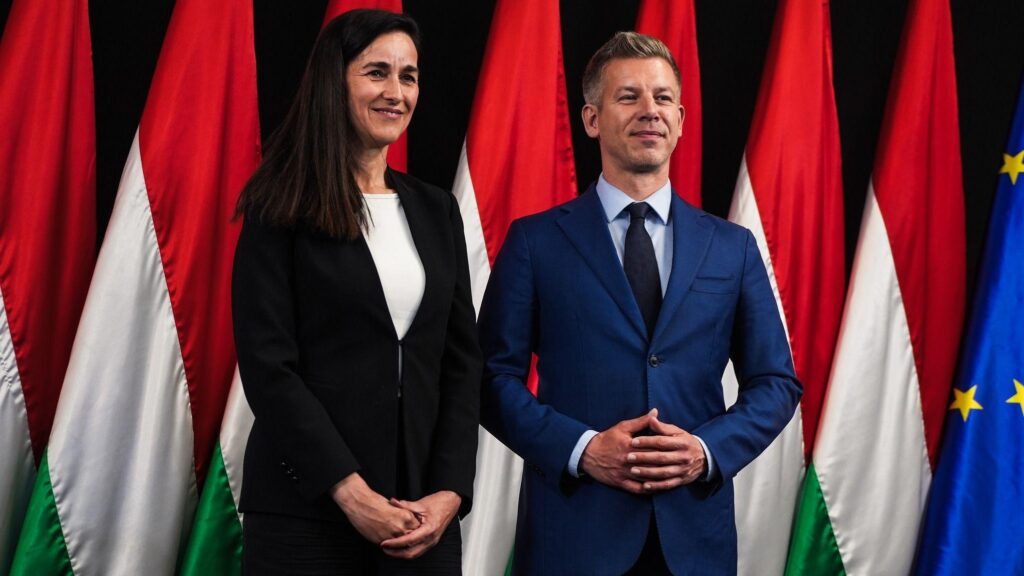
Under its current concept, Paks II would also rely on the Danube for cooling. Prime Minister Péter Magyar has already said that the project should be reconsidered from this perspective and has publicly mentioned cooling towers as one possible alternative. The relevant question surrounding Paks II is therefore not simply whether Hungary needs new nuclear generation; it is whether the current project can deliver that capacity at an acceptable cost, within a credible timeframe and with a cooling concept sufficiently resilient to the hydrological conditions the Danube may face over the coming decades.
Engineering alternatives exist. Wet cooling towers are used at numerous nuclear plants worldwide and could reduce dependence on river conditions. Changing the cooling concept would require technical reassessment and would inevitably affect both cost and schedule. The cooling problem itself, however, is not necessarily insoluble.
Paks II was agreed upon with Russia in 2014. Under the original contracts, the two units were expected to begin operation in 2025 and 2026. More than a decade later, the first concrete for Unit 5 was poured only in February 2026. The project is now formally under construction, but the new government is reviewing its contractual, financial and technical foundations. SMRs have also emerged as a potential alternative in this debate. This adds another dimension to the review: whether Hungary should continue with the two large reactors already under construction, or reconsider the longer-term nuclear strategy around smaller modular units. The latter may offer greater flexibility, but it would also introduce another major uncertainty: time. That review is necessary, but it cannot continue indefinitely. Will Hungary complete Paks II, or abandon the project and start again?
Both options would cost enormous sums. Continuing Paks II means dealing with years of delay, its Russian contractual structure, uncertain final costs, and potentially additional engineering requirements, while also trying to diversify parts of the project through Western technologies and suppliers. Starting again would mean writing off at least part of the investment already made and accepting another lengthy process of technology selection, contracting, licensing and construction before a replacement nuclear plant could generate a single megawatt-hour. The cooling problem can be engineered. Time cannot.
Related articles:
At a time when public debate is increasingly polarized and superficial, Hungarian Conservative remains committed to depth, intellectual honesty, and independent conservative thought.
Producing high-quality journalism requires resources. Your contribution helps us expand our coverage, reach new audiences, and keep our content accessible.

Please consider supporting our mission.