The following is an adapted version of an article written by Orsolya Ferenczi-Bónis, originally published in Hungarian in Magyar Krónika.
Pentecost is the celebration of the coming of the Holy Spirit and the birth of the Church. How can we feel the guidance of the Holy Spirit, and how can we connect with it, even in nature? Magyar Krónika asked Virág Dyekiss, an ethnographer and mother of nine, about waiting and celebrating, symbols and folk customs.
***
It seems that preparation for Pentecost does not receive the same emphasis as Advent or Lent, and the feast itself appears to play a less prominent role in the life of our families and communities than Christmas or Easter.
Indeed, this is true, even though Pentecost is the third great pillar of the liturgical year. Its significance is also reflected in the fact that the period of preparation for Pentecost lasts 50 days, whereas Advent is approximately 30 days long, and Lent consists of 40 days.
The 50 days of anticipation for Pentecost are divided into a 40-day and a ten-day period. In Sacred Scripture, we read that after the resurrection, Jesus remained with the disciples for 40 days. Before His Ascension, He opened their minds to understand the Scriptures and entrusted them with the mission of proclaiming repentance and the forgiveness of sins in His name to all nations. He told them that He would pour out upon them the promise of the Father, but instructed them to remain in the city until they were clothed with power from on high.
After this, the disciples spent ten days praying together in Jerusalem. They did not know what would happen to them; they did not know that they were about to encounter the Holy Spirit. Therefore, they spent this period in an attitude of open and trusting anticipation.
Our connection to the Holy Spirit is so intimate and personal that the world cannot grasp it from the outside, which is why it is difficult for Pentecost to find its place in the liturgy of families. On the other hand, it is a community holiday, since with the birth of the Church, a community was born, so it gives us a lot if we can participate in a glorifying occasion, a parish parade or a celebration of the charisms, so that we can experience that we do not exist as lonely islands, but are many together in the Church; and this is our common birthday at Pentecost.
How can we discover what Pentecost means to us?
After Easter, the miracle of the resurrection will remain with us. The message of Pentecost is that joy and exultation are an important part of our lives: let us learn to rejoice and live our everyday lives in this miracle.
Let us find joy in our everyday lives, let us be filled with the power of the created world, let us connect with the world around us. Let us set ourselves challenges that can deepen our inner exultation.
Let us look at the sky, the clouds, the birds or even the greyness for a few minutes every day. Let us also use those senses that we rely on less often! Let us touch something in nature every day, pay more attention to the taste of our food, and be grateful for it. Our body and soul work together, but by spring, our body’s energy stores are depleted, so let us move and exercise for at least ten minutes a day. The Way of Joy was created on the model of the Stations of the Cross, with 14 stations from the resurrection to the coming of the Holy Spirit, 14 encounters with Jesus or the Holy Spirit. If we personally pray through it, delve into it, we also feel that this holiday is what is most about us.
The disciples who remained without Jesus underwent a tremendous personal development as a result of their encounter with the Holy Spirit: the previously secluded apostles went out among the people. We are also called to this, and we can learn the most from this: we are not passive observers of what Jesus did for us, but we can actively act by following Him.
How can we prepare for the holiday as a family?
The gateway to the Pentecost season is the feast of the Ascension of Jesus, celebrated on Ascension Thursday. We can prepare for this day through small symbolic gestures that help us enter more deeply into the spirit of the feast.
In our family, for example, we have whipped-cream waffles for breakfast on Ascension Day: the waffle symbolizes the sandy ground from which Jesus ascended into heaven, while the whipped cream represents the clouds that concealed Him from sight.
At Easter, the children make a drawing of Jesus, which we place in the ‘Holy Tomb’. Sometime between Easter and the feast of the Ascension, I quietly remove the drawing, symbolizing the Resurrection—that He is no longer there. Then, on Ascension Day, I place it in a prominent spot in the living room, symbolically signifying that these ten days are a transitional period. The Ascension marks the first day of these ten days, while Pentecost Sunday is the tenth, leaving us with eight days of preparation in between.
For this time, I would especially recommend reflecting on the eight gifts of the Holy Spirit, dedicating each day to prayerfully contemplating one of the Spirit’s fruits.
How can we connect to the Holy Spirit?
The guidance of the Holy Spirit is difficult to put into words. Whenever we try to describe it, we are attempting to grasp the ungraspable—searching for images that might express that sometimes wonderfully gentle sensitivity, at other times firmer guidance, through which the Holy Spirit is able to work together with the human person.
Yet the rich symbolism associated with the Holy Spirit helps us draw closer to this mystery. For this reason, during these days it is worth focusing each day on a different symbol of the Holy Spirit, and even experiencing in nature the sensations these symbols evoke.
One of the most important symbols is the dove, the bearer of peace in the story of Noah. Through its whiteness, it represents purity, while at the same time symbolizing perfect freedom, for it is bound by nothing and moves entirely under God’s direction wherever it flies. In the story of Saint John the Baptist, we read that the Holy Spirit descended upon Jesus in the form of a snow-white dove.
Recently, I read in a study that this image refers to a living Hebrew proverb according to which God’s presence surrounds us like a dove. Following this image, we may imagine ourselves being gathered beneath the wings of the dove—sheltered and embraced by God Himself.
‘The rich symbolism associated with the Holy Spirit helps us draw closer to this mystery’
Within the soaring movement of the Holy Spirit, there is also protection, care, and warmth. The symbol of the dove is especially rich and easy to approach in many different ways: we can bake bird-shaped pastries, or make small doves from origami or folded-paper wings.
Folk tradition, too, preserves traces of invoking the Holy Spirit. Among the Csángó people of Gyimes, for example, Easter eggs are decorated on Good Friday, and one of them is fashioned into a dove with a tail made from the reed head. It is then hung from the beam and remains there until Pentecost.
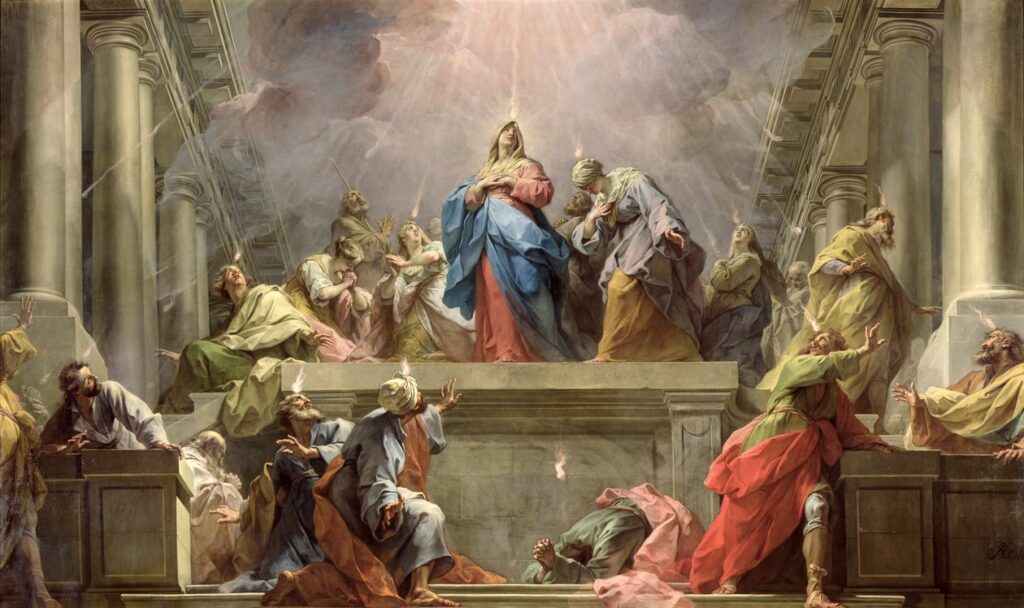
In Sacred Scripture, we read that when the day of Pentecost had come, and the disciples were gathered together in anticipation, suddenly a mighty sound came from heaven, like the rushing of a violent wind, and it filled the entire house where they were sitting. Air and wind are therefore also important symbols of the Holy Spirit. In this, they resemble the dove: we do not know where they come from or where they are going, what they sweep away and what they bring in.
In the same way, the Holy Spirit renews our lives. We cannot see Him, yet if we trust Him—if we dare to let Him freely carry away what has been familiar to us until now, and bring something new in its place—then all will be well.
Even when it seems to us that the world is collapsing, when a storm wind comes and sweeps away everything we once knew, that too may be the wind of the Holy Spirit. For the wind is not only gentle and caressing—it also possesses immense power.
We can experience something of this through kite flying, because a kite essentially sails upon the wind. Yet we must remain attentive: just as we must hold the string firmly when the wind lifts the kite into the sky, so that it is neither dashed down nor torn from our hands, we must also follow with constant inner attentiveness the direction in which the Holy Spirit is leading us.
Tongues of flame appeared above the disciples and descended upon each of them; for this reason, fire too is a symbol of the Holy Spirit. We might cut flames from red and orange paper and write upon them a blessing or a quotation. There are many ways to connect with fire and light, which bring about transformation: we may light a campfire, switch on a small LED candle, or simply experience the strength of the sun shining ever more intensely in late spring and early summer.
A lesser-known symbol of the Holy Spirit is holy oil, to which we may connect through the sense of smell. Just as we can feel the warmth of the dove’s wings or the gentle touch of the wind upon our faces, so too can we perceive a fragrance—one whose source we may not even know, yet which awakens something deep within us.
The phenomenon of miraculous fragrance, or ‘fragrance visions’, is well known within the Church. It is often reported that at pilgrimage sites, people sense the fragrance of lilies, while at Marian shrines, the scent of roses is perceived even when no flowers are present. Likewise, in the legends of the saints, we frequently read that a wondrous fragrance surrounded their tombs long after their deaths.
Another profound symbol of the Holy Spirit is water. I would encourage everyone at least once to step out into the rain and experience what it feels like when the power of water flows over us—washing through us, cleansing and renewing us.
What foods should we eat at Pentecost?
The liturgical colour of Pentecost is red, and we can reflect this in our meals as well. We may freely choose simple red dishes such as tomato soup or macaroni Milanese. In the Hebrew tradition, Pentecost corresponds to Shavuot, the feast of thanksgiving for the harvest, as well as the commemoration of the giving of the Torah—the Law on Mount Sinai—and the promise of a new homeland, a land flowing with milk and honey.
It is beautiful to see how the feast of the Exodus deepens along the same symbolic lines into the feast of Redemption: the written law becomes the inner law of a life guided by the inward compass of God’s presence, while arrival in the land flowing with milk and honey becomes arrival into the reign of God and into the heart of the Church.
According to tradition, dairy and honey-based foods are eaten during Shavuot; one such dessert is cheesecake, which members of the Jewish community in New York traditionally enjoy on this day. Another symbolic baked food is the Seven Heavens challah of the Sephardic Jews.
Inspired by this tradition, we too might bake a ‘Holy Spirit bread’, dividing it into four sections and placing within each one a different symbol of the Holy Spirit. It can become even more personal if we also include reminders of moments in our own lives and in the life of our family for which we are grateful for the guidance of the Holy Spirit.
What folk customs are connected to Pentecost?
Folk tradition, even unconsciously, uses many techniques through which it tries to sense the guidance of the Holy Spirit, but the practice of these is not connected specifically to Pentecost; rather, they are generally present, and they do not call it the Holy Spirit, but an unspoken supernatural force with which they try to find connection.
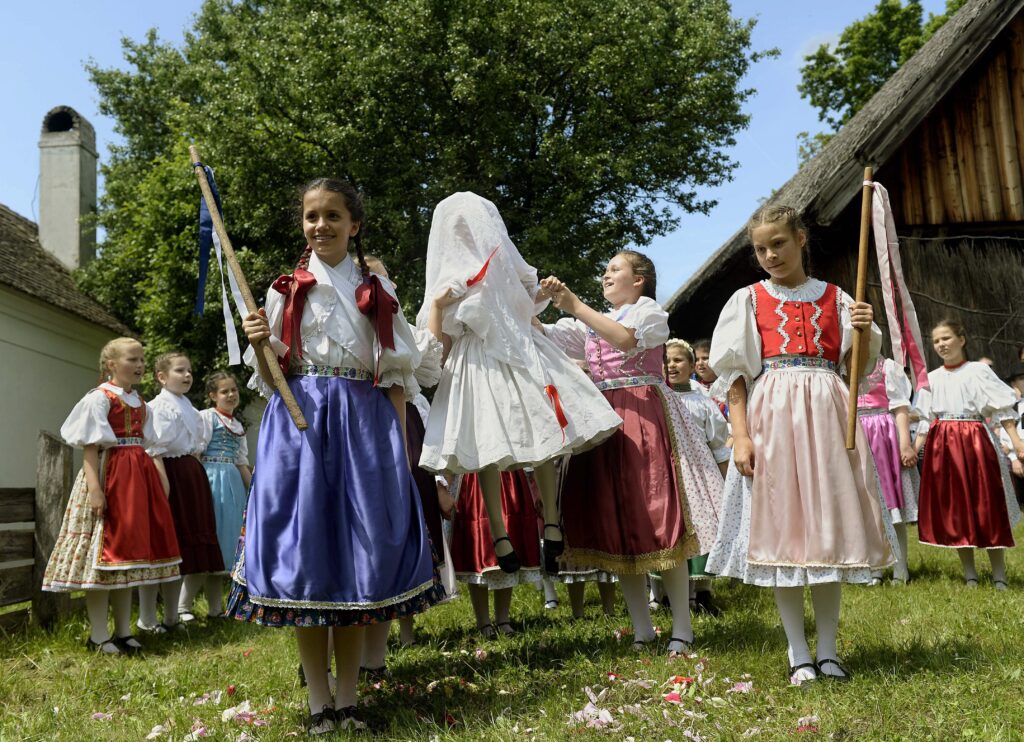
Pentecost folk customs are festive acts connected to spring and early summer fertility rites. In places where the maypole was not erected on 1 May, it was put up at Pentecost, or it was taken down then, which was also called ‘dancing it out’, since it was accompanied by large communal dancing, feasting, and drinking.
‘Pentecost folk customs are festive acts connected to spring and early summer fertility rites’
At the centre of the communal celebration stood, on the one hand, communal dancing and the circle as a symbol of protection and blessing, and on the other hand, prowess. The most widespread folk custom was the contest of the young men. The members of the band of lads chose the Pentecost king at this time, who then enjoyed privileges throughout the year, such as being allowed to drink for free in the tavern. On this day, the initiation into the bands of lads also took place, which was sometimes carried out roughly.
The feminine side of this prowess, energy, and fertility force appeared in folk customs such as dancing in circles, carrying green branches, and the procession of the Pentecost queen.
What do we celebrate on Pentecost Monday?
The liturgical reform of the Second Vatican Council abolished the octave of Pentecost, closing the 50-day Easter season with Pentecost Sunday, and therefore it no longer considers Pentecost Monday a separate church feast day. This decision has been debated ever since.
Precisely in order to restore the feast to its rightful place as the third pillar of the year, Pope Francis decreed in 2018 that the liturgical memorial of the Blessed Virgin Mary, Mother of the Church, should be celebrated on the Monday following Pentecost Sunday. In Sacred Scripture, we read that Jesus spoke the following words to His mother and to His disciple standing beneath the cross: ‘Woman, behold your son; son, behold your mother.’ This message is addressed to all of us, because all of us are able to relate to Mary as our mother.
As the conclusion of Pentecost, we may also mention the feast of the Day of the Lord, the feast of the Eucharist, which we celebrate on the second Sunday after Pentecost. If we succeed in integrating it into our personal lives, then alongside the Holy Spirit, the Eucharist can also become a great source of strength for us. If we find it difficult to connect to the gentle, quiet voice living within us, but we go to Mass, it can preserve the golden thread even through difficult times, and therefore it is good to connect the celebration of the Eucharist with Pentecost as well.
Related articles:
Click here to read the original article.
At a time when public debate is increasingly polarized and superficial, Hungarian Conservative remains committed to depth, intellectual honesty, and independent conservative thought.
Producing high-quality journalism requires resources. Your contribution helps us expand our coverage, reach new audiences, and keep our content accessible.

Please consider supporting our mission.