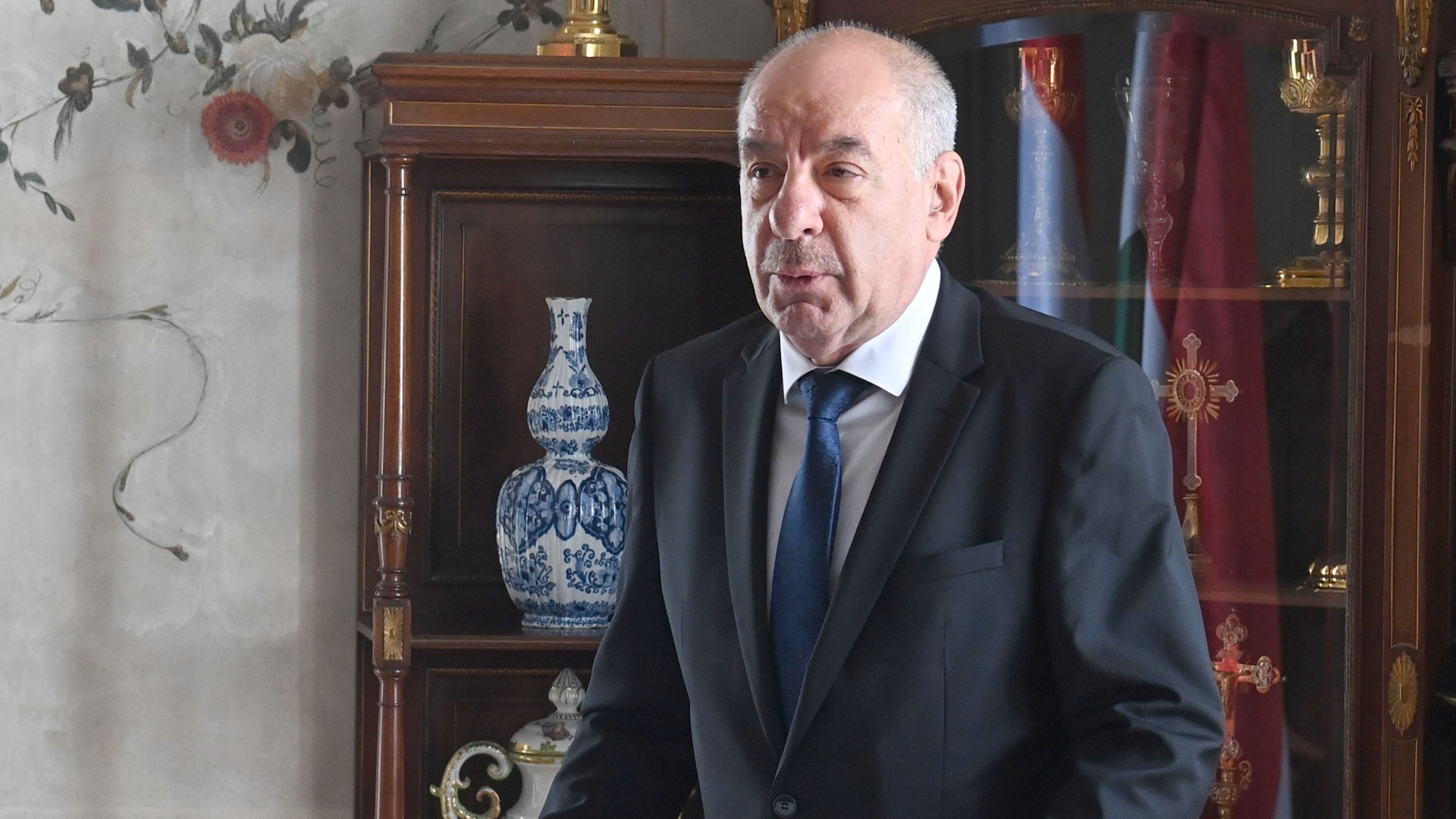
Hungarian President Tamás Sulyok said there is currently no legal or constitutional reason that would justify his resignation, responding to Prime Minister Péter Magyar’s demand that the head of state and several other senior public officials step down by 31 May.
In an interview published Monday by Index, Sulyok said he had sworn an oath to Hungary’s constitution and constitutional order, and that this oath binds him equally to the governing majority, the opposition and the entire political nation.
‘I understand that there are social and political intentions aimed at redefining the powers of the president of the republic, but there is no constitutional reason for my resignation,’ Sulyok said. ‘I remain faithful to my oath, and as long as the exercise of my office is not made impossible, I intend to fulfil the mandate I accepted,’ he added. The president emphasized that his constitutional duty extends to the whole political community rather than only to the governing majority or minority.
Responding to criticism from Magyar, who previously described him as unfit and unworthy to serve as the guardian of legality in Hungary, Sulyok said the Hungarian constitution contains no legal categories such as ‘unfitness’ or ‘unworthiness’. ‘These are political value judgments, and I do not wish to comment on them, because it is not my role to deal with political opinions,’ he said. According to Sulyok, Magyar’s inaugural speech as prime minister suggested that a political reinterpretation of the constitutional status and powers of the presidency had begun.
He acknowledged that reconsidering the role of a constitutional institution that has operated largely unchanged for 36 years could be a legitimate political ambition. ‘The constitutional status of the president has undergone only minor modifications since the democratic transition, and even the Fundamental Law adopted in 2011 did not substantially alter it,’ Sulyok said. ‘I have now become the target of this reinterpretation effort, and through me, the presidential institution itself,’ he added.
At the same time, the president stressed that new political expectations do not alter his current legal status and that he continues to exercise his duties within the existing constitutional framework. ‘If there is truly strong political demand for redefining the presidential function, then sooner or later it must also appear at the level of law,’ he said.
‘Hungary’s real regime change took place in 1990 with the dismantling of the one-party dictatorship’
Asked whether the victory of the Tisza Party represented a simple change of government or a genuine regime change, Sulyok argued that Hungary’s real regime change took place in 1990 with the dismantling of the one-party dictatorship. ‘Since then, a democratic constitutional state has functioned according to our constitution, and governments change through parliamentary elections depending on the outcome. What happened now was a government change,’ he said.
He added that constitutional amendments alone do not constitute regime change. ‘The constitution was also amended in 2011, and the Fundamental Law can be amended with a two-thirds majority,’ Sulyok noted, adding that Hungary’s constitution does not contain ‘eternity clauses’ like Germany’s constitution that would limit future constitutional changes.
According to the president, the real constraints are international law, European Union law and the fundamental constitutional principles that no rule-of-law system can abandon.
Sulyok also revealed that he held ‘honest and objective’ discussions with Magyar before the inaugural parliamentary session and prior to the appointment of new ministers. ‘He behaved as one would expect from a future prime minister and showed the respect due to the presidential office,’ Sulyok said.
Asked whether he could have taken a more proactive role in child protection issues, the president replied that the constitutional position of the head of state requires distance from party-political disputes over professional matters. He said the president should intervene only if systemic dysfunction emerges within democratic institutions. ‘In these cases, however, the authorities performed their duties; therefore, the president cannot interfere in ongoing procedures,’ he said.
Regarding reported government intentions to remove him from office, Sulyok said statements made by Justice Minister Márta Görög suggest that the government is considering solutions compatible with rule-of-law, European and international constitutional standards.
Commenting on reports that he had been cropped out of an official state news agency photograph featuring Agriculture Minister Szabolcs Bóna and Magyar, Sulyok said he does not concern himself with whether he appears in photographs. ‘The president of the republic does not have the task of making value judgments in such matters,’ he added.
Related articles:
At a time when public debate is increasingly polarized and superficial, Hungarian Conservative remains committed to depth, intellectual honesty, and independent conservative thought.
Producing high-quality journalism requires resources. Your contribution helps us expand our coverage, reach new audiences, and keep our content accessible.

Please consider supporting our mission.